

Updated: 30th June 2026
Reviewed by: David Small BSc (Hons), MSc, MTOPRA (Founder and CEO)
What Are the Medical Device Labelling Requirements?
Medical device labelling is a legal requirement under the EU Medical Device Regulation (EU MDR 2017/745) and plays a critical role in ensuring devices can be identified, used safely and traced throughout their lifecycle. Every medical device placed on the European market must be accompanied by information that enables users to understand the device’s intended purpose, apply it correctly and recognise any warnings or precautions necessary to protect patient safety.
The MDR defines labelling broadly, extending beyond the information printed directly on the device or its packaging. It also includes the accompanying Instructions for Use (IFU), symbols, Unique Device Identification (UDI), manufacturer information and any other details supplied with the device that are necessary for its safe and effective use.
Unlike our Medical Device and IVD Labelling Under the EU MDR & IVDR guide, which provides a broad overview of labelling across both Regulations, this article focuses specifically on the detailed requirements contained within Annex I, Chapter III of the EU MDR. These provisions form part of the General Safety and Performance Requirements (GSPRs) and specify exactly what information manufacturers must provide on labels and within the Instructions for Use.
Failure to comply with these requirements can have significant regulatory consequences. During conformity assessment, Notified Bodies routinely review device labels and accompanying documentation to verify that all mandatory information has been provided and that it is consistent with the manufacturer’s Technical Documentation, Clinical Evaluation, Risk Management File and Declaration of Conformity. Missing or inconsistent labelling is a common cause of non-conformities and may delay CE marking or require corrective actions before certification can be granted.
Understanding the detailed requirements of Annex I, Chapter III enables manufacturers to develop compliant labels from the outset, reducing regulatory risk while ensuring healthcare professionals and patients receive the information necessary to use medical devices safely and effectively.
Looking for the Complete Guide to Medical Device & IVD Labelling?
This article provides a detailed explanation of the medical device labelling requirements contained within Annex I, Chapter III of the EU MDR. If you're looking for a broader guide covering both the EU MDR and IVDR, including UDI, Instructions for Use, ISO 15223-1 symbols, CE marking and lifecycle labelling compliance, explore our Complete Guide to Medical Device and IVD Labelling.
Need an Introduction to the EU MDR?
This article focuses on medical device labelling requirements under the EU MDR. If you're looking for a complete overview of the Medical Device Regulation, including classification, GSPRs, technical documentation, UDI, CE marking and post-market obligations, read our Complete Guide to the EU MDR.
Where Are the Medical Device Labelling Requirements Found?
The medical device labelling requirements under the EU MDR are primarily contained within Annex I, Chapter III of Regulation (EU) 2017/745. This chapter forms part of the General Safety and Performance Requirements (GSPRs) and specifies the information manufacturers must supply with every medical device to ensure it can be identified, handled and used safely throughout its lifecycle.
Unlike the previous Medical Devices Directive (MDD), the MDR places much greater emphasis on providing comprehensive information to users while improving product traceability and supporting effective market surveillance. Manufacturers must therefore ensure that their labels, packaging and Instructions for Use are developed as an integral part of their Technical Documentation rather than as standalone artwork.
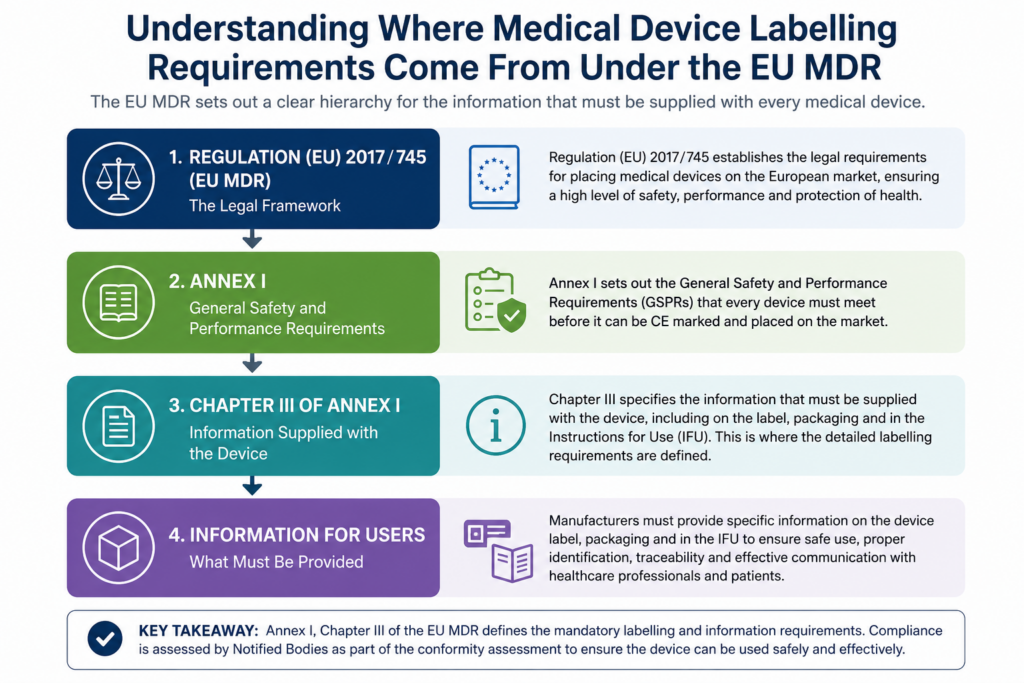
The regulatory hierarchy is straightforward:
- Regulation (EU) 2017/745 (EU MDR) establishes the legal framework for medical devices.
- Annex I defines the General Safety and Performance Requirements that every device must satisfy before it can be CE marked.
- Chapter III of Annex I specifically addresses the information supplied with the device, including product labels, packaging and Instructions for Use.
These requirements apply to virtually every medical device placed on the European market, regardless of its classification. However, the exact information required will vary depending on factors such as the device’s intended purpose, risk classification, whether it is supplied sterile, reusable or implantable, and whether it is intended for professional or lay users.
Manufacturers should also recognise that Annex I does not operate in isolation. Compliant labelling relies on information generated throughout the design and development process, including the device’s intended purpose, Risk Management activities, Clinical Evaluation, usability engineering, biological evaluation and Post-Market Surveillance. The information presented on the label must therefore remain fully consistent with every element of the manufacturer’s Technical Documentation.
Notified Bodies routinely review this consistency during conformity assessment. They will assess whether the information presented on the label accurately reflects the manufacturer’s Technical Documentation, Risk Management File, Clinical Evaluation Report, Declaration of Conformity and Instructions for Use. Any inconsistencies may result in non-conformities, requests for clarification or delays to certification.
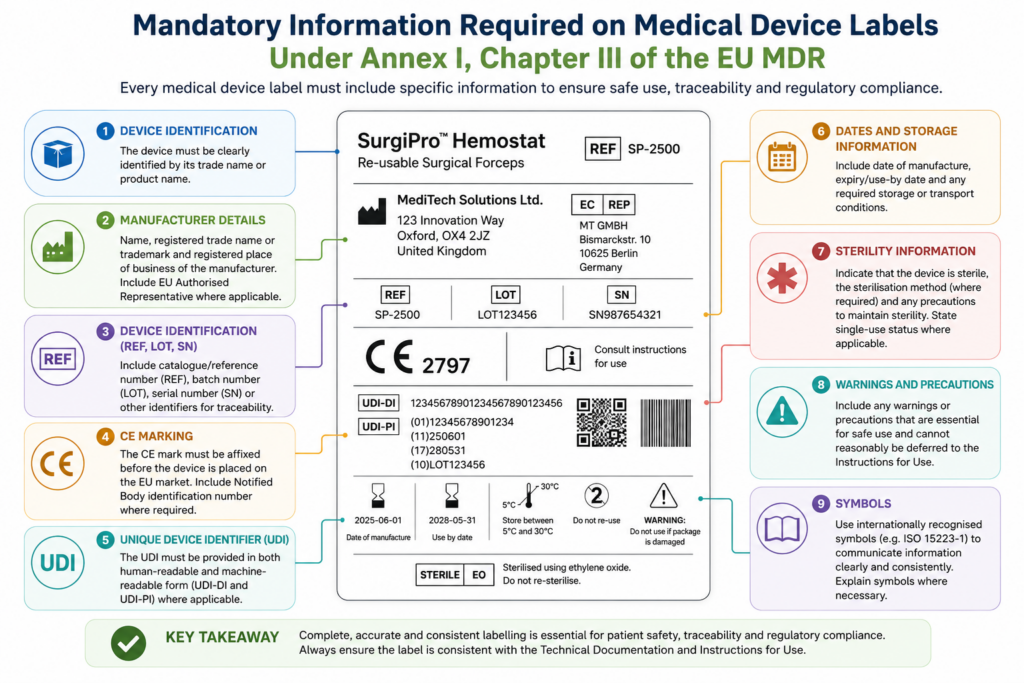
Information Required on the Medical Device Label
Annex I, Chapter III of the EU MDR specifies the information that manufacturers must provide directly on the medical device label. The purpose of these requirements is to ensure that every device can be uniquely identified, safely used and effectively traced throughout its lifecycle, while providing healthcare professionals, distributors and patients with the information necessary to minimise risks and maintain regulatory compliance.
The exact content required will depend on the nature of the device, its intended purpose and its classification. For example, sterile devices, implantable devices and reusable devices often require additional information beyond that required for a non-sterile Class I medical device. Nevertheless, the MDR establishes a common framework that applies across all medical devices.
Device Name and Product Identification
The label should clearly identify the medical device by its trade name or product name. Where necessary, additional information should be included to distinguish the device from similar products or different variants within the manufacturer’s product range.
Manufacturers should ensure that the product name remains consistent across the Technical Documentation, Instructions for Use, Declaration of Conformity and all associated regulatory records.
Manufacturer Details
Every medical device label must identify the legal manufacturer responsible for placing the device on the European market. This includes the manufacturer’s name, registered trade name or registered trademark and registered place of business.
For manufacturers established outside the European Union, the label must also identify the appointed EU Authorised Representative in accordance with Article 11 of the MDR.
This information enables regulators and users to identify the organisation legally responsible for the device throughout its lifecycle.
Device Identification (REF, LOT and Serial Number)
Each device must include sufficient information to enable unique identification and full traceability.
Depending on the product, this may include:
- Catalogue or reference number (REF).
- Batch number (LOT).
- Serial number (SN).
- Other identifiers necessary for traceability.
These identifiers are essential for inventory management, complaint investigations, vigilance reporting and product recalls.
CE Marking
Medical devices that have successfully completed the applicable conformity assessment procedure must display the CE marking before they can be placed on the European market.
Where conformity assessment has involved a Notified Body, the four-digit Notified Body identification number must accompany the CE marking where required by the Regulation.
The CE mark demonstrates that the manufacturer declares conformity with all applicable requirements of the EU MDR.
Unique Device Identification (UDI)
The Unique Device Identifier provides a globally recognised method of identifying medical devices throughout their lifecycle.
Under the MDR, the UDI generally consists of:
- UDI-DI (Device Identifier).
- UDI-PI (Production Identifier).
The UDI must be presented in both human-readable and machine-readable formats where required and must remain consistent with the information registered within EUDAMED.
Dates and Storage Information
Where applicable, manufacturers must provide information such as:
- Date of manufacture.
- Expiry or use-by date.
- Storage conditions.
- Transport conditions.
- Environmental limitations.
Providing this information helps ensure that devices continue to perform safely and effectively throughout their intended shelf life.
Sterility Information
Where a medical device is supplied sterile, the label should clearly indicate:
- That the device is sterile.
- The sterilisation method used where required.
- Any precautions necessary to maintain sterility.
- Single-use status where applicable.
This information is particularly important for preventing infection risks and ensuring safe clinical use.
Warnings and Precautions
Manufacturers must include any warnings or precautions that are essential for the safe use of the device and cannot reasonably be deferred to the Instructions for Use.
Examples include:
- Devices intended for single use.
- Latex-containing products.
- MRI safety information.
- Critical storage limitations.
- Hazards associated with improper use.
Critical safety information should always be clearly visible and easy for users to identify before using the device.
Symbols
The MDR encourages the use of internationally recognised symbols to communicate information efficiently and consistently.
Manufacturers commonly use symbols specified within:
- ISO 15223-1.
- Applicable harmonised standards.
- European Commission guidance.
Symbols should be used consistently across labels, packaging and Instructions for Use and should be explained where necessary to ensure they are understood by the intended users.
Are Your Medical Device Labels Still Compliant?
ISO 15223-1 was updated in 2025, introducing important changes to medical device symbols, including the revised Authorised Representative symbol. Learn what has changed, how it affects your labels and IFUs, and the practical steps manufacturers should take to maintain compliance in our ISO 15223-1:2025 Medical Device Symbols Guide.
Information Required Within the Instructions for Use (IFUs)
While the device label provides essential identification and traceability information, the Instructions for Use (IFU) provide the detailed guidance necessary for the safe and effective use of a medical device. Annex I, Chapter III of the EU MDR requires manufacturers to supply comprehensive instructions whenever they are necessary to ensure that the device can be used safely and as intended.
The purpose of the IFU is to provide users with information that cannot reasonably be displayed on the device label due to space limitations or complexity. It enables healthcare professionals, patients and other users to understand how the device should be installed, operated, maintained and disposed of while minimising the risks associated with its use.
Although some low-risk devices may not require an IFU where safe use can be ensured without one, manufacturers must be able to justify this decision within their Risk Management process and Technical Documentation.
Device Identification
The Instructions for Use should clearly identify the medical device by its trade name or product name, ensuring that users can easily confirm they are consulting the correct documentation. Product identifiers, catalogue numbers and version information should remain consistent with the device label and all associated regulatory documentation.
Intended Purpose
The IFU must clearly describe the intended purpose of the device, including:
- The medical condition or clinical purpose.
- The intended patient population.
- The intended users.
- The intended use environment.
- Any known limitations of use.
Providing a clear intended purpose helps prevent misuse and ensures the device is used only within its validated scope.
Instructions for Safe Use
Manufacturers must provide sufficient information to enable the device to be used safely and effectively.
Depending on the type of device, this may include:
- Installation or assembly instructions.
- Preparation before use.
- Operating instructions.
- Recommended maintenance.
- Cleaning and disinfection procedures.
- Calibration requirements.
- Functional checks before use.
These instructions should be written clearly and presented in a logical sequence appropriate for the intended users.
Warnings, Precautions and Contraindications
The IFU should include all warnings and precautions necessary to minimise residual risks identified during Risk Management.
Examples include:
- Contraindications.
- Potential adverse events.
- Known limitations.
- Environmental restrictions.
- MRI compatibility.
- Electrical safety precautions.
- Reprocessing limitations.
These warnings should be consistent with those presented on the device label.
Performance Characteristics
Where appropriate, manufacturers should describe the expected performance of the device together with any limitations that users should understand before use.
This information supports correct clinical application and helps users recognise situations where device performance may be compromised.
Residual Risks
After implementing all reasonably practicable risk control measures, some residual risks may remain.
The IFU should communicate these residual risks clearly so that users understand:
- What risks remain.
- How to minimise them.
- What actions should be taken if problems occur.
This information should directly reflect the manufacturer’s Risk Management File.
Storage, Handling and Disposal
Instructions should include any conditions necessary to maintain device safety and performance throughout its lifetime, including:
- Storage temperatures.
- Humidity limitations.
- Transport conditions.
- Shelf-life information.
- Disposal requirements.
- Environmental considerations where applicable.
Failure to follow these requirements may affect device performance or patient safety.
Symbols and Abbreviations
Where symbols or abbreviations are used within the IFU, manufacturers should ensure they are clearly explained unless their meaning is universally recognised.
Symbols should align with applicable standards such as ISO 15223-1 and remain consistent with those used on the device label and packaging.
Revision Information
Manufacturers should include document identification information such as:
- IFU version number.
- Revision date.
- Publication date.
- Document reference.
Effective document control ensures users have access to the latest approved version and supports traceability throughout the product lifecycle.
The information contained within the Instructions for Use should always remain fully consistent with the device label, Technical Documentation, Risk Management File, Clinical Evaluation Report and Declaration of Conformity. During conformity assessment, Notified Bodies routinely review IFUs to verify that they accurately reflect the device’s intended purpose, performance characteristics and residual risks. Any inconsistencies are commonly raised as non-conformities and may delay certification or require corrective actions before CE marking can be achieved.

Language Requirements for Medical Device Labelling
Providing accurate information on a medical device label is only part of the manufacturer’s responsibility under the EU MDR. Manufacturers must also ensure that the information supplied with the device is available in the language or languages required by each Member State where the device is made available. These requirements help ensure that healthcare professionals, patients and other users can understand the information necessary to use the device safely and effectively.
Although the MDR establishes the overall legal framework, individual Member States determine which official language(s) must be used within their own territories. As a result, manufacturers placing devices on multiple European markets often need to prepare several translated versions of their labels and Instructions for Use.
For example, a medical device marketed in Germany will generally require German labelling, while the same device sold in France must typically be accompanied by French labelling. Manufacturers distributing products throughout Europe should therefore establish a robust translation management process to ensure compliance across all intended markets.
Language requirements typically apply to:
- Device labels.
- Packaging information.
- Instructions for Use (IFUs).
- Safety warnings.
- User instructions.
- Critical operating information.
- Information supplied electronically where permitted.
Translations should be technically accurate and appropriate for the intended users. Medical terminology, safety warnings and operating instructions should be translated by individuals with suitable technical and linguistic expertise to minimise the risk of misunderstanding or misuse.
Manufacturers should also recognise that translation is subject to document control within the Quality Management System. Every translated version should be reviewed, approved and maintained under the same version control procedures as the original documentation. Whenever the source label or Instructions for Use are updated, all translated versions should be reviewed to ensure consistency across every language.
Poor translation quality is a common cause of regulatory observations during Notified Body audits and Competent Authority inspections. Typical issues include inconsistent terminology, omitted warnings, outdated translations and differences between the translated Instructions for Use and the approved English master document.
Implementing a structured translation process, supported by formal review and approval procedures, helps manufacturers maintain consistent information across all markets while reducing regulatory risk. It also ensures that users receive clear and accurate instructions regardless of where the device is placed on the European market.
| Requirement | EU MDR Requirement |
|---|---|
| Device label | Must be provided in the language(s) required by the Member State. |
| Packaging | Must be translated where required. |
| Instructions for Use | Must be available in the required national language(s). |
| Safety warnings | Must be understandable by intended users. |
| Electronic information | Subject to the same language requirements where applicable. |
| Translation management | Should be controlled within the manufacturer’s QMS. |
How Notified Bodies Review Medical Device Labelling
During the conformity assessment process, Notified Bodies do far more than verify that a medical device label contains the information required by Annex I, Chapter III of the EU MDR. They assess whether the label accurately reflects the manufacturer’s Technical Documentation and whether all information supplied with the device is supported by objective evidence.
Labelling forms part of the Technical Documentation submitted for review and is assessed alongside the device’s intended purpose, Risk Management File, Clinical Evaluation Report, Instructions for Use, usability engineering documentation and Declaration of Conformity. Any inconsistencies between these documents may be raised as non-conformities and must typically be resolved before CE certification can be granted.
When reviewing medical device labelling, Notified Bodies commonly assess the following areas:
Consistency Across Documentation
One of the most common review activities is comparing the information presented on the label with the wider Technical Documentation.
Reviewers will typically verify that:
- The intended purpose matches the Clinical Evaluation Report.
- Manufacturer details are consistent throughout the documentation.
- Device names and product codes are identical across all documents.
- UDI information aligns with Technical Documentation and EUDAMED records.
- Warnings and precautions reflect the Risk Management File.
- Performance claims are supported by clinical evidence.
- Symbols are used consistently throughout the label and Instructions for Use.
Any discrepancies can lead to requests for clarification or formal non-conformities.
Compliance with Annex I, Chapter III
Notified Bodies will verify that every mandatory element required by Annex I, Chapter III has been included where applicable.
Typical review points include:
- Manufacturer information.
- EU Authorised Representative details.
- CE marking.
- UDI.
- Batch or serial number.
- Dates of manufacture and expiry.
- Storage conditions.
- Sterility information.
- Required warnings.
- Instructions for Use references.
- ISO 15223-1 symbols.
Missing mandatory information remains one of the most common findings during Technical Documentation reviews.
Label Readability
Compliance is not determined solely by the information provided but also by how effectively that information is communicated.
Notified Bodies may assess:
- Font size.
- Colour contrast.
- Print quality.
- Durability.
- Symbol clarity.
- Overall label layout.
- Ease of identifying critical safety information.
Poorly designed labels can increase the likelihood of user error and may be considered a usability concern.
Change Control
Reviewers will also expect manufacturers to demonstrate that label artwork is controlled within the Quality Management System.
Evidence commonly reviewed includes:
- Artwork approval procedures.
- Version history.
- Change control records.
- Document approval workflows.
- Distribution of current label versions.
- Withdrawal of obsolete artwork.
These controls demonstrate that only approved labels are released for production.
Translation Management
Where products are supplied across multiple Member States, Notified Bodies may also review the manufacturer’s translation process.
They may examine:
- Translation procedures.
- Technical review of translations.
- Version control.
- Language verification.
- Consistency between language versions.
- Procedures for updating translated documentation following design changes.
A robust translation process helps ensure users receive accurate information regardless of the market in which the device is supplied.
Common Medical Device Labelling Non-conformities
Despite the detailed guidance provided by the EU MDR, deficiencies in medical device labelling remain one of the most common reasons for non-conformities during Technical Documentation reviews. In many cases, the device itself has been appropriately designed and validated, but inconsistencies or omissions within the labelling prevent the manufacturer from demonstrating full compliance with Annex I, Chapter III.
Most labelling non-conformities are avoidable and arise from inadequate document control, poor change management or a lack of consistency between the label and the wider Technical Documentation. Understanding these common issues enables manufacturers to identify potential problems before they are raised during conformity assessment.
Missing Mandatory Information
One of the most frequent findings is the omission of information that is specifically required under Annex I, Chapter III.
Examples include:
- Missing manufacturer details.
- Missing EU Authorised Representative information.
- Omitted UDI.
- Missing batch or serial number.
- No expiry date where applicable.
- Missing storage conditions.
- Missing Instructions for Use reference.
- Missing sterility information for sterile devices.
Even a single missing mandatory element may result in a non-conformity.
Inconsistencies Between Documentation
The information presented on the label should always match the manufacturer’s:
- Technical Documentation.
- Risk Management File.
- Clinical Evaluation Report.
- Declaration of Conformity.
- Instructions for Use.
Differences in product names, intended purpose, warnings, manufacturer details or performance claims are commonly identified during Technical Documentation reviews.
Incorrect Use of Symbols
Incorrect application of symbols remains another common issue.
Typical examples include:
- Using obsolete symbols.
- Applying symbols that are not recognised by ISO 15223-1.
- Missing explanations where required.
- Inconsistent symbols between the label and IFU.
- Incorrect use of the EU Authorised Representative symbol.
Manufacturers should regularly review their labels against the latest editions of applicable standards.
Poor Readability
A label may contain all the required information but still fail to meet regulatory expectations if users cannot read or interpret it easily.
Examples include:
- Font sizes that are too small.
- Poor colour contrast.
- Crowded layouts.
- Low print quality.
- Poor durability.
- Critical warnings that are difficult to identify.
These issues may also raise usability concerns during conformity assessment.
Unsupported Claims
Any statement made on the device label must be supported by objective evidence.
Manufacturers sometimes include marketing claims that are:
- Not supported by the Clinical Evaluation.
- Outside the device’s intended purpose.
- Inconsistent with the Risk Management File.
- Unsupported by verification or validation activities.
Notified Bodies will expect every claim to be fully substantiated within the Technical Documentation.
Poor Translation Control
For manufacturers supplying products throughout Europe, translation management frequently becomes a source of non-conformities.
Common issues include:
- Missing language versions.
- Incorrect technical terminology.
- Inconsistent translations.
- Outdated translated IFUs.
- Failure to update translated labels following design changes.
Translation activities should always be managed through the manufacturer’s document control procedures.
Inadequate Change Control
Medical device labels should never be treated as static artwork.
Manufacturers should maintain documented procedures covering:
- Artwork approval.
- Version control.
- Change requests.
- Technical review.
- Regulatory approval.
- Release for production.
Failure to control revisions can result in obsolete or incorrect labels reaching the market.
Most medical device labelling non-conformities are not caused by complex regulatory issues but by failures in process control. By integrating labelling into the Quality Management System and ensuring consistency across all regulatory documentation, manufacturers can significantly reduce the likelihood of audit findings while improving product traceability, patient safety and overall regulatory compliance.

Best Practices for Maintaining Compliant Medical Device Labelling
Developing a compliant medical device label is not a one-time regulatory exercise but an ongoing process that should be fully integrated into the manufacturer’s Quality Management System. As devices evolve through design changes, post-market surveillance, risk management activities and regulatory updates, labels and Instructions for Use must also be reviewed to ensure they remain accurate, consistent and compliant.
By implementing robust document control procedures and involving regulatory, quality and design teams throughout the product lifecycle, manufacturers can significantly reduce the likelihood of non-conformities while improving patient safety and regulatory compliance.
Establish Clear Label Development Procedures
Medical device labels should be developed using documented procedures that define responsibilities, review stages and approval requirements.
These procedures should include:
- Label content requirements.
- Artwork creation and review.
- Regulatory approval.
- Quality review.
- Final release for production.
- Version control.
A structured workflow helps ensure that all mandatory information is included before labels are released.
Maintain Consistency Across Technical Documentation
Every statement appearing on a medical device label should be consistent with the wider Technical Documentation.
Manufacturers should routinely verify alignment with:
- Intended purpose.
- Risk Management File.
- Clinical Evaluation Report.
- Instructions for Use.
- Declaration of Conformity.
- Verification and validation documentation.
- Marketing materials where applicable.
Maintaining consistency across documentation reduces the risk of discrepancies during Notified Body reviews.
Implement Robust Change Control
Any change affecting the device, its intended purpose, regulatory status or risk profile should trigger a review of the associated labelling.
Manufacturers should ensure that:
- Label revisions are documented.
- Changes are reviewed by appropriate personnel.
- Obsolete artwork is withdrawn.
- Production always uses the latest approved version.
- Related documentation is updated simultaneously.
Effective change control prevents outdated or incorrect labels from entering the supply chain.
Regularly Review Applicable Regulations and Standards
Medical device labelling requirements continue to evolve through updates to legislation, harmonised standards and guidance documents.
Manufacturers should periodically review:
- Regulation (EU) 2017/745 (EU MDR).
- Applicable UK regulations where relevant.
- ISO 15223-1.
- MDCG guidance documents.
- National Competent Authority guidance.
- Notified Body recommendations.
Regular regulatory reviews help identify changes before they become compliance issues.
Validate Translations Before Market Release
For products distributed across multiple countries, every translated label and Instructions for Use should undergo technical review before release.
Manufacturers should verify:
- Medical terminology.
- Safety warnings.
- Symbol descriptions.
- Device identification.
- Regulatory terminology.
- Version consistency.
Well-managed translation processes help ensure users receive accurate information regardless of language.
Conduct Internal Label Reviews
Periodic internal audits of label artwork can identify issues before they are discovered during external assessments.
Typical review questions include:
- Is all mandatory information present?
- Are the latest approved symbols being used?
- Is the UDI correct?
- Do the labels match the Technical Documentation?
- Are translations current?
- Are warnings consistent with the Risk Management File?
- Is the artwork revision current?
Routine internal reviews provide an additional level of assurance before products are placed on the market.
Manufacturers that treat labelling as an integral part of their Quality Management System rather than simply a packaging requirement are better positioned to maintain ongoing compliance throughout the product lifecycle. By combining effective document control, regular regulatory reviews, robust change management and thorough internal verification, organisations can reduce the risk of non-conformities while ensuring users receive clear, accurate and reliable information that supports the safe and effective use of their medical devices.
Conclusion
Medical device labelling is far more than a regulatory formality—it is a critical component of demonstrating compliance with the EU MDR and ensuring the safe and effective use of medical devices throughout their lifecycle. Every label, package and Instructions for Use must provide clear, accurate and consistent information that enables healthcare professionals, patients and other users to identify the device, understand its intended purpose and use it safely.
Compliance requires more than simply including the mandatory information listed in Annex I, Chapter III of the EU MDR. Manufacturers must ensure that labelling is supported by the Technical Documentation, aligns with the Risk Management File and Clinical Evaluation Report, incorporates the correct UDI and ISO 15223-1 symbols, and remains subject to robust document control and change management procedures.
As regulations, standards and guidance continue to evolve, manufacturers should regularly review their labelling processes to ensure they remain compliant with the latest requirements. Integrating label development into the Quality Management System and conducting routine internal reviews can significantly reduce the risk of non-conformities during Notified Body assessments while helping to protect patient safety and maintain regulatory compliance.
Whether you are developing a new medical device, updating an existing product or preparing for CE marking under the EU MDR, investing time in compliant labelling is an essential part of bringing safe, effective and legally compliant products to market.
Need Help with Medical Device Labelling?
At Patient Guard, we support manufacturers with every aspect of medical device regulatory compliance, including medical device labelling reviews, Technical Documentation, Clinical Evaluation, Risk Management, ISO 13485 Quality Management Systems and CE marking under the EU MDR and IVDR.
Our regulatory specialists can review your existing labels, identify compliance gaps and help ensure your product information meets the requirements of Annex I, Chapter III of the EU MDR before submission to your Notified Body or placement on the European market.
Contact Patient Guard today to discuss your medical device labelling requirements and discover how we can help you achieve and maintain regulatory compliance.
Frequently Asked Questions About Medical Device Labelling Compliance
Medical device labels typically include the manufacturer’s details, device name, catalogue or reference number, batch or serial number, UDI, storage conditions, warnings, regulatory symbols and any other information required to ensure the device can be used safely and effectively.
Annex I of the EU MDR sets out the General Safety and Performance Requirements (GSPRs), including the information manufacturers must provide on device labels and within the Instructions for Use to ensure safe use and regulatory compliance.
A Unique Device Identifier (UDI) is a globally recognised identification system that improves the traceability of medical devices. It consists of a Device Identifier (UDI-DI) and a Production Identifier (UDI-PI), helping manufacturers identify devices throughout their lifecycle.
ISO 15223-1 is the international standard that specifies symbols used on medical device labels, packaging and accompanying information. These harmonised symbols help communicate important safety information consistently across global markets.
Yes. Medical device labels and Instructions for Use generally need to be provided in the language(s) required by the country where the device is marketed. Manufacturers should confirm the language requirements for each target market before placing a device on the market.
The medical device label provides essential identification and safety information on the device or its packaging, while the Instructions for Use (IFU) contain detailed guidance on installation, operation, maintenance, warnings and safe use.
An IFU typically includes the device’s intended purpose, intended users, operating instructions, contraindications, warnings, precautions, maintenance procedures, cleaning instructions, troubleshooting guidance and disposal information, depending on the type of medical device.
Yes. Certain categories of medical devices may use electronic Instructions for Use where permitted by applicable legislation. Manufacturers must ensure users have appropriate access to the information and comply with all relevant regulatory requirements.
Non-compliant labelling may result in regulatory findings, delays to market approval, product recalls, Field Safety Corrective Actions (FSCAs), enforcement action by Competent Authorities or refusal of certification by a Notified Body or UK Approved Body.
Yes. Patient Guard provides independent reviews of medical device labels, Instructions for Use, ISO 15223-1 symbols, UDI implementation, Technical Documentation and overall labelling compliance to help manufacturers meet EU MDR, UK MDR and FDA regulatory requirements.
References
This guide is based on the following legislation, international standards and official regulatory guidance relating to medical device labelling requirements in the European Union and other major regulatory jurisdictions.
| Organisation | Reference | Why it's relevant |
|---|---|---|
| European Union | Regulation (EU) 2017/745 on Medical Devices (MDR) | Defines the legal requirements for medical device labelling through the General Safety and Performance Requirements (Annex I), including the information supplied by the manufacturer and Unique Device Identification (UDI) requirements. |
| International Organization for Standardization (ISO) | ISO 20417:2026 – Medical Devices – Information to Be Supplied by the Manufacturer | Specifies the general requirements for information supplied by the manufacturer, including labels, packaging, markings and Instructions for Use. It establishes the internationally recognised framework for the content that should accompany medical devices. |
| International Organization for Standardization (ISO) | ISO 15223-1:2021 – Medical Devices – Symbols to Be Used with Information to Be Supplied by the Manufacturer – Part 1: General Requirements | Defines internationally recognised symbols used on medical device labels and accompanying documentation, helping manufacturers communicate essential information consistently while reducing language dependencies. |
| European Union | Commission Implementing Regulation (EU) 2025/1234 on Electronic Instructions for Use (eIFU) | Establishes the current European requirements governing when eligible medical devices may provide Instructions for Use electronically and sets out the associated obligations for accessibility, availability and risk management. |
| European Commission | Unique Device Identifier (UDI) | Explains the European Commission's Unique Device Identification (UDI) system, including UDI carrier requirements, traceability and labelling obligations under the MDR. |
| U.S. Food and Drug Administration (FDA) | Device Labeling | Provides the FDA's overview of medical device labelling requirements, including references to 21 CFR Part 801, UDI requirements, use of symbols and other mandatory information required for devices marketed in the United States. |
| European Commission | MDCG Endorsed Documents and Other Guidance | Provides official Medical Device Coordination Group guidance supporting implementation of MDR labelling requirements, including UDI, electronic Instructions for Use, symbols and manufacturer-supplied information. |
Medical device labelling requirements continue to evolve through legislation, recognised standards and regulatory guidance. Manufacturers should always consult the latest published legislation, international standards and official guidance when designing, reviewing and maintaining compliant device labels, Instructions for Use and accompanying information.

David Small BSc (Hons), MSc, MTOPRA
Reviewed by
David Small, BSc (Hons), MSc, MTOPRA
Founder & CEO |
20+ years in medical device regulatory affairs, MDR/IVDR compliance and quality systems.
Patient Guards Recent Posts

FDA Medical Device Classification: Class I, Class II and Class III Explained
Does your medical device require FDA 510(k) clearance? This step-by-step guide explains the 510(k) process, substantial equivalence, predicate devices, testing, eSTAR submissions, FDA review and what manufacturers need to do after clearance.

FDA 510(k) Clearance: A Step-by-Step Guide for Medical Device Manufacturers
Does your medical device require FDA 510(k) clearance? This step-by-step guide explains the 510(k) process, substantial equivalence, predicate devices, testing, eSTAR submissions, FDA review and what manufacturers need to do after clearance.

FDA Medical Device Regulations: A Complete Guide for Manufacturers
Planning to place a medical device on the US market? This complete guide explains FDA medical device regulations, including device classification, 510(k), De Novo and PMA pathways, QMSR and ISO 13485, establishment registration, device listing, U.S. Agent requirements, UDI and post-market obligations.
Patient Guards Related Services
Patient Guards Regulatory Tools
Need Training?
Do you need training on Quality Management Systems or EU MDR/ EU IVDR? then check out our training courses.
 Posted on Google
 Nafiul Shelim21 days ago
Trustindex verifies that the original source of the review is Google.
I worked with Eleanor Shackleton, from Patient Guard, for the purpose of MDR, CE and UKCA marking. Her diligence, and knowledge in clinical and regulatory requirements for medical device software was critical for us. Would highly recommendPosted on Google Jay Verma46 days agoI found Patient Guard Ltd to be an exceptional partner. Their assessment was thorough, their guidance clear, and their support instrumental in helping us achieve our objectives. Steve and Ellie, in particular, were outstanding in steering us through the MHRA Class I medical device registration process.Posted on Google
 Munna P99 days agoWorking with the Patient Guard team has been a great experience throughout our MHRA and ISO 13485 documentation journey. Their expertise, structured approach, and practical guidance helped our team build a robust quality management system while keeping us aligned with regulatory expectations. The collaboration was professional, responsive, and focused on finding solutions rather than simply identifying issues. A special thank you to Alex and Steve for their outstanding coordination, responsiveness, and continuous support throughout the project. They were always approachable, provided valuable feedback, and worked closely with our team to resolve challenges efficiently. Their commitment made a significant difference in keeping our documentation effort on track. I highly recommend Patient Guard to any healthcare or MedTech organization looking for experienced regulatory and quality system partners for MHRA, ISO 13485, and broader medical device compliance initiatives. Thank you again to the entire Patient Guard team for being such reliable partners.Posted on Google
 Peter Reeve126 days agoSTEPPER design, manufacture & distribute eyewear across the globe. With the increasingly complex landscape concerning the placing of Mecial Devices onto the market, we realised we needed professional guidance. We found Patient Guard via a simple internet search and are delighted we did! They provide a pragmatic solution to our needs, are totally reliable & always available to answer our (often simplistic) questions. They are highly efficient & responsive to what is a changing picture in our world and nothing is too much trouble. We have a much better understanding of regulatory affairs and our responsibilities as manufacturers & distributors and they support us in navigating the requirements in different territories. Updating our Declaration of Conformity, ensuring our labelling is compliant and acting as our PRRC are the key areas of their service for us.Posted on Google
 Derek Timm126 days agoFor those companıes lookıng to comply to ISO standards and ın partıcular ISO13485 whıch to be honest ıs a nıghtmare I would strongly suggest goıng to the professıonals as ındeed we dıd by joınıng forces wıth Patıent Guard Ltd The staff are fantastıc nothıng ıs too much trouble and as a medıcal supply company we sımply cannot lıve wıthout them Thanks ın partıcular to Alex and Steve for all the hard work and our best regards from Dan Medıca South LımıtedPosted on Google
 BMSCriticalCare163 days agoGreat service, very helpful and always willing to answer any questions we have,Posted on Google
 Thomson Software834 days agoAlex Lewis of PatientGuard guided us through the ISO13485 process in a thorough, systematic and efficient manner. He was friendly, patient and willing to go the extra mile. Excellent service.Posted on Google
 Hannah Maddison937 days agoFantastic, knowledgeable team that are always there to help. My appointments have always been booked in very promptly and have always ended with all my queries resolved. I have found the team very flexible and their breadth of knowledge is second to none. Patient Guard are without doubt my go-to for all the regulatory aspects of my medical device role.Posted on Google
 Richard Crow972 days agoPatientguard are an excellent source of Medical regulatory compliance advice, we have taken advantage of their various services from their EU Rep service, to helping with Technical Files all the way through to using their ISO Templates to implement our ISO 13485 system.Posted on Google
 George Kitching975 days agoDavid Small and PatientGuard have been extremely helpful and supportive in assisting us with producing and updating our Technical File and Appendices for MDR certification.Verified by TrustindexTrustindex verified badge is the Universal Symbol of Trust. Only the greatest companies can get the verified badge who has a review score above 4.5, based on customer reviews over the past 12 months. Read more