
Is Your Product a Medical Device Under EU MDR?
Assess whether your product or concept may fall within the definition of a medical device under the EU Medical Device Regulation (MDR) 2017/745. Our free online tool guides users through a series of structured regulatory questions to support preliminary determination and regulatory pathway planning.
Updated: 14th May 2026

Founder and CEO
Medical Device Determination Tool
Evaluate your product against the regulatory framework of the EU MDR (EU 2017/745). Answer the following questions to identify if your device falls under the classification criteria set out in Article 2.
Previous Answers
Is the product to be used for human beings?
Does the product have a medical purpose?
Is the product intended for diagnosis of disease, which does not achieve its principal intended action by pharmacological, immunological or metabolic means, in or on the human body, but which may be assisted in its function by such means?
Is the product intended for prevention of disease, which does not achieve its principal intended action by pharmacological, immunological or metabolic means, in or on the human body, but which may be assisted in its function by such means?
Is the product intended for monitoring of disease, which does not achieve its principal intended action by pharmacological, immunological or metabolic means, in or on the human body, but which may be assisted in its function by such means?
Is the product intended for prediction of disease, which does not achieve its principal intended action by pharmacological, immunological or metabolic means, in or on the human body, but which may be assisted in its function by such means?
Is the product intended for treatment of disease, which does not achieve its principal intended action by pharmacological, immunological or metabolic means, in or on the human body, but which may be assisted in its function by such means?
Is the product intended for alleviation of disease, which does not achieve its principal intended action by pharmacological, immunological or metabolic means, in or on the human body, but which may be assisted in its function by such means?
Is the product intended for diagnosis of an injury or disability, which does not achieve its principal intended action by pharmacological, immunological or metabolic means, in or on the human body, but which may be assisted in its function by such means?
Is the product intended for monitoring of an injury or disability, which does not achieve its principal intended action by pharmacological, immunological or metabolic means, in or on the human body, but which may be assisted in its function by such means?
Is the product intended for treatment of an injury or disability, which does not achieve its principal intended action by pharmacological, immunological or metabolic means, in or on the human body, but which may be assisted in its function by such means?
Is the product intended for alleviation of or compensation for an injury or disability, which does not achieve its principal intended action by pharmacological, immunological or metabolic means, in or on the human body, but which may be assisted in its function by such means?
Is the product intended for investigation of the anatomy, which does not achieve its principal intended action by pharmacological, immunological or metabolic means, in or on the human body, but which may be assisted in its function by such means?
Is the product intended for modification of the anatomy, which does not achieve its principal intended action by pharmacological, immunological or metabolic means, in or on the human body, but which may be assisted in its function by such means?
Is the product intended for investigation of a physiological or pathological process or state, which does not achieve its principal intended action by pharmacological, immunological or metabolic means, in or on the human body, but which may be assisted in its function by such means?
Is the product intended for replacement of a physiological or pathological process or state, which does not achieve its principal intended action by pharmacological, immunological or metabolic means, in or on the human body, but which may be assisted in its function by such means?
Is the product intended for modification of a physiological or pathological process or state, which does not achieve its principal intended action by pharmacological, immunological or metabolic means, in or on the human body, but which may be assisted in its function by such means?
Is the product intended for control or support of conception?
Is the product intended for the cleaning, disinfection or sterilisation of devices?
Result: Not explicitly a medical device under MDR EU 2017/745 based on standard medical intent.
However, if it falls within one of these Annex XVI categories, it must still comply with EU MDR requirements:
- Contact lenses or other items intended to be introduced into or onto the eye.
- Products intended to be totally or partially introduced into the human body through surgically invasive means for the purpose of modifying the anatomy or fixation of body parts (excluding tattooing products and piercings).
- Substances, combinations of substances, or items intended to be used for facial or other dermal or mucous membrane filling by subcutaneous, submucous or intradermal injection or other introduction (excluding tattooing).
- Equipment intended to be used to reduce, remove or destroy adipose tissue, such as equipment for liposuction, lipolysis or lipoplasty.
- High intensity electromagnetic radiation emitting equipment (e.g., infra-red, visible light, and ultra-violet) for skin resurfacing, tattoo/hair removal, or other skin treatments.
- Equipment intended for brain stimulation that apply electrical currents or magnetic or electromagnetic fields to modify neuronal activity.
Legal Disclaimer: Patient Guard does not accept legal responsibility for the use of this tool. Any information provided should be checked by a qualified professional before determining the legal status of your product.
Classified as a Medical Device? What’s Next?
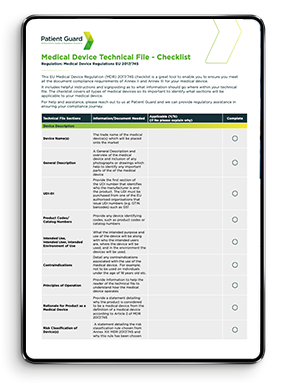
Identifying your product as a medical device is just step one. Next, you must determine its risk classification (Class I, IIa, IIb, or III) to build your Technical File. Don’t risk costly timeline delays or non-compliance.
OR
FAQs
What happens if this tool determines my product is an EU MDR medical device?
If your product qualifies as a medical device under Article 2 of the EU MDR (2017/745), you must comply with strict legal obligations before placing it on the European market. Your immediate next steps are to determine its risk classification (Class I, Class IIa, Class IIb, or Class III) according to the MDR Annex VIII classification rules, establish an ISO 13485-compliant Quality Management System (QMS), and compile a comprehensive Technical File.
Because a false step here can cause massive project delays, we highly recommend booking a technical consultation with an expert to formally map out your regulatory compliance pathway.
What are Annex XVI products, and do they have to comply with the EU MDR?
Yes. Annex XVI of the EU MDR covers specific groups of products that do not have an intended medical purpose but have a similar risk profile to medical devices. This includes aesthetic and cosmetic items such as non-prescription colored contact lenses, dermal fillers, liposuction equipment, intense pulsed light (IPL) machines for hair or skin resurfacing, and brain stimulation equipment.
Even though these products do not claim to treat or diagnose a disease, they must still undergo formal conformity assessments and achieve CE marking under the MDR. Navigating these "borderline" categories can be incredibly complex, which is where specialized consulting support becomes invaluable.
Can standalone software or mobile apps be classified as medical devices under the EU MDR?
Absolutely. Under the EU MDR, standalone software and mobile applications are known as Software as a Medical Device (SaMD). If your software performs an action on data for a specific medical purpose—such as diagnosing, predicting, monitoring, or treating a medical condition—it is legally a medical device. If it merely stores, archives, or performs simple library searches of medical data, it is generally filtered out as non-medical.
Most medical software automatically triggers a Class IIa or higher classification under MDR Rule 11, requiring independent verification by a Notified Body.
Is an online self-assessment tool enough to legally determine my product’s status?
No. Interactive tools like this offer an excellent, highly accurate starting framework based on the text of Regulation EU 2017/745, but they cannot replace a formal regulatory strategy. Regulatory bodies and Notified Bodies require a signed, rigorously documented "Qualification and Classification Justification Report" inside your Technical File.
Grey areas, borderline characteristics, and multi-use products require expert human oversight to avoid legal penalties or product recalls. If you need definitive legal certainty for your device, the Patient Guard team can author a formal regulatory determination report for your product.
Does this determination tool also cover In Vitro Diagnostic (IVD) medical devices?
No, this specific tool is designed strictly around the criteria for general medical devices under the EU MDR (Regulation EU 2017/745). In Vitro Diagnostic devices, such as pregnancy tests, blood glucose monitors, or laboratory reagents, are regulated under a completely separate framework: the EU IVDR (Regulation EU 2017/746).
While the general concept of medical intent is similar, the IVDR has its own unique definition set out in Article 2, focusing on the examination of specimens derived from the human body. If you are developing an assay, test kit, or laboratory software, you will need to evaluate it against the IVDR framework. Our consultants can assist you in determining whether your product falls under the MDR or IVDR pathway.
If my product qualifies as an EU MDR medical device, does that mean it is also approved for the UK market?
Not automatically. Since Brexit, the UK market is governed by the Medicines and Healthcare products Regulatory Agency (MHRA) under the UK Medical Devices Regulations 2002. Currently, the UK still recognizes valid CE certificates under the EU MDR for a transitional period, allowing you to place CE-marked devices on the Great Britain market.
However, to legally sell your device in the UK, manufacturers based outside of the UK must appoint a UK Responsible Person (UKRP) and formally register the device with the MHRA. Patient Guard frequently acts as the legal UKRP for international manufacturers, managing the entire MHRA registration process seamlessly alongside your European compliance strategy.