


Speak with a Regulatory Expert

Get expert support with EU MDR, IVDR, UKCA, cosmetics, PPE and global regulatory compliance. Tell us about your product or project, and one of our specialists will contact you within 24 hours.

500+ Manufacturers Supported
BSI ISO 13485 Certified
UK & EU Offices
Former MHRA Expertise
Established 2017
Patient Guard medical device regulatory consultancy illustration showing UKCA, CE MDR, FDA, ISO 13485, IVDR and technical documentation.

How can we help you?

Select the area most relevant to your product or regulatory needs.

Medical Devices

EU MDR and UKCA support

In Vitro Diagnostics (IVD)

IVDR and FDA 510(k) support

Cosmetics

EU and UK cosmetic compliance

Quality Assurance

ISO 13485, ISO/IEC 27001 ISO 9001 support

FDA Submissions

US regulatory strategy and submissions

Request a Quote or Book a Consultation

Tell us about your product and regulatory requirements, and one of our specialists will contact you within 24 hours. 

Why contact Patient Guard?

What happens next?
1. We review your enquiry
2. A specialist contacts you within 24 hours
3. We arrange a consultation if needed
4. You receive clear next steps
Prefer to speak to us now?
Call us for immediate support
Prefer to book a call?

Book a free 30-minute consultation with one of our regulatory experts.

Book a Free Consultation

Find the right Patient Guard Service

Complete this short form and our team will review your enquiry and identify the most suitable support for your product, project, or regulatory need

Our Locations

Patient Guard Ltd 

Lancaster House Amy Johnson Way, Blackpool, Lancashire, FY4 2RP. United Kingdom

Company Registration Number: 10654752

Patient Guard Europe UG (haftungsbeschränkt)

Hauffstraße 41, 73765, Neuhausen, Deutschland (Germany)

Company Registration Number: HRB 779309

Supporting EU Market Access via our Germany-based Authorized Representative services.

EUDAMED Authorised Representative SRN: DE-AR-000007523

EUDAMED Importer SRN: DE-IM-000025621

Frequently Asked Questions (FAQs)

Our internal Quality Management team recently led Patient Guard through a successful BSI certification. Depending on your current documentation state, we can typically perform a Gap Analysis within 2–3 weeks to prepare you for Notified Body scrutiny.

Yes. With physical offices in both Blackpool (UK) and Neuhausen (Germany), we provide seamless dual-market access, acting as your legal representative for both the MHRA and EU Notified Bodies.

Absolutely. Our clinical specialists are BSI-trained in MDR Clinical Evaluation and IVDR Performance Evaluation. We ensure your technical files meet GSPR requirements and ICH GCP standards for clinical data.

Yes. We have in-house expertise in ISO 10993 (Toxicology) and a Lead Auditor for ISO 27001 (Information Security). This integrated approach is essential for modern Software as a Medical Device (SaMD) and high-risk hardware.

Yes. Our team is specifically certified by BSI for the In Vitro Diagnostic Regulation (IVDR). We provide comprehensive support for Performance Evaluation Reports (PER), Scientific Validity, and Analytical/Clinical Performance, ensuring your IVD products meet the rigorous 2026-2027 compliance deadlines.

Absolutely. Led by our toxicology and biocompatibility specialist, Steve Condie, we provide expert guidance on ISO 10993-1 testing strategies. We help manufacturers avoid over-testing while ensuring chemical characterization and biological safety requirements are fully satisfied for global submissions.

News from Patient Guard

Cosmetic Product Safety Report (CPSR): A Complete Guide to UK Cosmetic Compliance

Before a cosmetic product can legally be placed on the UK market, manufacturers and Responsible Persons must demonstrate that it is safe for human use under normal or reasonably foreseeable conditions. The Cosmetic Product Safety Report (CPSR) is one of the most important regulatory documents required under the UK Cosmetics Regulation. This guide explains what a CPSR is, who can prepare one, what information it must contain, how it relates to the Product Information File (PIF) and how it supports legal cosmetic compliance.

Read More »

IVDR PMPF Explained: A Complete Guide to Post-Market Performance Follow-up

Post-Market Performance Follow-up (PMPF) is a fundamental requirement under the EU In Vitro Diagnostic Regulation (IVDR), ensuring that manufacturers continually monitor the scientific validity, analytical performance and clinical performance of their in vitro diagnostic medical devices after CE marking. This guide explains IVDR PMPF requirements, PMPF Plans, PMPF Reports, Annex XIII expectations and how ongoing performance monitoring supports continued regulatory compliance throughout the device lifecycle.

Read More »

IVDR Scientific Validity Explained: A Complete Guide for Manufacturers

Scientific Validity is the first pillar of IVDR Performance Evaluation and provides the scientific foundation demonstrating that an analyte or biomarker is associated with a specific clinical condition or physiological state. This guide explains Scientific Validity under Regulation (EU) 2017/746, including literature reviews, Scientific Validity Reports, Annex XIII requirements, evidence appraisal and how Scientific Validity supports successful CE marking.

Read More »
IVDR Performance Evaluation Explained image for Patient Guards blog on IVDR Performance Evaluation

IVDR Performance Evaluation Explained: A Complete Guide for Manufacturers

Performance Evaluation is one of the most important requirements under the EU In Vitro Diagnostic Regulation (IVDR). Every manufacturer must demonstrate that their in vitro diagnostic medical device achieves its intended purpose through robust scientific validity, analytical performance and clinical performance evidence. This guide explains every stage of IVDR Performance Evaluation, including Performance Evaluation Plans (PEPs), Performance Evaluation Reports (PERs), Post-Market Performance Follow-up (PMPF) and how Performance Evaluation supports successful CE marking under Regulation (EU) 2017/746.

Read More »

IVDR Classification Explained: A Complete Guide to Class A, B, C and D IVDs

Understanding how your in vitro diagnostic device is classified under the EU IVDR is one of the first and most important steps towards regulatory compliance. This guide explains the IVDR classification rules, the differences between Class A, B, C and D IVDs, how Annex VIII is applied, and how classification affects conformity assessment, technical documentation and Notified Body involvement.

Read More »

Book a Free Consultation

Speak to one of our regulatory and compliance experts to arrange an obligation-free call. Our experienced team is ready to help you get your medical device to market.

UK Office

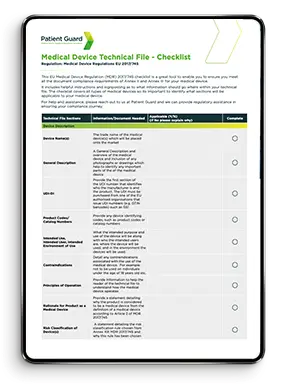
Get the Medical Device Technical Checklist

Thank you! The checklist is now ready to download.