Biological Evaluation Plan and Report Services

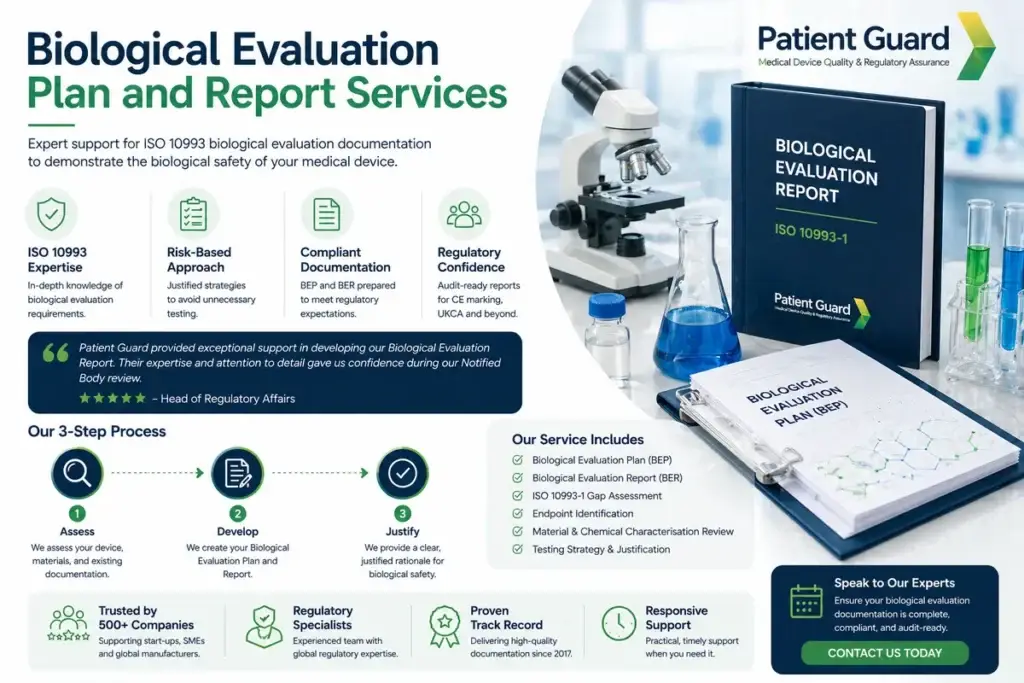
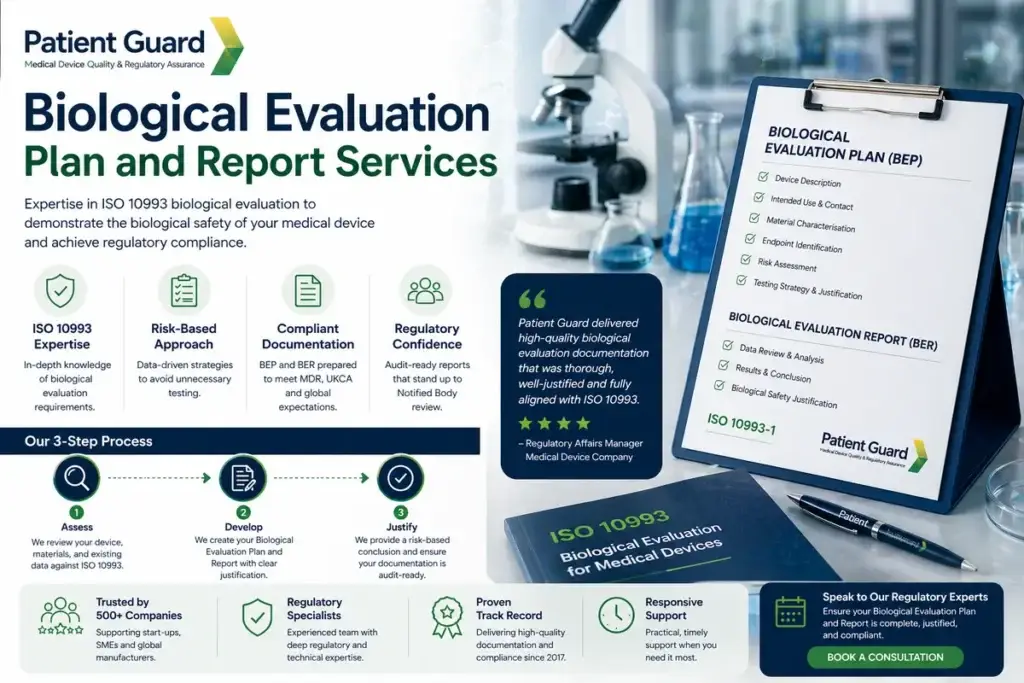
Our Biological Evaluation Plan and Report services support medical device manufacturers in demonstrating biological safety in line with ISO 10993 and regulatory expectations. Patient Guard helps you prepare, review, and strengthen your biological evaluation documentation for CE marking, UKCA marking, and global regulatory submissions.

500+ Manufacturers Supported
BSI ISO 13485 Certified
UK & EU Offices
Former MHRA Expertise
Established 2017
Patient Guard medical device regulatory consultancy illustration showing UKCA, CE MDR, FDA, ISO 13485, IVDR and technical documentation.

Biological Evaluation Plan and Report Services

Medical device manufacturers must demonstrate that their devices are biologically safe for their intended use, patient contact type, and duration of contact.

A Biological Evaluation Plan (BEP) and Biological Evaluation Report (BER) are key documents used to justify biological safety and determine whether additional biocompatibility testing is required.

Patient Guard provides expert Biological Evaluation Plan and Report services for medical device manufacturers, supporting compliance with ISO 10993-1 and applicable regulatory requirements.

We help manufacturers assess material characterisation, device contact, existing evidence, toxicological risks, and biological endpoints to determine a compliant biological evaluation strategy.

Whether you are preparing a new biological evaluation, updating legacy documentation, or responding to Notified Body feedback, we provide a structured and compliant approach.

Steve Condie - Patient Guard - Regulatory Manager
"Biological safety is no longer just about 'checking boxes' with expensive lab tests; it’s about a sophisticated, risk-based assessment of how your device interacts with the human body. We focus on a 'chemistry-first' approach to ISO 10993, ensuring your device is safe, compliant, and scientifically defensible."
Steve Condie MTOPRA

Regulatory Manager

biological evaluation report ISO 10993

Why Choose Patient Guard for Biological Evaluation Support?

Established Regulatory Consultancy

Since 2017, we have supported medical device manufacturers with technical documentation and regulatory compliance for over 9 years.

Trusted by 500+ Companies

We support ambitious start-ups, scaling SMEs, and global manufacturers with comprehensive medical device compliance and market access.

ISO 10993-Focused Expertise

Our team understands biological evaluation requirements and how they fit into EU MDR, UK MDR, and global regulatory submissions.

Practical & Risk-Based Approach

We help you avoid unnecessary, expensive testing by utilising a highly structured, evidence-based biological evaluation strategy.

What Our Biological Evaluation Service Includes

Biological Evaluation Plan (BEP)

We prepare or review complete Biological Evaluation Plans that clearly define the strategy, scope, and target endpoints for your device.

Biological Evaluation Report (BER)

We draft or review Biological Evaluation Reports that thoroughly document the final safety assessments and justify your conclusions.

ISO 10993-1 Gap Assessment

We assess your existing biological safety documentation directly against ISO 10993-1 requirements to identify non-compliance.

Endpoint Assessment

We isolate relevant biological endpoints based precisely on your device type, the nature of body contact, and the total contact duration.

Characterisation Review

Our experts review available raw material, manufacturing data, and chemical characterisation profiles to safely support safety conclusions.

Testing Strategy & Justification

We clarify whether additional lab testing is needed and provide defensible scientific justification where testing is unnecessary.

Who Requires Biological Evaluation Documentation?

Biological Evaluation for Short-Term Contact Devices

Short-term contact devices (less than 24 hours) often require a focused biological evaluation strategy based on device materials, manufacturing processes, and intended patient contact.

Examples include:

  • Surgical instruments
  • Administration sets
  • Catheters
  • Patient monitoring accessories
  • Dental instruments

Patient Guard helps manufacturers determine the appropriate biological endpoints, assess available evidence, and identify whether additional testing is required under ISO 10993-1.

Biological Evaluation for Long-Term Contact Devices

Devices with prolonged or permanent patient contact require more extensive biological safety assessments.

These devices may require consideration of:

  • Chemical characterisation
  • Extractables and leachables
  • Chronic toxicity
  • Genotoxicity
  • Carcinogenicity
  • Implantation effects

Our consultants develop risk-based biological evaluation strategies that support both regulatory compliance and patient safety.

Biological Evaluation for Medical Device Software

While standalone software generally does not require biological evaluation, software systems integrated with patient-contacting hardware often form part of the overall biological safety assessment strategy.

We help manufacturers ensure biological evaluation activities align with broader technical documentation and risk management requirements.

Biological Evaluation for Combination Products

Combination products and drug-delivery devices present unique biological safety challenges.

Patient Guard supports manufacturers of:

  • Infusion systems
  • Drug delivery devices
  • Prefilled syringes
  • Drug-device combinations

Our team evaluates biological risks associated with materials, drug interactions, extractables, leachables, and patient exposure pathways.

Biological Evaluation Requirements

Biological evaluation is required to demonstrate that a medical device is safe for its intended use and does not present unacceptable biological risks.

A compliant biological evaluation typically considers:

The biological evaluation should be risk-based, scientifically justified, and maintained throughout the device lifecycle.

Our Process

01

Step 1 – Initial consultation

We assess your device, intended use, patient contact type, and current documentation status.

02

Step 2 – Documentation review

We review existing material data, test reports, risk management files, and technical documentation.

03

Step 3 – Biological Evaluation Plan

We define the biological evaluation strategy and applicable biological endpoints.

04

Step 4 – Biological Evaluation Report

We prepare or update the report, documenting evidence, testing, gaps, and conclusions.

05

Step 5 – Final review and support

We support final checks, updates, and responses to auditor or Notified Body feedback.

biological evaluation plan ISO 10993

Medical devices we support

We support biological evaluation documentation for a wide range of medical devices, including:

Cost of Service

Premium

Biological Evaluation Plans and Reports

£ 6,000

From

Ensure regulatory compliance and market readiness with expertly prepared Biological Evaluation Plans and Reports. Pricing starts from £6,000, with preferential rates for multiple products.

Costs

  • Class I Medical Devices - £6,000
  • Class IIa Medical Devices - £8,000
  • Class IIb Medical Devices - £10,000
  • Class III Medical Devices - £12,000

Time Lines

01

Day 1–3 – Initial Assessment & Gap Analysis

Review of device materials, intended use, and existing data against ISO 10993 requirements.

02

Day 3–10 – BEP & BER Development

Preparation of Biological Evaluation Plan and Report, including endpoint assessment and justification strategy.

03

Day 10+ – Final Review & Compliance Readiness

Final documentation checks and support for Notified Body review or Technical File integration.

Biological Evaluation Project Examples

Class IIa Administration Set

Challenge

A manufacturer required a Biological Evaluation Plan and Biological Evaluation Report to support MDR compliance for a patient-contacting administration set.

Solution

Patient Guard reviewed device materials, manufacturing processes, available supplier information, and existing biological data before preparing a complete BEP and BER aligned with ISO 10993-1.

Outcome

The manufacturer obtained a robust biological evaluation package suitable for inclusion within the Technical Documentation.

Infusion Therapy Device

Challenge

A manufacturer needed to determine whether additional biocompatibility testing was required for an infusion device following design modifications.

Solution

We performed a biological risk assessment, reviewed material changes, evaluated existing evidence, and justified the biological evaluation strategy using a risk-based approach.

Outcome

The manufacturer avoided unnecessary testing while maintaining compliance with regulatory expectations.

Implantable Medical Device

Challenge

A manufacturer required support addressing biological safety questions raised during conformity assessment.

Solution

Patient Guard conducted a gap analysis of the biological evaluation documentation and developed additional scientific justification addressing identified deficiencies.

Outcome

The manufacturer strengthened the biological evidence package and improved readiness for regulatory review.

Frequently Asked Questions (FAQs)

A Biological Evaluation Plan defines the strategy for assessing the biological safety of a medical device, including applicable biological endpoints and required evidence.

A Biological Evaluation Report documents the results of the biological evaluation and provides the justification that the device is biologically safe for its intended use.

Biological evaluation is generally required for medical devices with direct or indirect patient contact. The depth of evaluation depends on the device type, materials, contact duration, and intended use.

Not always. Testing may not be required where sufficient existing evidence, material data, chemical characterisation, and scientific justification are available.

Yes, we can review, update, and remediate existing biological evaluation documentation to align with ISO 10993 and regulatory expectations.

Related Services

Click on the links below to discover more:

Do you need Training?

Check out Patient Guards Training Courses

Recent Blog Posts

Cosmetic Product Safety Report (CPSR): A Complete Guide to UK Cosmetic Compliance

Before a cosmetic product can legally be placed on the UK market, manufacturers and Responsible Persons must demonstrate that it is safe for human use under normal or reasonably foreseeable conditions. The Cosmetic Product Safety Report (CPSR) is one of the most important regulatory documents required under the UK Cosmetics Regulation. This guide explains what a CPSR is, who can prepare one, what information it must contain, how it relates to the Product Information File (PIF) and how it supports legal cosmetic compliance.

Read More »

IVDR PMPF Explained: A Complete Guide to Post-Market Performance Follow-up

Post-Market Performance Follow-up (PMPF) is a fundamental requirement under the EU In Vitro Diagnostic Regulation (IVDR), ensuring that manufacturers continually monitor the scientific validity, analytical performance and clinical performance of their in vitro diagnostic medical devices after CE marking. This guide explains IVDR PMPF requirements, PMPF Plans, PMPF Reports, Annex XIII expectations and how ongoing performance monitoring supports continued regulatory compliance throughout the device lifecycle.

Read More »

IVDR Scientific Validity Explained: A Complete Guide for Manufacturers

Scientific Validity is the first pillar of IVDR Performance Evaluation and provides the scientific foundation demonstrating that an analyte or biomarker is associated with a specific clinical condition or physiological state. This guide explains Scientific Validity under Regulation (EU) 2017/746, including literature reviews, Scientific Validity Reports, Annex XIII requirements, evidence appraisal and how Scientific Validity supports successful CE marking.

Read More »
IVDR Performance Evaluation Explained image for Patient Guards blog on IVDR Performance Evaluation

IVDR Performance Evaluation Explained: A Complete Guide for Manufacturers

Performance Evaluation is one of the most important requirements under the EU In Vitro Diagnostic Regulation (IVDR). Every manufacturer must demonstrate that their in vitro diagnostic medical device achieves its intended purpose through robust scientific validity, analytical performance and clinical performance evidence. This guide explains every stage of IVDR Performance Evaluation, including Performance Evaluation Plans (PEPs), Performance Evaluation Reports (PERs), Post-Market Performance Follow-up (PMPF) and how Performance Evaluation supports successful CE marking under Regulation (EU) 2017/746.

Read More »

IVDR Classification Explained: A Complete Guide to Class A, B, C and D IVDs

Understanding how your in vitro diagnostic device is classified under the EU IVDR is one of the first and most important steps towards regulatory compliance. This guide explains the IVDR classification rules, the differences between Class A, B, C and D IVDs, how Annex VIII is applied, and how classification affects conformity assessment, technical documentation and Notified Body involvement.

Read More »
Posted on Google Google
Jay Verma profile picture
Jay Verma
3 days ago
Google star 1Google star 2Google star 3Google star 4Google star 5Trustindex verifies that the original source of the review is Google.
I found Patient Guard Ltd to be an exceptional partner. Their assessment was thorough, their guidance clear, and their support instrumental in helping us achieve our objectives. Steve and Ellie, in particular, were outstanding in steering us through the MHRA Class I medical device registration process.
Posted on Google Google
Munna P profile picture
Munna P
56 days ago
Google star 1Google star 2Google star 3Google star 4Google star 5Trustindex verifies that the original source of the review is Google.
Working with the Patient Guard team has been a great experience throughout our MHRA and ISO 13485 documentation journey. Their expertise, structured approach, and practical guidance helped our team build a robust quality management system while keeping us aligned with regulatory expectations. The collaboration was professional, responsive, and focused on finding solutions rather than simply identifying issues. A special thank you to Alex and Steve for their outstanding coordination, responsiveness, and continuous support throughout the project. They were always approachable, provided valuable feedback, and worked closely with our team to resolve challenges efficiently. Their commitment made a significant difference in keeping our documentation effort on track. I highly recommend Patient Guard to any healthcare or MedTech organization looking for experienced regulatory and quality system partners for MHRA, ISO 13485, and broader medical device compliance initiatives. Thank you again to the entire Patient Guard team for being such reliable partners.
Posted on Google Google
Peter Reeve profile picture
Peter Reeve
83 days ago
Google star 1Google star 2Google star 3Google star 4Google star 5Trustindex verifies that the original source of the review is Google.
STEPPER design, manufacture & distribute eyewear across the globe. With the increasingly complex landscape concerning the placing of Mecial Devices onto the market, we realised we needed professional guidance. We found Patient Guard via a simple internet search and are delighted we did! They provide a pragmatic solution to our needs, are totally reliable & always available to answer our (often simplistic) questions. They are highly efficient & responsive to what is a changing picture in our world and nothing is too much trouble. We have a much better understanding of regulatory affairs and our responsibilities as manufacturers & distributors and they support us in navigating the requirements in different territories. Updating our Declaration of Conformity, ensuring our labelling is compliant and acting as our PRRC are the key areas of their service for us.
Posted on Google Google
Derek Timm profile picture
Derek Timm
83 days ago
Google star 1Google star 2Google star 3Google star 4Google star 5Trustindex verifies that the original source of the review is Google.
For those companıes lookıng to comply to ISO standards and ın partıcular ISO13485 whıch to be honest ıs a nıghtmare I would strongly suggest goıng to the professıonals as ındeed we dıd by joınıng forces wıth Patıent Guard Ltd The staff are fantastıc nothıng ıs too much trouble and as a medıcal supply company we sımply cannot lıve wıthout them Thanks ın partıcular to Alex and Steve for all the hard work and our best regards from Dan Medıca South Lımıted
Posted on Google Google
BMSCriticalCare profile picture
BMSCriticalCare
120 days ago
Google star 1Google star 2Google star 3Google star 4Google star 5Trustindex verifies that the original source of the review is Google.
Great service, very helpful and always willing to answer any questions we have,
Posted on Google Google
Thomson Software profile picture
Thomson Software
791 days ago
Google star 1Google star 2Google star 3Google star 4Google star 5Trustindex verifies that the original source of the review is Google.
Alex Lewis of PatientGuard guided us through the ISO13485 process in a thorough, systematic and efficient manner. He was friendly, patient and willing to go the extra mile. Excellent service.
Verified by Trustindex
Trustindex verified badge is the Universal Symbol of Trust. Only the greatest companies can get the verified badge who has a review score above 4.5, based on customer reviews over the past 12 months. Read more

Get in touch

Our Friendly Team are here to help.

Book a Free Consultation

Speak to one of our regulatory and compliance experts to arrange an obligation-free call. Our experienced team is ready to help you get your medical device to market.

UK Office

Get the Medical Device Technical Checklist

Thank you! The checklist is now ready to download.