
What is your Medical Device Classification under EU MDR 2017/745?
Device’s risk class one of the most complex stages of market access. This interactive classification engine walks you step-by-step through the formal European Medical Device Regulation criteria to identify your structural classification tier—from Class I up to Class III. Simply answer the technical criteria regarding your device’s invasiveness, duration of use, active energy transmission, or software functionality to find your regulatory heading.
Updated: 14th May 2026

Founder and CEO
Annex VIII Classification Engine
Evaluate your medical device against the structural classification criteria of EU Regulation 2017/745.
Is the product invasive?
Invasive device: Any device which, in whole or in part, penetrates inside the body, either through a body orifice or through the surface of the body.
Body orifice: Any natural opening in the body, as well as the external surface of the eyeball, or any permanent artificial opening, such as a stoma.
Is the product surgically invasive?
Surgically invasive device:
(a) an invasive device which penetrates inside the body through the surface of the body, including through mucous membranes of body orifices with the aid or in the context of a surgical operation; and
(b) a device which produces penetration other than through a body orifice.
Is the product intended for transient use?
Transient use: Normally intended for continuous use for less than 60 minutes.
Is the product intended to supply energy in the form of ionising radiation?
Does the product have a biological effect or is it wholly or mainly absorbed?
Does the product administer medicinal products by means of a delivery system?
Is the product intended specifically to control, diagnose, monitor or correct a defect of the heart or of the central circulatory system through direct contact with those parts of the body?
Is the product intended for short-term use?
Short term: Normally intended for continuous use for between 60 minutes and 30 days.
Is the product intended specifically to control, diagnose, monitor or correct a defect of the heart or of the central circulatory system through direct contact with those parts of the body?
Is the product intended specifically for use in direct contact with the heart, central circulatory system, or central nervous system?
Is the product intended to supply energy in the form of ionising radiation?
Is the product intended to have a biological effect or is it wholly or mainly absorbed?
Is the product intended to be placed in the teeth?
Is the product intended to administer medicinal products?
Is the product intended to undergo chemical change in the body?
Is the product implantable or long-term surgically invasive?
Implantable device: Any device, including those that are partially or wholly absorbed, intended to be totally introduced into the body, or replace an epithelial surface/surface of the eye, remaining after clinical intervention. Any device partially introduced staying ≥ 30 days is also considered implantable.
Long term: Normally intended for continuous use for more than 30 days.
Is the product intended to be placed in the teeth?
Is the product intended to be used in direct contact with the heart, the central circulatory system, or the central nervous system?
Does the product have a biological effect or is it wholly or mainly absorbed?
Is the product intended to undergo chemical change in the body?
Is the product intended to administer medicinal products?
Is the product an active implantable device or an accessory to an active implantable device?
Active device: Operation depends on source of energy other than that generated by human body or gravity, acting by changing density or converting energy.
Is the product a breast implant or surgical mesh?
Is the product a total or partial joint replacement?
Is the product a spinal disc replacement implant or implantable device that comes into contact with the spinal column?
Is the product an invasive device with respect to body orifices, intended for connection to a class IIa, class IIb or class III active device?
Is the product an invasive device with respect to body orifices, intended for connection to a class I active device?
Is the product an invasive device intended for transient use?
Is the product an invasive device intended for short-term use and used either in the oral cavity as far as the pharynx, in an ear canal up to the ear drum, or in the nasal cavity?
Is the product an invasive device intended for short-term use?
Is the product an invasive device intended for long-term use and used either in the oral cavity as far as the pharynx, in an ear canal up to the ear drum, or in the nasal cavity?
Is the product an invasive device intended for long-term use?
Is the product an active device?
*Note: Standalone software is explicitly considered an active device under EU MDR. However, for the purpose of this visual tool path, if your product is standalone software, please select No here to path directly to the software logic module.
Is the product an active device that is intended for controlling, monitoring, or directly influencing the performance of active implantable devices?
Is the product an active device intended to emit ionizing radiation for therapeutic purposes, including devices which control or monitor such devices, or which directly influence their performance?
Is the product an active device intended to control or monitor the performance of active therapeutic class IIb devices, or directly influence their performance?
Is the product an active therapeutic device intended to administer energy to or exchange energy with the human body in a potentially hazardous way?
Active therapeutic device: Any active device used, whether alone or in combination, to support, modify, replace or restore biological functions/structures with a view to treatment or alleviation of illness, injury or disability.
Is the product an active therapeutic device intended to administer or exchange energy?
Is the product an active device intended to emit ionizing radiation for diagnostic purposes?
Is the product an active device intended to image in vivo distribution of radiopharmaceuticals for the purpose of diagnosis and monitoring?
Is the product intended to illuminate the patient's body, in the visible spectrum for the purposes of diagnosis and monitoring?
Is the product an active device for diagnosis and monitoring which is intended to supply energy which will be absorbed by the human body?
Is the product an active device intended for monitoring of vital physiological parameters, where the nature of variations of those parameters is such that it could result in immediate danger to the patient?
Is the product an active device intended to allow direct diagnosis or monitoring of vital physiological processes?
Is the product an active device intended to administer and/or remove medicinal products, body liquids, or other substances to or from the body?
Is the product software?
Is the software intended to provide information which is used to take decisions with diagnosis or therapeutic purposes?
Could this lead to death or an irreversible deterioration of a person's state of health?
Could this lead to a serious deterioration of a person's state of health or a surgical intervention?
Is the software intended to monitor physiological processes?
Is the software intended for monitoring of vital physiological parameters, where the nature of variations of those parameters is such that it could result in immediate danger to the patient?
Is the product non-invasive?
Is the product intended for channelling or storing blood, body liquids, cells, or tissues for eventual infusion or introduction into the body?
Is the product a blood bag?
Is the product intended to modify the biological or chemical composition of body fluids, tissues, or cells?
Does the treatment involve filtration, centrifugation, or gas/heat exchange?
Does the product consist of substances used in vitro in contact with human cells or embryos?
Does the product contact injured skin or mucous membranes?
Your Device Classification
| Framework Metric | Result Details |
|---|---|
| Indicated Classification | Class Pending |
| MDR Pathway Rule | Rule Pending |
| Notified Body Audit Requirement | Audit Pending |
To legally place this medical device onto the EU market, you must establish an MDR-compliant QMS, author an appropriate Clinical Evaluation Report (CER), and design your technical file structural indices.
Diagnostic Audit History:
Disclaimer: This tool acts as an interactive navigational framework based on Annex VIII text inside EU Regulation 2017/745. It does not constitute formal corporate legal qualification documentation. Full compliance reviews require technical sign-offs from our advisory specialists.
Classified Your Device? What’s Next?
Identifying your medical device classification under Annex VIII of the EU MDR is a crucial first milestone. Your classification dictates your exact route to market approval and the level of regulatory scrutiny your team will face.
1. Establish a Quality Management System
Whether your device is Class I or Class III, you must establish a Quality Management System (QMS) compliant with ISO 13485 to seamlessly manage your device's full lifecycle.
2. Build Technical Documentation
Compile your technical documentation demonstrating comprehensive conformity. This includes robust risk management (ISO 14971), clinical evaluations, and structural safety data.
3. Engage a Notified Body
For Class IIa, IIb, and III devices, you must select and apply to an accredited Notified Body to audit your QMS and Technical Documentation before gaining CE marking authorization.
Need Expert Guidance on Your Regulatory Route?
Navigating MDR classifications, clinical evaluation gaps, or QMS audits can be daunting. Let our team guide you from tool classification to global market access.
Speak with a Regulatory Expert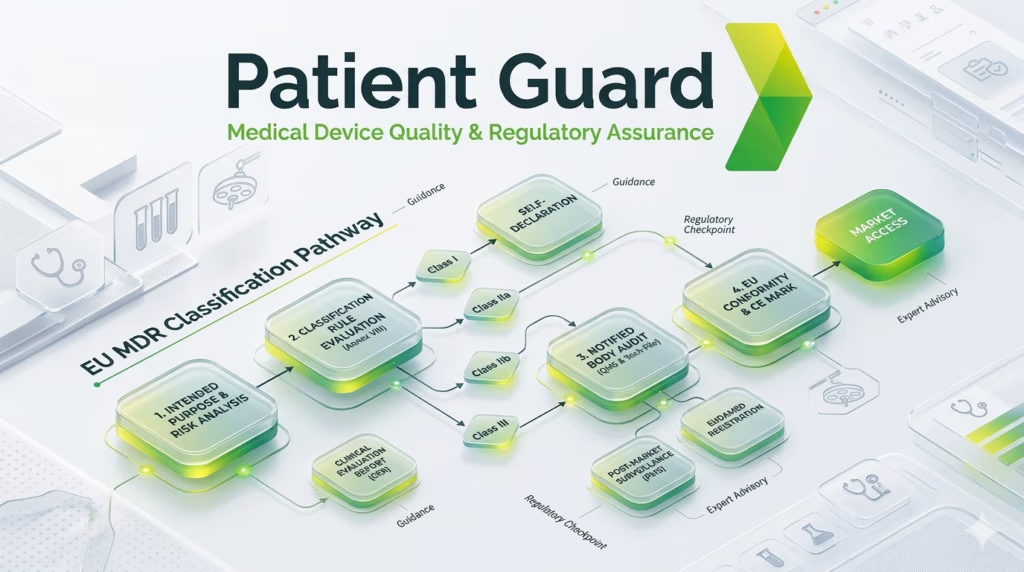
FAQs
What happens if my device triggers multiple classification rules under Annex VIII?
Under the EU MDR Implementing Rules (Annex VIII, Chapter II), if a medical device features multiple intended uses or characteristics that trigger different classification criteria, the strictest rule applies. This means your device will automatically default to the highest resulting risk classification tier (for example, if both Class IIa and Class IIb rules apply, your device is formally Class IIb).
Can standalone software be classified using this tool?
Yes. Under the EU MDR, standalone software (MDSW) is explicitly governed by Rule 11. This classification engine includes the specific logic paths for software. Depending on whether the software drives diagnostic decisions, clinical therapeutic decisions, or simply monitors vital processes, its risk class can scale sharply from Class I up to Class III.
What is the core difference between transient, short-term, and long-term use?
MDR classifications heavily rely on continuous duration thresholds defined in Annex VIII:
Transient Use: Continuous device application normally intended for less than 60 minutes.
Short-Term Use: Continuous application normally intended for between 60 minutes and 30 days.
Long-Term Use: Continuous application normally intended for more than 30 days.
Do all classifications require a Notified Body assessment?
No. Standard Class I devices (provided they are not sterile, do not have a measuring function, and are not reusable surgical instruments) allow for a self-declaration pathway without direct third-party Notified Body audits. However, Class I (sterile/measuring/reusable), Class IIa, Class IIb, and Class III devices strictly require formal Quality Management System and technical documentation audits by an EU Notified Body before market entry.
What if my device is a borderline product or doesn't cleanly fit a rule?
If a device is considered a borderline product (overlapping with medicinal products, cosmetics, or biocides) or its technical parameters lead to disputes with a Notified Body, a formal decision can be requested from competent authorities. In these circumstances, professional regulatory gap analysis is vital to establish robust justification rationales within your technical documentation.
Can I use this dynamic result to directly create my EUDAMED registration?
This tool operates strictly as a directional assessment based on the structural criteria of Annex VIII. While it provides an accurate compliance compass, it does not substitute for signed corporate regulatory filings. Before submitting device profiles to EUDAMED or the MHRA, your technical file data indices should be verified by QA/RA professionals. Feel free to contact our advisory team directly through our Contact Us page to secure a definitive classification sign-off.