
Quality Management

Cosmetic Product Safety Report (CPSR): A Complete Guide to UK Cosmetic Compliance

Before a cosmetic product can legally be placed on the UK market, manufacturers and Responsible Persons must demonstrate that it is safe for human use under normal or reasonably foreseeable conditions. The Cosmetic Product Safety Report (CPSR) is one of the most important regulatory documents required under the UK Cosmetics Regulation. This guide explains what a CPSR is, who can prepare one, what information it must contain, how it relates to the Product Information File (PIF) and how it supports legal cosmetic compliance.

Cosmetic Product Safety Report (CPSR): A Complete Guide to UK Cosmetic Compliance Read More »

IVDR PMPF Explained: A Complete Guide to Post-Market Performance Follow-up

Post-Market Performance Follow-up (PMPF) is a fundamental requirement under the EU In Vitro Diagnostic Regulation (IVDR), ensuring that manufacturers continually monitor the scientific validity, analytical performance and clinical performance of their in vitro diagnostic medical devices after CE marking. This guide explains IVDR PMPF requirements, PMPF Plans, PMPF Reports, Annex XIII expectations and how ongoing performance monitoring supports continued regulatory compliance throughout the device lifecycle.

IVDR PMPF Explained: A Complete Guide to Post-Market Performance Follow-up Read More »

IVDR Scientific Validity Explained: A Complete Guide for Manufacturers

Scientific Validity is the first pillar of IVDR Performance Evaluation and provides the scientific foundation demonstrating that an analyte or biomarker is associated with a specific clinical condition or physiological state. This guide explains Scientific Validity under Regulation (EU) 2017/746, including literature reviews, Scientific Validity Reports, Annex XIII requirements, evidence appraisal and how Scientific Validity supports successful CE marking.

IVDR Scientific Validity Explained: A Complete Guide for Manufacturers Read More »

IVDR Performance Evaluation Explained image for Patient Guards blog on IVDR Performance Evaluation

IVDR Performance Evaluation Explained: A Complete Guide for Manufacturers

Performance Evaluation is one of the most important requirements under the EU In Vitro Diagnostic Regulation (IVDR). Every manufacturer must demonstrate that their in vitro diagnostic medical device achieves its intended purpose through robust scientific validity, analytical performance and clinical performance evidence. This guide explains every stage of IVDR Performance Evaluation, including Performance Evaluation Plans (PEPs), Performance Evaluation Reports (PERs), Post-Market Performance Follow-up (PMPF) and how Performance Evaluation supports successful CE marking under Regulation (EU) 2017/746.

IVDR Performance Evaluation Explained: A Complete Guide for Manufacturers Read More »

IVDR Classification Explained: A Complete Guide to Class A, B, C and D IVDs

Understanding how your in vitro diagnostic device is classified under the EU IVDR is one of the first and most important steps towards regulatory compliance. This guide explains the IVDR classification rules, the differences between Class A, B, C and D IVDs, how Annex VIII is applied, and how classification affects conformity assessment, technical documentation and Notified Body involvement.

IVDR Classification Explained: A Complete Guide to Class A, B, C and D IVDs Read More »

When Do You Need New Biocompatibility Testing for a Medical Device?

A material change, supplier switch, manufacturing transfer or design modification does not automatically require new ISO 10993 biocompatibility testing. Learn how manufacturers use Biological Evaluation Plans (BEPs), chemical characterisation, toxicological risk assessments and Biological Evaluation Reports (BERs) to determine whether existing biological evidence remains valid or whether additional testing is required under ISO 10993-1, the EU MDR and FDA expectations.

When Do You Need New Biocompatibility Testing for a Medical Device? Read More »

Why Notified Bodies Reject IVDR Performance Evaluation Reports: The Top 3 Mistakes Manufacturers Make

More than half of IVDR submissions face deficiencies during Notified Body review, with Performance Evaluation Reports (PERs) among the most common areas of concern. Learn the three critical mistakes that lead to PER rejections—including weak State of the Art justification, non-systematic literature reviews, and poor traceability between Scientific Validity, Analytical Performance, and Clinical Performance data—and discover how to build a compliant, audit-ready IVDR technical file.

Why Notified Bodies Reject IVDR Performance Evaluation Reports: The Top 3 Mistakes Manufacturers Make Read More »

10 Common Technical Documentation Deficiencies Found During EU MDR and IVDR Notified Body Reviews

10 Common Technical Documentation Deficiencies Found During EU MDR and IVDR Notified Body Reviews

Preparing technical documentation for EU MDR or IVDR certification is only half the challenge. Successfully passing a Notified Body review depends on demonstrating consistency across your Quality Management System, Clinical Evaluation, Risk Management, Biological Evaluation, Performance Evaluation and Post-Market Surveillance activities. Discover ten of the most common technical documentation deficiencies identified during MDR and IVDR conformity assessments—and learn how to reduce the likelihood of costly review cycles and certification delays.

10 Common Technical Documentation Deficiencies Found During EU MDR and IVDR Notified Body Reviews Read More »

Patient Guard EU Authorised Representative Services

EU Authorised Representative Services for Medical Device & IVD Manufacturers

Selling medical devices or IVDs in Europe? If your company is based outside the EU, appointing an EU Authorised Representative (EC Rep) is a legal requirement under EU MDR 2017/745 and IVDR 2017/746. Patient Guard provides expert EU Authorised Representative services, EUDAMED support, regulatory guidance, and ongoing compliance management to help manufacturers access and maintain the European market with confidence.

EU Authorised Representative Services for Medical Device & IVD Manufacturers Read More »

Agile Compliance for Medical Device Software

Predetermined Change Control Plans (PCCPs): The Future of Agile Compliance for Medical Device Software

Learn how PCCPs help medical device software manufacturers manage updates, support AI systems, and enable agile compliance under evolving MDR and UKCA frameworks.

Predetermined Change Control Plans (PCCPs): The Future of Agile Compliance for Medical Device Software Read More »

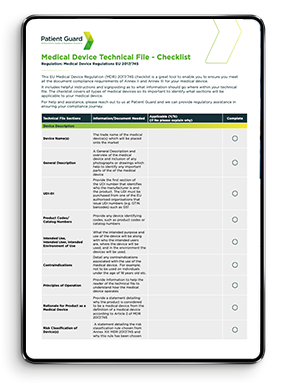
Get the Medical Device Technical Checklist

Thank you! The checklist is now ready to download.