
Updated: 25h August 2026
Reviewed by: David Small BSc (Hons), MSc, MTOPRA (Founder & CEO)
UK Responsible Person (UKRP) for Medical Devices
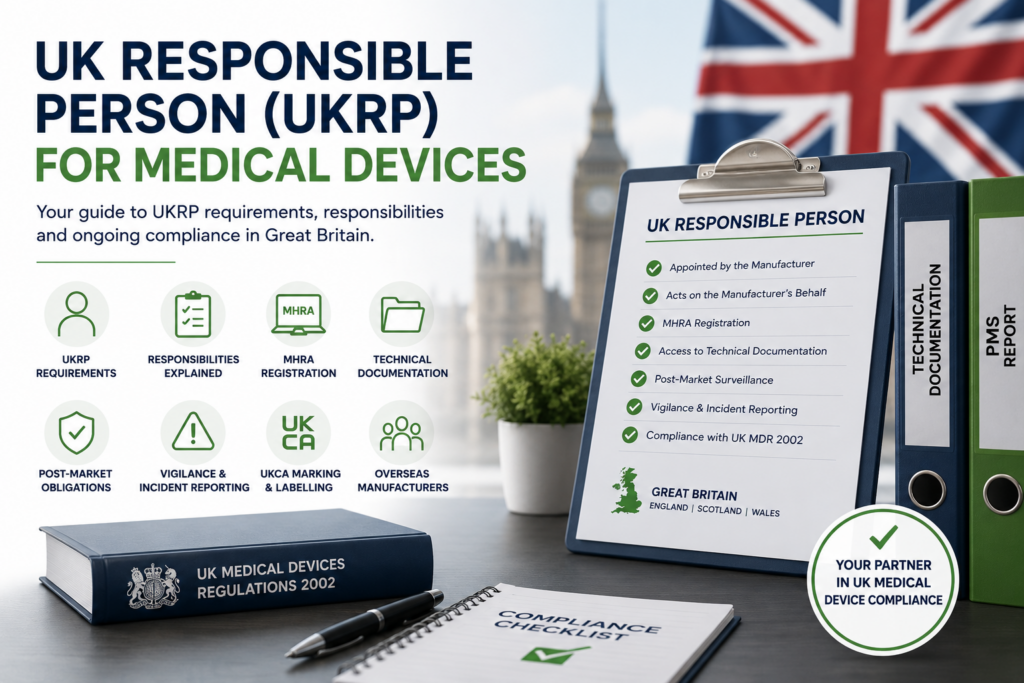
Manufacturers based outside the United Kingdom that wish to place medical devices or in vitro diagnostic medical devices (IVDs) on the Great Britain market must appoint a UK Responsible Person (UKRP).
The UK Responsible Person is established in the UK and acts on behalf of the overseas manufacturer in relation to specified regulatory responsibilities under the UK Medical Devices Regulations 2002 (UK MDR 2002), as amended.
The role was introduced following the UK’s departure from the European Union to provide overseas medical device manufacturers with a UK-based regulatory representative and point of contact with the Medicines and Healthcare products Regulatory Agency (MHRA).
A UK Responsible Person has important responsibilities relating to:
- MHRA medical device registration.
- Technical Documentation.
- Declarations of Conformity.
- Conformity assessment documentation and certificates.
- Communication with the MHRA.
- Complaints and suspected incidents.
- Preventive and corrective actions.
- Ongoing regulatory compliance.
The manufacturer must formally designate its UK Responsible Person and provide written evidence that the UKRP has authority to act on its behalf. The MHRA confirms that manufacturers based outside the UK must appoint a UKRP to place devices on the Great Britain market.
Great Britain and Northern Ireland Have Different Requirements
It is important to distinguish between the Great Britain market (England, Scotland and Wales) and Northern Ireland.
The UK Responsible Person requirements described in this guide primarily concern devices being placed on the Great Britain market. Different regulatory arrangements apply in Northern Ireland, where EU medical device legislation continues to apply in important areas.
Manufacturers intending to supply medical devices in both Great Britain and Northern Ireland should therefore assess the requirements for each market separately. The MHRA’s regulatory guidance expressly distinguishes the conformity and market-access arrangements for Great Britain and Northern Ireland.
Need an Introduction to UK Medical Device Regulations?
This article focuses on the role and responsibilities of the UK Responsible Person. If you're looking for a complete overview of UK medical device regulations, including UKCA marking, MHRA registration, classification, UKRP requirements and post-market surveillance, read our Complete Guide to UK Medical Device Regulations.
What Is a UK Responsible Person?
A UK Responsible Person (UKRP) is a person or legal entity established in the United Kingdom that is formally appointed to act on behalf of a medical device or IVD manufacturer based outside the UK in relation to specified regulatory obligations.
For manufacturers wishing to place devices on the Great Britain market, the UKRP provides an important regulatory link between the overseas manufacturer and the Medicines and Healthcare products Regulatory Agency (MHRA).
The UK Responsible Person acts on the manufacturer’s behalf for specific tasks, including registering the manufacturer’s devices with the MHRA and supporting communication with the regulator.
The UKRP must have written evidence demonstrating that the manufacturer has authorised them to act in this role.
Who Needs to Appoint a UKRP?
A manufacturer must appoint a UK Responsible Person if it is established outside the UK and intends to place medical devices on the Great Britain market.
This includes manufacturers based in:
- European Union countries.
- The United States.
- Canada.
- Australia.
- China.
- India.
- Switzerland.
- Other countries outside the UK.
The requirement can apply to manufacturers of:
- General medical devices.
- In vitro diagnostic medical devices (IVDs).
- Active implantable medical devices.
- Custom-made medical devices.
- Certain systems and procedure packs.
The requirement is based on where the manufacturer is established, rather than where the device was manufactured or whether the device carries a CE or UKCA mark.
Therefore, an EU manufacturer using CE marking to access the Great Britain market may still require a UK Responsible Person.
Does a UK Manufacturer Need a UK Responsible Person?
No. A manufacturer established in the UK does not need to appoint a UK Responsible Person for placing its own devices on the Great Britain market.
The UKRP mechanism exists to provide manufacturers established outside the UK with an appropriately established representative for their Great Britain regulatory obligations.
One UKRP for the Manufacturer
An overseas manufacturer appoints a UK Responsible Person to act on its behalf for the devices covered by the appointment.
The UKRP then becomes an important point of contact for the manufacturer’s Great Britain regulatory activities, including MHRA registration and regulatory communication.
However, appointing a UKRP does not remove the manufacturer’s responsibility for ensuring that its devices comply with the applicable requirements of the UK MDR 2002.
The MHRA’s current guidance confirms that manufacturers based outside the UK must appoint a UK Responsible Person to place devices on the Great Britain market and that the UKRP assumes responsibility for registering those devices with the MHRA.
A UKRP Is Not Simply an Importer or Distributor
The UK Responsible Person is a specific regulatory role and should not be confused with the commercial organisations involved in importing or distributing a medical device.
An importer or distributor does not automatically become the manufacturer’s UK Responsible Person simply because it supplies the manufacturer’s products in Great Britain.
The UKRP must be specifically appointed by the manufacturer and have written evidence of its authority to perform the regulatory tasks associated with the role.
What Does a UK Responsible Person Do?
A UK Responsible Person acts on behalf of a manufacturer established outside the UK in relation to specified regulatory responsibilities for medical devices placed on the Great Britain market.
While MHRA registration is one of the most visible responsibilities of the UKRP, the role extends beyond registration. The UK Responsible Person also acts as an important regulatory contact between the overseas manufacturer and the Medicines and Healthcare products Regulatory Agency (MHRA).
Register Medical Devices with the MHRA
Before a medical device is placed on the Great Britain market, it must be registered with the MHRA in accordance with the applicable requirements.
Where the manufacturer is based outside the UK, the UK Responsible Person assumes responsibility for registering the manufacturer’s devices with the MHRA.
The UKRP must ensure that the information submitted during registration is accurate and should work with the manufacturer to ensure that registration information is kept up to date when relevant details change.
Verify Key Regulatory Documentation
The UK Responsible Person must ensure that the manufacturer has drawn up the appropriate Declaration of Conformity and Technical Documentation.
Where conformity assessment by a third party is required, the UKRP must also ensure that the appropriate conformity assessment procedure has been carried out by the manufacturer.
This does not mean that the UKRP becomes responsible for creating all of the manufacturer’s Technical Documentation. The manufacturer remains responsible for demonstrating that its device complies with the applicable regulatory requirements.
Keep Regulatory Documentation Available to the MHRA
The UK Responsible Person must keep certain documentation available for inspection by the MHRA.
This includes:
- A copy of the Technical Documentation.
- A copy of the Declaration of Conformity.
- Where applicable, a copy of the relevant conformity assessment certificate.
- Any relevant amendments or supplements to those certificates.
Manufacturers should therefore ensure that their UKRP has appropriate access to the regulatory documentation necessary to perform the role effectively.
Act as a Regulatory Contact with the MHRA
The UKRP provides the MHRA with an established UK point of contact for the overseas manufacturer.
Where the MHRA requests information or documentation relating to a device, the UKRP should be able to communicate effectively with both the regulator and the manufacturer and facilitate an appropriate response.
This is one reason manufacturers should consider regulatory competence and responsiveness when selecting a UK Responsible Person rather than viewing the appointment solely as an administrative requirement.
Complaints and Post-Market Information
The UK Responsible Person also has an important role in the flow of post-market information.
Under the strengthened Great Britain Post-Market Surveillance requirements, the UKRP must immediately inform the manufacturer of complaints or reports it receives relating to a medical device for which it has been appointed.
This information may need to be considered within the manufacturer’s:
- Post-Market Surveillance system.
- Risk Management process.
- Clinical Evaluation.
- Vigilance procedures.
- CAPA system.
- Technical Documentation.
The manufacturer remains responsible for operating an effective PMS system, but the UKRP provides an important regulatory communication channel for information received within Great Britain.
Take Action Where the Manufacturer Fails to Meet Its Obligations
The UKRP role also carries an important compliance responsibility.
If the manufacturer acts contrary to its obligations under the applicable regulations, the UK Responsible Person must terminate its legal relationship with the manufacturer and inform the MHRA and, where applicable, the relevant UK Approved Body.
This demonstrates why the UKRP should not be regarded simply as a name and address used for MHRA registration.
A competent UK Responsible Person should have appropriate processes for maintaining regulatory documentation, communicating with the manufacturer, handling regulatory enquiries and supporting ongoing compliance throughout the period of appointment.

UKRP and MHRA Medical Device Registration
Medical devices must be registered with the Medicines and Healthcare products Regulatory Agency (MHRA) before they are placed on the Great Britain market.
Where a manufacturer is established outside the UK, its appointed UK Responsible Person is responsible for registering the manufacturer’s devices with the MHRA.
Registration is managed through the MHRA’s Device Online Registration System (DORS). The UKRP therefore needs appropriate information from the manufacturer to establish and maintain accurate device registrations.
What Information Is Required for MHRA Registration?
The information required will depend on the device and regulatory route, but manufacturers should be prepared to provide their UKRP with information including:
- Manufacturer details.
- Device type and classification.
- Medical device brand or trade name.
- Model, version or catalogue information.
- Appropriate GMDN information.
- UDI information where applicable.
- Conformity assessment information.
- Details of relevant certificates where applicable.
- Information relating to the device’s regulatory status.
The manufacturer and UKRP should ensure that the information submitted accurately reflects the devices being placed on the Great Britain market.
Registration should also be reviewed when relevant information changes. The MHRA specifically advises registration account holders to review their accounts regularly to ensure that the data remains correct.
MHRA Registration Fees
The MHRA introduced a new medical device registration fee structure on 1 April 2026.
For the period from 1 April 2026 to 31 March 2027, the annual fee is:
£300 per applicable Level 2 GMDN category, or Level 1 category where no Level 2 category exists.
This replaced the previous one-off registration fee model with an annual charging system supporting ongoing regulatory oversight and post-market surveillance.
Importantly, the fee is based on the applicable GMDN registration categories rather than simply the number of individual products. Where multiple devices or products fall within the same chargeable category, the manufacturer is generally charged once per year for that category. New registrations made part-way through a charging period are charged on a pro-rata basis.
Proposed MHRA Fee Increase from April 2027
Manufacturers should also be aware that MHRA registration fees may change.
In August 2026, the MHRA opened a public consultation on changes to its statutory fees from 1 April 2027, including a phased increase to the medical device post-market surveillance fee. The consultation closes on 25 September 2026.
As this remains a consultation, manufacturers should check the latest MHRA fee schedule rather than treating the proposed future charge as confirmed.
Keeping MHRA Registrations Up to Date
MHRA registration is not simply a one-time market-access exercise.
Manufacturers and their UK Responsible Persons should have processes for identifying changes that could affect registered information and ensuring that appropriate updates are made.
This may include changes relating to:
- Manufacturer information.
- UK Responsible Person information.
- Device or product details.
- Certification.
- Regulatory status.
- Devices that are no longer being placed on the market.
Some changes can be made without charge, while other changes or re-registration may result in a statutory fee. Since 1 April 2026, the MHRA no longer charges separately for uploading a new Letter of Designation or updating an organisation’s name or address.
Maintaining accurate registration information is an important part of the relationship between the overseas manufacturer and its UK Responsible Person.
UK Responsible Person Labelling Requirements
Manufacturers often ask whether the name and address of their UK Responsible Person must appear on the medical device label or packaging.
The answer depends on the device, the regulatory route being used and the applicable requirements of the UK Medical Devices Regulations 2002 (UK MDR 2002).
Manufacturers should therefore review the specific labelling requirements that apply to their device rather than assuming that appointment of a UKRP automatically creates the same labelling obligations as an EU Authorised Representative under the EU MDR or IVDR.
UKRP Details and MHRA Registration
Even where UKRP details are not required to appear directly on a particular device label, the UK Responsible Person remains formally linked to the overseas manufacturer through MHRA registration.
The MHRA’s public registration database can display the name and address of the UK Responsible Person within the overseas manufacturer’s registration record.
Manufacturers should therefore ensure that:
- Their UKRP appointment is formally documented.
- The correct UKRP information is supplied to the MHRA.
- Registration information remains accurate and current.
- Relevant labelling requirements have been assessed for each device and regulatory route.
- Changes to the UKRP are appropriately controlled and reflected in relevant regulatory records.
Custom-Made Medical Devices
There are specific labelling requirements for custom-made devices.
MHRA guidance states that, for custom-made devices imported into the UK, the label must include the name and address of the UK Responsible Person.
This is a good example of why manufacturers should assess the requirements applicable to their particular device rather than relying on a general assumption about UKRP labelling.
Future UK Regulatory Requirements
UK medical device regulation is continuing to evolve, and future market-access routes may introduce additional requirements concerning UKRP identification.
For example, the MHRA’s proposed international recognition framework envisages the UK Responsible Person’s name and address being included on the device label, potentially through over-labelling, while the MHRA has also indicated that digital labelling solutions are being considered.
Manufacturers should therefore review current MHRA guidance when introducing a device to Great Britain or making changes to existing labelling.
UK Responsible Person vs EU Authorised Representative
A UK Responsible Person and an EU Authorised Representative perform broadly comparable representative functions, but they operate under different regulatory frameworks and for different markets.
Following the UK’s departure from the European Union, a representative established in Great Britain is no longer recognised as an EU Authorised Representative. Similarly, appointing an EU Authorised Representative does not remove the requirement for an overseas manufacturer to appoint a UK Responsible Person when one is required for the Great Britain market.
| UK Responsible Person (UKRP) | EU Authorised Representative (EU AR) | |
|---|---|---|
| Primary market | Great Britain (England, Scotland and Wales) | European Union / EEA and, where applicable, Northern Ireland |
| Main regulatory framework | UK Medical Devices Regulations 2002 (UK MDR 2002), as amended | EU MDR 2017/745 or EU IVDR 2017/746 |
| Who generally needs one? | Manufacturers established outside the UK placing devices on the GB market | Manufacturers established outside the EU placing devices on the EU market |
| Where must they be established? | United Kingdom | EU Member State; an appropriately established representative in Northern Ireland can also fulfil relevant NI/EU-market requirements |
| Regulatory authority/system | MHRA | Relevant EU competent authorities and EUDAMED |
| Device registration | UKRP registers applicable devices with the MHRA for the overseas manufacturer | EU registration responsibilities operate under MDR/IVDR and EUDAMED |
| Appointment | Formal written designation from the manufacturer | Written mandate between manufacturer and Authorised Representative |
| Technical Documentation | Must perform the documentation-related responsibilities specified under the UK framework | Performs the documentation and verification responsibilities specified by MDR/IVDR and its mandate |
| Same appointment for GB and EU? | No | No |
The MHRA confirms that manufacturers based outside the UK must appoint a UK Responsible Person to place devices on the Great Britain market, while manufacturers outside the EU need an EU or Northern Ireland-based Authorised Representative to supply relevant devices to the EU market.
Manufacturers Selling in Both Great Britain and the EU
An overseas manufacturer intending to sell medical devices in both Great Britain and the European Union may therefore require two separate regulatory representatives:
- A UK Responsible Person for Great Britain.
- An EU Authorised Representative for the European Union.
For example, a US medical device manufacturer selling into Great Britain and Germany would generally need a UKRP for its Great Britain regulatory obligations and an EU Authorised Representative for its EU regulatory obligations.
The two representatives may need access to similar regulatory documentation, but their responsibilities arise from separate legislation and should be managed accordingly.
What About Northern Ireland?
Northern Ireland needs particular attention because medical device regulation there differs from Great Britain.
The EU MDR and EU IVDR apply in Northern Ireland under the Windsor Framework. For example, a manufacturer based in Great Britain supplying devices to Northern Ireland must designate an Authorised Representative established in the EU or Northern Ireland.
Since 28 May 2026, four EUDAMED modules have become mandatory, including Actor Registration and UDI/Device Registration. This has also changed how most devices supplied to Northern Ireland are registered, although custom-made devices continue to be registered through MHRA DORS.
Manufacturers supplying devices across Great Britain, Northern Ireland and the EU should therefore avoid treating the UK as a single regulatory market for representative and registration purposes.
Do You Also Need an EU Authorised Representative?
A UK Responsible Person supports overseas manufacturers placing medical devices on the Great Britain market, while manufacturers established outside the EU may require a separate EU Authorised Representative for access to the European market. For guidance on the role, responsibilities, appointment requirements and regulatory obligations of an EU AR, read our complete guide to EU Authorised Representatives for medical devices.

How to Appoint a UK Responsible Person
A manufacturer established outside the UK must formally appoint a UK Responsible Person before placing its medical devices on the Great Britain market.
The appointment should establish the UKRP’s authority to act on behalf of the manufacturer and clearly define the regulatory responsibilities covered by the relationship.
Selecting a UK Responsible Person
The UK Responsible Person must be established in the United Kingdom.
When selecting a UKRP, manufacturers should consider more than simply whether the organisation can provide a UK address and complete an MHRA registration.
A UKRP should have appropriate systems and regulatory knowledge to support responsibilities including:
- MHRA device registration.
- Maintaining access to required regulatory documentation.
- Communication with the MHRA.
- Managing regulatory enquiries.
- Handling complaints or reports received in relation to represented devices.
- Supporting communication concerning post-market and vigilance matters.
- Maintaining accurate information about the manufacturer and its registered devices.
- Identifying situations where the manufacturer may no longer be meeting its regulatory obligations.
An importer or distributor can also act as the UK Responsible Person, provided it is appropriately appointed and can fulfil the requirements of the role.
The UKRP Letter of Designation
The relationship between the manufacturer and UK Responsible Person must be formally documented.
For MHRA registration, a Letter of Designation must be provided where applicable. The MHRA describes this as a legal contract that identifies the UKRP as the manufacturer’s exclusive UK Responsible Person and specifies the mandatory tasks it is contracted to undertake.
The designation documentation should clearly identify:
- The overseas manufacturer.
- The UK Responsible Person.
- The relevant company names and addresses.
- The authority granted to the UKRP.
- The regulatory responsibilities covered by the appointment.
- The devices or scope covered by the arrangement.
- The effective dates of the appointment.
The validity dates entered into DORS should correspond with the contractual relationship between the manufacturer and UKRP. Current MHRA guidance states that the maximum validity period entered for a Letter of Designation is five years.
What Should the Manufacturer Provide to Its UKRP?
Once appointed, the manufacturer should provide the UK Responsible Person with sufficient information and documentation to perform its regulatory responsibilities effectively.
Depending on the device and conformity assessment route, this may include:
- Technical Documentation.
- Declaration of Conformity.
- Applicable CE or UKCA certificates.
- Device classification information.
- Intended purpose and device descriptions.
- Product and model information.
- GMDN information.
- Labelling and Instructions for Use.
- Manufacturer contact information.
- Relevant post-market and vigilance information.
- Details of Great Britain importers.
- Information required for MHRA registration.
The UKRP must keep available copies of the Technical Documentation, Declaration of Conformity and relevant certificates, including amendments and supplements, for inspection by the MHRA.
The UKRP Appointment Should Be Maintained
The appointment should not be treated as a one-off administrative step completed when the device is first registered.
The manufacturer and UKRP should maintain communication throughout the relationship so that relevant changes to devices, certificates, manufacturer information and regulatory status can be appropriately managed.
If the Letter of Designation expires, a new valid designation should be uploaded to the MHRA registration system. The MHRA’s April 2026 guidance also confirms that uploading a new Letter of Designation no longer attracts a separate statutory change fee.
Changing Your UK Responsible Person
An overseas manufacturer is not permanently tied to the same UK Responsible Person. A manufacturer can change its UKRP, but the transition should be carefully managed to avoid gaps in representation, inaccurate MHRA records or disruption to Great Britain market access.
The manufacturer should ensure that the outgoing appointment is appropriately terminated and that the new UK Responsible Person is formally designated before it assumes responsibility for the manufacturer’s regulatory activities.
Appointing the New UKRP
The incoming UK Responsible Person should be provided with the documentation and information necessary to perform the role effectively.
This may include:
- A new Letter of Designation.
- Manufacturer details.
- Details of devices placed on the Great Britain market.
- Technical Documentation.
- Declarations of Conformity.
- Applicable conformity assessment certificates.
- Device classification and GMDN information.
- Existing MHRA registration information.
- Details of Great Britain importers.
- Relevant complaint, vigilance and post-market information.
The manufacturer should also establish clear dates for the end of the previous UKRP appointment and commencement of the new appointment.
Updating MHRA Registration
A change of UK Responsible Person must be appropriately reflected within the MHRA’s Device Online Registration System (DORS).
This is particularly important because the UKRP is the organisation responsible for registering the overseas manufacturer’s devices with the MHRA. Current MHRA guidance requires registration information to be kept accurate and up to date and states that changes should be made as they occur.
The MHRA also requires a manufacturer established outside the UK to appoint a single UK Responsible Person to take responsibility for all of its medical devices for the Great Britain market.
Manufacturers should therefore plan a UKRP transfer before terminating their existing arrangement rather than leaving a period in which there is no appropriately appointed UK Responsible Person.
Review Importer Information
Changing UKRP is also a good opportunity to check the manufacturer’s Great Britain importer information.
A Great Britain importer must inform the manufacturer or UKRP of its intention to import a device. The manufacturer or UKRP is then responsible for submitting the importer’s details, including its place of business in Great Britain, to the MHRA.
Any changes affecting these relationships should therefore be reflected in the manufacturer’s regulatory records where necessary.
Maintain Continuity of Regulatory Information
The manufacturer should ensure that important regulatory information is not lost during the transition between representatives.
Particular attention should be given to ongoing matters such as:
- Open complaints.
- Serious incident investigations.
- Vigilance reports.
- Field Safety Corrective Actions.
- MHRA correspondence.
- Post-Market Surveillance activities.
- Outstanding regulatory requests.
- Changes to devices or certification.
A structured handover helps ensure that the new UKRP understands the regulatory status of the manufacturer’s devices and can respond appropriately if contacted by the MHRA.
Do Not Treat a UKRP Change as Simply an Administrative Change
Because the UK Responsible Person performs an ongoing regulatory function, manufacturers should consider the wider impact of changing representative rather than focusing only on the DORS account.
The transition should be documented within the manufacturer’s Quality Management System, with responsibilities, effective dates, documentation transfer and regulatory updates clearly controlled.
How to Choose a UK Responsible Person
Choosing a UK Responsible Person should be treated as an important regulatory decision rather than simply an administrative requirement.
The UKRP may need to communicate with the MHRA, maintain access to regulatory documentation, manage device registrations, forward complaints and suspected incident information, and cooperate with regulatory authorities on preventive or corrective actions. The MHRA also requires the UKRP to terminate its legal relationship with a manufacturer and inform the regulator if the manufacturer acts contrary to its regulatory obligations.
Manufacturers should therefore consider the UKRP’s regulatory capability, systems and responsiveness as well as the cost of the service.
Regulatory Knowledge and Experience
A UKRP should understand the UK Medical Devices Regulations 2002 (UK MDR 2002) and the regulatory requirements applying to medical devices placed on the Great Britain market.
This is particularly important because UK medical device regulation is continuing to evolve.
The UKRP should understand areas relevant to its responsibilities, including:
- MHRA registration.
- UKCA and recognised CE-marking routes.
- Medical device classification.
- Technical Documentation.
- Declarations of Conformity.
- Conformity assessment certificates.
- Post-Market Surveillance.
- Vigilance and incident reporting.
- Regulatory communication with the MHRA.
Ability to Review Regulatory Documentation
The UKRP must ensure that the Declaration of Conformity and Technical Documentation have been drawn up and, where applicable, that the manufacturer has completed the appropriate conformity assessment procedure.
It must also keep copies of relevant documentation available for inspection by the MHRA.
Manufacturers should therefore consider whether a prospective UKRP has sufficient regulatory expertise to understand the documentation it is expected to hold and identify obvious compliance concerns.
Effective MHRA Registration Processes
The UKRP is responsible for registering the overseas manufacturer’s devices with the MHRA before they are placed on the Great Britain market.
A prospective UKRP should therefore have established processes for:
- Collecting registration information.
- Reviewing information before submission.
- Managing GMDN information.
- Maintaining manufacturer records.
- Recording importer information where required.
- Managing registration changes.
- Monitoring the continuing accuracy of registration information.
Post-Market and Vigilance Capability
The UKRP’s responsibilities continue after initial registration.
For example, the UKRP must immediately inform the manufacturer of complaints and reports received from healthcare professionals, patients and users concerning suspected incidents associated with represented devices. It must also cooperate with the MHRA on preventive or corrective actions intended to eliminate or mitigate device risks.
Manufacturers should therefore understand how a prospective UKRP handles urgent regulatory communications and how information will be escalated.
Responsiveness and Communication
Good communication between the manufacturer and UKRP is essential.
A manufacturer should consider:
- Who will be its day-to-day regulatory contact?
- How quickly will MHRA enquiries be communicated?
- How are complaints and suspected incidents escalated?
- How are changes to registered devices managed?
- How will urgent safety issues be handled?
- What happens outside normal working arrangements if a serious regulatory matter arises?
The UKRP may need to respond to requests from the MHRA for information, documentation, device samples or access to devices.
Clear Scope and Transparent Fees
The UKRP agreement should clearly establish what is included within the service.
Manufacturers should understand whether the fee covers activities such as:
- Acting as the designated UKRP.
- Initial MHRA registration support.
- Addition of new devices.
- Registration amendments.
- Document review.
- Regulatory enquiries.
- Complaint handling.
- Vigilance support.
- Annual renewal.
- Additional regulatory consultancy.
This can help avoid unexpected costs as the manufacturer’s Great Britain product portfolio grows.
Consider the Long-Term Relationship
A UK Responsible Person may represent a manufacturer for many years.
Manufacturers should therefore consider whether the organisation can support them not only at initial registration but throughout the lifecycle of their devices.
The cheapest UKRP service may not necessarily provide the regulatory support, responsiveness or expertise required if an MHRA enquiry, vigilance issue or significant regulatory change arises.
UKRP, Post-Market Surveillance and Vigilance
The responsibilities of a UK Responsible Person continue after a medical device has been registered and placed on the Great Britain market.
Post-Market Surveillance (PMS) is primarily the manufacturer’s responsibility, but the UKRP forms an important part of the communication pathway between an overseas manufacturer, users of its devices and the Medicines and Healthcare products Regulatory Agency (MHRA).
The strengthened Great Britain Post-Market Surveillance requirements came into force on 16 June 2025 and introduced more detailed requirements for manufacturers relating to PMS systems, PMS Plans, complaints, incident reporting, trend reporting, corrective actions, PMS Reports and Periodic Safety Update Reports.
Complaints and Reports Received by the UKRP
The UK Responsible Person must ensure that it immediately informs the manufacturer of any complaints or reports it receives relating to a medical device for which it has been appointed.
Manufacturers and UKRPs should therefore have clear procedures for receiving, documenting and escalating information such as:
- Customer complaints.
- Reports from healthcare professionals.
- Patient or user feedback.
- Suspected incidents.
- Potential safety concerns.
- Information that could indicate a new or changing risk.
Relevant information should then be evaluated through the manufacturer’s PMS and risk-management processes.
Vigilance and Serious Incident Reporting
Certain incidents involving medical devices must be reported to the MHRA under the Great Britain medical device vigilance system.
The manufacturer remains legally responsible for ensuring that its vigilance obligations are met. However, individual vigilance tasks may be delegated to a UK Responsible Person where responsibilities are clearly documented between the parties.
Serious incidents, Field Safety Corrective Actions (FSCAs) and reportable trends are submitted to the MHRA through its Manufacturer’s Online Reporting Environment (MORE). Reports may be submitted by the manufacturer or its UK Responsible Person.
Preventive and Corrective Actions
Where post-market information identifies a safety or performance issue, the manufacturer may need to take preventive or corrective action.
Under the current GB PMS requirements, manufacturers must inform their UKRP of preventive and corrective actions taken after certification to address a risk or non-conformity that compromises the safety or performance of the device.
The UK-based manufacturer or UK Responsible Person must also cooperate with the MHRA on preventive or corrective action taken to reduce risks posed by medical devices.
This may include matters relating to:
- Device recalls.
- Device withdrawals.
- Field Safety Corrective Actions.
- Field Safety Notices.
- Changes to labelling or Instructions for Use.
- Software or firmware updates.
- Additional risk-control measures.
The Manufacturer Remains Responsible for PMS
Appointing a UK Responsible Person does not transfer the manufacturer’s overall responsibility for Post-Market Surveillance.
The manufacturer must establish and maintain the PMS system, proactively gather and analyse post-market information and produce the appropriate PMSR or PSUR for its devices.
Post-market information should also feed back into relevant regulatory processes, including:
- Risk Management.
- Clinical Evaluation.
- Technical Documentation.
- CAPA.
- Product design and manufacturing controls.
- Labelling and Instructions for Use.
The manufacturer and UKRP should therefore establish clear communication procedures so that relevant safety information received in Great Britain can be rapidly assessed and acted upon.
Why the UKRP Relationship Matters After Market Entry
A UKRP should not be viewed simply as an organisation required to obtain an MHRA registration number.
If an incident, safety concern, MHRA enquiry or Field Safety Corrective Action occurs, the UKRP may become an important part of the manufacturer’s regulatory response in Great Britain.
For this reason, manufacturers should ensure that their UKRP relationship includes clear procedures for complaint escalation, vigilance communication, corrective actions and urgent regulatory correspondence.
Need to Understand Post-Market Surveillance Requirements?
A UK Responsible Person plays an important role in the flow of post-market information for overseas manufacturers, but responsibility for maintaining an effective Post-Market Surveillance system remains with the manufacturer. For detailed guidance on PMS Plans, PMS Reports, PSURs, vigilance, trend reporting, PMCF, PMPF and the strengthened Great Britain requirements introduced in June 2025, read our complete guide to Post-Market Surveillance for medical devices and IVDs.
How Can Patient Guard Support You?
Patient Guard provides UK Responsible Person services for medical device and IVD manufacturers based outside the UK that wish to place their products on the Great Britain market.
Rather than treating the UKRP role simply as an address or registration service, we provide ongoing regulatory support throughout the period in which we act as your UK Responsible Person.
Patient Guard's UK Responsible Person Service
As your appointed UKRP, Patient Guard can support you with:
- Formal appointment as your UK Responsible Person.
- Preparation and management of the UKRP Letter of Designation.
- MHRA medical device and IVD registration.
- Review of information required for MHRA registration.
- Technical Documentation and Declaration of Conformity verification.
- Maintenance of access to required regulatory documentation.
- Communication and liaison with the MHRA.
- Management of changes affecting your MHRA registration.
- Support with importer information and regulatory records.
- Complaint and post-market information escalation.
- Vigilance and serious incident support.
- Field Safety Corrective Action support where required.
- Ongoing monitoring of changes to UK medical device regulations.
More Than MHRA Registration
Appointing a UK Responsible Person creates an ongoing regulatory relationship.
Patient Guard’s regulatory team can work alongside your organisation throughout the device lifecycle, helping you respond to changes in your products, certification and regulatory requirements and supporting communication with the MHRA when required.
Where additional regulatory support is needed, our wider medical device consultancy services can also assist with areas such as:
- UKCA Technical Documentation.
- Medical device classification.
- Clinical Evaluation.
- Biological Evaluation.
- ISO 14971 Risk Management.
- ISO 13485 Quality Management Systems.
- Post-Market Surveillance.
- Vigilance.
- UK regulatory strategy.
This allows manufacturers to use Patient Guard as both their appointed UK Responsible Person and a wider regulatory support partner where required.
UK and EU Representation
Manufacturers selling medical devices in both Great Britain and the European Union may require separate regulatory representatives for each market.
Patient Guard can provide UK Responsible Person services through our UK operation, while EU Authorised Representative services are available through Patient Guard Europe UG for manufacturers requiring representation within the European Union
Appoint Patient Guard as Your UK Responsible Person
If your organisation is based outside the UK and you intend to place medical devices or IVDs on the Great Britain market, Patient Guard can help you establish the appropriate UK representation and registration arrangements.
Our team can review your devices and existing regulatory position, confirm the information required for appointment and MHRA registration, and support you through onboarding and ongoing Great Britain compliance.
Speak to Patient Guard about appointing us as your UK Responsible Person.
Frequently Asked Questions About UK Responsible Person
A UK Responsible Person (UKRP) is a person or organisation established in the UK that is formally appointed to act on behalf of a medical device manufacturer based outside the UK in relation to specified regulatory responsibilities.
The UKRP acts as an important regulatory contact between the overseas manufacturer and the Medicines and Healthcare products Regulatory Agency (MHRA) for devices placed on the Great Britain market.
If your organisation is established outside the UK and you intend to place medical devices or in vitro diagnostic medical devices (IVDs) on the Great Britain market, you must appoint a UK Responsible Person.
This includes manufacturers based in the EU, United States, Canada, Australia, China and other countries outside the UK.
Yes. An EU-based manufacturer is considered an overseas manufacturer for the purposes of placing medical devices on the Great Britain market.
Therefore, an EU manufacturer generally needs to appoint a UK Responsible Person even where its devices are CE marked and eligible to be placed on the Great Britain market under the current CE recognition arrangements.
Yes, where the manufacturer is established outside the UK.
Recognition of an eligible CE mark provides a route for the device to be placed on the Great Britain market, but it does not remove the requirement for an overseas manufacturer to appoint a UK Responsible Person and meet applicable MHRA registration requirements.
Yes. Where the manufacturer is established outside the UK, its appointed UK Responsible Person assumes responsibility for registering the manufacturer’s medical devices with the MHRA.
Medical devices must be registered before they are placed on the Great Britain market, and registered information must be kept accurate and up to date.
Potentially, yes, provided the organisation is established in the UK, is formally appointed by the overseas manufacturer and is capable of fulfilling the responsibilities of the UKRP.
However, an importer or distributor does not automatically become the UK Responsible Person simply because it imports or sells the manufacturer’s devices. Importers and distributors are not themselves required to appoint a UKRP.
No. They are separate regulatory roles operating under different regulatory frameworks.
A UK Responsible Person represents an overseas manufacturer in relation to specified requirements for the Great Britain market. An EU Authorised Representative represents a manufacturer established outside the EU under the EU MDR or EU IVDR.
A manufacturer selling devices in both Great Britain and the European Union may therefore require both a UK Responsible Person and an EU Authorised Representative.
No. The manufacturer retains its regulatory responsibilities for the safety, performance and compliance of its medical devices.
The UKRP performs specified regulatory tasks on behalf of the manufacturer, including MHRA registration, maintaining access to required documentation and cooperating with the MHRA. The role should therefore not be viewed simply as providing a UK address.
The UKRP needs access to documentation necessary to fulfil its regulatory responsibilities. Depending on the device and regulatory route, this can include the Technical Documentation, Declaration of Conformity, relevant conformity assessment certificates and information required for MHRA registration.
The manufacturer should ensure that its UKRP receives updated documentation when relevant regulatory information changes.
The manufacturer remains responsible for establishing and maintaining its Post-Market Surveillance system, but the UKRP has important responsibilities within the post-market communication process.
Under the strengthened Great Britain PMS requirements, the UKRP must immediately inform the manufacturer of complaints or reports it receives concerning devices for which it has been appointed. The UKRP must also cooperate with the MHRA regarding preventive or corrective actions intended to reduce risks associated with medical devices.
Serious incidents and Field Safety Corrective Actions can also be reported to the MHRA by the manufacturer or its UK Responsible Person through the Manufacturer’s Online Reporting Environment (MORE).
Yes. An overseas manufacturer can change its UK Responsible Person.
The transition should be carefully managed so that there is appropriate continuity of representation, documentation and regulatory communication. The new UKRP should be formally appointed, and relevant MHRA registration information should be updated in accordance with the current DORS requirements.
The regulatory arrangements for Northern Ireland differ from those applying in Great Britain.
EU medical device legislation continues to apply in Northern Ireland in important areas, and manufacturers should determine whether an EU or Northern Ireland Authorised Representative is required for their particular circumstances.
Manufacturers selling into both Great Britain and Northern Ireland should therefore assess the representative and registration requirements for each market separately. MHRA guidance specifically distinguishes GB and Northern Ireland registration requirements.
References
This guide is based on the following UK legislation, MHRA guidance and official regulatory resources relating to UK Responsible Persons, medical device registration, post-market surveillance and the responsibilities of overseas manufacturers placing medical devices on the Great Britain market.
| Organisation | Reference | Why it's relevant |
|---|---|---|
| UK Government | Medical Devices Regulations 2002 (SI 2002 No. 618) | Provides the primary legislative framework governing medical devices in Great Britain, including the regulatory basis for manufacturer obligations, conformity assessment, registration and representation requirements. |
| MHRA / GOV.UK | Regulating Medical Devices in the UK | Core MHRA guidance explaining the UK Responsible Person role, when an overseas manufacturer must appoint a UKRP, documentation responsibilities, MHRA cooperation and requirements for placing devices on the Great Britain market. |
| MHRA / GOV.UK | Register Medical Devices to Place on the Market | Provides detailed guidance on MHRA medical device registration, Device Online Registration System (DORS), overseas manufacturers, UK Responsible Persons, Letters of Designation, importer information and maintaining registration records. |
| MHRA / GOV.UK | Medical Devices: Post-Market Surveillance Requirements | Explains the strengthened Great Britain post-market surveillance requirements applying from 16 June 2025, including PMS systems, vigilance, incident reporting, preventive and corrective actions and the role of the UK Responsible Person. |
| MHRA / GOV.UK | Requirements of the Manufacturer's PMS System | Provides detailed guidance on PMS Plans, PMSRs, PSURs, complaints and post-market information. It also specifies that the UKRP must immediately inform the manufacturer of complaints or reports received relating to represented devices. |
| MHRA / GOV.UK | Medical Devices: Post-Market Surveillance and Vigilance | Official MHRA collection covering medical device vigilance, adverse incident reporting, Field Safety Corrective Actions, Field Safety Notices, MORE reporting and ongoing post-market responsibilities. |
| MHRA / GOV.UK | Current MHRA Fees | Provides the current statutory fees charged by the MHRA, including the annual medical device registration fee applicable from April 2026 based on relevant GMDN categories. |
| MHRA / GOV.UK | Implementation of the Medical Devices Future Regime | Provides information on the continuing reform of the Great Britain medical device regulatory framework and future requirements that may affect overseas manufacturers and UK Responsible Persons. |
| MHRA / GOV.UK | MHRA Consultation on Statutory Fees 2026 | August 2026 public consultation covering proposed changes to MHRA statutory fees from 1 April 2027, including the proposed phased increase to the medical device post-market surveillance registration fee. |
UK medical device regulation continues to evolve. Overseas manufacturers and UK Responsible Persons should consult the latest version of the UK Medical Devices Regulations 2002 and current MHRA guidance when determining registration, representation, post-market surveillance and ongoing regulatory requirements.

David Small BSc (Hons), MSc, MTOPRA
Reviewed by
David Small, BSc (Hons), MSc, MTOPRA
Founder & CEO |
20+ years in medical device regulatory affairs, MDR/IVDR compliance and quality systems.
Patient Guards Recent Posts

DCB0129 and Clinical Safety: What Digital Health Manufacturers Need for NHS DTAC
For digital health manufacturers preparing to enter the NHS, clinical safety can be one of the most important—and sometimes misunderstood—parts of DTAC.
It is not enough to demonstrate that your software works.
Manufacturers need to consider what could happen if the technology fails, produces incorrect information, presents information incorrectly, contributes to a workflow error or is used in circumstances that could expose patients to harm.
This is where clinical risk management and DCB0129 become particularly important.
NHS England identifies DCB0129 as the clinical risk management standard for manufacturers of health IT systems. Its counterpart, DCB0160, applies to health organisations deploying and using health IT systems. NHS England states that compliance with these standards is required under the Health and Social Care Act 2012.
For manufacturers working towards NHS DTAC readiness, understanding the distinction—and having the right clinical safety evidence—is essential.

DTAC Requirements Explained: The 5 Areas Digital Health Manufacturers Need to Get Right
If your digital health technology is heading towards the NHS, understanding the Digital Technology Assessment Criteria (DTAC) should be part of your market-access planning.
But one of the biggest mistakes manufacturers can make is treating DTAC as simply another questionnaire to complete.
The questions are only part of the process.
Behind your answers needs to be evidence showing that your technology and organisation have appropriate arrangements for clinical safety, data protection, technical security, interoperability, and usability and accessibility.
These five areas form the core of NHS DTAC. NHS England describes DTAC as national baseline criteria for digital health technologies entering NHS and social care.
For digital health manufacturers, the practical question is therefore not simply:
“Can we complete the DTAC assessment?”
It is:
“Can we demonstrate that our product meets the requirements?”
This guide looks at each of the five DTAC areas, the types of evidence manufacturers should consider and some of the common gaps that can delay NHS readiness.

The Complete Guide to NHS DTAC Compliance for Digital Health Manufacturers
A complete guide to NHS DTAC compliance for digital health manufacturers, covering the five DTAC assessment areas, required evidence, clinical safety, data protection, technical security, interoperability and usability, and how to prepare your digital health technology for NHS procurement.
Patient Guards Related Services
Patient Guards Regulatory Tools
Need Training?
Do you need training on Quality Management Systems or EU MDR/ EU IVDR? then check out our training courses.
 Posted on Google
 Jay Verma15 days ago
Trustindex verifies that the original source of the review is Google.
I found Patient Guard Ltd to be an exceptional partner. Their assessment was thorough, their guidance clear, and their support instrumental in helping us achieve our objectives. Steve and Ellie, in particular, were outstanding in steering us through the MHRA Class I medical device registration process.Posted on Google Munna P68 days agoWorking with the Patient Guard team has been a great experience throughout our MHRA and ISO 13485 documentation journey. Their expertise, structured approach, and practical guidance helped our team build a robust quality management system while keeping us aligned with regulatory expectations. The collaboration was professional, responsive, and focused on finding solutions rather than simply identifying issues. A special thank you to Alex and Steve for their outstanding coordination, responsiveness, and continuous support throughout the project. They were always approachable, provided valuable feedback, and worked closely with our team to resolve challenges efficiently. Their commitment made a significant difference in keeping our documentation effort on track. I highly recommend Patient Guard to any healthcare or MedTech organization looking for experienced regulatory and quality system partners for MHRA, ISO 13485, and broader medical device compliance initiatives. Thank you again to the entire Patient Guard team for being such reliable partners.Posted on Google
 Peter Reeve94 days agoSTEPPER design, manufacture & distribute eyewear across the globe. With the increasingly complex landscape concerning the placing of Mecial Devices onto the market, we realised we needed professional guidance. We found Patient Guard via a simple internet search and are delighted we did! They provide a pragmatic solution to our needs, are totally reliable & always available to answer our (often simplistic) questions. They are highly efficient & responsive to what is a changing picture in our world and nothing is too much trouble. We have a much better understanding of regulatory affairs and our responsibilities as manufacturers & distributors and they support us in navigating the requirements in different territories. Updating our Declaration of Conformity, ensuring our labelling is compliant and acting as our PRRC are the key areas of their service for us.Posted on Google
 Derek Timm95 days agoFor those companıes lookıng to comply to ISO standards and ın partıcular ISO13485 whıch to be honest ıs a nıghtmare I would strongly suggest goıng to the professıonals as ındeed we dıd by joınıng forces wıth Patıent Guard Ltd The staff are fantastıc nothıng ıs too much trouble and as a medıcal supply company we sımply cannot lıve wıthout them Thanks ın partıcular to Alex and Steve for all the hard work and our best regards from Dan Medıca South LımıtedPosted on Google
 BMSCriticalCare132 days agoGreat service, very helpful and always willing to answer any questions we have,Posted on Google
 Thomson Software803 days agoAlex Lewis of PatientGuard guided us through the ISO13485 process in a thorough, systematic and efficient manner. He was friendly, patient and willing to go the extra mile. Excellent service.Posted on Google
 Hannah Maddison906 days agoFantastic, knowledgeable team that are always there to help. My appointments have always been booked in very promptly and have always ended with all my queries resolved. I have found the team very flexible and their breadth of knowledge is second to none. Patient Guard are without doubt my go-to for all the regulatory aspects of my medical device role.Posted on Google
 Richard Crow941 days agoPatientguard are an excellent source of Medical regulatory compliance advice, we have taken advantage of their various services from their EU Rep service, to helping with Technical Files all the way through to using their ISO Templates to implement our ISO 13485 system.Posted on Google
 George Kitching944 days agoDavid Small and PatientGuard have been extremely helpful and supportive in assisting us with producing and updating our Technical File and Appendices for MDR certification.Posted on Google
 Tracey Slater944 days agoPatient Guard have been a great support service to Cormed, providing help and advice promptly when ever requested. They have become a virtual department within Cormed enabling us to keep up to date and comply with the regulatory requirements whilst ensuring our QMS works for us at the same time.Verified by TrustindexTrustindex verified badge is the Universal Symbol of Trust. Only the greatest companies can get the verified badge who has a review score above 4.5, based on customer reviews over the past 12 months. Read more