
Updated: 24th June 2026
Reviewed by: David Small BSc (Hons), MSc, MTOPRA (Founder & CEO)
What are the GSPRs?
The General Safety and Performance Requirements (GSPRs) form the foundation of medical device safety and compliance under the European Union Medical Device Regulation (EU MDR) 2017/745. Before a medical device can achieve CE marking and be placed on the European market, manufacturers must demonstrate that it satisfies every applicable GSPR throughout its entire lifecycle.
Contained within Annex I of the EU MDR, the GSPRs establish the essential requirements for device safety, performance, design, manufacturing, labelling and risk management. Rather than prescribing exactly how manufacturers must design their devices, the GSPRs define the outcomes that must be achieved and require manufacturers to provide objective evidence demonstrating compliance through their technical documentation.
The GSPRs replaced the Essential Requirements (ERs) found within the former Medical Device Directive (MDD), introducing a more comprehensive, lifecycle-based approach to regulatory compliance. Today, demonstrating compliance with the GSPRs is one of the most important components of the conformity assessment process and is reviewed by Notified Bodies when assessing technical documentation for CE marking.
The GSPRs are divided into three broad areas:
- General Requirements – Covering safety, clinical performance, risk management and the overall benefit-risk profile of the device.
- Design and Manufacturing Requirements – Addressing areas such as biological safety, chemical and physical properties, software, usability, infection control, sterility and manufacturing processes.
- Information Supplied with the Device – Covering labelling, Instructions for Use (IFU), packaging and the information needed to ensure the device can be used safely and effectively.
New to the EU MDR?
General Safety and Performance Requirements are a key part of MDR compliance. For a complete overview of Regulation (EU) 2017/745, including classification, Article 10 obligations, clinical evaluation, technical documentation, UDI, EUDAMED and CE marking, explore our EU MDR for Beginners Guide.
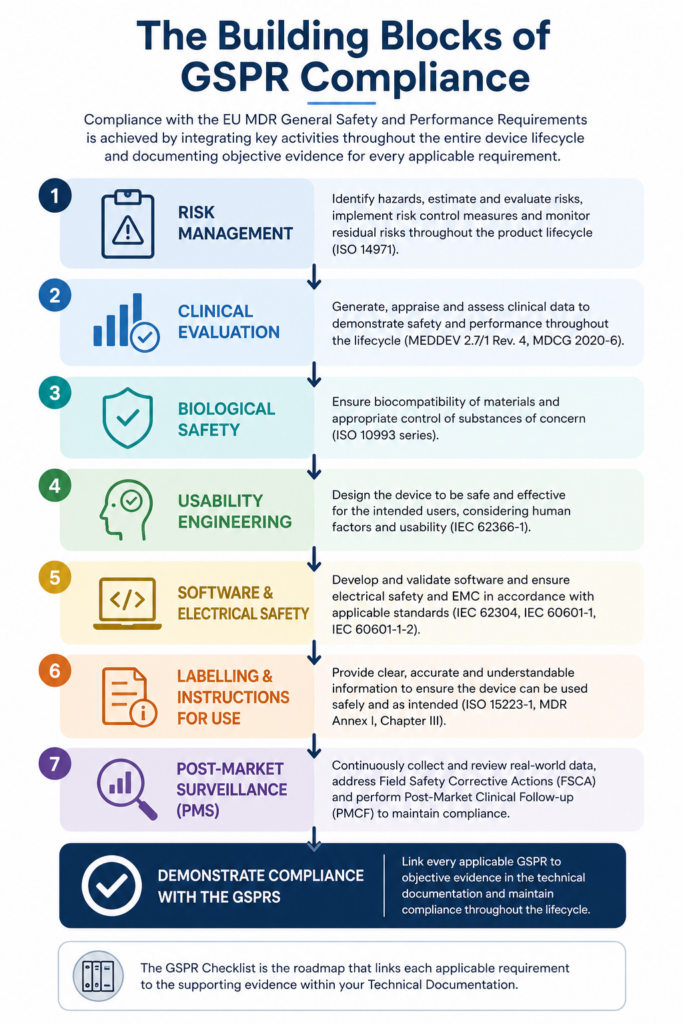
How the GSPRs Compare with the Previous Essential Requirements
| Area | Medical Device Directive (MDD) – Essential Requirements | EU MDR – General Safety and Performance Requirements (GSPRs) |
|---|---|---|
| Regulatory Framework | Medical Device Directive 93/42/EEC | Regulation (EU) 2017/745 |
| Primary Focus | Basic safety and essential performance | Comprehensive safety, clinical performance and lifecycle compliance |
| Risk Management | General requirement | Continuous risk management throughout the entire product lifecycle, typically following ISO 14971 |
| Clinical Evidence | Clinical evaluation required, with less prescriptive expectations | Robust clinical evaluation and ongoing clinical evidence expected throughout the device lifecycle |
| Biological Safety | Addressed where applicable | Greater emphasis on biocompatibility, hazardous substances and chemical safety |
| Usability | Limited requirements | Human factors and usability engineering are expected, particularly for higher-risk devices |
| Software | Minimal coverage | Specific expectations for software validation, cybersecurity and software lifecycle processes |
| Post-Market Activities | Limited post-market requirements | Integrated with Post-Market Surveillance (PMS), Post-Market Clinical Follow-up (PMCF) and vigilance activities |
| Technical Documentation | Less prescriptive | Extensive technical documentation demonstrating objective evidence for every applicable GSPR |
| Conformity Assessment | Essential Requirements Checklist | GSPR Checklist linking each applicable requirement to supporting evidence within the technical documentation |
Key Takeaway
Although the GSPRs replaced the Essential Requirements under the Medical Device Directive, they are far more than a simple update. The EU MDR introduces a lifecycle-based approach to compliance, requiring manufacturers to demonstrate not only that their device is safe and performs as intended before CE marking, but that compliance is maintained through ongoing risk management, clinical evaluation and post-market surveillance activities. As a result, the GSPR Checklist has become one of the most important documents within the technical file, providing a clear link between each applicable Annex I requirement and the evidence demonstrating conformity.
Key Features of the GSPRs
1. Safety and Performance
Every medical device must achieve its intended purpose while ensuring that risks are minimized. The GSPRs emphasize the importance of risk-benefit analysis and require manufacturers to demonstrate compliance with robust evidence.
2. Risk Management
Manufacturers must implement a risk management system, typically aligned with ISO 14971. This involves identifying hazards, estimating and evaluating risks, controlling risks, and monitoring residual risks throughout the product lifecycle.
3. Biological Safety
Devices that come into contact with the human body must ensure biocompatibility. This includes avoiding toxic, harmful, or sensitizing substances unless justified and mitigated.
4. Chemical and Physical Properties
GSPRs highlight the need for devices to be free from unacceptable levels of contaminants and residues. For example, phthalates and carcinogenic substances must be minimized, and their use must be justified if present.
5. Sterility and Microbial Safety
For sterile devices, manufacturers must validate their sterilization processes and ensure sterility is maintained throughout the device’s shelf life.
6. Information for Users
Labels, packaging, and instructions for use must be clear, understandable, and designed with the intended user in mind. Multilingual documentation is often required to meet the diverse needs of the EU market.
How to Demonstrate Compliance with the GSPRs
Demonstrating compliance with the General Safety and Performance Requirements (GSPRs) is one of the most important aspects of preparing technical documentation under the EU MDR. Rather than simply confirming that a device meets Annex I, manufacturers must provide objective evidence showing how each applicable requirement has been addressed throughout the design, development, verification and post-market lifecycle of the device.
A well-prepared GSPR Checklist acts as a roadmap for both the manufacturer and the Notified Body, linking each applicable requirement to the supporting evidence contained within the technical documentation.
Step 1 – Determine Which GSPRs Apply
Not every requirement within Annex I applies to every medical device. Manufacturers should assess each GSPR individually, considering the device’s:
- Intended purpose
- Classification
- Design and construction
- Materials of manufacture
- Sterile or non-sterile status
- Active or non-active functionality
- Software components
- Clinical application
Where a requirement is not applicable, this should be clearly identified within the GSPR Checklist together with a documented justification explaining why it does not apply.
Step 2 – Link Each Requirement to Objective Evidence
For every applicable GSPR, manufacturers should reference the evidence demonstrating compliance. Rather than repeating information, the checklist should point directly to the relevant documents within the technical file.
Typical evidence includes:
- Risk Management File (ISO 14971)
- Clinical Evaluation Report (CER)
- Biological Evaluation Report (ISO 10993)
- Verification and validation testing
- Electrical safety and EMC testing
- Sterilisation validation
- Software lifecycle documentation (IEC 62304)
- Usability Engineering File (IEC 62366-1)
- Labelling and Instructions for Use
- Post-Market Surveillance documentation
This approach allows auditors and Notified Bodies to quickly verify that every applicable requirement has been addressed.
Step 3 – Reference Applicable Standards
Although harmonised standards are generally voluntary, applying recognised international standards provides strong evidence that the relevant GSPRs have been satisfied.
Common examples include:
- ISO 14971 – Risk Management
- ISO 13485 – Quality Management Systems
- ISO 10993 – Biological Evaluation
- IEC 62366-1 – Usability Engineering
- IEC 62304 – Medical Device Software Lifecycle
- ISO 15223-1 – Medical Device Symbols
Where alternative methods are used, manufacturers should document and justify how an equivalent level of safety and performance has been achieved.
Step 4 – Maintain the GSPR Checklist Throughout the Device Lifecycle
GSPR compliance is not a one-time exercise completed before CE marking. The checklist should be reviewed whenever significant changes are made to the device or when new evidence becomes available through activities such as:
- Design changes
- Software updates
- Clinical Evaluation updates
- Risk Management reviews
- Post-Market Surveillance
- Post-Market Clinical Follow-up (PMCF)
- Changes to applicable standards or regulatory requirements
Keeping the checklist up to date helps demonstrate continued compliance throughout the entire lifecycle of the medical device.
Practical Example
A manufacturer developing a reusable surgical instrument may determine that Annex I requirements relating to biological safety, cleaning, sterilisation, labelling and risk management are applicable. Their GSPR Checklist would reference the Biological Evaluation Report, sterilisation validation reports, Risk Management File, Instructions for Use and verification testing within the technical documentation, providing clear evidence of compliance for each applicable requirement.
Need Help Demonstrating GSPR Compliance?
This article explains what the General Safety and Performance Requirements (GSPRs) are. If you're looking for practical guidance on completing a GSPR Checklist, linking Annex I requirements to technical documentation and demonstrating compliance with Regulation (EU) 2017/745, explore our Complete EU MDR GSPRs Guide.
Why GSPRs Matter for Medical Device Manufacturers
The General Safety and Performance Requirements (GSPRs) are not just regulatory obligations; they are essential for safeguarding public health and maintaining the integrity of the medical device industry.
Consequences of Non-Compliance
Failure to meet GSPR requirements can lead to severe repercussions, including:
Market Withdrawal: Devices that fail to meet the GSPRs may be recalled or prohibited from being sold in the EU.
Financial Penalties: Manufacturers can face significant fines, impacting their profitability and market standing.
Reputational Damage: Non-compliance erodes trust among healthcare professionals, patients, and regulatory authorities, making it harder to establish credibility in the market.
Benefits of Compliance
Conversely, adhering to the GSPRs offers numerous advantages:
Market Access: Compliance is a prerequisite for obtaining the CE marking, which allows devices to be marketed across the EU.
Enhanced Patient Safety: Meeting these rigorous standards ensures that devices are both safe and effective, reducing the risk of adverse events.
Competitive Advantage: A compliant device demonstrates a manufacturer’s commitment to quality, which can differentiate it in a crowded market.
Innovation Opportunity: By aligning with GSPRs, manufacturers are encouraged to adopt advanced technologies and improve their design and manufacturing processes.
Role in Building Trust
Healthcare professionals and patients rely on the assurance that medical devices meet the highest standards of safety and performance. GSPR compliance not only fulfills legal requirements but also builds a foundation of trust, fostering long-term relationships with stakeholders and promoting brand loyalty.
By proactively addressing the GSPRs, manufacturers can turn regulatory challenges into strategic opportunities, ensuring both compliance and business success.
How Patient Guard Can Help
At Patient Guard, we specialize in helping medical device manufacturers navigate the complexities of the EU MDR, including GSPR compliance. Our team provides tailored support, from gap analyses and technical documentation development to Notified Body liaison. Whether you are new to the EU market or updating your device for MDR compliance, we are here to guide you every step of the way.
EU MDR GSPR Frequently Asked Questions
The General Safety and Performance Requirements (GSPRs) are the safety, performance, design, manufacturing and information requirements set out in Annex I of Regulation (EU) 2017/745. Medical device manufacturers must demonstrate that their devices comply with every applicable GSPR before placing them on the EU market.
The GSPRs replaced the Essential Requirements contained within the former Medical Device Directive 93/42/EEC. While both frameworks address device safety and performance, the EU MDR introduces more detailed requirements relating to lifecycle risk management, clinical evidence, usability, software, post-market surveillance, hazardous substances and information supplied with the device.
Yes. All devices placed on the EU market under the MDR must comply with the GSPRs that are applicable to their intended purpose, design and characteristics. However, not every individual requirement will apply to every device. Any requirement identified as not applicable should be supported by a clear and device-specific justification.
A GSPR Checklist is a controlled document that lists each requirement within Annex I and records whether it applies to the device. For every applicable requirement, the checklist should identify the standards, test reports, procedures and technical documentation that provide objective evidence of compliance.
Evidence may include the Risk Management File, Clinical Evaluation Report, Biological Evaluation Report, verification and validation test reports, sterilisation validation, electrical safety and EMC testing, software lifecycle documentation, usability engineering records, labelling, Instructions for Use and post-market surveillance documentation. The evidence required will depend on the device and the applicable GSPR.
Harmonised standards are generally voluntary. However, applying a harmonised standard whose reference has been published in the Official Journal of the European Union may provide a presumption of conformity with the relevant requirements covered by that standard. Manufacturers using an alternative method should document how it provides an equivalent level of safety and performance.
For devices requiring Notified Body involvement, the Notified Body reviews the manufacturer’s technical documentation and conformity assessment evidence. This includes assessing whether the applicable GSPRs have been identified correctly and whether sufficient objective evidence has been provided to demonstrate compliance. Class I devices that are not sterile, measuring or reusable surgical instruments are generally self-declared by the manufacturer and do not require routine Notified Body assessment.
The GSPR Checklist should be reviewed throughout the device lifecycle rather than treated as a one-time CE-marking document. Updates may be required following design changes, software updates, changes to the intended purpose, revised standards, new risk information, clinical evaluation updates or findings from post-market surveillance and vigilance activities.
Summary
Understanding and implementing the GSPRs is essential for any manufacturer aiming to place medical devices on the EU market. With a structured approach and expert guidance, compliance becomes achievable. If you need support with your EU MDR journey, contact Patient Guard today and let us help you achieve regulatory success.
References
This guide is based on the following legislation, international standards and official regulatory guidance relating to demonstrating compliance with the General Safety and Performance Requirements (GSPRs) under Regulation (EU) 2017/745.
| Organisation | Reference | Why it's relevant |
|---|---|---|
| European Union | Regulation (EU) 2017/745 on Medical Devices (MDR) | Contains Annex I, which establishes the General Safety and Performance Requirements (GSPRs) that manufacturers must demonstrate compliance with before placing a medical device on the European market. |
| European Commission | MDCG Endorsed Documents and Other Guidance | Provides official Medical Device Coordination Group (MDCG) guidance supporting implementation of the GSPRs, technical documentation, clinical evaluation, post-market surveillance and conformity assessment. |
| European Commission | Notified Bodies for Medical Devices | Provides official information on the role and responsibilities of Notified Bodies responsible for assessing technical documentation and verifying compliance with the General Safety and Performance Requirements. |
| International Organization for Standardization (ISO) | ISO 13485:2016 – Medical Devices – Quality Management Systems – Requirements for Regulatory Purposes | Defines the internationally recognised Quality Management System requirements that support manufacturers in creating, maintaining and controlling the documentation needed to demonstrate GSPR compliance. |
| International Organization for Standardization (ISO) | ISO 14971:2019 – Medical Devices – Application of Risk Management to Medical Devices | Provides the internationally recognised framework for risk management, supporting the identification, evaluation and control of risks that underpin compliance with many Annex I General Safety and Performance Requirements. |
Demonstrating compliance with the General Safety and Performance Requirements requires objective evidence that is maintained throughout the product lifecycle. Manufacturers should always consult the latest published legislation, recognised standards and official guidance when preparing and maintaining GSPR Checklists and supporting technical documentation.

David Small BSc (Hons), MSc, MTOPRA
Reviewed by
David Small, BSc (Hons), MSc, MTOPRA
Founder & CEO |
20+ years in medical device regulatory affairs, MDR/IVDR compliance and quality systems.
Patient Guards Recent Posts
FDA Medical Device Classification: Class I, Class II and Class III Explained
Does your medical device require FDA 510(k) clearance? This step-by-step guide explains the 510(k) process, substantial equivalence, predicate devices, testing, eSTAR submissions, FDA review and what manufacturers need to do after clearance.

FDA 510(k) Clearance: A Step-by-Step Guide for Medical Device Manufacturers
Does your medical device require FDA 510(k) clearance? This step-by-step guide explains the 510(k) process, substantial equivalence, predicate devices, testing, eSTAR submissions, FDA review and what manufacturers need to do after clearance.

FDA Medical Device Regulations: A Complete Guide for Manufacturers
Planning to place a medical device on the US market? This complete guide explains FDA medical device regulations, including device classification, 510(k), De Novo and PMA pathways, QMSR and ISO 13485, establishment registration, device listing, U.S. Agent requirements, UDI and post-market obligations.
Patient Guards Related Services
Patient Guards Regulatory Tools
Need Training?
Do you need training on Quality Management Systems or EU MDR/ EU IVDR? then check out our training courses.
 Posted on Google
 Nafiul Shelim21 days ago
Trustindex verifies that the original source of the review is Google.
I worked with Eleanor Shackleton, from Patient Guard, for the purpose of MDR, CE and UKCA marking. Her diligence, and knowledge in clinical and regulatory requirements for medical device software was critical for us. Would highly recommendPosted on Google Jay Verma46 days agoI found Patient Guard Ltd to be an exceptional partner. Their assessment was thorough, their guidance clear, and their support instrumental in helping us achieve our objectives. Steve and Ellie, in particular, were outstanding in steering us through the MHRA Class I medical device registration process.Posted on Google
 Munna P99 days agoWorking with the Patient Guard team has been a great experience throughout our MHRA and ISO 13485 documentation journey. Their expertise, structured approach, and practical guidance helped our team build a robust quality management system while keeping us aligned with regulatory expectations. The collaboration was professional, responsive, and focused on finding solutions rather than simply identifying issues. A special thank you to Alex and Steve for their outstanding coordination, responsiveness, and continuous support throughout the project. They were always approachable, provided valuable feedback, and worked closely with our team to resolve challenges efficiently. Their commitment made a significant difference in keeping our documentation effort on track. I highly recommend Patient Guard to any healthcare or MedTech organization looking for experienced regulatory and quality system partners for MHRA, ISO 13485, and broader medical device compliance initiatives. Thank you again to the entire Patient Guard team for being such reliable partners.Posted on Google
 Peter Reeve126 days agoSTEPPER design, manufacture & distribute eyewear across the globe. With the increasingly complex landscape concerning the placing of Mecial Devices onto the market, we realised we needed professional guidance. We found Patient Guard via a simple internet search and are delighted we did! They provide a pragmatic solution to our needs, are totally reliable & always available to answer our (often simplistic) questions. They are highly efficient & responsive to what is a changing picture in our world and nothing is too much trouble. We have a much better understanding of regulatory affairs and our responsibilities as manufacturers & distributors and they support us in navigating the requirements in different territories. Updating our Declaration of Conformity, ensuring our labelling is compliant and acting as our PRRC are the key areas of their service for us.Posted on Google
 Derek Timm126 days agoFor those companıes lookıng to comply to ISO standards and ın partıcular ISO13485 whıch to be honest ıs a nıghtmare I would strongly suggest goıng to the professıonals as ındeed we dıd by joınıng forces wıth Patıent Guard Ltd The staff are fantastıc nothıng ıs too much trouble and as a medıcal supply company we sımply cannot lıve wıthout them Thanks ın partıcular to Alex and Steve for all the hard work and our best regards from Dan Medıca South LımıtedPosted on Google
 BMSCriticalCare163 days agoGreat service, very helpful and always willing to answer any questions we have,Posted on Google
 Thomson Software834 days agoAlex Lewis of PatientGuard guided us through the ISO13485 process in a thorough, systematic and efficient manner. He was friendly, patient and willing to go the extra mile. Excellent service.Posted on Google
 Hannah Maddison937 days agoFantastic, knowledgeable team that are always there to help. My appointments have always been booked in very promptly and have always ended with all my queries resolved. I have found the team very flexible and their breadth of knowledge is second to none. Patient Guard are without doubt my go-to for all the regulatory aspects of my medical device role.Posted on Google
 Richard Crow972 days agoPatientguard are an excellent source of Medical regulatory compliance advice, we have taken advantage of their various services from their EU Rep service, to helping with Technical Files all the way through to using their ISO Templates to implement our ISO 13485 system.Posted on Google
 George Kitching975 days agoDavid Small and PatientGuard have been extremely helpful and supportive in assisting us with producing and updating our Technical File and Appendices for MDR certification.Verified by TrustindexTrustindex verified badge is the Universal Symbol of Trust. Only the greatest companies can get the verified badge who has a review score above 4.5, based on customer reviews over the past 12 months. Read more