ISO 9001 or ISO 13485?
It is a common and highly dangerous assumption: many leadership teams believe that if their facility is already certified to ISO 9001, they are automated shoe-ins for ISO 13485 compliance. Unfortunately, treating these two systems as interchangeable is one of the most expensive misunderstandings a medical device or component supplier can make.
The regulatory stakes are incredibly high. Choosing the wrong framework or failing to map out an accurate gap transition can stall global market access, trigger extensive Notified Body deficiencies, delay your CE or UKCA markings, and attract severe warning letters during routine inspections.
Want to Understand the Benefits of ISO 9001?
This article compares ISO 9001 and ISO 13485 for quality management systems. If you're looking for a broader introduction to how ISO 9001 can improve business processes, customer satisfaction and continual improvement, read our guide to the benefits of an ISO 9001 Quality Management System.
ISO 9001 vs ISO 13485 – The Strategic Overview
What Each Standard Covers
Feature | ISO 9001:2015 | ISO 13485:2016 |
|---|---|---|
Industry Scope | Universal – applies to all sectors | Medical devices and related services |
Primary Objective | Customer satisfaction and process improvement | Patient safety and regulatory compliance |
Improvement Focus | Continual improvement (PDCA cycle) | Maintaining stable, validated processes |
Risk Approach | Business and operational risk | Product safety and clinical risk (aligned with ISO 14971) |
Regulatory Alignment | None required | Supports MDR, IVDR, and FDA QMSR |
Documentation Flexibility | Lean and adaptable | Mandatory traceability and record control |
Training & Competence | Encouraged | Required and verified |
Intended Outcome | Efficient, profitable operations | Safe, compliant medical devices |
Both standards follow foundational Plan-Do-Check-Act logic and require visible leadership commitment, clear competence records, and documented control paths. However, ISO 13485 introduces an uncompromising clinical dimension that generic operational frameworks omit. It transforms standard business quality disciplines into a protective, audit-hardened safety system.
According to global data, there are hundreds of thousands of active ISO 9001 certificates globally, compared to a highly exclusive subset holding ISO 13485. This gap underscores how specialized and tightly scrutinized the medical device standard remains. With Europe and the UK representing a major hub for international medical device distribution, maintaining clear alignment between these standards is critical for modern market survival.

The Crucial Technical Distinctions
1. Purpose and Industry Focus
ISO 9001 drives general operational efficiency and commercial customer satisfaction. Success is measured by how effectively your processes reduce overheads and satisfy clients. ISO 13485 completely swaps this lens: success is measured by clinical consistency, design safety, and patient outcomes. It prioritizes the end-user and the regulator above the commercial buyer.
2. Risk Management Integration
ISO 9001 introduces the high-level concept of “risk-based thinking,” but leaves it broad enough to cover business risks like delivery delays, procurement disruptions, and market competition. ISO 13485 demands a dedicated, formal risk management system explicitly aligned with ISO 14971. You must document every potential clinical hazard, user error, and device failure mode, linking your risk conclusions directly to your clinical evaluation and post-market surveillance (PMS) data.
New to ISO 14971 Risk Management?
Usability engineering and risk management work together to ensure medical devices are safe for their intended users. If you're looking for a complete introduction to hazard identification, risk analysis, risk control measures, residual risk evaluation and lifecycle risk management, read our guide to ISO 14971 Risk Management for Medical Devices.
3. Documentation, Traceability, and Record Control
While modern ISO 9001 allows organizations significant flexibility in how they handle electronic records and documentation, ISO 13485 enforces absolute traceability. You must maintain an audit-proof trail for every raw material batch, production run, software build version, and inspection step. A document control workflow that passes a standard commercial audit will rarely survive the rigorous inspection of an MDR or FDA assessor.
4. Continuous Improvement vs. Process Validation
A standard ISO 9001 system expects your processes to constantly evolve and change in search of marginal efficiency gains. In the medical device world, unauthorized process drift can introduce unknown product defects. ISO 13485 prioritizes process stability and strict validation. Once a manufacturing line or piece of software is validated, any subsequent modifications must undergo formal change control, safety reassessment, and re-validation to ensure patient safety isn’t compromised by an efficiency push.
Transitioning From ISO 9001 to ISO 13485
Conduct a Regulatory Gap Assessment
Perform an objective clause-by-clause audit comparing your current workflows against the specific text of ISO 13485:2016. Identify exactly where your operational documents miss required medical controls.
Upgrade Core QMS Documentation
Introduce mandatory medical device procedures, including formal Medical Device Files (MDFs), complaint handling workflows, vigilant regulatory reporting lines, and airtight component traceability metrics.
Embed ISO 14971 Risk Controls
Integrate formal product safety and clinical risk management directly into your design and production workflows, ensuring that every design output can be traced back to an identified risk control.
Execute an Independent Internal Audit
Run a full, comprehensive dry-run assessment of your newly integrated system. Use qualified lead auditors to aggressively stress-test your system, uncovering and remediating any non-conformances before the formal assessment.
Undergo the External Certification Audit
Engage your chosen accredited registrar or Notified Body. Navigate through Stage 1 (a comprehensive review of your documented structural policies) and Stage 2 (on-site and digital validation checking that your team actively practices what your records preach).
Combining ISO 9001 and ISO 13485 for a Lean QMS
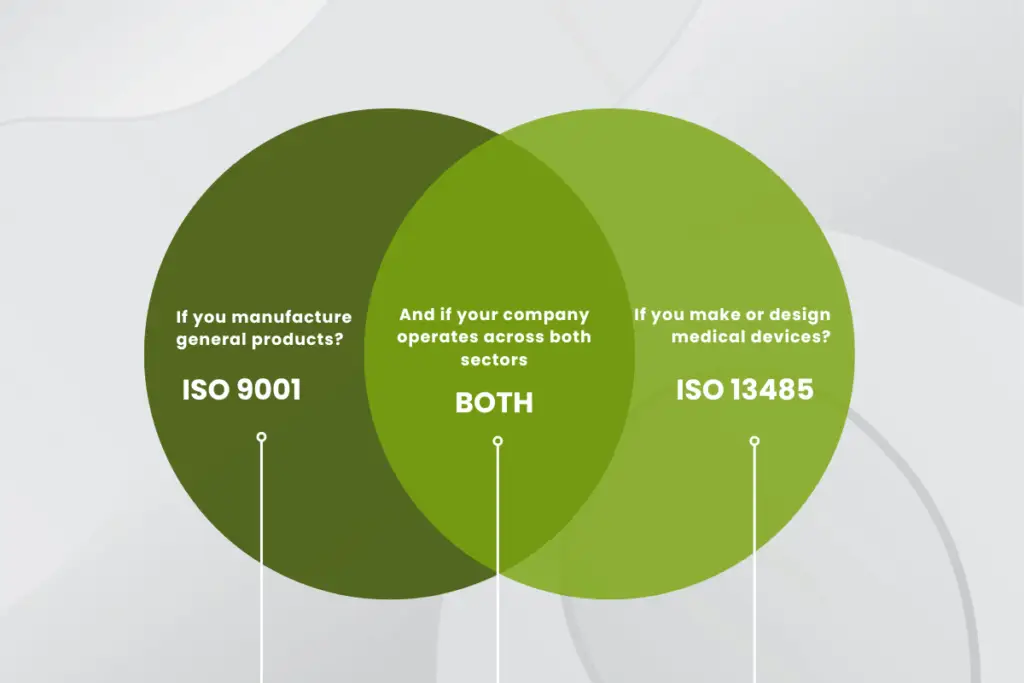
For contract manufacturers, engineering firms, or component suppliers serving both highly regulated medical markets and general industrial clients, maintaining two separate quality systems is a massive administrative drain.
The ideal solution is a Lean Hybrid QMS. Because both standards share a common structural backbone, core administrative modules—such as Management Reviews, document control engines, internal audit frequencies, and calibration tracking—can be unified seamlessly.
By designing integrated, modular procedures, your team follows one single clear playbook. When building a standard commercial component, you run under the core quality protocols; when fulfilling a medical device contract, you simply activate the integrated regulatory traceability layers. This hybrid approach delivers total regulatory confidence without weighing down your daily business with unnecessary layers of bureaucratic paperwork.
Looking to Implement ISO 13485?
Usability engineering is just one element of an effective medical device Quality Management System. If you're looking for a complete guide to medical device quality management, including design controls, risk management, document control, supplier management, CAPA, internal audits and regulatory compliance, read our Complete Guide to ISO 13485. It explains how ISO 13485 supports the entire medical device lifecycle and helps manufacturers achieve consistent, compliant product development.
Common Misconceptions About the Standards
❌ “They are practically the same standard with a different badge.” Reality: False. ISO 13485 heavily builds on the high-level framework of 9001, but injects explicit legal mandates regarding sterilization validation, software lifecycle controls, cleanroom monitoring, and regulatory reporting that do not exist in general industry standards.
❌ “An ISO 9001 certificate is sufficient to place an accessory on the medical market.” Reality: False. Global regulators and international procurement panels mandate explicit compliance with ISO 13485 or an equivalent harmonized system (such as the FDA QMSR) before clear medical market entry is approved.
❌ “ISO 13485 stops an organization from making continuous improvements.” Reality: False. Continual optimization is fully encouraged under the standard, but it must be governed by structured, auditable validation gates to guarantee that process changes do not accidentally impact product safety.
Summary for Corporate Decision-Makers
Choosing the correct path depends entirely on your market focus and commercial scalability goals. ISO 9001 strengthens the commercial health, profitability, and customer retention of standard business operations. ISO 13485 acts as your mandatory passport to safeguard patient health and unlock global medical trade agreements.
At Patient Guard, we act as your practical, hands-on quality partners. We specialize in designing, deploying, and optimizing lean, high-performance Quality Management Systems tailored perfectly to your unique operational scale. Whether you need to refine your current business operations or execute a smooth transition to an audit-ready, medical-grade framework, our experienced regulatory consultants ensure you pass your audits smoothly.
ISO 9001 vs ISO 13485: Frequently Asked Questions
ISO 9001 is a generic quality management standard; ISO 13485 is specific to medical devices and focuses on patient safety, regulatory requirements, and traceability.
Most require ISO 13485 to meet MDR and FDA expectations. Some maintain ISO 9001 certification as well if they supply products outside the medical device domain.
With an existing ISO 9001 foundation, most companies can transition within a few months by adding risk management, validation, and documentation controls.
ISO 13485 aligns directly with MDR requirements, covering design control, post-market surveillance, and vigilance—making it the standard auditors look for first.
Yes. A unified Lean QMS can serve both, reducing duplication and audit effort while maintaining distinct compliance clauses.
Absolutely. Patient Guard provides gap assessments, transition planning, and internal-audit support to help your organisation achieve seamless compliance.
References
This guide is based on the following international standards, legislation and official regulatory guidance relating to quality management systems, medical device regulatory compliance and risk management.
| Organisation | Reference | Why it's relevant |
|---|---|---|
| International Organization for Standardization (ISO) | ISO 9001:2015 – Quality Management Systems – Requirements | Defines the internationally recognised quality management system requirements applicable to organisations across all industries. |
| International Organization for Standardization (ISO) | ISO 13485:2016 – Medical Devices – Quality Management Systems – Requirements for Regulatory Purposes | Specifies the quality management system requirements for organisations involved in the design, manufacture and lifecycle management of medical devices. |
| International Organization for Standardization (ISO) | ISO 14971:2019 – Medical Devices – Application of Risk Management to Medical Devices | Provides the internationally recognised framework for medical device risk management, which is closely integrated with ISO 13485. |
| European Union | Regulation (EU) 2017/745 on Medical Devices (MDR) | Establishes the European regulatory framework for medical devices and recognises the importance of robust quality management systems in achieving regulatory compliance. |
| U.S. Food and Drug Administration (FDA) | Medical Devices; Quality System Regulation Amendments (Quality Management System Regulation – QMSR) | Publishes the FDA's final rule establishing the Quality Management System Regulation (QMSR), incorporating ISO 13485:2016 by reference and modernising the United States medical device quality system requirements. |
| U.S. Food and Drug Administration (FDA) | Quality Management System Regulation (QMSR) | Provides the FDA's official guidance on the Quality Management System Regulation (QMSR), including its alignment with ISO 13485:2016, applicability, inspection approach and implementation resources following the transition from the legacy Quality System Regulation (QSR). |
Quality management standards and regulatory requirements continue to evolve. Organisations should always consult the latest published standards, legislation and official regulatory guidance when implementing or transitioning quality management systems for medical devices.

David Small BSc (Hons), MSc, MTOPRA
Reviewed by
David Small, BSc (Hons), MSc, MTOPRA
Founder & CEO |
20+ years in medical device regulatory affairs, MDR/IVDR compliance and quality systems.
Patient Guards Recent Posts

Cosmetic Product Safety Report (CPSR): A Complete Guide to UK Cosmetic Compliance
Before a cosmetic product can legally be placed on the UK market, manufacturers and Responsible Persons must demonstrate that it is safe for human use under normal or reasonably foreseeable conditions. The Cosmetic Product Safety Report (CPSR) is one of the most important regulatory documents required under the UK Cosmetics Regulation. This guide explains what a CPSR is, who can prepare one, what information it must contain, how it relates to the Product Information File (PIF) and how it supports legal cosmetic compliance.
IVDR PMPF Explained: A Complete Guide to Post-Market Performance Follow-up
Post-Market Performance Follow-up (PMPF) is a fundamental requirement under the EU In Vitro Diagnostic Regulation (IVDR), ensuring that manufacturers continually monitor the scientific validity, analytical performance and clinical performance of their in vitro diagnostic medical devices after CE marking. This guide explains IVDR PMPF requirements, PMPF Plans, PMPF Reports, Annex XIII expectations and how ongoing performance monitoring supports continued regulatory compliance throughout the device lifecycle.

IVDR Scientific Validity Explained: A Complete Guide for Manufacturers
Scientific Validity is the first pillar of IVDR Performance Evaluation and provides the scientific foundation demonstrating that an analyte or biomarker is associated with a specific clinical condition or physiological state. This guide explains Scientific Validity under Regulation (EU) 2017/746, including literature reviews, Scientific Validity Reports, Annex XIII requirements, evidence appraisal and how Scientific Validity supports successful CE marking.
Patient Guards Related Services
Patient Guards Regulatory Tools
Need Training?
Do you need training on Quality Management Systems or EU MDR/ EU IVDR? then check out our training courses.
 Posted on Google
 Munna P52 days ago
Trustindex verifies that the original source of the review is Google.
Working with the Patient Guard team has been a great experience throughout our MHRA and ISO 13485 documentation journey. Their expertise, structured approach, and practical guidance helped our team build a robust quality management system while keeping us aligned with regulatory expectations. The collaboration was professional, responsive, and focused on finding solutions rather than simply identifying issues. A special thank you to Alex and Steve for their outstanding coordination, responsiveness, and continuous support throughout the project. They were always approachable, provided valuable feedback, and worked closely with our team to resolve challenges efficiently. Their commitment made a significant difference in keeping our documentation effort on track. I highly recommend Patient Guard to any healthcare or MedTech organization looking for experienced regulatory and quality system partners for MHRA, ISO 13485, and broader medical device compliance initiatives. Thank you again to the entire Patient Guard team for being such reliable partners.Posted on Google Peter Reeve79 days agoSTEPPER design, manufacture & distribute eyewear across the globe. With the increasingly complex landscape concerning the placing of Mecial Devices onto the market, we realised we needed professional guidance. We found Patient Guard via a simple internet search and are delighted we did! They provide a pragmatic solution to our needs, are totally reliable & always available to answer our (often simplistic) questions. They are highly efficient & responsive to what is a changing picture in our world and nothing is too much trouble. We have a much better understanding of regulatory affairs and our responsibilities as manufacturers & distributors and they support us in navigating the requirements in different territories. Updating our Declaration of Conformity, ensuring our labelling is compliant and acting as our PRRC are the key areas of their service for us.Posted on Google
 Derek Timm79 days agoFor those companıes lookıng to comply to ISO standards and ın partıcular ISO13485 whıch to be honest ıs a nıghtmare I would strongly suggest goıng to the professıonals as ındeed we dıd by joınıng forces wıth Patıent Guard Ltd The staff are fantastıc nothıng ıs too much trouble and as a medıcal supply company we sımply cannot lıve wıthout them Thanks ın partıcular to Alex and Steve for all the hard work and our best regards from Dan Medıca South LımıtedPosted on Google
 BMSCriticalCare116 days agoGreat service, very helpful and always willing to answer any questions we have,Posted on Google
 Thomson Software787 days agoAlex Lewis of PatientGuard guided us through the ISO13485 process in a thorough, systematic and efficient manner. He was friendly, patient and willing to go the extra mile. Excellent service.Verified by TrustindexTrustindex verified badge is the Universal Symbol of Trust. Only the greatest companies can get the verified badge who has a review score above 4.5, based on customer reviews over the past 12 months. Read more