

Updated 16th June 2026

What is a Medical Device Regulatory Strategy?
A medical device regulatory strategy is a structured plan that outlines how a product will achieve compliance with applicable regulations and obtain market approval.
The strategy should address:
- Intended purpose and claims
- Medical device classification
- Target markets
- Clinical evidence requirements
- Quality management systems
- Technical documentation requirements
- Post-market surveillance obligations
- Regulatory submission pathways
Developing a regulatory strategy early helps startups make informed business decisions and reduce regulatory risks throughout the product lifecycle.
Why Startups Should Consider Regulatory Requirements Early
Many startups delay regulatory planning until product development is nearly complete. This often results in costly redesigns and delayed market entry.
Early regulatory planning provides several benefits:
- Faster route to market
- Reduced development costs
- Improved investor confidence
- Better risk management
- Stronger product design decisions
- Easier regulatory submissions
Investors increasingly expect startups to demonstrate a clear understanding of their regulatory pathway before committing significant funding.
Step 1: Determine Whether Your Product is a Medical Device
Before developing a regulatory strategy, you must establish whether your product meets the legal definition of a medical device.
Products may be regulated as medical devices if they are intended for:
- Diagnosis of disease
- Prevention of disease
- Monitoring of disease
- Treatment of disease
- Alleviation of injury or disability
Software, mobile applications, artificial intelligence systems and digital health technologies may also qualify as medical devices.
If your product falls within the scope of medical device regulations, a regulatory strategy should be developed immediately.
Step 2: Determine Medical Device Classification
Medical device classification is one of the most important decisions for any startup.
Classification affects:
- Regulatory pathway
- Clinical evidence requirements
- Notified Body involvement
- Development costs
- Approval timelines
Under the EU MDR and UK MDR, devices are generally classified as:
- Class I
- Class IIa
- Class IIb
- Class III
Higher-risk devices require greater levels of regulatory scrutiny and supporting evidence.
For software medical devices, special classification rules such as MDR Rule 11 may apply.
Step 3: Identify Your Target Markets
Regulatory requirements differ significantly between regions.
Common startup target markets include:
United Kingdom
Requirements may include:
European Union
Requirements include:
- CE marking
- EU MDR compliance
- EU Authorised Representative
- Notified Body assessment where required
United States
Requirements may include:
- FDA registration
- 510(k) submissions
- De Novo pathway
- PMA applications
Selecting target markets early helps avoid unnecessary development work and reduces future compliance costs.
Step 4: Implement a Quality Management System
Most successful medical device startups implement a Quality Management System (QMS) during early development.
ISO 13485 is the internationally recognised standard for medical device quality management systems.
A QMS provides controls for:
- Design and development
- Risk management
- Supplier management
- Complaint handling
- Document control
- Corrective and preventive actions
Establishing a QMS early reduces compliance risks and supports future certification activities.
Step 5: Develop a Risk Management Process
Risk management is a fundamental requirement under both UK MDR and EU MDR.
Manufacturers are expected to identify:
- Hazards
- Foreseeable misuse
- Risks
- Risk control measures
- Residual risks
Risk management activities are generally conducted in accordance with ISO 14971.
A documented risk management process should be established before design activities progress too far.
Step 6: Plan Clinical Evidence Requirements
Clinical evidence is often underestimated by startups.
Depending on the device classification and intended purpose, manufacturers may need:
- Clinical evaluations
- Literature reviews
- Clinical investigations
- Post-market clinical follow-up (PMCF)
Clinical evidence requirements should be considered during the earliest stages of product development.
Failure to plan for clinical evidence can result in substantial delays later in the project.
Step 7: Prepare Technical Documentation
Technical documentation demonstrates compliance with regulatory requirements.
Typical documentation includes:
- Device description
- Intended purpose
- Risk management files
- Clinical evaluation reports
- Verification and validation data
- Labelling
- Instructions for use
Preparing documentation progressively throughout development is significantly easier than creating it retrospectively.
How Much Does Medical Device Regulatory Approval Cost?
Costs vary depending on:
- Device classification
- Regulatory markets
- Testing requirements
- Clinical evidence requirements
- Notified Body involvement
Approximate ranges:
| Device Type | Estimated Regulatory Costs |
|---|---|
| Class I | £5,000 – £25,000 |
| Class IIa | £20,000 – £100,000+ |
| Class IIb | £50,000 – £250,000+ |
| Class III | £100,000 – £1M+ |
These figures vary considerably depending on the complexity of the device.
Typical Regulatory Timelines for Startups
| Device Classification | Typical Timeframe |
|---|---|
| Class I | 3–12 months |
| Class IIa | 9–24 months |
| Class IIb | 12–36 months |
| Class III | 24–60 months |
Planning these timelines early can help startups manage investor expectations and funding requirements.
Common Regulatory Mistakes Made by Startups
Common issues include:
- Delaying regulatory planning
- Incorrect device classification
- Lack of a quality management system
- Poor risk management practices
- Inadequate clinical evidence
- Failure to understand target market requirements
- Underestimating costs and timelines
Avoiding these mistakes can significantly improve the likelihood of commercial success.
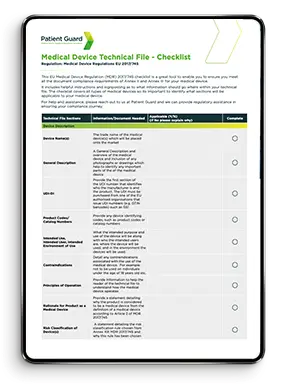
Medical Device Startup Regulatory Checklist
Before progressing to market approval, ensure you have:
- Determined medical device status
- Confirmed device classification
- Selected target markets
- Implemented a QMS
- Established risk management processes
- Planned clinical evidence activities
- Created technical documentation
- Developed a post-market strategy
Why Startups Choose Patient Guard
- Established since 2017
- Trusted by 500+ customers
- UK and EU presence
- Former MHRA expertise
- ISO 13485 certified organisation
How Patient Guard Can Help
Patient Guard supports medical device startups throughout the entire product lifecycle.
Our services include:
- Medical device classification
- Regulatory strategy development
- UK Responsible Person services
- EU Authorised Representative services
- ISO 13485 implementation
- Clinical evaluation
- CE Technical Files
- UKCA Technical Files
Whether you are developing a new medical device, software medical device, or in vitro diagnostic device, our regulatory specialists can help you develop a clear and efficient route to market.
Contact Patient Guard today to discuss your medical device startup and regulatory strategy requirements.
FAQs
Medical device startups should begin regulatory planning as early as possible, ideally during the concept or feasibility stage. Early regulatory planning helps determine whether a product is a medical device, identify the applicable classification, estimate development costs, and avoid costly redesigns later in the project. Establishing a regulatory strategy early can significantly reduce time to market and improve investor confidence.
While not every startup is legally required to be certified to ISO 13485 immediately, implementing a quality management system based on ISO 13485 is strongly recommended. A QMS helps control design and development activities, supports risk management, and prepares the company for future regulatory submissions, CE marking, UKCA marking, and market expansion.
The timeframe depends on the device classification, technology, and target market. Lower-risk Class I devices may reach the market within a few months, whereas Class IIa, IIb, and Class III devices can take several years due to additional testing, clinical evidence requirements, and Notified Body involvement. Developing a regulatory strategy early helps minimise delays and establish realistic project timelines.
One of the most common mistakes is leaving regulatory activities until late in the development process. Startups often focus on product development and funding while overlooking classification, clinical evidence, risk management, and quality management requirements. This can lead to significant delays, increased costs, and difficulties obtaining regulatory approval. A proactive regulatory strategy helps identify and address these requirements from the outset.
The cost of regulatory consulting for a medical device startup depends on several factors, including the device classification, target markets, technology complexity, and the level of support required. Early-stage startups may only need assistance with medical device determination and classification, while more advanced projects may require support with ISO 13485 implementation, risk management, clinical evaluation, technical documentation, and market approval activities. Investing in regulatory support early can help reduce development delays, avoid costly mistakes, and accelerate market access.
This FAQ is particularly useful because it targets commercial intent and often attracts founders who are actively evaluating regulatory support options.

David Small BSc (Hons), MSc, MTOPRA
Reviewed by
David Small, BSc (Hons), MSc, MTOPRA
Founder & CEO |
20+ years in medical device regulatory affairs, MDR/IVDR compliance and quality systems.
Patient Guards Recent Posts

Predetermined Change Control Plans (PCCPs): The Future of Agile Compliance for Medical Device Software
Learn how PCCPs help medical device software manufacturers manage updates, support AI systems, and enable agile compliance under evolving MDR and UKCA frameworks.

The AI Act Omnibus Explained: What the 2026 EU Rules Mean for Medical Device and IVD Manufacturers
Discover how the EU AI Act Omnibus affects AI medical devices and IVD manufacturers. Learn about the No Duplication principle, transparency rules, key 2026 and 2028 deadlines, and how MDR and IVDR compliance are converging with AI regulation.

Post-Deadline Reality Check: I’ve Submitted My IVDR Class C – Now What?
Submitted your IVDR Class C application? Learn what happens next, common causes of delays, review timelines, and why the September 2026 contract deadline is critical for maintaining EU market access.
Patient Guards Related Services
Patient Guards Regulatory Tools
Need Training?
Do you need training on Quality Management Systems or EU MDR/ EU IVDR? then check out our training courses.