Quality Management

V-58.-How-Changes-in-the-EU-MDR-Impact-Your-Supply-Chain-Agreements

How EU MDR Changes Impact Supply Chain Agreements

The EU MDR supply chain agreement revolution has caught many medical device companies off guard. What started as a regulatory update has evolved into a comprehensive overhaul of how suppliers, distributors, and manufacturers must collaborate. If your contracts still look like they were written during the Medical Devices Directive era, you’re playing regulatory Russian roulette.

How EU MDR Changes Impact Supply Chain Agreements Read More »

Medical Device Distributor Responsibilities Under the EU MDR

Understand the responsibilities of medical device distributors under the EU MDR, including verification checks, storage and transport controls, traceability, complaint handling, non-compliant devices and cooperation with manufacturers, importers and competent authorities.

Medical Device Distributor Responsibilities Under the EU MDR Read More »

CHOOSING-THE-RIGHT-PARTNER

How to Select a Compliant EU Authorised Representative or Importer

Selecting an EU Authorised Representative or Importer is one of the most important regulatory decisions a non-EU medical device manufacturer will make. These organisations play a key role in market access, regulatory communications and ongoing compliance, so choosing the right partner requires more than simply comparing prices.

This guide explains how to assess prospective Authorised Representatives and Importers, the questions you should ask before appointment, the warning signs to avoid and the evidence you should review before signing an agreement.

How to Select a Compliant EU Authorised Representative or Importer Read More »

MDR/IVDR Compliance Obligations for Importers & Distributors

Understanding Your Obligations Under MDR/IVDR

Under the EU Medical Device Regulation (MDR) and In Vitro Diagnostic Regulation (IVDR), compliance isn’t just the manufacturer’s responsibility. Importers, distributors, and suppliers are now considered economic operators — and that means you are legally liable for specific obligations. From verifying CE marking and language requirements to registering devices in EUDAMED and maintaining long-term traceability, your role in the supply chain is critical.

Understanding Your Obligations Under MDR/IVDR Read More »

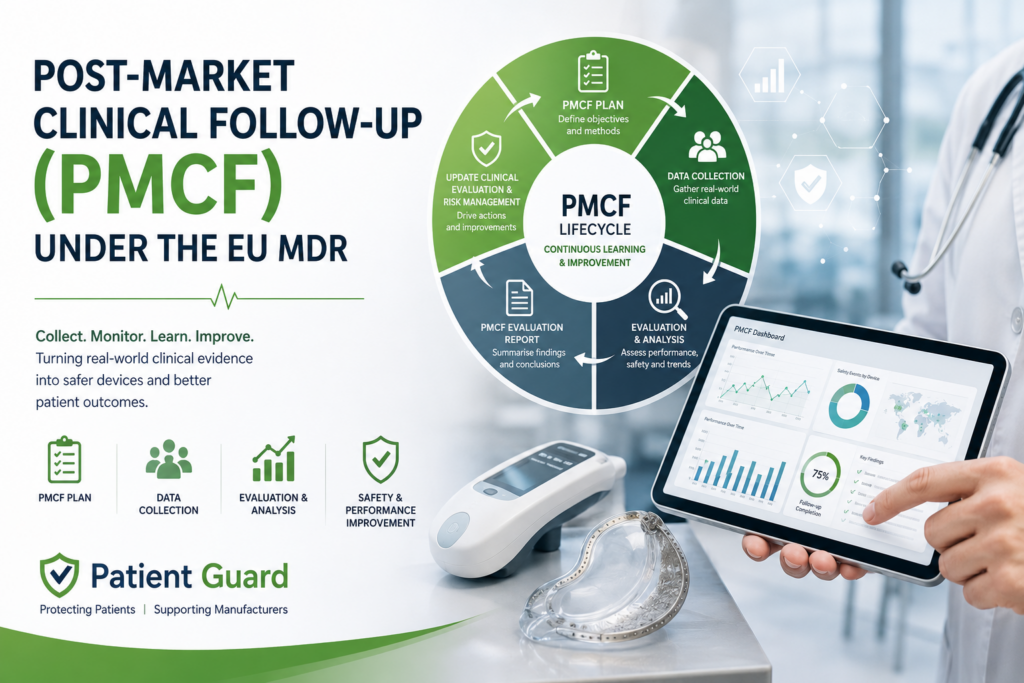
Post-Market Clinical Follow-up infographic showing the PMCF lifecycle under the EU MDR, including PMCF planning, clinical data collection, evaluation, reporting and updates to Clinical Evaluation and risk management.

Post-Market Clinical Follow-up (PMCF) Under the EU MDR

A practical guide to Post-Market Clinical Follow-up (PMCF) under the EU MDR, covering PMCF Plans, data collection methods, PMCF Evaluation Reports and how post-market clinical evidence feeds into Clinical Evaluation, risk management and ongoing medical device compliance.

Post-Market Clinical Follow-up (PMCF) Under the EU MDR Read More »

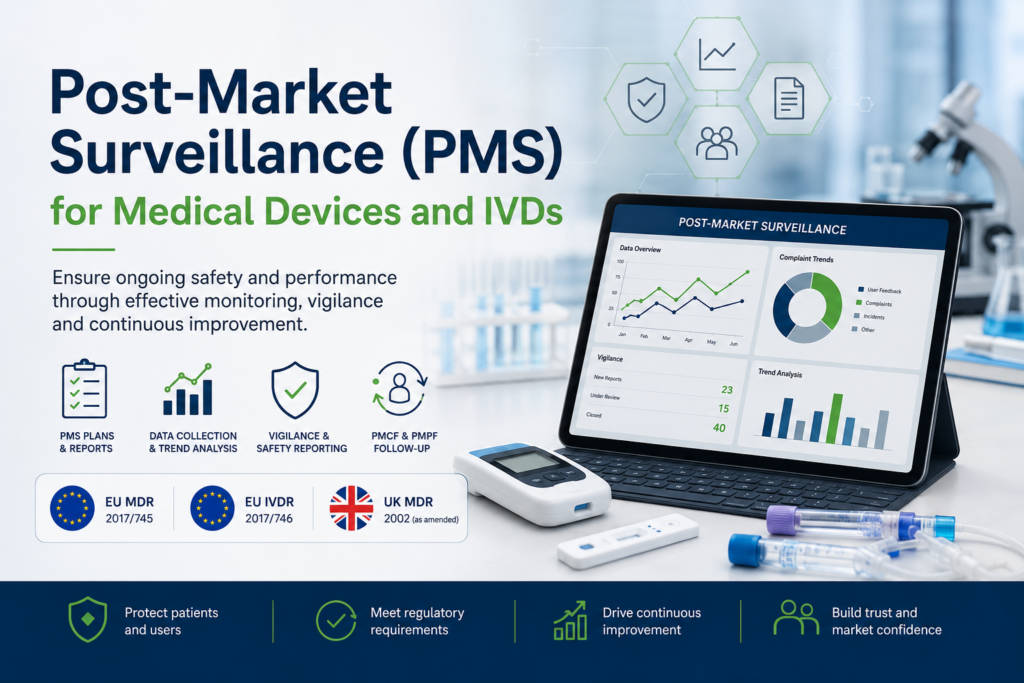
Post-market surveillance for medical devices and IVDs under the EU MDR, EU IVDR and UK MDR.

Post-Market Surveillance (PMS) for Medical Devices and IVDs

A comprehensive guide to post-market surveillance under the EU MDR, EU IVDR and UK MDR. Understand PMS plans, PMS reports, PSURs, vigilance, PMCF, PMPF and how manufacturers must monitor the safety and performance of medical devices and IVDs throughout their lifecycle.

Post-Market Surveillance (PMS) for Medical Devices and IVDs Read More »

Patient Guard hero image illustrating the core elements of an ISO 13485 Quality Management System, including leadership, document control, risk management, design and development, supplier management, validation, internal audits, CAPA and continual improvement for medical device manufacturers.

Understanding the core elements of Quality Management Systems

In today’s competitive marketplace, delivering high-quality products and services is essential for business success. A Quality Management System (QMS) is a structured framework that helps organizations ensure they meet customer requirements and enhance customer satisfaction. But what are the fundamental elements that constitute a robust QMS? In this blog, we will explore the basic components that form the backbone of effective quality management systems.

Understanding the core elements of Quality Management Systems Read More »

Hero image comparing ISO 13485 and the FDA Quality System Regulation (21 CFR Part 820/QMSR), illustrating the key differences between international and US medical device quality management systems, including risk management, design controls, documentation, supplier management and regulatory compliance.

5 Differences Between ISO 13485 & FDAs Medical Device QSR

Medical device manufacturers face a daunting task: navigating complex regulatory landscapes to ensure their products meet safety and quality standards. In order to sell products in the US, manufacturers are required to comply with CFR 21 Part 820, whereas for global markets, the voluntary ISO 13485 is used. These two standards are not the same, and companies must understand the differences between them if they are to get their products to market across regions. However, with the FDA actively working to align CFR 21 Part 820 more closely with ISO 13485, the effort toward global harmonization is a promising sign for medical device manufacturers.

5 Differences Between ISO 13485 & FDAs Medical Device QSR Read More »

A certificate that says 'ISO 13485 certified' on it - This image is used by patient guard to represent ISO 13485 quality assurance and QMS services.

What is ISO 13485? The Complete Guide to Medical Device QMS

ISO 13485:2016 is the international standout standard that defines the precise requirements for a Quality Management System (QMS) specific to the medical device industry. Unlike general business quality frameworks, it prioritizes patient safety, clinical efficacy, and global regulatory compliance ahead of standard consumer satisfaction metrics.

Whether you are an active medical device manufacturer, a software-as-a-service (SaMD) developer, an importer, or an EU/UK distributor, demonstrating compliance with this standard is virtually mandatory to secure and retain critical market access.

What is ISO 13485? The Complete Guide to Medical Device QMS Read More »

Illustration of the European Database on Medical Devices (EUDAMED) under the EU MDR and IVDR, showing the six interconnected modules—Actor Registration, UDI and Device Registration, Notified Bodies and Certificates, Clinical Investigations and Performance Studies, Vigilance, and Market Surveillance—supporting medical device transparency, traceability and patient safety across the European Union.

What is EUDAMED? A Complete Guide for Medical Device Manufacturers

EUDAMED (the European Database on Medical Devices) is the European Commission’s central database supporting the implementation of the Medical Device Regulation (EU) 2017/745 (EU MDR) and the In Vitro Diagnostic Medical Device Regulation (EU) 2017/746 (IVDR). It brings together information on manufacturers, medical devices, certificates, clinical investigations, vigilance activities and market surveillance into a single interconnected system.

By improving transparency, traceability and regulatory oversight, EUDAMED helps competent authorities, notified bodies, manufacturers and healthcare professionals access accurate information throughout the medical device lifecycle. This guide explains what EUDAMED is, how its six modules work together and why it has become an essential part of medical device regulatory compliance.

What is EUDAMED? A Complete Guide for Medical Device Manufacturers Read More »

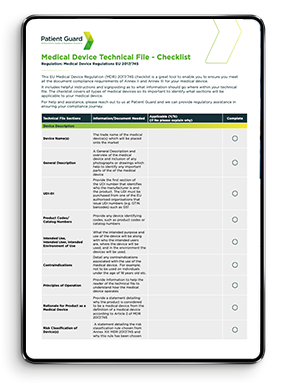
Get the Medical Device Technical Checklist

Thank you! The checklist is now ready to download.