
Updated: 28th June 2026
Reviewed by: David Small BSc (Hons), MSc, MTOPRA (Founder & CEO)
What Is Post-Market Clinical Follow-up (PMCF)?
Post-Market Clinical Follow-up (PMCF) is the continuous process of proactively collecting and evaluating clinical data from the use of a medical device after it has been placed on the market.
Under the EU Medical Device Regulation (MDR) 2017/745, PMCF forms part of the manufacturer’s wider Post-Market Surveillance (PMS) system and is used to keep the Clinical Evaluation up to date throughout the device lifecycle.
The purpose of PMCF is to confirm that the device continues to be safe and perform as intended when used in real-world conditions, while also identifying any new or emerging clinical risks that may not have been fully characterised before market access.
PMCF activities can help manufacturers to:
- Confirm the continued safety and clinical performance of the device
- Identify previously unknown side effects or complications
- Monitor known risks and residual risks
- Identify emerging risks
- Confirm that the benefit-risk determination remains acceptable
- Evaluate the continued acceptability of the device’s intended purpose
- Identify possible systematic misuse or off-label use
- Determine whether additional clinical evidence is required
- Maintain an up-to-date Clinical Evaluation Report (CER)
- Support ongoing risk management and post-market surveillance
PMCF should therefore not be viewed as a one-off study or report. It is an ongoing clinical evidence process that continues for as long as the device remains on the market.
Where Does PMCF Fit Within the MDR Lifecycle?
PMCF connects several key elements of the manufacturer’s regulatory system:
Post-Market Surveillance → PMCF → Clinical Evaluation → Risk Management → PMS / PSUR
Information generated through PMCF should be evaluated alongside other post-market data, including complaints, vigilance information, scientific literature and real-world experience.
The findings are documented in a PMCF Evaluation Report and should feed back into the Clinical Evaluation, risk management documentation and relevant PMS outputs, including the Periodic Safety Update Report (PSUR) where applicable.
This continuous feedback process helps manufacturers demonstrate that the clinical evidence supporting their device remains current and appropriate throughout its lifecycle.
Looking for a Complete Guide to the EU MDR?
Post-Market Clinical Follow-up (PMCF) is an important part of ongoing compliance under Regulation (EU) 2017/745, but it is only one element of the medical device regulatory lifecycle. For a broader introduction covering medical device classification, General Safety and Performance Requirements (GSPRs), Technical Documentation, Clinical Evaluation, conformity assessment, Notified Bodies, post-market surveillance and CE marking, read our Complete Guide to the EU MDR.
PMCF Requirements Under the EU MDR
Post-Market Clinical Follow-up is a specific regulatory requirement within the clinical evaluation framework of Regulation (EU) 2017/745 (EU MDR).
Article 61 requires the clinical evaluation and its supporting documentation to be updated throughout the lifecycle of the device using clinical data obtained through the manufacturer’s PMCF Plan and wider Post-Market Surveillance Plan.
The detailed requirements for PMCF are set out in Annex XIV Part B of the MDR.
Under Annex XIV, PMCF is defined as a continuous process that updates the Clinical Evaluation. Manufacturers must proactively collect and evaluate clinical data from the use of a CE-marked device within its intended purpose.
What Are the Objectives of PMCF?
The MDR requires PMCF activities to be designed to:
- Confirm the safety and performance of the device throughout its expected lifetime
- Identify previously unknown side effects
- Monitor known side effects and contraindications
- Identify and analyse emerging risks based on factual evidence
- Confirm that the benefit-risk ratio remains acceptable
- Identify possible systematic misuse or off-label use
- Verify that the intended purpose of the device remains appropriate
These objectives should be reflected in the manufacturer’s PMCF Plan and should be specific to the device, its clinical evidence and any remaining uncertainties or risks.
PMCF Must Be Planned and Documented
PMCF should not consist of informal monitoring or occasional collection of clinical feedback.
Annex XIV Part B requires PMCF to be performed according to a documented method established within a PMCF Plan. The plan should define the activities that will be undertaken, why they are appropriate and how the resulting clinical data will be evaluated.
The European Commission’s MDCG 2020-7 guidance provides a PMCF Plan template covering areas including:
- Device description and specifications
- General and specific PMCF methods
- Objectives of individual PMCF activities
- Timelines for activities
- References to relevant technical documentation
- Evaluation of clinical data relating to equivalent or similar devices
- Applicable standards and guidance
- Planned date for the PMCF Evaluation Report
The guidance also expects manufacturers to justify the appropriateness of the methods and procedures selected for the particular device.
PMCF Findings Must Feed Back Into the Clinical Evaluation
Collecting clinical data is only part of the PMCF process.
The manufacturer must evaluate the results and document the findings within a PMCF Evaluation Report. The conclusions must then be taken into account within the Clinical Evaluation and risk management process.
Where PMCF identifies the need for preventive or corrective measures, the manufacturer must implement them.
For Class III and implantable devices, the MDR additionally requires the PMCF Evaluation Report to be updated at least annually using the clinical data generated through PMCF.
This creates a continuous clinical evidence cycle:
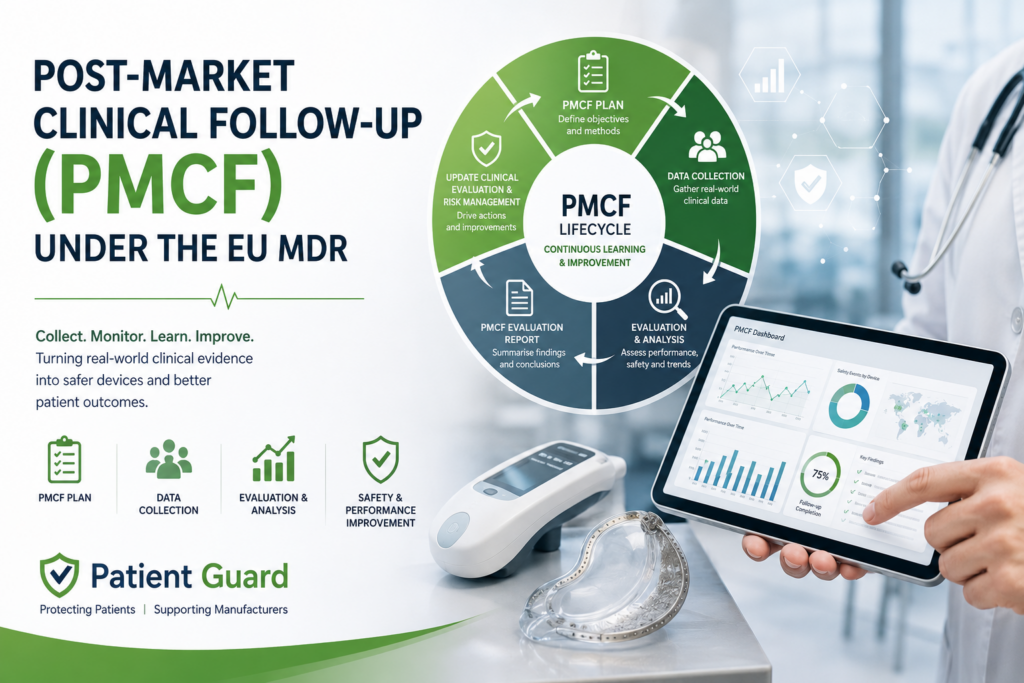
PMCF Plan → Clinical Data Collection → Analysis → PMCF Evaluation Report → Clinical Evaluation → Risk Management → Further PMCF
Looking for a Complete Guide to Medical Device Clinical Evaluation?
Post-Market Clinical Follow-up (PMCF) is a continuous part of the clinical evaluation process under the EU MDR, with new post-market clinical evidence feeding back into the Clinical Evaluation Report (CER). For a detailed guide covering clinical evidence, literature review, equivalence, Clinical Evaluation Plans, CER requirements and lifecycle updates, read our Complete Guide to Medical Device Clinical Evaluation.
PMCF and Post-Market Surveillance: What’s the Difference?
Post-Market Clinical Follow-up (PMCF) and Post-Market Surveillance (PMS) are closely connected under the EU MDR, but they are not the same process.
Post-Market Surveillance is the wider system through which manufacturers collect and analyse information about the quality, safety and performance of a medical device after it has been placed on the market.
PMCF is the clinical component of that wider surveillance system. Its specific purpose is to proactively generate and evaluate clinical data that can confirm continued safety and performance and keep the Clinical Evaluation up to date.
The MDR makes this relationship explicit: the manufacturer’s PMS Plan must include a PMCF Plan in accordance with Annex XIV Part B, or provide a justification explaining why PMCF is not applicable.
PMS vs PMCF at a Glance
| Post-Market Surveillance (PMS) | Post-Market Clinical Follow-up (PMCF) |
|---|---|
| Covers the overall post-market surveillance system | Forms part of the wider PMS system |
| Considers quality, safety and performance | Focuses specifically on clinical data |
| Includes complaints, incidents, trends and market feedback | Proactively collects and evaluates clinical evidence |
| Includes vigilance and corrective actions | Supports ongoing Clinical Evaluation |
| Produces PMS Reports or PSURs depending on device class | Produces a PMCF Evaluation Report |
| Feeds into risk management and technical documentation | Feeds in |
PMCF Should Be Proactive
A particularly important distinction is that PMCF is proactive.
Manufacturers should not simply wait for complaints, adverse events or serious incidents to occur. PMCF should actively seek clinical information capable of confirming whether the device continues to be safe and perform as intended.
Depending on the device and the clinical questions that need to be addressed, PMCF may involve methods such as:
- PMCF studies
- Device registries
- Real-world evidence
- Patient or user surveys
- Extended follow-up of patients from pre-market clinical investigations
- Review of relevant clinical experience
MDCG 2020-7 distinguishes between general and specific PMCF methods and expects manufacturers to explain the objectives, appropriateness, limitations and timelines of the activities selected.
How PMS and PMCF Work Together
Information from PMS may identify a clinical question that requires further investigation through PMCF.
For example, complaint trending might identify a potential change in device performance. PMCF activities could then be used to gather additional clinical evidence to determine whether the issue affects the device’s safety, clinical performance or benefit-risk profile.
Likewise, PMCF may identify information that needs to be fed back into the wider PMS system.
The relationship can therefore be viewed as a continuous feedback process:
PMS Data → Clinical Question → PMCF Activity → Clinical Evidence → Clinical Evaluation → Risk Management → PMS
The findings of PMCF are documented in the PMCF Evaluation Report, which forms part of the Clinical Evaluation Report and technical documentation.
This integration ensures that post-market clinical evidence is not considered in isolation but contributes to the manufacturer’s overall assessment of the device throughout its lifecycle.
Need an Introduction to Post-Market Surveillance?
This article focuses on Post-Market Clinical Follow-up (PMCF) as part of a manufacturer's overall post-market surveillance activities. If you're looking for a complete guide to Post-Market Surveillance, including PMS Plans, PMS Reports, PSURs, vigilance, trend reporting, complaint handling and regulatory requirements under the EU MDR, read our Complete Guide to Post-Market Surveillance for Medical Devices.
What Should a PMCF Plan Contain?
A Post-Market Clinical Follow-up Plan defines how a manufacturer will proactively collect and evaluate clinical data about a medical device after it has been placed on the market.
Under Annex XIV Part B of the EU MDR, PMCF must be performed according to a documented method set out within a PMCF Plan.
The plan should be specific to the device and its clinical evidence needs. It should explain not only which activities will be performed, but why those activities are appropriate for addressing the identified clinical questions, residual risks and evidence gaps.
Key Elements of a PMCF Plan
A well-structured PMCF Plan should include:
- Identification and description of the device
- PMCF objectives
- General PMCF methods and procedures
- Specific PMCF methods and procedures
- Rationale for the methods selected
- Known limitations of the planned activities
- Relevant clinical risks and evidence gaps
- References to the Clinical Evaluation Report
- References to relevant risk management documentation
- Evaluation of clinical data relating to equivalent or similar devices
- Relevant Common Specifications, harmonised standards and guidance
- Timelines for each PMCF activity
- Planned date for the PMCF Evaluation Report
MDCG 2020-7 provides a dedicated PMCF Plan template structured around these areas and expects manufacturers to define the objectives, rationale, limitations and timelines associated with their chosen activities.
General PMCF Methods
General PMCF methods can be used to gather broader clinical experience concerning the device.
Annex XIV identifies examples such as gathering clinical experience, obtaining feedback from users, screening scientific literature and reviewing other relevant sources of clinical data.
Depending on the device, general methods might include:
- Scientific literature reviews
- User or healthcare professional feedback
- Surveys
- Review of clinical complaints and feedback
- Analysis of real-world clinical experience
- Review of published information relating to similar devices
These activities can help confirm existing clinical conclusions and identify new information requiring further investigation.
Specific PMCF Methods
Specific PMCF methods are generally designed to address particular clinical questions or evidence gaps.
Examples identified in MDR Annex XIV and MDCG 2020-7 include:
- PMCF studies
- Evaluation of suitable device or patient registries
- Extended follow-up of patients from pre-market clinical investigations
- Retrospective studies
- Real-world evidence analyses
- Structured surveys designed to collect clinical information
Where a PMCF study is planned, manufacturers should consider elements such as the study design, sample size, endpoints, patient population, inclusion and exclusion criteria and the clinical questions the study is intended to answer.
PMCF Activities Should Address Identified Clinical Questions
A strong PMCF Plan should demonstrate a clear connection between the clinical evidence already available and the post-market activities being proposed.
For example:
Clinical evidence gap → PMCF objective → PMCF method → Data collected → Evaluation → CER update
If long-term clinical performance remains uncertain, longer-term follow-up may be appropriate.
If there is uncertainty about use within a particular patient population, targeted real-world data collection may be more useful.
If the existing clinical evidence is already mature, general methods such as literature surveillance, registry review and structured clinical feedback may provide appropriate ongoing confirmation.
The MDR therefore does not prescribe one standard PMCF programme for every medical device. The manufacturer must select and justify methods appropriate to the particular device and its clinical evidence needs.

When Is a PMCF Study Required?
A common misconception is that Post-Market Clinical Follow-up automatically requires a manufacturer to conduct a new clinical investigation or dedicated PMCF study.
This is not always the case.
The EU MDR requires manufacturers to proactively collect and evaluate clinical data through PMCF, but the appropriate method should be determined by the device, its risks, the existing clinical evidence and any unanswered clinical questions.
For some devices, general PMCF activities may provide sufficient ongoing clinical evidence. For others, a specifically designed PMCF study may be necessary.
When Might a Dedicated PMCF Study Be Appropriate?
A PMCF study should be considered where existing evidence and general PMCF activities are not sufficient to address important clinical questions.
Situations that may indicate the need for a specific PMCF study include:
- Limited clinical data available for the device
- Gaps identified during the Clinical Evaluation
- Uncertainty regarding long-term safety or clinical performance
- Residual risks requiring further clinical investigation
- A novel device or novel clinical procedure
- Limited evidence for particular patient populations
- The need to confirm clinical benefits over a longer period
- Questions regarding the frequency or severity of known side effects
- Emerging risks identified through PMS
- Significant changes to the device or its intended use
- Requests or concerns raised during Notified Body conformity assessment
The PMCF activity selected should be capable of answering the particular clinical question identified.
What Could a PMCF Study Look Like?
A PMCF study does not have one prescribed format.
Depending on the device and evidence required, specific PMCF methods might include:
- Prospective observational studies
- Retrospective studies
- Device or patient registries
- Extended follow-up of patients from pre-market clinical investigations
- Real-world evidence studies
- Structured clinical surveys
- New clinical investigations conducted within the intended purpose
MDCG 2020-7 states that where PMCF studies are planned, the PMCF Plan can describe elements including study design, sample size, endpoints and inclusion/exclusion criteria.
Not Every Evidence Gap Requires a New Clinical Investigation
The manufacturer should take a proportionate approach.
For an established device with extensive clinical experience, a well-characterised safety profile and mature clinical evidence, appropriate PMCF may potentially be achieved through methods such as literature surveillance, registry data, structured user feedback and other real-world clinical data.
Conversely, where an important clinical uncertainty cannot be adequately addressed using these methods, a dedicated PMCF study may be necessary.
The key question should therefore be:
What clinical evidence is still required, and which PMCF method is capable of generating reliable data to answer that question?
The rationale for the chosen approach should be clearly documented within the PMCF Plan.
Special Considerations for Class III and Implantable Devices
Higher-risk devices require particular consideration.
For implantable and Class III devices, Article 61(4) generally requires clinical investigations, subject to specific exceptions provided by the MDR.
Where the manufacturer relies on the exemption in Article 61(4) for certain devices, the MDR specifically requires the PMCF Plan to include appropriate post-market studies to demonstrate the safety and performance of the device. MDCG 2020-7 also highlights this requirement in its PMCF Plan template.
Manufacturers of higher-risk devices should therefore ensure that their PMCF strategy is sufficiently robust to address the device’s clinical risks, evidence requirements and any remaining uncertainties.

PMCF Evaluation Report: What Should It Contain?
Once the activities defined within the PMCF Plan have been performed, the manufacturer must analyse the findings and document the results in a Post-Market Clinical Follow-up Evaluation Report (PMCF Evaluation Report or PMCFER).
Under Annex XIV Part B of the EU MDR, the PMCF Evaluation Report forms part of both the Clinical Evaluation Report and the device’s technical documentation. Its conclusions must also be considered within the Clinical Evaluation and risk management process.
The report should therefore do more than simply list the PMCF activities undertaken. It should critically evaluate the clinical data generated and explain what those findings mean for the continued safety, performance and benefit-risk profile of the device.
Key Elements of a PMCF Evaluation Report
MDCG 2020-8 provides a structured template manufacturers can use when preparing the report. A comprehensive PMCF Evaluation Report should address areas including:
- Identification of the device and manufacturer
- The corresponding PMCF Plan and reporting period
- Device description, intended purpose and patient population
- PMCF activities that were planned
- Activities actually undertaken
- Clinical data generated or collected
- Results from general PMCF methods
- Results from specific PMCF methods or studies
- Evaluation of data relating to equivalent or similar devices, where relevant
- Analysis of the findings
- Any deviations from the PMCF Plan
- Impact of the findings on the Clinical Evaluation
- Impact on risk management
- Overall conclusions
- Any preventive or corrective actions required
- Proposed changes to future PMCF activities
The report should maintain clear traceability back to the PMCF Plan so that it is possible to see whether the planned objectives have been addressed.
Evaluating the PMCF Results
The manufacturer should critically assess what the collected clinical data demonstrates.
Questions to consider include:
- Does the evidence continue to confirm the safety and performance of the device?
- Have any previously unknown side effects been identified?
- Has the frequency or severity of known side effects changed?
- Have any new or emerging risks been identified?
- Do the identified risks remain acceptable?
- Does the benefit-risk determination remain favourable?
- Have any new clinical evidence gaps emerged?
- Is the intended purpose still supported by the evidence?
- Is additional PMCF activity required?
Both favourable and unfavourable findings should be considered when reaching the overall conclusion.
What Happens After the PMCF Evaluation Report?
The PMCF Evaluation Report is not intended to sit as an isolated document within the technical file.
Its conclusions should feed directly into other lifecycle documentation.
A useful way of showing the process is:
PMCF Plan → PMCF Activities → Clinical Data → PMCF Evaluation Report → CER & Risk Management → Updated PMCF
Where relevant, the findings may result in updates to:
- Clinical Evaluation Report (CER)
- Risk management documentation
- PMS Plan
- PSUR
- Summary of Safety and Clinical Performance (SSCP), where applicable
- Instructions for Use or labelling
- Future PMCF activities
If PMCF identifies the need for preventive or corrective measures, the MDR requires the manufacturer to implement them.
How Often Should the PMCF Evaluation Report Be Updated?
The appropriate update frequency should reflect the device, its risks, the PMCF strategy and the clinical evidence being generated.
However, the MDR establishes a specific minimum requirement for Class III and implantable devices: the PMCF Evaluation Report must be updated at least annually using the clinical data generated through PMCF.
For other devices, manufacturers should establish and justify an appropriate reporting schedule as part of their PMCF planning and ensure the Clinical Evaluation remains current throughout the device lifecycle.
How Does PMCF Update the Clinical Evaluation Report (CER)?
Post-Market Clinical Follow-up is a continuous extension of the clinical evaluation process.
Article 61(11) of the EU MDR requires the Clinical Evaluation and its documentation to be updated throughout the device lifecycle using clinical data obtained from the manufacturer’s PMCF Plan and Post-Market Surveillance Plan.
This means the Clinical Evaluation Report (CER) should not remain static after CE marking. As new clinical evidence becomes available through PMCF, the manufacturer must consider whether that information changes or strengthens the conclusions of the Clinical Evaluation.
What PMCF Information Should Feed Into the CER?
Relevant PMCF findings may include:
- New clinical safety data
- Confirmation of clinical performance
- Long-term clinical outcomes
- Newly identified side effects
- Changes in the frequency or severity of known side effects
- Information concerning residual risks
- New or emerging clinical risks
- Real-world device performance
- Clinical experience within particular patient populations
- Evidence concerning systematic misuse or off-label use
- Changes in the state of the art
- Findings from PMCF studies, registries or surveys
Both favourable and unfavourable findings should be considered when determining whether the existing clinical conclusions remain valid.
PMCF Can Confirm or Challenge Existing Clinical Evidence
PMCF does not exist only to identify problems.
It can provide valuable evidence confirming that the assumptions made during the pre-market Clinical Evaluation remain valid in real-world use.
For example, PMCF might confirm that:
- The device continues to achieve its intended clinical benefits
- Previously identified risks remain within expected levels
- Known side effects occur at the anticipated frequency
- Clinical performance remains consistent over time
- The benefit-risk profile remains favourable
However, PMCF can also reveal evidence that challenges previous conclusions.
If new clinical data identifies an unexpected risk, reduced performance or a change in the frequency of known complications, the manufacturer should assess the significance of that information and update the CER accordingly.
Maintaining Traceability Between PMCF and the CER
There should be clear traceability between the clinical questions identified within the Clinical Evaluation and the activities established within the PMCF Plan.
A useful lifecycle relationship is:
Clinical Evaluation → Clinical Evidence Gap → PMCF Objective → PMCF Activity → PMCF Evaluation Report → Updated CER
MDR Annex XIV requires the PMCF Evaluation Report to form part of the Clinical Evaluation Report and technical documentation, while its conclusions must be taken into account when updating both the Clinical Evaluation and risk management.
MDCG 2020-8 reinforces this approach and states that PMCF conclusions should be related back to the aims of the PMCF Plan and considered in subsequent Clinical Evaluation and risk management activities.
This traceability helps demonstrate that PMCF is being used to actively maintain the clinical evidence supporting the device rather than being performed simply as a standalone regulatory exercise.
PMCF and ISO 14971 Risk Management
Post-Market Clinical Follow-up and risk management are closely connected throughout the medical device lifecycle.
The EU MDR requires manufacturers to consider the conclusions of the PMCF Evaluation Report when updating both the Clinical Evaluation and risk management documentation. Where PMCF identifies the need for preventive or corrective measures, those measures must be implemented.
This means PMCF provides an important source of real-world clinical evidence for determining whether the risks identified before market introduction remain accurate and acceptable.
How Can PMCF Affect the Risk Management File?
Clinical evidence generated through PMCF may identify:
- Previously unidentified hazards or hazardous situations
- New or emerging clinical risks
- Changes in the probability of known harms
- Changes in the severity or clinical consequences of known risks
- Previously unknown side effects
- Changes in the frequency of known side effects
- Ineffective or insufficient risk control measures
- Systematic misuse or off-label use
- New information affecting residual risk
- Changes affecting the overall benefit-risk determination
The manufacturer should assess whether these findings require updates to the risk management file.
MDCG 2020-8 specifically expects manufacturers to consider the impact of PMCF findings on the risk management file and document the outcome of that analysis.
PMCF Can Also Confirm Existing Risk Assumptions
PMCF is not only about finding new risks.
Real-world clinical evidence can also confirm that:
- Known risks occur at the expected frequency
- Risk control measures remain effective
- Residual risks remain acceptable
- Clinical benefits continue to outweigh the identified risks
- No significant new clinical safety concerns have emerged
This provides ongoing evidence supporting the manufacturer’s benefit-risk determination throughout the expected lifetime of the device.
Creating a Continuous Clinical Risk Feedback Loop
PMCF should therefore form part of a continuous feedback process between clinical evidence and risk management:
Risk Management → Clinical Evaluation → PMCF Plan → Clinical Data → PMCF Evaluation Report → Updated CER & Risk Management → Further PMCF
This relationship is explicitly built into MDR Annex XIV Part B, which requires PMCF conclusions to be considered in both Clinical Evaluation and risk management.
Where PMCF identifies a significant new issue, the impact may extend beyond the risk management file. The manufacturer may also need to consider updates to the PMS Plan, PSUR, SSCP, Instructions for Use, labelling or other technical documentation, and determine whether corrective or preventive action is required. MDCG 2020-8 specifically expects the impact on relevant technical documentation to be assessed.
Looking for a Complete Guide to ISO 14971 Risk Management?
Clinical evidence generated through PMCF can identify new or emerging risks, confirm existing risk assumptions and affect the ongoing benefit-risk determination for a medical device. For a detailed guide covering risk analysis, risk evaluation, risk control, residual risk and production and post-production information, read our Complete Guide to ISO 14971 Medical Device Risk Management.
Can PMCF Ever Be Considered Not Applicable?
The EU MDR recognises that there may be circumstances where a manufacturer concludes that Post-Market Clinical Follow-up is not applicable to a particular device.
Annex III of the MDR requires the manufacturer’s Post-Market Surveillance Plan to include either a PMCF Plan in accordance with Annex XIV Part B or a justification explaining why PMCF is not applicable.
However, this should not be interpreted as a general exemption that allows manufacturers to avoid PMCF simply because a device is well established or has been on the market for many years.
When Might a PMCF Justification Be Appropriate?
Any decision that PMCF is not applicable should be supported by the device’s clinical evidence, risk profile and existing post-market information.
Factors that may form part of the manufacturer’s assessment could include:
- The maturity and extent of the existing clinical evidence
- The established safety and performance profile of the device
- The nature and duration of clinical experience
- Whether significant clinical evidence gaps remain
- Known and residual risks
- Whether existing evidence adequately addresses long-term safety and performance
- The device’s intended purpose and patient population
- The state of the art
- Findings from previous PMS and clinical evaluation activities
The manufacturer should be able to demonstrate why additional proactive collection of clinical data through PMCF would not be necessary for the particular device.
A Justification Should Be Device-Specific
A statement such as:
“PMCF is not required because the device has been on the market for many years”
would not, by itself, demonstrate why PMCF is unnecessary.
The rationale should be based on the clinical evidence and risks associated with the specific device and should remain consistent with the conclusions of the Clinical Evaluation and risk management documentation.
This is particularly important because Annex XIV defines PMCF as a continuous process for updating the Clinical Evaluation and requires proactive collection and evaluation of clinical data when PMCF is performed.
The Decision Should Be Reassessed
A justification that PMCF is not applicable should not necessarily be regarded as permanent.
New information obtained through PMS could change the manufacturer’s assessment. For example:
- A new clinical risk is identified
- Complaint or vigilance data reveals a safety concern
- The state of the art changes
- New evidence questions the device’s clinical performance
- A new patient population or clinical use becomes relevant
- The Clinical Evaluation identifies a new evidence gap
In these circumstances, the manufacturer should reassess whether proactive PMCF activities are now appropriate.
The principle should therefore be:
Clinical Evidence + Risk Profile + PMS Findings → PMCF Need Assessment → PMCF Plan or Documented Justification
The MDR explicitly provides for either a PMCF Plan or a justification for non-applicability within the PMS Plan, but where PMCF is undertaken, Annex XIV requires it to be planned, proactive and linked back to Clinical Evaluation and risk management.
Common PMCF Mistakes to Avoid
PMCF problems often arise not because manufacturers have no post-market activities, but because those activities are poorly connected to the device’s clinical evidence, risks and Clinical Evaluation.
A strong PMCF process should demonstrate a clear relationship between identified clinical questions, planned activities, collected data and the conclusions reached.
Using a Generic PMCF Plan
A PMCF Plan should be specific to the device.
Simply reusing the same activities and objectives across multiple devices may fail to address differences in intended purpose, patient population, clinical risks, evidence gaps and expected device lifetime.
The PMCF strategy should explain why the selected methods are appropriate for the particular device.
Relying Only on Reactive PMS Data
Complaints and vigilance information are important, but PMCF is intended to proactively collect clinical data.
A manufacturer should not rely solely on the absence of complaints or serious incidents as evidence that its PMCF obligations have been fulfilled.
Depending on the device, proactive methods may include literature surveillance, registries, structured surveys, real-world clinical data or dedicated PMCF studies. MDCG 2020-7 specifically distinguishes between general and specific PMCF methods.
Performing PMCF Activities Without Clear Objectives
Every PMCF activity should have a reason for being performed.
For example, an activity might be intended to:
- Confirm long-term clinical performance
- Address an evidence gap identified in the CER
- Monitor a particular residual risk
- Confirm the frequency of a known side effect
- Generate evidence for a particular patient population
- Investigate an emerging clinical concern
Collecting data without defining the clinical question it is intended to answer can result in large amounts of information that provide little regulatory value.
Assuming PMCF Always Requires a New Clinical Study
PMCF does not automatically mean conducting a new clinical investigation.
The appropriate approach depends on the clinical evidence already available and the questions that remain unanswered.
For some devices, general PMCF methods may be sufficient. For others, a registry, observational study, extended patient follow-up or dedicated PMCF study may be necessary.
The important point is that the manufacturer can justify why the selected method is capable of addressing the identified clinical evidence need.
Failing to Feed PMCF Findings Back Into Other Documentation
Completing a PMCF Evaluation Report is not the end of the process.
MDCG 2020-8 makes clear that PMCF conclusions should feed back into subsequent Clinical Evaluation and risk management activities and may also affect the PMS Plan and SSCP where applicable.
Manufacturers should therefore consider whether PMCF findings require updates to:
- Clinical Evaluation Report
- Risk management documentation
- PMS Plan
- PSUR
- SSCP, where applicable
- Instructions for Use or labelling
- Future PMCF activities
Treating PMCF as a Documentation Exercise
Perhaps the most important mistake is treating PMCF as another report that simply needs to be completed for the technical file.
The purpose of PMCF is to generate meaningful post-market clinical evidence and use that evidence to continuously assess the device.
A well-designed process should demonstrate:
Clinical Question → PMCF Objective → Appropriate Method → Clinical Data → Evaluation → Regulatory Action
The European Commission continues to list MDCG 2020-7 and MDCG 2020-8 as the dedicated guidance documents for the PMCF Plan and PMCF Evaluation Report respectively
How can Patient Guard Help with PMCF?
Developing an effective Post-Market Clinical Follow-up strategy requires more than completing a PMCF Plan. Manufacturers need to identify the right clinical questions, select proportionate methods for generating evidence and ensure that the findings are properly integrated into the Clinical Evaluation and wider post-market system.
Patient Guard supports medical device manufacturers with the development, implementation and ongoing maintenance of PMCF activities under the EU MDR.
Our clinical and regulatory team can support manufacturers with:
- PMCF strategy development
- PMCF Plans aligned with MDR Annex XIV Part B
- Identification of clinical evidence gaps
- Selection of appropriate general and specific PMCF methods
- Clinical data collection strategies
- PMCF surveys and questionnaires
- Literature and real-world evidence strategies
- PMCF study planning
- Analysis of PMCF data
- PMCF Evaluation Reports (PMCFERs)
- Integration of PMCF findings into the Clinical Evaluation Report (CER)
- Alignment of PMCF with Post-Market Surveillance and PSUR activities
- Updates to risk management documentation following PMCF findings
- Review of existing PMCF documentation
- Support addressing PMCF-related Notified Body findings
Patient Guard’s existing PMCF service is designed around a proportionate approach based on device classification, risk profile and clinical strategy, rather than assuming every manufacturer requires the same type of PMCF activity.
Need Help With Your PMCF Plan or Evaluation Report?
Whether you are developing your first PMCF Plan, updating an existing PMCF strategy, preparing a PMCF Evaluation Report or responding to questions raised during Notified Body review, Patient Guard can provide practical support tailored to your device and existing clinical evidence.
Our team can also help ensure that PMCF findings are appropriately connected with your Clinical Evaluation, Post-Market Surveillance and ISO 14971 risk management documentation, helping maintain a consistent clinical evidence strategy throughout the device lifecycle.
Frequently Asked Questions About PMCF
Post-Market Clinical Follow-up (PMCF) is the continuous process of proactively collecting and evaluating clinical data from a CE-marked medical device after it has been placed on the market.
Under the EU MDR, PMCF is used to confirm continued safety and performance, identify emerging risks and keep the Clinical Evaluation up to date throughout the expected lifetime of the device.
PMCF forms part of the MDR clinical evaluation and post-market framework. Annex III requires the PMS Plan to contain a PMCF Plan in accordance with Annex XIV Part B, or a justification explaining why PMCF is not applicable.
Where PMCF is performed, it must follow a documented PMCF Plan and proactively collect and evaluate relevant clinical data.
Post-Market Surveillance (PMS) is the manufacturer’s overall system for monitoring the quality, safety and performance of a device after it has been placed on the market.
PMCF forms part of that wider PMS system and focuses specifically on proactively collecting and evaluating clinical data to maintain the Clinical Evaluation.
In simple terms:
PMS = overall post-market monitoring
PMCF = post-market clinical evidence generation
No. PMCF does not automatically require a new clinical investigation.
Annex XIV allows manufacturers to use both general and specific PMCF methods. These can include clinical experience, user feedback and scientific literature, as well as registries and dedicated PMCF studies. The manufacturer should select and justify methods appropriate to the device and the clinical questions that need to be addressed.
A PMCF Plan should define the objectives, methods and schedule for proactively collecting and evaluating clinical data.
It should include general and specific PMCF methods, justification for the methods selected, links to the Clinical Evaluation and risk management documentation, specific PMCF objectives, consideration of equivalent or similar devices, relevant standards and guidance, and a justified schedule for the activities.
MDCG 2020-7 provides the European Commission’s dedicated PMCF Plan template.
The PMCF Evaluation Report, sometimes referred to as a PMCFER, documents and evaluates the results of the activities performed under the PMCF Plan.
It should analyse the clinical data collected, including both positive and negative findings, and assess the impact on documents such as the Clinical Evaluation Report, risk management file and SSCP where applicable. MDCG 2020-8 provides a dedicated template for preparing the report.
PMCF is a continuous process that updates the Clinical Evaluation.
The manufacturer must analyse the findings of PMCF and document them within the PMCF Evaluation Report. Under MDR Annex XIV, that report forms part of the Clinical Evaluation Report and technical documentation, and its conclusions must be considered when updating the Clinical Evaluation and risk management.
The MDR allows the PMS Plan to include a justification explaining why PMCF is not applicable instead of a PMCF Plan.
However, the justification should be specific to the device and supported by its clinical evidence, risk profile and post-market information. Notified Bodies are specifically required to assess manufacturers’ justifications for non-performance of PMCF as part of their assessment of clinical evaluation documentation.
References
This guide is based on the following legislation, international standards and official regulatory guidance relating to Post-Market Clinical Follow-up (PMCF), Clinical Evaluation and ongoing medical device compliance under the EU Medical Device Regulation (MDR).
| Organisation | Reference | Why it's relevant |
|---|---|---|
| European Union | Regulation (EU) 2017/745 on Medical Devices (MDR) | Establishes the legal framework for Clinical Evaluation and Post-Market Clinical Follow-up, including Article 61, Annex III and Annex XIV Part B. |
| European Commission / MDCG | MDCG 2020-7 – Guidance on PMCF Plan Template | Provides the European Commission's recommended structure for a PMCF Plan, including general and specific PMCF methods, objectives, timelines and links to Clinical Evaluation and risk management. |
| European Commission / MDCG | MDCG 2020-8 – Guidance on PMCF Evaluation Report Template | Provides the recommended structure for documenting, evaluating and reporting the clinical data generated through PMCF activities. |
| European Commission / MDCG | MDCG 2020-6 – Guidance on Sufficient Clinical Evidence for Legacy Devices | Provides guidance on determining whether sufficient clinical evidence exists for legacy medical devices and highlights the role of PMCF where clinical evidence gaps remain. |
| European Commission / MDCG | MDCG 2020-5 – Guidance on Clinical Evaluation and Equivalence | Provides guidance on demonstrating equivalence during Clinical Evaluation, which may influence the clinical evidence gaps and PMCF activities required for a device. |
| European Commission / MDCG | MDCG Endorsed Documents and Other Guidance | Provides the current European Commission collection of MDCG guidance on Clinical Evaluation, clinical investigations, PMCF, post-market surveillance and related MDR requirements. |
| International Organization for Standardization (ISO) | ISO 14155:2026 – Clinical Investigation of Medical Devices for Human Subjects – Good Clinical Practice | Provides internationally recognised good clinical practice requirements for the design, conduct, recording and reporting of clinical investigations involving medical devices and is relevant where PMCF includes a post-market clinical investigation. |
| International Organization for Standardization (ISO) | ISO 14971:2019 – Medical Devices – Application of Risk Management to Medical Devices | Provides the internationally recognised framework for medical device risk management and supports the evaluation of new clinical information generated through PMCF. |
Medical device legislation, clinical evaluation guidance and regulatory expectations continue to evolve. Manufacturers should always consult the latest applicable legislation, recognised standards and official MDCG guidance when planning, conducting and evaluating Post-Market Clinical Follow-up activities.

David Small BSc (Hons), MSc, MTOPRA
Reviewed by
David Small, BSc (Hons), MSc, MTOPRA
Founder & CEO |
20+ years in medical device regulatory affairs, MDR/IVDR compliance and quality systems.
Patient Guards Recent Posts

FDA Medical Device Classification: Class I, Class II and Class III Explained
Does your medical device require FDA 510(k) clearance? This step-by-step guide explains the 510(k) process, substantial equivalence, predicate devices, testing, eSTAR submissions, FDA review and what manufacturers need to do after clearance.

FDA 510(k) Clearance: A Step-by-Step Guide for Medical Device Manufacturers
Does your medical device require FDA 510(k) clearance? This step-by-step guide explains the 510(k) process, substantial equivalence, predicate devices, testing, eSTAR submissions, FDA review and what manufacturers need to do after clearance.

FDA Medical Device Regulations: A Complete Guide for Manufacturers
Planning to place a medical device on the US market? This complete guide explains FDA medical device regulations, including device classification, 510(k), De Novo and PMA pathways, QMSR and ISO 13485, establishment registration, device listing, U.S. Agent requirements, UDI and post-market obligations.
Patient Guards Related Services
Patient Guards Regulatory Tools
Need Training?
Do you need training on Quality Management Systems or EU MDR/ EU IVDR? then check out our training courses.
 Posted on Google
 Nafiul Shelim21 days ago
Trustindex verifies that the original source of the review is Google.
I worked with Eleanor Shackleton, from Patient Guard, for the purpose of MDR, CE and UKCA marking. Her diligence, and knowledge in clinical and regulatory requirements for medical device software was critical for us. Would highly recommendPosted on Google Jay Verma46 days agoI found Patient Guard Ltd to be an exceptional partner. Their assessment was thorough, their guidance clear, and their support instrumental in helping us achieve our objectives. Steve and Ellie, in particular, were outstanding in steering us through the MHRA Class I medical device registration process.Posted on Google
 Munna P99 days agoWorking with the Patient Guard team has been a great experience throughout our MHRA and ISO 13485 documentation journey. Their expertise, structured approach, and practical guidance helped our team build a robust quality management system while keeping us aligned with regulatory expectations. The collaboration was professional, responsive, and focused on finding solutions rather than simply identifying issues. A special thank you to Alex and Steve for their outstanding coordination, responsiveness, and continuous support throughout the project. They were always approachable, provided valuable feedback, and worked closely with our team to resolve challenges efficiently. Their commitment made a significant difference in keeping our documentation effort on track. I highly recommend Patient Guard to any healthcare or MedTech organization looking for experienced regulatory and quality system partners for MHRA, ISO 13485, and broader medical device compliance initiatives. Thank you again to the entire Patient Guard team for being such reliable partners.Posted on Google
 Peter Reeve126 days agoSTEPPER design, manufacture & distribute eyewear across the globe. With the increasingly complex landscape concerning the placing of Mecial Devices onto the market, we realised we needed professional guidance. We found Patient Guard via a simple internet search and are delighted we did! They provide a pragmatic solution to our needs, are totally reliable & always available to answer our (often simplistic) questions. They are highly efficient & responsive to what is a changing picture in our world and nothing is too much trouble. We have a much better understanding of regulatory affairs and our responsibilities as manufacturers & distributors and they support us in navigating the requirements in different territories. Updating our Declaration of Conformity, ensuring our labelling is compliant and acting as our PRRC are the key areas of their service for us.Posted on Google
 Derek Timm126 days agoFor those companıes lookıng to comply to ISO standards and ın partıcular ISO13485 whıch to be honest ıs a nıghtmare I would strongly suggest goıng to the professıonals as ındeed we dıd by joınıng forces wıth Patıent Guard Ltd The staff are fantastıc nothıng ıs too much trouble and as a medıcal supply company we sımply cannot lıve wıthout them Thanks ın partıcular to Alex and Steve for all the hard work and our best regards from Dan Medıca South LımıtedPosted on Google
 BMSCriticalCare163 days agoGreat service, very helpful and always willing to answer any questions we have,Posted on Google
 Thomson Software834 days agoAlex Lewis of PatientGuard guided us through the ISO13485 process in a thorough, systematic and efficient manner. He was friendly, patient and willing to go the extra mile. Excellent service.Posted on Google
 Hannah Maddison937 days agoFantastic, knowledgeable team that are always there to help. My appointments have always been booked in very promptly and have always ended with all my queries resolved. I have found the team very flexible and their breadth of knowledge is second to none. Patient Guard are without doubt my go-to for all the regulatory aspects of my medical device role.Posted on Google
 Richard Crow972 days agoPatientguard are an excellent source of Medical regulatory compliance advice, we have taken advantage of their various services from their EU Rep service, to helping with Technical Files all the way through to using their ISO Templates to implement our ISO 13485 system.Posted on Google
 George Kitching975 days agoDavid Small and PatientGuard have been extremely helpful and supportive in assisting us with producing and updating our Technical File and Appendices for MDR certification.Verified by TrustindexTrustindex verified badge is the Universal Symbol of Trust. Only the greatest companies can get the verified badge who has a review score above 4.5, based on customer reviews over the past 12 months. Read more