
Updated: 31st August 2026
Reviewed by: David Small BSc (Hons), MSc, MTOPRA (Founder and CEO)
Cosmetics Regulation
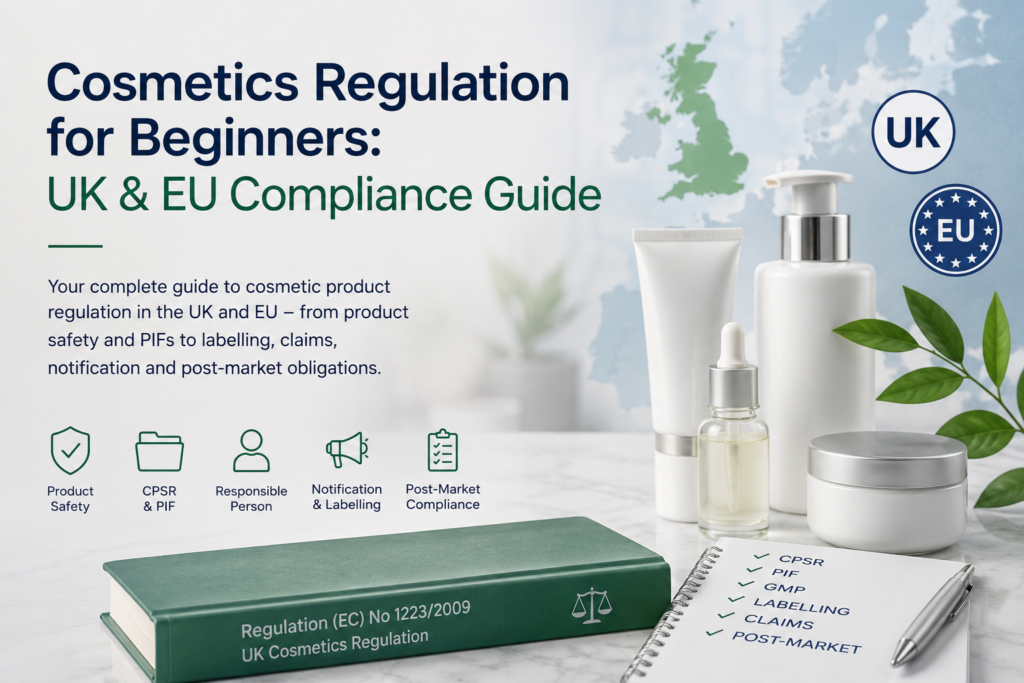
Cosmetic products sold in the United Kingdom and European Union are subject to strict regulatory requirements designed to protect consumer health and ensure that products placed on the market are safe, appropriately manufactured and correctly labelled.
For cosmetic brands, manufacturers, importers and distributors, compliance begins long before a product reaches the shelf. Depending on the market, businesses may need to appoint a Responsible Person, assess the safety of the formulation, prepare a Cosmetic Product Safety Report (CPSR), compile a Product Information File (PIF), ensure compliant labelling and claims, and complete the appropriate product notification before the cosmetic can be placed on the market.
Although the UK and EU regulatory frameworks remain closely aligned in many areas, they now operate as separate regulatory systems. Cosmetic products placed on the EU market are principally regulated under Regulation (EC) No 1223/2009, while products placed on the Great Britain market must meet the applicable requirements of the UK cosmetics regulatory framework.
This means a company selling the same cosmetic product in both Great Britain and the EU may need separate Responsible Persons and separate product notifications, as well as ensuring that its documentation and labelling meet the requirements of each market.
This guide provides a practical introduction to UK and EU cosmetics regulation and explains the key stages of cosmetic product compliance, including:
- cosmetic product classification and regulatory scope;
- ingredient and formulation requirements;
- Cosmetic Product Safety Reports (CPSRs);
- Product Information Files (PIFs);
- UK and EU Responsible Persons;
- CPNP and SCPN product notification;
- cosmetic labelling and claims;
- Good Manufacturing Practice (GMP);
- post-market responsibilities and safety monitoring.
Whether you are developing a new cosmetic product, importing an existing product or expanding a cosmetic brand into the UK or EU, understanding these requirements early can help prevent regulatory delays, costly reformulation and compliance issues after launch.
What Is a Cosmetic Product?
Under both the EU and Great Britain regulatory frameworks, whether a product is considered a cosmetic depends on its intended purpose, where it is applied and its composition.
Regulation (EC) No 1223/2009 defines a cosmetic product as a substance or mixture intended to come into contact with the external parts of the human body — including the skin, hair, nails, lips and external genital organs — or with the teeth and mucous membranes of the oral cavity, principally for one or more cosmetic purposes.
These purposes include:
- cleaning;
- perfuming;
- changing appearance;
- protecting;
- keeping the relevant part of the body in good condition; or
- correcting body odours.
Products commonly regulated as cosmetics therefore include:
- moisturisers, creams and lotions;
- shampoos and conditioners;
- soaps and cleansing products;
- deodorants and antiperspirants;
- make-up and decorative cosmetics;
- perfumes and fragrances;
- lip products;
- nail products;
- shaving products;
- sunscreens and tanning products; and
- toothpastes and other cosmetic oral-care products.
Borderline Cosmetic Products
Not every product applied to the skin or body is automatically a cosmetic.
A product’s intended purpose, presentation, claims, composition and mode of action can affect which regulatory framework applies. This is particularly important for products that sit close to the boundary between cosmetics and other regulated product categories.
For example, depending on its characteristics and intended purpose, a product may instead fall within legislation governing:
- medicinal products;
- medical devices;
- biocidal products; or
- other consumer products.
Products intended to be ingested, inhaled, injected or implanted into the human body are not cosmetic products under the cosmetics framework. UK government guidance specifically highlights the importance of considering borderline classification where the regulatory status of a product is unclear.
The claims made for a product are particularly important. A cosmetic product should not be presented as having characteristics or functions that it does not possess, and businesses should carefully consider claims that could imply a medicinal or other non-cosmetic purpose.
Correctly determining the regulatory status of a product should therefore be one of the first steps in bringing a new cosmetic product to market. An incorrect classification can affect the safety assessment, technical documentation, labelling, claims, notification and other regulatory requirements that apply.
EU vs UK Cosmetics Regulation
Since the United Kingdom left the European Union, cosmetic products placed on the EU and Great Britain markets are subject to separate regulatory regimes. Although the requirements remain closely aligned in many areas, manufacturers and brands need to consider each market independently.
EU Cosmetics Regulation
Cosmetic products placed on the market in the European Union are regulated principally by Regulation (EC) No 1223/2009 on cosmetic products.
The Regulation establishes requirements covering areas including:
- product safety;
- Responsible Persons;
- Good Manufacturing Practice (GMP);
- restricted and prohibited ingredients;
- Cosmetic Product Safety Reports (CPSRs);
- Product Information Files (PIFs);
- product notification;
- labelling;
- cosmetic claims;
- nanomaterials; and
- post-market safety obligations.
Before a cosmetic product is placed on the EU market, it must have undergone an appropriate safety assessment and a CPSR must be prepared in accordance with Annex I of the Regulation.
Every cosmetic product placed on the EU market must also have a Responsible Person established within the EU. The Responsible Person is responsible for ensuring that the applicable requirements of Regulation (EC) No 1223/2009 are fulfilled.
Products must also be notified through the European Commission’s Cosmetic Products Notification Portal (CPNP) before being placed on the EU market.
Cosmetics Regulation in Great Britain
Following Brexit, Great Britain — England, Scotland and Wales — operates a separate cosmetics regulatory system.
Cosmetic products placed on the GB market are regulated under Regulation (EC) No 1223/2009 as it applies in Great Britain, as amended by UK legislation including the Product Safety and Metrology etc. (Amendment etc.) (EU Exit) Regulations 2019.
Many of the fundamental compliance principles remain similar to those applying in the EU. Cosmetic products must be safe, appropriately assessed, manufactured in accordance with GMP and supported by the required product information.
However, there are important differences in how products are brought to the GB market.
In particular, a cosmetic product placed on the GB market must have a Responsible Person established in the UK.
Cosmetic products must also be notified to the Office for Product Safety and Standards (OPSS) using the UK’s Submit Cosmetic Product Notifications (SCPN) service.
This means that an EU CPNP notification does not, by itself, satisfy the notification requirements for a cosmetic product being placed on the GB market.
What About Northern Ireland?
Northern Ireland needs to be considered separately from Great Britain.
Under the arrangements applying in Northern Ireland, Regulation (EC) No 1223/2009 continues to apply. A cosmetic product placed on the Northern Ireland market must therefore have a Responsible Person established in Northern Ireland or the EEA and must be notified through the EU CPNP.
This creates three important market considerations for cosmetic businesses:
| Market | Principal Regulatory Route | Responsible Person | Product Notification |
|---|---|---|---|
| European Union | Regulation (EC) No 1223/2009 | EU-established Responsible Person | CPNP |
| Great Britain | GB cosmetics regulatory framework | UK-established Responsible Person | SCPN |
| Northern Ireland | Regulation (EC) No 1223/2009 as applicable in NI | NI or EEA-established Responsible Person | CPNP |
There are specific arrangements for qualifying Northern Ireland goods moving from Northern Ireland to Great Britain under unfettered access, so businesses operating across these markets should consider their individual supply chain and regulatory position.
Selling the Same Cosmetic Product in the UK and EU
A cosmetic business wishing to sell the same product in both Great Britain and the EU will therefore commonly need to address both regulatory systems.
For a manufacturer established outside these markets, this may include:
- appointing an appropriate UK Responsible Person for Great Britain;
- appointing an EU Responsible Person for the European Union;
- ensuring the CPSR and PIF meet the applicable requirements;
- completing an SCPN notification for Great Britain;
- completing a CPNP notification for the EU;
- ensuring product labels contain the appropriate Responsible Person information; and
- monitoring subsequent regulatory changes in both jurisdictions.
Although much of the underlying product safety documentation can potentially support compliance across both markets, manufacturers should not assume that compliance with one regime automatically establishes compliance with the other.
The Cosmetic Product Compliance Lifecycle
Bringing a cosmetic product to the UK or EU market involves more than completing a safety assessment or submitting a product notification. Compliance should be considered throughout the product development process, from the initial formulation and intended claims through to post-market monitoring once the product is available to consumers.
While the exact requirements will depend on the product and the market in which it is sold, a typical cosmetic compliance pathway includes the following stages.
1. Confirm the Product Is a Cosmetic
The first step is to confirm that the product falls within the definition of a cosmetic product and does not instead fall under another regulatory framework, such as medicines, medical devices or biocides.
The product’s intended purpose, composition, presentation, mode of action and claims should all be considered when determining its regulatory status.
2. Review the Formulation and Ingredients
The formulation should be reviewed to ensure that each ingredient is permitted for its intended cosmetic use and that any applicable restrictions, concentration limits or conditions of use are met.
Particular consideration may be required for substances such as:
- preservatives;
- colourants;
- UV filters;
- fragrance allergens;
- restricted substances;
- substances classified as carcinogenic, mutagenic or toxic for reproduction (CMRs); and
- nanomaterials.
Ingredient compliance should be established early in product development. Discovering that an ingredient or concentration is unsuitable after testing and safety assessment can result in costly reformulation and delays.
3. Generate the Required Safety and Product Evidence
Appropriate information must be available to demonstrate the safety, quality and stability of the finished cosmetic product.
Depending on the formulation and product type, this may include information relating to:
- physical and chemical characteristics;
- microbiological quality;
- preservative effectiveness;
- stability;
- packaging compatibility;
- impurities and traces;
- exposure;
- toxicological profiles of ingredients; and
- evidence supporting the intended product claims.
The exact evidence required should be determined based on the characteristics and risk profile of the individual product rather than applying the same testing programme to every cosmetic.
4. Prepare the Cosmetic Product Safety Report (CPSR)
Before a cosmetic product is placed on the market, its safety must be assessed and documented in a Cosmetic Product Safety Report.
The CPSR brings together the information necessary to evaluate the safety of the formulation, including ingredient toxicology, exposure, microbiological quality, stability and other relevant product information.
It consists of:
Part A – Cosmetic Product Safety Information
and
Part B – Cosmetic Product Safety Assessment.
Part B must be completed by an appropriately qualified safety assessor. The safety assessment must conclude whether the product is safe for human health when used under normal or reasonably foreseeable conditions.
5. Compile the Product Information File (PIF)
The Product Information File brings together the key regulatory documentation supporting the cosmetic product.
This includes the CPSR alongside other required information concerning the product, its manufacture and the evidence supporting its claimed effects.
The PIF is therefore not the same as the CPSR. Rather, the CPSR forms a critical part of the wider PIF. For products placed on the GB market, the PIF must be kept up to date and retained for 10 years after the last batch has been made available.
6. Establish the Responsible Person
Every cosmetic product placed on the market must have an appropriate Responsible Person.
The Responsible Person has significant regulatory responsibilities, including ensuring that the product is safe, maintaining the required documentation, checking labelling and ensuring that the appropriate product notification has been completed.
Companies selling into both Great Britain and the EU may need separate Responsible Person arrangements for the two markets.
7. Review the Product Labelling and Claims
Before launch, the cosmetic product’s container, packaging and associated claims should be reviewed for regulatory compliance.
Required information can include the Responsible Person’s details, nominal content, durability information, precautions for use, batch identification, product function and ingredient list.
Marketing claims must also be supportable and must not imply that the cosmetic possesses characteristics or functions that it does not have.
8. Complete the Product Notification
The appropriate product notification must be completed before the cosmetic is placed on the relevant market.
For Great Britain, cosmetic products are notified to the Office for Product Safety and Standards (OPSS) through the Submit Cosmetic Product Notifications (SCPN) service.
For the European Union, products are notified through the Cosmetic Products Notification Portal (CPNP).
Notification should be treated as one of the final regulatory steps rather than the beginning of the compliance process. The necessary safety documentation, Responsible Person arrangements and product information should already be established.
9. Place the Cosmetic Product on the Market
Once the applicable regulatory requirements have been satisfied, the cosmetic product can be placed on the relevant market.
However, regulatory responsibility does not end when the product is launched.
10. Maintain Post-Market Compliance
The Responsible Person must continue to monitor the safety and compliance of the cosmetic product throughout its time on the market.
This can include:
- maintaining the PIF;
- reviewing new safety information;
- monitoring complaints and undesirable effects;
- reporting Serious Undesirable Effects (SUEs) where required;
- maintaining evidence supporting claims;
- assessing formulation or manufacturing changes;
- responding to regulatory changes affecting ingredients; and
- taking corrective action where a product presents a safety or compliance concern.
For GB products, serious undesirable effects must be reported to OPSS.

Cosmetic Ingredients and Formulation Compliance
Before a cosmetic product can be placed on the UK or EU market, its formulation must comply with the applicable restrictions on cosmetic ingredients.
The fact that an ingredient is commonly used in cosmetics does not automatically mean that it can be used in every product, at any concentration or for every intended purpose. Ingredient compliance depends on factors such as the substance itself, its concentration, the product type, site of application, intended users and conditions of use.
For businesses planning to sell the same formulation in both Great Britain and the EU, it is also increasingly important to check the requirements for each market separately. Although the regulatory frameworks remain closely related, changes to permitted and restricted cosmetic ingredients may not necessarily take effect in both jurisdictions at the same time.
Prohibited and Restricted Substances
Regulation (EC) No 1223/2009 contains a series of Annexes governing the use of substances in cosmetic products.
These include:
- Annex II – substances prohibited in cosmetic products;
- Annex III – substances subject to restrictions;
- Annex IV – permitted colourants;
- Annex V – permitted preservatives; and
- Annex VI – permitted UV filters.
A formulation review should therefore consider not only whether an ingredient is permitted, but also whether any conditions apply to its use.
These conditions can include:
- maximum permitted concentrations;
- restrictions for particular product types;
- limitations according to the area of application;
- restrictions for certain user populations;
- purity requirements; and
- mandatory warnings or precautions that must appear on the product label.
CMR Substances
Particular consideration is required for substances classified as carcinogenic, mutagenic or toxic for reproduction (CMR) under the EU Classification, Labelling and Packaging Regulation.
The EU Cosmetics Regulation places significant restrictions on the use of substances classified as CMR substances, with use only possible in specific circumstances where the applicable regulatory conditions are satisfied.
This is an area that requires ongoing monitoring because changes to substance classifications can subsequently affect whether an ingredient can continue to be used in cosmetic products.
Nanomaterials
Cosmetic products containing nanomaterials can also be subject to additional regulatory requirements.
Under the EU Cosmetics Regulation, a nanomaterial is an insoluble or biopersistent and intentionally manufactured material with specified nanoscale characteristics. Certain products containing nanomaterials are subject to additional notification requirements before being placed on the EU market.
The presence of nanomaterials must therefore be identified during formulation review rather than discovered late in the compliance process.
Fragrances and Allergens
Fragrances can contain numerous individual substances, some of which are subject to specific restrictions or labelling requirements.
Where applicable, fragrance allergens must be considered when preparing the ingredient list and determining the information that needs to appear on the product label.
This is particularly important because allergen labelling requirements can change. For example, the EU has expanded its requirements for the individual labelling of fragrance allergens through Regulation (EU) 2023/1545, with transitional periods applying to affected products.
Brands selling products in multiple markets should therefore avoid assuming that an existing ingredient list will remain compliant indefinitely.
Ingredient Documentation
A robust formulation review also depends on having appropriate information about the raw materials used to manufacture the product.
Depending on the ingredient and formulation, relevant documentation may include:
- full quantitative and qualitative formulation information;
- INCI names;
- raw material specifications;
- Certificates of Analysis;
- Safety Data Sheets;
- fragrance documentation;
- allergen information;
- impurity information;
- information concerning preservatives, colourants and UV filters; and
- supporting toxicological data.
This information subsequently feeds into the Cosmetic Product Safety Report (CPSR) and Product Information File.
Formulation Changes Must Be Controlled
Cosmetic compliance is not a one-time exercise.
If the formulation changes after the CPSR has been completed — for example, through a change in ingredient, supplier, concentration, fragrance or preservative system — the regulatory impact of that change should be assessed.
The existing CPSR, PIF, product notification and labelling may need to be reviewed or updated before the modified product is placed on the market.
Similarly, regulatory changes affecting an ingredient already used in a product may require action even where the formulation itself has not changed.
UK and EU Requirements Can Diverge
This point deserves particular emphasis in our updated pillar.
Following Brexit, cosmetic businesses selling into both Great Britain and the EU should monitor regulatory developments in both jurisdictions.
An ingredient restriction adopted by the EU should not automatically be assumed to apply in Great Britain on the same date, and vice versa. Businesses should therefore establish which version of the applicable cosmetics legislation applies to the market where the product will be sold.
For brands operating internationally, formulation compliance should consequently be treated as an ongoing regulatory activity rather than simply a check performed immediately before product launch.
Cosmetic Product Safety Report (CPSR)
Before a cosmetic product can be placed on the UK or EU market, its safety must be assessed and documented through a Cosmetic Product Safety Report (CPSR).
The CPSR is one of the central components of cosmetic product compliance. Its purpose is to demonstrate, using appropriate scientific evidence, that the cosmetic product is safe for human health when used under normal or reasonably foreseeable conditions.
Under Article 10 of Regulation (EC) No 1223/2009, the Responsible Person must ensure that the product has undergone an appropriate safety assessment and that a CPSR has been prepared in accordance with Annex I before the product is placed on the EU market. Equivalent safety assessment requirements apply to cosmetics placed on the Great Britain market.
What Does a CPSR Contain?
The CPSR is divided into two main parts:
Part A – Cosmetic Product Safety Information
Part A brings together the information required to enable the safety of the cosmetic product to be assessed. Annex I identifies ten areas of information, including:
- quantitative and qualitative composition;
- physical and chemical characteristics and product stability;
- microbiological quality;
- impurities, traces and information about the packaging material;
- normal and reasonably foreseeable use;
- exposure to the cosmetic product;
- exposure to individual substances;
- toxicological profiles of the substances;
- undesirable effects and serious undesirable effects; and
- other relevant information about the cosmetic product.
Depending on the nature of the product, supporting evidence may therefore include stability data, microbiological testing, preservative efficacy or challenge testing, raw-material information, packaging information and toxicological data.
Part B – Cosmetic Product Safety Assessment
Part B is the professional safety assessment of the information assembled in Part A.
It includes:
- the safety assessor’s conclusion on the safety of the cosmetic product;
- any warnings or instructions necessary to ensure its safe use;
- the scientific reasoning supporting the assessment; and
- the safety assessor’s credentials, signature and date.
The assessment should consider the intended use of the product, reasonably foreseeable use and the anticipated exposure to the individual ingredients in the finished formulation.
Who Can Complete a CPSR?
The safety assessment cannot simply be completed by the cosmetic brand or manufacturer unless the individual carrying it out possesses the required qualifications.
For the EU, Article 10(2) requires the Part B safety assessment to be carried out by a person holding a university-level qualification in pharmacy, toxicology, medicine or a similar discipline, or a qualification recognised as equivalent by a Member State.
The GB framework similarly requires the safety assessment to be undertaken by an appropriately qualified safety assessor.
This is why having the correct formulation and supporting documentation available is important: the safety assessor must have sufficient information to reach and justify a scientifically robust conclusion about product safety.
Does Every Cosmetic Product Need a CPSR?
A safety assessment and CPSR are required before a cosmetic product is placed on the market.
The complexity of that assessment, however, will depend on the individual product. Factors such as formulation, intended use, exposure, target population, application area, microbiological risk and packaging can all affect the evidence needed to support the assessment.
Particular consideration is required for certain products. For example, the GB regulatory guidance specifically identifies the need for a specific safety assessment for cosmetic products intended for use on children under three and products intended exclusively for external intimate hygiene.
The CPSR Is Part of the PIF
The CPSR and Product Information File (PIF) are sometimes treated as interchangeable terms, but they are not the same document.
The CPSR is the safety report, whereas the PIF is the wider regulatory file containing the CPSR together with other required information about the cosmetic product, its manufacture, claimed effects and associated regulatory documentation.
We will look at the PIF in more detail in the next section.
The CPSR Must Be Kept Up to Date
Preparing a CPSR is not simply a one-time exercise completed before launch.
Article 10 requires the CPSR to be kept up to date in light of additional relevant information generated after the product has been placed on the market. Current GB guidance similarly states that the safety assessment should be reviewed and revised where new information could alter the original safety conclusion.
A CPSR may therefore need to be reviewed following matters such as:
- changes to the formulation;
- new or changed raw materials;
- changes to packaging that could affect product safety;
- new stability or microbiological information;
- emerging toxicological information;
- undesirable effects or consumer safety information; or
- regulatory changes affecting ingredients.
The CPSR should therefore be viewed as part of the product’s ongoing safety management rather than merely as a document required to launch the product.
Need to Understand CPSR Requirements?
A Cosmetic Product Safety Report (CPSR) is a core requirement for placing cosmetic products on the UK and EU markets. For a detailed explanation of CPSR Part A and Part B, safety assessor requirements, supporting documentation, testing and ongoing review, read our Cosmetic Product Safety Report (CPSR) Guide.
Product Information File (PIF)
Every cosmetic product placed on the UK or EU market must be supported by a Product Information File (PIF).
The PIF is the central regulatory file for the cosmetic product. It brings together the information needed to demonstrate that the product has been appropriately assessed, manufactured and supported by the documentation required under the applicable cosmetics legislation.
The Responsible Person is responsible for ensuring that the PIF is maintained and made readily accessible to the relevant competent authority.
What Does a Cosmetic PIF Contain?
Under Article 11 of Regulation (EC) No 1223/2009, the PIF must contain the following key information:
- a description of the cosmetic product that clearly links the PIF to the product concerned;
- the Cosmetic Product Safety Report (CPSR);
- a description of the method of manufacture and a statement demonstrating compliance with Good Manufacturing Practice (GMP);
- proof of the effect claimed for the cosmetic product, where justified by the nature or effect of the product; and
- information relating to any animal testing performed by the manufacturer, agents or suppliers in connection with the development or safety assessment of the cosmetic product or its ingredients.
The PIF may therefore contain or reference a substantial amount of supporting documentation, depending on the nature and complexity of the product.
The CPSR and PIF Are Not the Same Thing
One of the most common areas of confusion for businesses new to cosmetics regulation is the relationship between the CPSR and PIF.
The CPSR is one component of the PIF.
The CPSR specifically addresses the safety of the cosmetic product, whereas the PIF is the wider regulatory file containing the CPSR together with the other information required to support the product’s compliance.
A cosmetic product therefore does not require a CPSR or a PIF — it requires both, with the completed CPSR forming part of the PIF.
Where Must the PIF Be Kept?
For products placed on the EU market, the Responsible Person must keep the PIF readily accessible in electronic or other format at the address indicated on the product label.
The file must be accessible to the competent authority of the Member State where the PIF is kept. Article 11 also requires the information to be available in a language that can be easily understood by that authority.
Similar requirements apply in Great Britain, where the UK Responsible Person must maintain the required product information and make it available to the relevant enforcement authority when required.
How Long Must a PIF Be Retained?
The PIF must be retained for 10 years following the date on which the last batch of the cosmetic product was placed on the market.
This is an important record-retention obligation and means that regulatory documentation may need to remain available for many years after a cosmetic product has been discontinued.
The PIF Must Be Kept Up to Date
Like the CPSR, the PIF should not be treated as a static document that is prepared once and then archived.
The information within the file should continue to reflect the cosmetic product being placed on the market.
A PIF may therefore need to be reviewed or updated following changes such as:
- formulation or ingredient changes;
- changes to raw-material suppliers or specifications;
- changes to the manufacturing process;
- new safety or toxicological information;
- packaging changes;
- updated product claims or supporting evidence;
- changes to the CPSR;
- new information concerning undesirable effects; or
- regulatory changes affecting the product or its ingredients.
Effective document and change control can help ensure that the PIF, CPSR, product label, notification and product actually being supplied remain consistent with one another.
Why Is the PIF Important?
The PIF provides regulatory authorities with access to the key evidence supporting the compliance and safety of a cosmetic product.
An incomplete or outdated PIF can therefore create a significant compliance issue even where the finished cosmetic itself has not changed.
For manufacturers and brands, maintaining a well-structured PIF also makes it easier to manage regulatory changes, update the CPSR, respond to authority requests and demonstrate how the product continues to meet the applicable requirements.
Need to Understand Cosmetic Product Information Files?
A Product Information File (PIF) is the central regulatory file for a cosmetic product and contains the CPSR alongside manufacturing, GMP, claims and other compliance information. For a detailed explanation of PIF contents, Responsible Person obligations, retention requirements and UK and EU requirements, read our Cosmetic Product Information File: UK & EU Guide.
Cosmetic Responsible Person Requirements
Every cosmetic product placed on the Great Britain or EU market must have a designated Responsible Person (RP).
The Responsible Person is not simply a contact address. They have a defined regulatory role and are responsible for ensuring that the cosmetic product complies with the applicable cosmetics legislation.
For the EU, Article 4 of Regulation (EC) No 1223/2009 requires a legal or natural person within the EU to be designated as the Responsible Person for each cosmetic product placed on the market.
Great Britain operates its own Responsible Person requirements. A cosmetic product cannot be placed on the GB market unless there is a Responsible Person established in the UK for that product.
What Does the Responsible Person Do?
The Responsible Person has responsibility for ensuring that applicable regulatory requirements have been satisfied.
Depending on the market and product, these responsibilities include ensuring:
- the cosmetic product is safe for human health;
- an appropriate safety assessment has been performed;
- a compliant Cosmetic Product Safety Report (CPSR) is available;
- an up-to-date Product Information File (PIF) is maintained;
- manufacture complies with Good Manufacturing Practice;
- prohibited and restricted substance requirements are met;
- the product is correctly labelled;
- cosmetic claims are appropriately supported;
- the required product notification has been completed;
- serious undesirable effects are appropriately reported; and
- corrective action is taken where a product is found to be non-compliant or presents a risk.
In Great Britain, the Responsible Person must also notify OPSS before the cosmetic product is made available to consumers and maintain the PIF in English.
Who Can Be the EU Responsible Person?
For cosmetic products manufactured within the EU, the EU-established manufacturer will generally be the Responsible Person.
For products imported from outside the EU, the importer generally becomes the Responsible Person for the product they place on the market. However, an importer may appoint another EU-established person as the Responsible Person through a written mandate, provided that person accepts the appointment in writing.
This is particularly relevant to cosmetic manufacturers and brands located in countries such as the UK, United States, Canada, Australia and elsewhere that want to sell their products within the EU.
An appropriately established third-party Responsible Person can provide the required EU presence while supporting the manufacturer’s ongoing regulatory obligations.
Who Can Be the UK Responsible Person?
For cosmetic products placed on the Great Britain market, the Responsible Person must be established in the UK.
Depending on the circumstances, the Responsible Person may be:
- the UK manufacturer;
- the UK importer;
- a distributor in certain circumstances; or
- an appropriately appointed UK-established company or individual.
A manufacturer or importer can appoint a third party to act as Responsible Person through a written mandate, which must be accepted by the appointed party.
This provides a route for overseas cosmetic manufacturers and brands that do not have their own UK establishment to appoint a specialist UK Responsible Person.
Responsible Person Details on Cosmetic Labelling
The identity of the Responsible Person also affects product labelling.
Cosmetic packaging must include the name and address of the applicable Responsible Person. For products imported into Great Britain, the country of origin must also be shown.
Companies intending to sell the same cosmetic product in several markets should therefore consider their Responsible Person arrangements during label development rather than waiting until immediately before launch.
Selling Cosmetics in Both Great Britain and the EU
Following Brexit, businesses should not assume that a single Responsible Person appointment will automatically cover both Great Britain and the EU.
An overseas cosmetic brand entering both markets will commonly need:
Great Britain
A Responsible Person established in the UK.
European Union
A Responsible Person established within the EU.
The product must then satisfy the associated requirements of each regulatory system, including the relevant product notification route.
For Great Britain, notification is made to OPSS through the Submit Cosmetic Product Notifications (SCPN) service.
For the EU, notification is made through the European Commission’s Cosmetic Products Notification Portal (CPNP).
Having the Responsible Person arrangements established early can therefore make the subsequent PIF, labelling and notification process considerably more straightforward.
The Responsible Person's Role Continues After Launch
Responsible Person obligations do not end when the cosmetic product reaches the market.
The Responsible Person has an ongoing role in maintaining regulatory compliance and responding where new information indicates that a product may no longer comply with the applicable requirements.
For example, under the GB framework, if the Responsible Person has reason to believe a cosmetic product is non-compliant, appropriate corrective action must be taken. Depending on the circumstances, this can include bringing the product into compliance, withdrawing it from the market or recalling it.
The Responsible Person therefore plays an important role throughout the cosmetic product lifecycle — from pre-market compliance through to post-market safety monitoring.
Selling Cosmetic Products in Great Britain?
Cosmetic products placed on the Great Britain market must have a UK-established Responsible Person. Patient Guard can act as your UK Responsible Person for Cosmetics, supporting PIF and CPSR compliance, SCPN notification, labelling requirements and ongoing regulatory obligations.
Selling Cosmetic Products in the European Union?
Cosmetic products placed on the EU market must have an EU-established Responsible Person. Patient Guard can act as your EU Responsible Person for Cosmetics, supporting PIF and CPSR compliance, CPNP notification, labelling requirements and ongoing compliance with Regulation (EC) No 1223/2009.
Cosmetic Product Notification: CPNP and SCPN
Before a cosmetic product is placed on the market, the Responsible Person must complete the appropriate product notification for the market in which the product will be sold.
Product notification allows regulatory authorities and relevant bodies to access important information about cosmetic products available to consumers, including information that may be needed in the event of a safety concern or medical emergency.
Following Brexit, Great Britain and the European Union operate separate cosmetic product notification systems.
EU Cosmetic Product Notification Portal (CPNP)
Cosmetic products placed on the EU market must be notified through the European Commission’s Cosmetic Products Notification Portal (CPNP) before being placed on the market.
The notification is made by the EU Responsible Person and provides regulatory authorities with information about the cosmetic product.
Depending on the product, the information submitted can include:
- the product category and product name;
- details of the Responsible Person;
- the Member State in which the product will first be placed on the market;
- contact details for urgent enquiries;
- information concerning nanomaterials;
- information concerning certain CMR substances;
- the product formulation or appropriate frame formulation; and
- the original product labelling and, where reasonably legible, a photograph of the corresponding packaging.
Once the required CPNP notification has been completed, a separate national notification is generally not required for each individual EU Member State.
However, CPNP notification is not an approval or certification of the cosmetic product. Responsibility for ensuring that the product complies with Regulation (EC) No 1223/2009 remains with the Responsible Person.
Great Britain – Submit Cosmetic Product Notifications (SCPN)
Cosmetic products made available to consumers in Great Britain must be notified to the Office for Product Safety and Standards (OPSS) through the Submit Cosmetic Product Notifications (SCPN) service.
The Responsible Person must complete the notification before the cosmetic product is made available to consumers in Great Britain. Current OPSS guidance confirms that every cosmetic product available to GB consumers must be notified.
Information required for an SCPN notification can include:
- the cosmetic product category and name;
- Responsible Person details;
- the address at which the PIF is kept;
- contact information for urgent enquiries;
- information concerning nanomaterials;
- information concerning CMR substances;
- chemical and formulation information;
- an image of the product label; and
- a photograph of the product packaging.
As with CPNP, completing an SCPN notification should not be interpreted as regulatory approval of the product. The Responsible Person remains responsible for ensuring that the cosmetic complies with the applicable GB requirements.
CPNP vs SCPN
For businesses selling internationally, the simplest distinction is:
| Market | Notification System | Submitted By |
|---|---|---|
| European Union | CPNP | EU Responsible Person |
| Great Britain | SCPN | UK Responsible Person |
| Northern Ireland | CPNP | NI or EEA Responsible Person |
Current OPSS information confirms that cosmetics placed on the GB market use SCPN, whereas products placed on the Northern Ireland market use CPNP through a Responsible Person based in Northern Ireland or the EEA.
Selling the Same Product in Great Britain and the EU
If the same cosmetic product is being launched in both Great Britain and the EU, businesses will commonly need to complete both notification processes.
For example, an overseas cosmetic manufacturer entering both markets may require:
EU
- EU Responsible Person;
- compliant CPSR and PIF;
- EU-compliant labelling; and
- CPNP notification.
Great Britain
- UK Responsible Person;
- compliant CPSR and PIF;
- GB-compliant labelling; and
- SCPN notification.
An existing EU CPNP notification should therefore not be assumed to satisfy the notification requirements for placing a product on the GB market.
When Should Notification Be Completed?
Notification is a pre-market requirement, but it should generally come towards the end of the regulatory preparation process.
Before notification, businesses should already have established matters such as:
- the final product formulation;
- the CPSR;
- the PIF;
- Responsible Person arrangements;
- the final product label;
- relevant warnings and precautions; and
- the information necessary to complete the notification.
This is important because information submitted through the notification system should correspond with the product that is actually being placed on the market.
Changes made after notification may also require the notification information to be updated.
Notification Is Only One Part of Compliance
One of the most important points for businesses new to cosmetics regulation is that obtaining a CPNP or SCPN notification does not by itself make a cosmetic product compliant.
Notification sits within a much wider compliance process involving formulation review, product safety, CPSR, PIF, GMP, Responsible Person requirements, labelling, claims and post-market obligations.
In Great Britain, failure to notify is itself a regulatory matter. The current SCPN service specifically warns businesses of potential enforcement consequences for failing to notify OPSS.
Cosmetic Product Labelling Requirements
Correct labelling is a fundamental part of cosmetic compliance. Before a cosmetic product is placed on the UK or EU market, its container and packaging must display the information required by the applicable cosmetics legislation.
Under Article 19 of Regulation (EC) No 1223/2009, mandatory information must be presented in indelible, easily legible and visible lettering. Similar requirements apply under the GB cosmetics framework.
A compliant label does more than identify the product. It provides consumers with important information about who is responsible for the product, how it should be used safely, its durability and what it contains.
What Information Must Appear on a Cosmetic Product?
Depending on the product and applicable exceptions, cosmetic labelling generally needs to include:
- the name and address of the Responsible Person;
- country of origin for imported products;
- nominal content by weight or volume;
- minimum durability or Period After Opening (PAO), as applicable;
- relevant precautions and warnings;
- batch number or other product identification;
- the function of the cosmetic product, unless this is obvious from its presentation; and
- a list of ingredients.
There are specific rules and exceptions governing how some of this information is presented, so labelling should be assessed for the individual product rather than relying solely on a generic cosmetic label template.
Responsible Person Name and Address
The cosmetic label must identify the applicable Responsible Person.
For products placed on the EU market, this is the EU Responsible Person. Article 19 requires the name or registered name and address of the Responsible Person to appear on the product. Where several addresses are shown, the address at which the PIF is readily accessible must be highlighted.
For Great Britain, the applicable UK Responsible Person details must be provided in accordance with the GB requirements. Current detailed UK government guidance confirms that the relevant address is the UK-based Responsible Person placing the product on the market.
Responsible Person arrangements should therefore be established before packaging artwork is finalised.
Country of Origin
Where a cosmetic product is imported, the country of origin must be identified on the label.
This is particularly relevant for overseas manufacturers entering the UK or EU markets and should be considered alongside the applicable Responsible Person information.
Nominal Content
The amount of cosmetic product contained within the packaging must generally be declared by weight or volume.
There are exceptions, including certain:
- packs containing less than 5 g or 5 ml;
- free samples;
- single-application packs; and
- products normally sold as multiple items where weight or volume is not relevant.
The precise exception should be checked before omitting nominal content from a label.
Minimum Durability and Period After Opening
Cosmetic labelling must also provide appropriate information about how long the product remains suitable for use.
Where a cosmetic product has a minimum durability of 30 months or less, the date of minimum durability must generally be indicated using the prescribed wording or symbol.
For products with a minimum durability of more than 30 months, a minimum durability date is generally not required. Instead, where relevant, the Period After Opening (PAO) is indicated using the open-jar symbol together with the period for which the product can safely be used after opening — for example, 12M.
This information should be supported by appropriate stability and product-safety evidence rather than selecting a shelf life or PAO arbitrarily.
Precautions and Warnings
Any particular precautions necessary for the safe use of the cosmetic must be provided on the label.
This includes applicable precautions required by the cosmetics legislation and any additional warnings or instructions identified through the product’s safety assessment.
There may also be specific precautions for professional-use products.
The label should therefore be consistent with the conclusions and conditions of use established within the CPSR.
Batch Number
A batch number or other reference that enables the cosmetic product to be identified must be provided.
Batch identification is particularly important for traceability. If a safety or quality problem is subsequently identified, the batch number helps determine which products may be affected and whether corrective action is necessary.
For very small products where including the batch number on both the container and packaging is impractical, specific provisions allow it to appear on the packaging alone.
Product Function
The function of the cosmetic product must be stated unless it is already obvious from its presentation.
For example, consumers can readily understand the purpose of a lipstick from its presentation. A less obvious product may require wording that explains what the cosmetic is intended to do.
This description should also remain consistent with the intended cosmetic purpose assessed within the CPSR and should not introduce claims that could change the product’s regulatory status.
Cosmetic Ingredient List
The cosmetic packaging must include an ingredient list, preceded by the term “Ingredients”.
Ingredients are generally listed in descending order by weight at the time they are added to the product, although specific provisions apply to ingredients present at concentrations below 1%, colourants and certain other substances.
Perfume and aromatic compositions may generally be identified using terms such as parfum or aroma, while certain fragrance allergens must be individually declared where the applicable requirements and concentration thresholds are met.
Nanomaterials on Cosmetic Labels
Where an ingredient is present in the form of a nanomaterial, this must be identified in the ingredient list.
The ingredient name is followed by the word “nano” in brackets, for example:
Titanium Dioxide (nano)
This provides transparency about the presence of nanomaterials in the cosmetic formulation.
What If There Is Not Enough Space on the Packaging?
Small cosmetic products can create practical difficulties where there is insufficient space to display all the required information.
In certain circumstances, precautions and ingredient information may be provided through an enclosed or attached leaflet, label, tape, tag or card, with the appropriate symbol used to direct the consumer to that information. UK guidance expressly recognises this approach where space makes inclusion impractical.
This does not mean that mandatory information can simply be removed because the packaging is small. The relevant regulatory provisions need to be followed.
UK and EU Cosmetic Labels Should Be Reviewed Separately
Businesses selling the same cosmetic product in Great Britain and the EU should not assume that one version of the artwork will automatically satisfy both markets.
Differences can arise from matters such as:
- Responsible Person details;
- applicable language requirements;
- ingredient restrictions;
- warnings;
- fragrance allergen requirements; and
- subsequent regulatory changes.
The final artwork should therefore be reviewed against the requirements of each target market before printing or production.
This is especially important because the label also feeds into other parts of the compliance process. For example, an image of the final product label is required when making an SCPN notification in Great Britain.
Labelling Should Match the CPSR, PIF and Notification
One of the most important principles is consistency.
The formulation, intended use, warnings, Responsible Person details and other relevant information appearing on the label should correspond with the documentation supporting the product.
A change to the label should therefore trigger consideration of whether corresponding changes are needed to the:
CPSR → PIF → CPNP/SCPN notification → claims documentation.
This is why regulatory label review should form part of the overall cosmetic compliance process rather than being treated simply as a packaging-design exercise.
Cosmetic Claims and Advertising Requirements
Cosmetic product claims are an important part of how products are marketed, but claims must be accurate, supportable and consistent with the characteristics and function of the product.
A claim can appear on product packaging, websites, advertisements, social media, brochures or other marketing materials. It can also be communicated through product names, trademarks, images or other signs.
Under Article 20 of Regulation (EC) No 1223/2009, cosmetic marketing must not use wording, names, trademarks, images or other signs that imply a product has characteristics or functions that it does not possess.
Similar requirements apply in Great Britain, where the Responsible Person must ensure that cosmetic claims comply with the applicable claims requirements.
The Six Common Criteria for Cosmetic Claims
Commission Regulation (EU) No 655/2013 establishes six common criteria against which cosmetic claims should be assessed:
- Legal compliance
- Truthfulness
- Evidential support
- Honesty
- Fairness
- Informed decision-making
These principles apply not only to explicit statements about a cosmetic product but also to claims communicated implicitly through marketing.
1. Legal Compliance
Claims must comply with the applicable regulatory requirements.
A cosmetic should not, for example, be promoted as having received regulatory approval from a competent authority where no such approval process exists.
Similarly, a manufacturer should not present basic compliance with a mandatory legal requirement as though it were a special benefit of the product.
For example, simply meeting a requirement that all cosmetics must satisfy should not be promoted as a unique advantage over competing compliant products.
2. Truthfulness
Claims must accurately reflect the cosmetic product.
If a brand claims that a product contains a particular ingredient, that ingredient must actually be deliberately present in the formulation.
Care is also required with ingredient-based marketing. The fact that an individual ingredient has a particular property does not automatically demonstrate that the finished cosmetic product provides the same effect.
For example, marketing a moisturiser around an ingredient associated with a particular benefit may require evidence that the finished formulation provides the claimed benefit.
3. Evidential Support
Cosmetic claims should be supported by adequate and verifiable evidence.
The level and type of evidence required will depend on the nature of the claim being made.
Evidence might include:
- scientific literature;
- ingredient data;
- instrumental testing;
- laboratory studies;
- consumer perception studies;
- clinical or dermatological studies;
- expert assessments; or
- other appropriately designed product-specific investigations.
Where studies are used, Regulation 655/2013 requires them to be relevant to the product and claimed benefit and to follow appropriately designed and conducted methodologies.
A stronger or more specific claim will generally require correspondingly robust evidence.
4. Honesty
The way a product’s performance is presented should not go beyond the available supporting evidence.
For example, results obtained under particular test conditions should not be presented in a way that suggests a broader or greater effect than the evidence actually demonstrates.
Where a claimed benefit depends upon specific conditions of use or use alongside another product, those conditions should also be made clear.
5. Fairness
Cosmetic claims should be objective and should not unfairly denigrate competitors or ingredients that are legally used in cosmetic products.
Claims should also not create confusion between the cosmetic product and a competitor’s product.
Comparative marketing therefore needs particular care.
6. Informed Decision-Making
Claims should provide information that is clear and understandable to the intended consumer.
The wording and presentation should take account of the target audience and enable consumers to make an informed decision about whether the cosmetic product is appropriate for them.
Claims Such as “Clinically Proven” and “Dermatologically Tested”
Claims that suggest a particular level of scientific or professional evidence require careful substantiation.
Examples include:
- “clinically proven”;
- “clinically tested”;
- “dermatologically tested”;
- “reduces the appearance of wrinkles”;
- “24-hour hydration”;
- “suitable for sensitive skin”;
- “hypoallergenic”; and
- specific percentage improvement claims.
The evidence should support the actual wording and consumer impression created by the claim.
For example, evidence that an ingredient has been investigated clinically does not necessarily substantiate a claim that the finished cosmetic product itself is “clinically proven”.
Similarly, where a numerical claim such as “reduces the appearance of wrinkles by 30%” is used, the business should hold appropriate evidence capable of supporting that specific representation.
“Natural”, “Organic”, “Clean” and “Free From” Claims
Claims relating to the composition or perceived characteristics of cosmetics also require careful consideration.
Terms such as:
- natural;
- organic;
- clean;
- vegan;
- cruelty-free;
- non-toxic; and
- “free from” particular ingredients
can influence purchasing decisions and should therefore not be used in a misleading manner.
Particular care is required with “free from” claims where the wording could unfairly denigrate ingredients that are legally permitted for cosmetic use or imply that the absence of a prohibited substance represents a special safety benefit.
The fairness and legal-compliance principles under Regulation 655/2013 are therefore relevant when developing these types of marketing messages.
Cosmetic Claims Must Not Become Medicinal Claims
Claims can also affect the regulatory classification of a product.
A cosmetic is principally intended to clean, perfume, change appearance, protect, keep in good condition or correct body odours. Claims suggesting that a product treats, prevents or cures a disease or medical condition can potentially move the product outside the normal cosmetic regulatory framework.
For example, there can be an important regulatory difference between cosmetic wording concerning the appearance or condition of skin and wording that claims to treat an underlying disease.
This is why claims should be considered during product development rather than added by the marketing team after the regulatory assessment has been completed.
Claims Evidence Should Be Included in the PIF
Claims substantiation also connects directly with the Product Information File.
Article 11 of Regulation (EC) No 1223/2009 requires the PIF to contain proof of the effect claimed for the cosmetic product where justified by the nature or effect of the product. The Responsible Person must also ensure that claims are consistent with the documentation supporting the claimed effect.
This creates an important relationship between:
Product formulation → CPSR → PIF → Label → Marketing claims
The product being advertised should therefore remain consistent with the formulation and regulatory documentation that support it.
Review Claims Before Product Launch
Claims review should ideally take place before labels, packaging, websites and advertising materials are finalised.
This allows potentially problematic wording to be identified before significant investment has been made in packaging or marketing.
For products intended for both Great Britain and the EU, businesses should also consider the applicable cosmetics, advertising and consumer-protection requirements within each target market.
Cosmetic Good Manufacturing Practice (GMP) and ISO 22716
Cosmetic product compliance does not only concern the finished formulation and safety assessment. Products must also be manufactured under appropriately controlled conditions to help ensure that they consistently meet the required standards of quality and safety.
Both the EU and Great Britain cosmetics frameworks require cosmetic products to be manufactured in accordance with Good Manufacturing Practice (GMP).
Under Article 8 of Regulation (EC) No 1223/2009, manufacture of cosmetic products must comply with GMP. Compliance is presumed where manufacture follows relevant harmonised standards published in the Official Journal of the European Union.
What Is ISO 22716?
ISO 22716 – Cosmetics — Good Manufacturing Practices (GMP) — Guidelines on Good Manufacturing Practices provides internationally recognised guidance for the production, control, storage and shipment of cosmetic products.
The standard provides a structured approach to managing manufacturing activities and reducing risks such as:
- contamination;
- product mix-ups;
- incorrect raw materials;
- manufacturing errors;
- inadequate hygiene;
- uncontrolled changes;
- incorrect packaging or labelling; and
- insufficient traceability.
ISO 22716 focuses specifically on cosmetic manufacturing rather than functioning as a general-purpose quality management system.
What Does Cosmetic GMP Cover?
An effective cosmetic GMP system should establish appropriate controls throughout the manufacturing process.
Areas addressed by ISO 22716 include:
- personnel;
- premises;
- equipment;
- raw materials and packaging materials;
- production;
- finished products;
- quality control laboratory activities;
- treatment of products outside specification;
- waste;
- subcontracting;
- deviations;
- complaints and recalls;
- change control;
- internal audits; and
- documentation.
The extent and complexity of these controls should be appropriate to the nature and scale of the cosmetic manufacturing operation.
Raw Material and Packaging Controls
Appropriate controls should be established for the materials entering the manufacturing process.
This can include defining specifications, verifying incoming materials, establishing appropriate storage conditions and maintaining sufficient traceability between suppliers, raw materials and finished products.
Packaging also requires consideration because interactions between the cosmetic formulation and its packaging can potentially affect product quality or safety.
Relevant packaging information may therefore also feed into the CPSR and supporting safety assessment.
Manufacturing and Batch Controls
Cosmetic manufacturers should have documented procedures governing how products are produced.
These can include:
- manufacturing instructions;
- weighing and dispensing controls;
- equipment cleaning;
- prevention of cross-contamination;
- in-process controls;
- batch identification;
- packaging operations;
- release procedures; and
- maintenance of manufacturing records.
Effective batch documentation provides traceability if a problem is subsequently identified with a product.
Quality Control
Appropriate quality controls help ensure that raw materials, bulk products and finished cosmetic products meet established specifications.
Depending on the product and manufacturing process, this can include physical, chemical and microbiological controls.
Products that do not meet established acceptance criteria should be appropriately identified, investigated and controlled rather than automatically released for sale.
Documentation and Traceability
Documentation is a fundamental part of GMP.
Records should provide evidence of what was manufactured, which materials were used, which processes were followed and what checks were completed.
Good traceability becomes particularly important if a complaint, undesirable effect, quality defect or other post-market issue needs to be investigated.
It can help a business determine:
which batch is affected → which materials were used → where the batch was distributed → whether other products may also be affected.
This information can be critical when deciding whether corrective action, withdrawal or recall is necessary.
Contract Manufacturing Does Not Remove Regulatory Responsibility
Many cosmetic brands do not manufacture their own products and instead use a third-party or contract manufacturer.
Using an external manufacturer does not remove the need to ensure that the product has been manufactured in accordance with the applicable GMP requirements.
Brands and Responsible Persons should therefore establish appropriate information and controls concerning their manufacturing arrangements.
Depending on the arrangement, this may include:
- identifying the manufacturing site;
- establishing manufacturing responsibilities;
- obtaining appropriate GMP evidence;
- agreeing product specifications;
- controlling formulation and manufacturing changes;
- managing deviations and non-conformities; and
- establishing arrangements for complaints and recalls.
This is particularly important for private-label and outsourced cosmetic products where the brand owner may have limited day-to-day involvement in manufacturing.
GMP and the Product Information File
GMP also connects directly with the Product Information File (PIF).
Article 11 of Regulation (EC) No 1223/2009 requires the PIF to contain a description of the method of manufacture and a statement demonstrating compliance with GMP.
Manufacturing compliance is therefore part of the regulatory evidence supporting the cosmetic product rather than a completely separate quality activity.
Does a Cosmetic Manufacturer Need ISO 22716 Certification?
It is important not to confuse compliance with GMP with holding an ISO certificate.
The legal requirement is for cosmetic manufacture to comply with GMP. ISO 22716 provides a recognised framework for demonstrating that appropriate cosmetic GMP principles are being followed.
This does not necessarily mean that every cosmetic manufacturer is legally required to obtain third-party ISO 22716 certification before its products can be placed on the UK or EU market.
However, implementing ISO 22716 can provide a structured way of establishing and demonstrating appropriate manufacturing controls and may also be requested by customers, retailers or commercial partners.
GMP Continues Throughout Commercial Manufacture
Like other aspects of cosmetic compliance, GMP is not simply something to establish for the first production batch.
Manufacturers should maintain their controls as products, processes, suppliers and facilities change.
For example, changes involving:
- raw-material suppliers;
- manufacturing equipment;
- manufacturing locations;
- production processes;
- packaging materials; or
- contract manufacturers
should be appropriately controlled and assessed for their potential impact on the product.
Where a change could affect product safety or regulatory documentation, the CPSR, PIF, labelling or notification may also require review.
Post-Market Compliance and Cosmetic Safety Monitoring
Cosmetic regulatory compliance does not end when a product is launched.
Once a cosmetic product has been placed on the UK or EU market, the Responsible Person must continue to monitor its safety and ensure that the product remains compliant throughout its commercial lifecycle.
Information obtained after launch — including complaints, undesirable effects, new toxicological information, regulatory changes or manufacturing issues — may affect the continued safety or compliance of the product.
An effective post-market process should therefore connect:
Consumer feedback → Safety monitoring → Investigation → CPSR/PIF review → Corrective action
Monitoring Complaints and Consumer Feedback
Complaints can provide valuable information about how a cosmetic product performs when used by consumers under real-world conditions.
Businesses should establish a process for recording, assessing and investigating relevant complaints.
Examples may include reports of:
- skin irritation;
- redness or itching;
- allergic reactions;
- eye irritation;
- unexpected changes in product appearance, odour or consistency;
- microbiological or contamination concerns;
- packaging failures;
- incorrect labelling;
- unexpected product performance; or
- other potential safety concerns.
Not every complaint represents a regulatory safety incident. However, complaints should be assessed appropriately to determine whether they indicate a product quality problem, undesirable effect, serious undesirable effect or wider compliance issue.
What Is an Undesirable Effect?
Under Regulation (EC) No 1223/2009, an Undesirable Effect (UE) is an adverse reaction to human health attributable to the normal or reasonably foreseeable use of a cosmetic product.
Examples could include reactions such as irritation or sensitisation associated with use of the product.
Information about undesirable effects is important because it can contribute to the ongoing assessment of the product’s safety.
The CPSR itself includes information concerning undesirable effects and serious undesirable effects as part of the cosmetic product safety information required under Annex I.
What Is a Serious Undesirable Effect?
A Serious Undesirable Effect (SUE) is an undesirable effect that results in:
- temporary or permanent functional incapacity;
- disability;
- hospitalisation;
- congenital anomalies;
- an immediate vital risk; or
- death.
Serious undesirable effects therefore require a higher level of regulatory attention than routine consumer complaints.
Reporting Serious Undesirable Effects
Responsible Persons and distributors have regulatory obligations concerning the reporting of Serious Undesirable Effects.
For products on the EU market, Article 23 of Regulation (EC) No 1223/2009 requires SUEs to be notified without delay to the competent authority of the Member State where the serious undesirable effect occurred.
For Great Britain, Serious Undesirable Effects must be reported to the Office for Product Safety and Standards (OPSS). UK government guidance provides a dedicated reporting process for cosmetic products.
The report can include information concerning the SUE, the cosmetic product involved and any corrective measures taken.
Businesses should therefore have an appropriate process for identifying and escalating potential serious reactions rather than dealing with them solely as routine customer-service complaints.
Investigating Safety Signals and Trends
Individual complaints should not always be considered in isolation.
A pattern of similar complaints may indicate a problem that is not obvious from a single report.
For example:
One complaint of irritation may represent an isolated event.
A developing pattern of similar irritation complaints associated with the same product or batch may justify a more detailed investigation.
Trend monitoring can therefore help identify emerging safety or quality signals and determine whether additional action is required.
Keeping the CPSR and PIF Up to Date
Post-market information can directly affect the regulatory documentation supporting a cosmetic product.
Article 10 requires the CPSR to be kept up to date in light of additional relevant information generated after the product has been placed on the market.
Information that could trigger review may include:
- new undesirable effects or SUEs;
- emerging toxicological information;
- changes in patterns of consumer use;
- formulation changes;
- new ingredient restrictions;
- manufacturing changes;
- stability or microbiological issues;
- packaging changes; or
- other information potentially affecting the original safety conclusion.
Where the CPSR changes, corresponding information within the PIF, labelling and product notification should also be considered.
Monitoring Regulatory Changes
Cosmetic regulations continue to evolve after a product has been launched.
Substances can become newly prohibited or restricted, permitted concentrations can change, new warning requirements can be introduced and labelling requirements can develop.
This is particularly important for companies selling in both Great Britain and the EU because the two regulatory frameworks can change independently.
Responsible Persons and cosmetic businesses should therefore monitor relevant regulatory developments and assess whether changes affect products already on the market.
This may lead to actions such as:
- reformulation;
- updated safety assessment;
- revised CPSR;
- updated PIF;
- label changes;
- updated product notifications; or
- changes to future production.
Corrective Action, Withdrawal and Recall
Where there is reason to believe that a cosmetic product does not comply with the applicable requirements, appropriate action may be necessary.
Depending on the nature and seriousness of the issue, this could involve:
- correcting the non-compliance;
- preventing further distribution;
- withdrawing affected products from the market; or
- recalling products from consumers.
Under the EU Cosmetics Regulation, the Responsible Person must immediately take the corrective measures necessary to bring a non-compliant product into conformity, withdraw it or recall it as appropriate. Where the product presents a risk to human health, competent authorities must also be informed.
Equivalent corrective-action responsibilities apply under the GB cosmetics framework.
Traceability Is Essential
Effective post-market action depends upon being able to identify where products came from and where they were supplied.
Businesses should maintain appropriate traceability information concerning their cosmetic supply chain.
This can become particularly important during a recall, where the business may need to determine rapidly:
Affected product → Batch → Manufacturing records → Distribution → Customers
Good batch identification, manufacturing records and distribution information can significantly improve the effectiveness of an investigation or corrective action.
Cosmetic Compliance Is an Ongoing Process
A useful way to think about cosmetic compliance is as a continuous lifecycle rather than a one-off route to market:
Develop → Assess → Document → Notify → Launch → Monitor → Review → Update
The CPSR, PIF and notification establish the regulatory foundation for placing the cosmetic product on the market, but post-market information provides evidence about how that product performs once it is being used by consumers.
Maintaining that feedback loop helps ensure that the original safety assessment remains valid and that emerging risks or regulatory changes are addressed appropriately throughout the product’s commercial life.

UK vs EU Cosmetics Compliance: Key Differences
Although the Great Britain and EU cosmetics frameworks share many fundamental principles, they are now separate regulatory systems.
Businesses selling cosmetic products in both markets should therefore assess the requirements for each jurisdiction rather than assuming that compliance in one automatically establishes compliance in the other.
The table below summarises some of the principal requirements.
| Requirement | Great Britain | European Union |
|---|---|---|
| Regulatory framework | Regulation (EC) No 1223/2009 as it applies in GB, as amended by UK legislation | Regulation (EC) No 1223/2009 |
| Regulatory authority / framework | OPSS and relevant enforcement authorities | Competent authorities of EU Member States |
| Responsible Person | Must be established in the UK | Must be established in the EU |
| Product safety assessment | Required | Required |
| CPSR | Required before placing the product on the market | Required before placing the product on the market |
| Safety assessor | Must meet applicable qualification requirements | Must meet Article 10(2) qualification requirements |
| PIF | Required | Required |
| PIF retention | 10 years after the last batch is placed on the market | 10 years after the last batch is placed on the market |
| Product notification | SCPN | CPNP |
| Notification timing | Before making the cosmetic available to consumers in GB | Before placing the cosmetic on the EU market |
| GMP | Required | Required |
| ISO 22716 | Recognised framework for cosmetic GMP | Harmonised standard supporting presumption of GMP compliance |
| Responsible Person details on label | UK Responsible Person | EU Responsible Person |
| Ingredient restrictions | GB requirements must be checked | EU Annexes and subsequent amendments must be checked |
| Serious Undesirable Effects | Report through the applicable GB/OPSS process | Report to the competent authority of the Member State where the SUE occurred |
| Ongoing compliance | Required | Required |
The EU framework is established by Regulation (EC) No 1223/2009, while Great Britain applies its own version of the cosmetics regulatory framework following the UK’s withdrawal from the EU.
What Does This Mean for Cosmetic Businesses?
For many products, much of the underlying scientific and technical information may be capable of supporting compliance in both markets.
For example, businesses may be able to use common information concerning:
- formulation;
- raw materials;
- toxicology;
- stability;
- microbiological quality;
- manufacturing;
- packaging; and
- claims substantiation.
However, this does not mean that the entire regulatory process can simply be completed once.
A business placing the same cosmetic product on both markets may need to establish separate:
UK Responsible Person → SCPN notification → GB labelling considerations
and
EU Responsible Person → CPNP notification → EU labelling considerations
The CPSR and PIF should also be reviewed to ensure that they appropriately support the product under the requirements applicable to each intended market.
Regulatory Divergence Is Increasingly Important
Another important consideration is regulatory divergence.
The EU continues to amend Regulation (EC) No 1223/2009, including its Annexes governing prohibited and restricted substances, colourants, preservatives and UV filters.
Great Britain can make its own amendments to the GB cosmetics framework.
This means that over time an ingredient, concentration, warning or other requirement may change in one jurisdiction without an identical change taking effect in the other at exactly the same time.
For businesses operating in both markets, ongoing regulatory monitoring should therefore include both EU and GB developments.
What About Northern Ireland?
Northern Ireland should not simply be treated as part of the Great Britain route shown above.
EU cosmetics rules continue to apply to cosmetics placed on the Northern Ireland market. Businesses supplying Northern Ireland should therefore determine the applicable Responsible Person, CPNP and other requirements for that market separately.
There are also specific arrangements concerning qualifying Northern Ireland goods moving to Great Britain, so businesses with supply chains involving Northern Ireland should assess their particular circumstances rather than applying the standard GB import route automatically.
Common Cosmetic Compliance Mistakes
1. Treating the CPSR and PIF as the Same Document
A CPSR is an essential component of the Product Information File, but it is not the complete PIF.
The PIF contains additional regulatory information concerning areas such as manufacture, GMP and claims substantiation.
2. Completing Product Notification Too Early
CPNP or SCPN notification should not be treated as the starting point for cosmetic compliance.
The formulation, safety assessment, CPSR, PIF, Responsible Person arrangements and final product information should be established before the product is notified and launched.
3. Assuming an EU Responsible Person Covers Great Britain
Following Brexit, an EU-established Responsible Person does not ordinarily fulfil the requirement for a UK Responsible Person for products being placed on the GB market.
Businesses entering both markets should establish the appropriate arrangements for each jurisdiction.
4. Assuming CPNP Registration Covers Great Britain
An EU CPNP notification does not replace the requirement to complete the applicable SCPN notification for a cosmetic product being made available to consumers in Great Britain.
5. Using an Unchecked Cosmetic Formulation
A formulation should be reviewed against the applicable ingredient restrictions before significant investment is made in testing, safety assessment, packaging and product launch.
A commonly used cosmetic ingredient may still be subject to concentration limits, conditions of use or other restrictions.
6. Making Claims Without Sufficient Evidence
Claims such as “clinically proven”, “24-hour hydration” or other performance statements should be supported by evidence appropriate to the claim being made.
Evidence concerning an individual ingredient does not automatically prove that the finished cosmetic provides the same claimed effect.
7. Making Medicinal Claims for a Cosmetic
Marketing claims that suggest treatment or prevention of disease can create significant regulatory classification issues.
Claims should be considered alongside the product’s intended cosmetic purpose before packaging and marketing materials are finalised.
8. Finalising Labels Before Appointing the Responsible Person
The applicable Responsible Person’s name and address form part of the required product information.
Responsible Person arrangements should therefore be established before final artwork is approved and packaging is printed.
9. Treating the CPSR and PIF as One-Time Documents
Cosmetic safety documentation must remain relevant to the product actually being marketed.
Formulation changes, new safety information, regulatory changes, packaging changes and post-market experience may require the CPSR and PIF to be reviewed or updated.
10. Forgetting Post-Market Responsibilities
Launching the product is not the end of the regulatory process.
Complaints, undesirable effects, Serious Undesirable Effects, safety signals and regulatory developments must continue to be appropriately managed throughout the product lifecycle.
How Patient Guard Can Help with UK & EU Cosmetic Compliance
Navigating cosmetic regulation can be challenging, particularly for manufacturers and brands entering the UK or EU markets for the first time.
Patient Guard provides regulatory support throughout the cosmetic product compliance lifecycle, helping businesses understand the requirements that apply to their products and prepare the documentation needed to bring cosmetics to market.
Whether you require support with an individual regulatory activity or the complete route to market, our team can help you develop a practical compliance pathway for Great Britain, the European Union or both markets.
Cosmetic Product Safety Reports (CPSRs)
Patient Guard can support the preparation of Cosmetic Product Safety Reports (CPSRs) for cosmetic products intended for the UK and EU markets.
This includes reviewing the formulation and available supporting information, identifying documentation or evidence gaps and preparing the safety assessment required to demonstrate that the cosmetic product is safe for its intended use.
Our CPSR support can include:
- formulation and ingredient review;
- review of raw-material documentation;
- identification of required supporting information;
- review of stability and microbiological evidence;
- toxicological assessment;
- exposure assessment;
- preparation of CPSR Part A;
- qualified safety assessment and CPSR Part B; and
- support with subsequent CPSR updates.
Product Information Files (PIFs)
Patient Guard can help manufacturers and cosmetic brands compile and maintain the Product Information File (PIF) required to support their products.
We can review existing documentation, identify missing information and help structure the PIF so that the relevant product, safety, manufacturing, GMP and claims documentation is appropriately maintained.
UK Responsible Person
Overseas cosmetic manufacturers and brands entering the Great Britain market require an appropriate UK-established Responsible Person.
Patient Guard can act as your UK Responsible Person for Cosmetics, providing a UK regulatory presence and supporting ongoing compliance with the applicable GB cosmetics requirements.
Our support can include:
- UK Responsible Person representation;
- regulatory documentation review;
- CPSR and PIF support;
- SCPN product notification;
- labelling review;
- regulatory communication; and
- ongoing post-market regulatory support.
EU Responsible Person
Manufacturers and brands located outside the European Union can also appoint Patient Guard to provide EU Responsible Person services for cosmetic products.
Through our EU presence, we can support manufacturers entering the European market with:
- EU Responsible Person representation;
- CPNP notification;
- CPSR and PIF requirements;
- cosmetic labelling;
- regulatory documentation;
- communication with relevant authorities; and
- ongoing EU regulatory compliance.
Cosmetic Labelling and Claims Review
Patient Guard can review cosmetic labels and packaging before products are launched to help identify potential compliance issues.
Reviews can consider areas including:
- Responsible Person information;
- ingredient lists;
- warnings and precautions;
- durability and PAO information;
- nominal content;
- country of origin;
- product function; and
- cosmetic claims.
Reviewing artwork before packaging is printed can help avoid the cost and delay associated with correcting non-compliant labels later in the launch process.
CPNP and SCPN Product Notification
Patient Guard can support the notification of cosmetic products through the appropriate system for the intended market:
European Union → Cosmetic Products Notification Portal (CPNP)
Great Britain → Submit Cosmetic Product Notifications (SCPN)
Where Patient Guard acts as the applicable Responsible Person, notification can form part of the wider regulatory support provided for bringing the product to market.
Support From Product Development to Post-Market Compliance
For businesses requiring broader assistance, Patient Guard can support the complete cosmetic regulatory pathway:
Product classification
↓
Formulation and ingredient review
↓
Testing and evidence requirements
↓
CPSR
↓
PIF
↓
Responsible Person
↓
Labelling and claims
↓
CPNP / SCPN notification
↓
Market launch
↓
Ongoing regulatory support
This allows manufacturers and brands to coordinate the different elements of cosmetic compliance through a single regulatory partner rather than managing each requirement independently.
Planning to Sell Cosmetics in the UK or EU?
Whether you are developing your first cosmetic product, importing an established range or expanding an existing brand into a new market, addressing the regulatory requirements early can help avoid unnecessary delays and compliance issues.
Patient Guard can help you determine the appropriate UK and EU regulatory pathway and support your products from initial compliance assessment through to market launch and ongoing regulatory compliance.
Frequently Asked Questions About Cosmetic Regulations
Under Regulation (EC) No 1223/2009, a cosmetic product is any substance or mixture intended to come into contact with the external parts of the human body, such as the skin, hair, nails, lips or teeth, for the primary purpose of cleaning, perfuming, changing appearance, protecting, keeping in good condition or correcting body odours. Products intended to treat or prevent disease may instead be regulated as medicines or medical devices.
The EU Cosmetics Regulation (Regulation (EC) No 1223/2009) is the primary legislation governing cosmetic products placed on the European market. It establishes requirements covering product safety, ingredients, Good Manufacturing Practice (GMP), labelling, Product Information Files (PIFs), Responsible Persons and post-market surveillance.
Yes. Every cosmetic product placed on the EU market must have a designated Responsible Person established within the European Union. The Responsible Person is legally responsible for ensuring that the product complies with the Cosmetics Regulation before it is made available to consumers.
A Cosmetic Product Safety Report (CPSR) is a mandatory safety assessment completed before a cosmetic product is placed on the EU market. It evaluates the formulation, ingredients, toxicological profile, microbiological quality and intended use of the product to demonstrate that it is safe under normal or reasonably foreseeable conditions of use.
The Product Information File (PIF) is the technical documentation supporting the compliance of a cosmetic product. It typically includes the Cosmetic Product Safety Report (CPSR), manufacturing information, product description, evidence supporting product claims, labelling, and other regulatory documentation. The PIF must be retained for at least ten years after the final batch has been placed on the market.
The Cosmetic Product Notification Portal (CPNP) is the European Commission’s online notification system for cosmetic products. Before a cosmetic product is placed on the EU market, the Responsible Person must submit key information about the product through the CPNP to support market surveillance and poison centre activities.
ISO 22716 is the internationally recognised standard providing guidance on Good Manufacturing Practice (GMP) for cosmetic products. It covers manufacturing processes, quality management, documentation, personnel, equipment, storage and traceability to help ensure cosmetic products are consistently produced to appropriate quality standards.
Yes, but imported cosmetic products must fully comply with the EU Cosmetics Regulation before they are placed on the market. This includes appointing an EU Responsible Person, preparing a Product Information File (PIF), completing a Cosmetic Product Safety Report (CPSR), notifying the product through the CPNP and ensuring the product is correctly labelled.
Non-compliant cosmetic products may be subject to enforcement action by Competent Authorities. This can include requests for corrective actions, product withdrawals, recalls, financial penalties or restrictions on placing the product on the market. Maintaining complete regulatory documentation and monitoring products after launch helps reduce these risks.
Yes. Patient Guard provides comprehensive cosmetic regulatory support, including EU and UK Responsible Person services, Product Information File (PIF) preparation, Cosmetic Product Safety Report (CPSR) coordination, CPNP and SCPN notifications, cosmetic label reviews, claims assessments and ongoing regulatory consultancy to help manufacturers achieve and maintain compliance with both EU and UK cosmetic regulations.
Summary
Navigating the world of the EU cosmetics regulations may seem overwhelming at first. But once you understand the basics—product safety, documentation, labeling, and Responsible Person requirements—compliance becomes manageable.
Taking the right steps early on will protect your business, your customers, and your brand reputation.
If you need expert help with your cosmetic product compliance, Patient Guard is here to support you every step of the way.
References
This guide is based on the following UK and European cosmetics legislation, international standards and official regulatory guidance relating to cosmetic product safety, Cosmetic Product Safety Reports (CPSRs), Product Information Files (PIFs), Responsible Persons, product notification, labelling, claims, Good Manufacturing Practice (GMP) and post-market compliance.
| Organisation | Reference | Why It's Relevant |
|---|---|---|
| European Union | Regulation (EC) No 1223/2009 on Cosmetic Products | Provides the principal regulatory framework for cosmetic products placed on the EU market, including requirements for product safety, Responsible Persons, CPSRs, PIFs, GMP, notification, labelling, ingredients, claims and post-market obligations. |
| European Union | Article 10 and Annex I – Cosmetic Product Safety Assessment and CPSR | Establishes the requirement for a cosmetic product to undergo a safety assessment before being placed on the market and specifies the content of the Cosmetic Product Safety Report, including Part A – Cosmetic Product Safety Information and Part B – Cosmetic Product Safety Assessment. |
| European Union | Article 11 – Product Information File (PIF) | Establishes the requirements for the Product Information File, including the product description, CPSR, manufacturing and GMP information, evidence supporting claimed effects and relevant animal-testing information. |
| UK Government / OPSS | Regulation 1223/2009 and the Cosmetic Products Enforcement Regulations 2013: Great Britain | Provides detailed UK Government guidance on the cosmetics regulatory framework applying in Great Britain, including product safety, the UK Responsible Person, safety assessment, CPSRs, PIFs, GMP, labelling and post-market obligations. |
| UK Government / OPSS | Making Cosmetic Products Available to Consumers in Great Britain | Provides practical guidance for businesses placing cosmetic products on the GB market, including Responsible Person requirements, product safety, PIFs, labelling, notification and ongoing compliance. |
| UK Government / OPSS | Submit a Cosmetic Product Notification | Provides official guidance on notifying cosmetic products before they are made available to consumers in Great Britain, including the information required for an SCPN notification. |
| UK Government / OPSS | Submit Cosmetic Product Notifications (SCPN) | The official UK notification service used by Responsible Persons to notify OPSS of cosmetic products made available to consumers in Great Britain. |
| European Commission | Cosmetic Products Notification Portal (CPNP) | Provides official European Commission information on the CPNP, through which Responsible Persons notify cosmetic products before they are placed on the EU market. |
| Scientific Committee on Consumer Safety (SCCS) | SCCS Notes of Guidance for the Testing of Cosmetic Ingredients and Their Safety Evaluation – 12th Revision | Provides detailed scientific guidance for cosmetic safety assessment, including toxicological evaluation, exposure assessment, Margin of Safety calculations and other considerations relevant to CPSR preparation. |
| Scientific Committee on Consumer Safety (SCCS) | SCCS Opinions and Statements | Provides scientific opinions and statements concerning the safety of cosmetic ingredients and substances that may need to be considered during formulation review and cosmetic safety assessment. |
| International Organization for Standardization (ISO) | ISO 22716:2007 – Cosmetics – Good Manufacturing Practices (GMP) | Provides internationally recognised guidance for the production, control, storage and shipment of cosmetic products and supports the implementation of appropriate cosmetic Good Manufacturing Practice. |
| European Union | Commission Regulation (EU) No 655/2013 – Common Criteria for Cosmetic Claims | Establishes the common criteria for cosmetic claims: legal compliance, truthfulness, evidential support, honesty, fairness and informed decision-making. |
| European Union | Regulation (EU) 2023/1545 – Fragrance Allergen Labelling | Amends the EU Cosmetics Regulation in relation to the individual labelling of fragrance allergens and is particularly relevant when reviewing cosmetic formulations, ingredient lists and product labelling for the EU market. |
| UK Government | Cosmetics Regulation in Northern Ireland | Explains the regulatory framework applying to cosmetic products placed on the Northern Ireland market, where EU cosmetics requirements continue to apply. |

David Small BSc (Hons), MSc, MTOPRA
Reviewed by
David Small, BSc (Hons), MSc, MTOPRA
Founder & CEO |
20+ years in medical device regulatory affairs, MDR/IVDR compliance and quality systems.
Patient Guards Recent Posts

DCB0129 and Clinical Safety: What Digital Health Manufacturers Need for NHS DTAC
For digital health manufacturers preparing to enter the NHS, clinical safety can be one of the most important—and sometimes misunderstood—parts of DTAC.
It is not enough to demonstrate that your software works.
Manufacturers need to consider what could happen if the technology fails, produces incorrect information, presents information incorrectly, contributes to a workflow error or is used in circumstances that could expose patients to harm.
This is where clinical risk management and DCB0129 become particularly important.
NHS England identifies DCB0129 as the clinical risk management standard for manufacturers of health IT systems. Its counterpart, DCB0160, applies to health organisations deploying and using health IT systems. NHS England states that compliance with these standards is required under the Health and Social Care Act 2012.
For manufacturers working towards NHS DTAC readiness, understanding the distinction—and having the right clinical safety evidence—is essential.

DTAC Requirements Explained: The 5 Areas Digital Health Manufacturers Need to Get Right
If your digital health technology is heading towards the NHS, understanding the Digital Technology Assessment Criteria (DTAC) should be part of your market-access planning.
But one of the biggest mistakes manufacturers can make is treating DTAC as simply another questionnaire to complete.
The questions are only part of the process.
Behind your answers needs to be evidence showing that your technology and organisation have appropriate arrangements for clinical safety, data protection, technical security, interoperability, and usability and accessibility.
These five areas form the core of NHS DTAC. NHS England describes DTAC as national baseline criteria for digital health technologies entering NHS and social care.
For digital health manufacturers, the practical question is therefore not simply:
“Can we complete the DTAC assessment?”
It is:
“Can we demonstrate that our product meets the requirements?”
This guide looks at each of the five DTAC areas, the types of evidence manufacturers should consider and some of the common gaps that can delay NHS readiness.

The Complete Guide to NHS DTAC Compliance for Digital Health Manufacturers
A complete guide to NHS DTAC compliance for digital health manufacturers, covering the five DTAC assessment areas, required evidence, clinical safety, data protection, technical security, interoperability and usability, and how to prepare your digital health technology for NHS procurement.
Patient Guards Related Services
Patient Guards Regulatory Tools
Need Training?
Do you need training on Quality Management Systems or EU MDR/ EU IVDR? then check out our training courses.
 Posted on Google
 Jay Verma15 days ago
Trustindex verifies that the original source of the review is Google.
I found Patient Guard Ltd to be an exceptional partner. Their assessment was thorough, their guidance clear, and their support instrumental in helping us achieve our objectives. Steve and Ellie, in particular, were outstanding in steering us through the MHRA Class I medical device registration process.Posted on Google Munna P68 days agoWorking with the Patient Guard team has been a great experience throughout our MHRA and ISO 13485 documentation journey. Their expertise, structured approach, and practical guidance helped our team build a robust quality management system while keeping us aligned with regulatory expectations. The collaboration was professional, responsive, and focused on finding solutions rather than simply identifying issues. A special thank you to Alex and Steve for their outstanding coordination, responsiveness, and continuous support throughout the project. They were always approachable, provided valuable feedback, and worked closely with our team to resolve challenges efficiently. Their commitment made a significant difference in keeping our documentation effort on track. I highly recommend Patient Guard to any healthcare or MedTech organization looking for experienced regulatory and quality system partners for MHRA, ISO 13485, and broader medical device compliance initiatives. Thank you again to the entire Patient Guard team for being such reliable partners.Posted on Google
 Peter Reeve94 days agoSTEPPER design, manufacture & distribute eyewear across the globe. With the increasingly complex landscape concerning the placing of Mecial Devices onto the market, we realised we needed professional guidance. We found Patient Guard via a simple internet search and are delighted we did! They provide a pragmatic solution to our needs, are totally reliable & always available to answer our (often simplistic) questions. They are highly efficient & responsive to what is a changing picture in our world and nothing is too much trouble. We have a much better understanding of regulatory affairs and our responsibilities as manufacturers & distributors and they support us in navigating the requirements in different territories. Updating our Declaration of Conformity, ensuring our labelling is compliant and acting as our PRRC are the key areas of their service for us.Posted on Google
 Derek Timm95 days agoFor those companıes lookıng to comply to ISO standards and ın partıcular ISO13485 whıch to be honest ıs a nıghtmare I would strongly suggest goıng to the professıonals as ındeed we dıd by joınıng forces wıth Patıent Guard Ltd The staff are fantastıc nothıng ıs too much trouble and as a medıcal supply company we sımply cannot lıve wıthout them Thanks ın partıcular to Alex and Steve for all the hard work and our best regards from Dan Medıca South LımıtedPosted on Google
 BMSCriticalCare132 days agoGreat service, very helpful and always willing to answer any questions we have,Posted on Google
 Thomson Software803 days agoAlex Lewis of PatientGuard guided us through the ISO13485 process in a thorough, systematic and efficient manner. He was friendly, patient and willing to go the extra mile. Excellent service.Posted on Google
 Hannah Maddison906 days agoFantastic, knowledgeable team that are always there to help. My appointments have always been booked in very promptly and have always ended with all my queries resolved. I have found the team very flexible and their breadth of knowledge is second to none. Patient Guard are without doubt my go-to for all the regulatory aspects of my medical device role.Posted on Google
 Richard Crow941 days agoPatientguard are an excellent source of Medical regulatory compliance advice, we have taken advantage of their various services from their EU Rep service, to helping with Technical Files all the way through to using their ISO Templates to implement our ISO 13485 system.Posted on Google
 George Kitching944 days agoDavid Small and PatientGuard have been extremely helpful and supportive in assisting us with producing and updating our Technical File and Appendices for MDR certification.Posted on Google
 Tracey Slater944 days agoPatient Guard have been a great support service to Cormed, providing help and advice promptly when ever requested. They have become a virtual department within Cormed enabling us to keep up to date and comply with the regulatory requirements whilst ensuring our QMS works for us at the same time.Verified by TrustindexTrustindex verified badge is the Universal Symbol of Trust. Only the greatest companies can get the verified badge who has a review score above 4.5, based on customer reviews over the past 12 months. Read more