

Updated: 23rd July 2026
Reviewed by: David Small BSc (Hons), MSc, MTOPRA (Founder and CEO)
What Is Article 120 of the EU MDR?
Article 120 of Regulation (EU) 2017/745, commonly known as the EU Medical Device Regulation (MDR), sets out the transitional provisions that allow certain legacy medical devices certified under the previous Medical Devices Directive (93/42/EEC) (MDD) or Active Implantable Medical Devices Directive (90/385/EEC) (AIMDD) to continue being placed on the market or put into service for a limited period after the MDR became applicable.
These transitional provisions were introduced to provide manufacturers with sufficient time to transition from the former directives to the significantly more demanding requirements of the EU MDR. Since the MDR entered into application on 26 May 2021, concerns over Notified Body capacity and the number of devices awaiting certification led the European Commission to extend the transition periods through Regulation (EU) 2023/607. These provisions were subsequently refined by Regulation (EU) 2024/1860, which introduced further measures relating to the availability of medical devices and the phased implementation of EUDAMED.
However, Article 120 does not provide an automatic extension for every legacy device. Manufacturers must satisfy a number of specific conditions to remain eligible for the extended transition periods. These include maintaining a valid certificate where applicable, ensuring the device continues to comply with the relevant directives, implementing appropriate post-market surveillance and vigilance systems, operating a compliant Quality Management System, and engaging with a Notified Body within the required timeframes.
It is also important to understand that Article 120 is a temporary transitional mechanism rather than an alternative route to compliance. Manufacturers relying on these provisions are expected to progress towards full MDR certification before the applicable deadlines while continuing to meet the ongoing regulatory obligations imposed by the MDR.
Understanding how Article 120 operates is essential for manufacturers of legacy medical devices. Failure to satisfy the transitional conditions can result in the loss of eligibility for the extended deadlines, preventing devices from being lawfully placed on the European market until full MDR certification has been achieved.
New to the EU MDR?
If you're looking for a complete introduction to Regulation (EU) 2017/745, including device classification, Article 10 manufacturer obligations, General Safety and Performance Requirements (GSPRs), Clinical Evaluation, Technical Documentation, UDI, EUDAMED and CE marking, explore our Complete Guide to the EU MDR.
Why Were the Article 120 Transitional Provisions Extended?
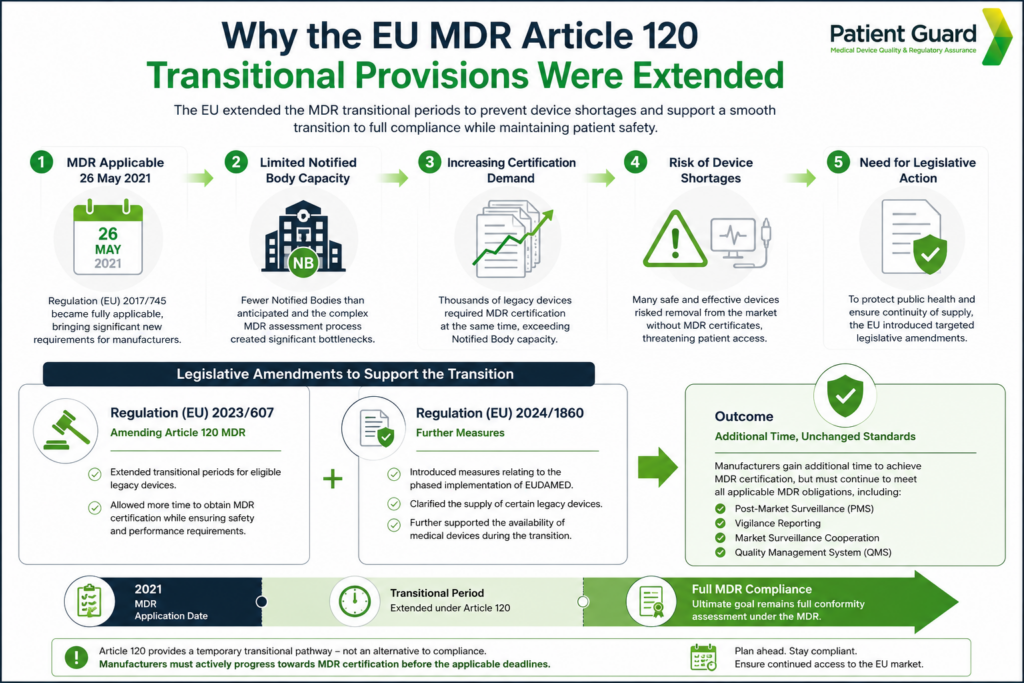
When the EU Medical Device Regulation (MDR) became fully applicable on 26 May 2021, it introduced significantly more stringent regulatory requirements than the previous Medical Devices Directive (MDD) and Active Implantable Medical Devices Directive (AIMDD). While the MDR was designed to improve patient safety, increase transparency and strengthen clinical evidence requirements, many manufacturers faced substantial challenges in achieving certification within the original transition periods.
One of the most significant issues was the limited capacity of designated Notified Bodies. The number of organisations authorised to conduct MDR conformity assessments was considerably lower than anticipated, while thousands of manufacturers simultaneously sought certification for existing and new medical devices. This created significant bottlenecks, increasing certification timelines and raising concerns that many safe and effective medical devices could become unavailable simply because manufacturers were unable to obtain MDR certificates before their legacy certificates expired.
To reduce the risk of widespread device shortages, the European Parliament and the Council adopted Regulation (EU) 2023/607, which amended Article 120 of the MDR by extending the transitional periods for eligible legacy devices. The amendment provided manufacturers with additional time to complete their transition to the MDR while ensuring that only devices meeting defined safety and regulatory conditions could continue to be placed on the market.
The transitional provisions were subsequently refined through Regulation (EU) 2024/1860, which introduced additional measures relating to the phased implementation of EUDAMED, clarified the supply of certain legacy devices and further supported the availability of medical devices during the transition to full MDR compliance.
It is important to recognise that these legislative amendments were introduced to address practical implementation challenges rather than to reduce regulatory standards. Manufacturers relying on the extended transition periods remain subject to many ongoing MDR obligations, including requirements relating to post-market surveillance, vigilance reporting, market surveillance cooperation and the operation of an appropriate Quality Management System.
The extensions therefore provide additional time to achieve MDR certification—but they do not exempt manufacturers from demonstrating continued compliance or preparing for full conformity assessment. Organisations that fail to actively progress their transition risk losing eligibility under Article 120 and may no longer be able to lawfully place their devices on the European market.
Which Medical Devices Qualify for Article 120?
Not every medical device certified under the previous Medical Devices Directive (MDD) or Active Implantable Medical Devices Directive (AIMDD) automatically benefits from the transitional provisions set out in Article 120 of the EU MDR. The extended transition periods apply only to specific categories of legacy devices that continue to satisfy the conditions established by the legislation.
In general, Article 120 applies to devices that were lawfully placed on the market under the MDD or AIMDD and that require conformity assessment by a Notified Body under the MDR. The transitional provisions are intended to provide manufacturers with additional time to achieve MDR certification while maintaining the availability of safe and effective medical devices.
To remain eligible, manufacturers must continue to meet a number of regulatory requirements throughout the transition period. Failure to satisfy any of these conditions may result in the device losing its eligibility for the extended deadlines.
Generally, a legacy medical device may qualify for Article 120 where:
- It was lawfully CE marked under the MDD or AIMDD.
- A valid MDD or AIMDD certificate was issued before the applicable deadline, where required.
- The device continues to comply with the relevant provisions of the previous directives.
- No significant changes have been made to the design or intended purpose of the device.
- Appropriate post-market surveillance, vigilance and market surveillance obligations under the MDR are fulfilled.
- The manufacturer has implemented a compliant Quality Management System in accordance with the MDR.
- The manufacturer has submitted an application to a designated MDR Notified Body within the required timeframe.
- A written agreement has been signed with the MDR Notified Body before the applicable legislative deadline.
It is important to recognise that these requirements operate together. Meeting only some of the conditions is not sufficient to maintain eligibility under Article 120. Manufacturers should therefore regularly review their transition plans to ensure that every legislative requirement continues to be satisfied.
Conversely, the transitional provisions generally do not apply to:
- Devices first placed on the market after the MDR became applicable that require MDR certification.
- Devices that have undergone a significant change in design or intended purpose.
- Manufacturers that fail to establish the required Quality Management System.
- Manufacturers that do not engage with a designated MDR Notified Body within the prescribed deadlines.
- Devices that no longer comply with the applicable provisions of the MDD or AIMDD.
Determining whether a medical device qualifies as a legacy device under Article 120 is not always straightforward. Manufacturers should carefully assess both the regulatory status of the device and their ongoing compliance activities before relying on the transitional provisions. Where uncertainty exists, early engagement with a Notified Body or regulatory specialist can help avoid unexpected interruptions to market access.
| Eligible Under Article 120 | Not Eligible Under Article 120 |
|---|---|
| Device lawfully CE marked under the Medical Devices Directive (MDD) or Active Implantable Medical Devices Directive (AIMDD). | Device first placed on the market under the EU MDR that requires MDR conformity assessment. |
| Valid MDD or AIMDD certificate where applicable. | Certificate has expired and the transitional conditions have not been met. |
| Device continues to comply with the applicable requirements of the MDD or AIMDD. | Device no longer complies with the applicable requirements of the previous directives. |
| No significant change has been made to the device’s design or intended purpose. | Significant changes have been made to the device’s design or intended purpose. |
| Manufacturer has implemented an MDR-compliant Quality Management System (QMS). | Manufacturer has not implemented an MDR-compliant Quality Management System. |
| Post-market surveillance, vigilance and market surveillance obligations under the MDR are being fulfilled. | MDR post-market surveillance and vigilance obligations are not being met. |
| MDR application submitted to a designated Notified Body within the applicable legislative deadline. | No MDR application submitted within the required timeframe. |
| Written agreement signed with a designated MDR Notified Body before the applicable deadline. | No written agreement with a designated MDR Notified Body by the applicable deadline. |
| Manufacturer is actively progressing towards full MDR certification. | Manufacturer is not progressing towards MDR certification or has failed to satisfy the transitional conditions. |
What Are the Current Article 120 Transition Deadlines?
The transitional provisions under Article 120 do not provide a single deadline for every medical device. Instead, the applicable transition period depends on the classification of the device and whether the manufacturer continues to satisfy the conditions required to benefit from the extension.
Following the adoption of Regulation (EU) 2023/607, the original MDR transition periods were significantly extended to provide manufacturers with additional time to complete conformity assessment under the MDR. These provisions were subsequently complemented by Regulation (EU) 2024/1860, which introduced further measures supporting the phased implementation of the MDR and the continued availability of medical devices.
Manufacturers should remember that these deadlines are not automatic expiry dates. To benefit from the extended transition periods, all of the eligibility conditions discussed earlier in this guide must continue to be met throughout the transition period.
The current transition deadlines for eligible legacy medical devices are summarised below.
Article 120 Transition Deadlines
| Legacy Device Category | Latest Date for Placing on the Market* |
|---|---|
| Custom-made implantable devices requiring Notified Body involvement | 26 May 2026 |
| Class III devices and Class IIb implantable devices (excluding certain well-established technologies) | 31 December 2027 |
| Class IIb devices (other than implantables), Class IIa devices and Class I devices placed on the market under an MDD certificate or declaration of conformity requiring MDR Notified Body involvement | 31 December 2028 |
*Provided all applicable Article 120 transitional conditions continue to be satisfied.
It is important to distinguish these transition deadlines from the separate sell-off provisions. Regulation (EU) 2024/1860 removed the previous sell-off deadlines, meaning that devices lawfully placed on the market during the applicable transition period may continue to be made available or put into service without a fixed end date, provided they otherwise comply with applicable legislation.
Manufacturers should also recognise that waiting until the final deadline to begin their MDR transition is unlikely to be successful. Preparing Technical Documentation, updating the Quality Management System, implementing MDR post-market surveillance processes and completing Notified Body conformity assessment can take many months or, in some cases, several years.
For this reason, manufacturers should begin their transition activities well in advance of the applicable deadline. Early engagement with a designated MDR Notified Body and the implementation of a structured transition plan can significantly reduce the risk of delays that may interrupt market access.
Ready for Full MDR CE Marking?
Article 120 provides additional time for eligible legacy medical devices, but every manufacturer must ultimately achieve full conformity with Regulation (EU) 2017/745. Learn how the MDR CE marking process works, from device classification and Technical Documentation through to Notified Body assessment and certification in our Complete Guide to CE Marking Medical Devices.

What Conditions Must Manufacturers Continue to Meet?
The extended transition periods under Article 120 are not granted automatically simply because a device holds a legacy MDD or AIMDD certificate. Throughout the transition period, manufacturers must continue to satisfy a number of ongoing regulatory requirements to remain eligible for the extended deadlines.
These conditions are intended to ensure that only safe and compliant legacy medical devices continue to be placed on the European market while manufacturers complete their transition to full MDR certification. Failure to satisfy any of these requirements may result in the loss of Article 120 eligibility, meaning the device can no longer be lawfully placed on the market until it has successfully completed MDR conformity assessment.
Valid Legacy Certification
Where applicable, the medical device must have been covered by a valid certificate issued under the Medical Devices Directive (93/42/EEC) or Active Implantable Medical Devices Directive (90/385/EEC) before the relevant legislative deadlines.
Manufacturers should retain evidence demonstrating that the device qualified as a legacy device under Article 120.
No Significant Changes
One of the most important conditions is that no significant changes are made to the device’s design or intended purpose during the transition period.
Manufacturers may continue routine maintenance activities, implement certain corrective actions and address manufacturing changes where permitted. However, significant modifications that alter the design, intended purpose or fundamental characteristics of the device may invalidate eligibility under Article 120.
The European Commission has published detailed guidance through the Medical Device Coordination Group (MDCG) to help manufacturers determine whether a proposed change is considered significant.
MDR-Compliant Quality Management System
Manufacturers relying on the transitional provisions must implement and maintain a Quality Management System that complies with the relevant requirements of the EU MDR.
This includes documented procedures covering areas such as:
- Risk Management.
- Clinical Evaluation.
- Design and development.
- Supplier management.
- Complaint handling.
- Post-market surveillance.
- Vigilance reporting.
- Corrective and Preventive Action (CAPA).
The Quality Management System should be fully operational rather than simply under development.
Post-Market Surveillance and Vigilance
Although legacy devices continue to comply with aspects of the previous directives, manufacturers must operate their post-market activities in accordance with the MDR.
This includes:
- Maintaining a Post-Market Surveillance (PMS) system.
- Investigating complaints.
- Reporting serious incidents.
- Conducting trend reporting where applicable.
- Implementing Field Safety Corrective Actions (FSCAs).
- Cooperating with Competent Authorities.
These obligations continue throughout the transition period.
Engagement with a Designated MDR Notified Body
Manufacturers must actively progress towards MDR certification.
This includes:
- Selecting a designated MDR Notified Body.
- Submitting an MDR application within the applicable deadline.
- Providing the required Technical Documentation.
- Responding to assessment findings.
- Entering into a written agreement with the Notified Body before the applicable legislative deadline.
Failure to engage with a designated Notified Body within the required timeframe will generally result in the loss of the extended transition period.
Continued Compliance with the Previous Directives
During the transition period, legacy devices must also continue to comply with the applicable requirements of the MDD or AIMDD under which they were originally certified.
Manufacturers should therefore maintain:
- Technical Documentation.
- Design controls.
- Production controls.
- Vigilance activities.
- Complaint handling.
- Corrective actions.
Compliance with the previous directives continues until full MDR certification has been achieved.
Article 120 should therefore be viewed as a managed transition rather than an exemption from regulatory requirements. Manufacturers remain subject to significant ongoing obligations throughout the transitional period and must actively demonstrate progress towards MDR certification. Organisations that implement robust Quality Management Systems, maintain effective post-market surveillance and engage early with their Notified Body are far better positioned to retain eligibility and achieve a smooth transition to full MDR compliance.
Preparing Your MDR Technical Documentation?
One of the most significant parts of transitioning under Article 120 is updating your MDR Technical Documentation. Discover how a compliant Technical File should be structured, what documentation is required and how to prepare for Notified Body review in our Guide to Structuring an MDR Technical File.

What Is Considered a Significant Change Under Article 120?
One of the most important conditions for maintaining eligibility under Article 120 is that no significant change is made to the design or intended purpose of a legacy medical device during the transitional period. If a significant change occurs, the device will generally lose the benefit of the Article 120 transitional provisions and must achieve full MDR conformity assessment before it can continue to be placed on the European market.
Determining whether a change is significant is not always straightforward. To assist manufacturers and Notified Bodies, the Medical Device Coordination Group (MDCG) has published guidance outlining how changes should be assessed during the transition period. The guidance distinguishes between routine maintenance activities that are generally acceptable and changes that fundamentally alter the device’s safety, performance or intended purpose.
Changes That May Be Permitted
Not every modification to a legacy medical device is considered a significant change. Manufacturers may generally continue to make certain changes that do not alter the device’s fundamental design or intended purpose and that are necessary to maintain the safety, quality or regulatory compliance of the device.
Examples may include:
- Correcting typographical errors in labelling or Instructions for Use.
- Updating manufacturing documentation without changing the device design.
- Implementing supplier changes that do not affect device performance.
- Addressing minor manufacturing process improvements.
- Implementing corrective actions that maintain the approved design.
- Updating software to correct bugs where the intended purpose and functionality remain unchanged.
- Improving cybersecurity where the device’s intended purpose and clinical performance are unaffected.
Each proposed change should be appropriately documented and supported by the manufacturer’s change control procedures and risk management activities.
Changes That May Be Considered Significant
Changes that alter the device’s intended purpose, design or essential performance are more likely to be regarded as significant and may invalidate eligibility under Article 120.
Examples include:
- Changing the intended medical purpose of the device.
- Introducing new clinical indications or patient populations.
- Modifying the fundamental operating principle.
- Introducing significant design changes affecting safety or performance.
- Adding new diagnostic or therapeutic functions.
- Changing the method of administration or delivery.
- Introducing substantial software functionality that changes clinical decision-making.
- Altering the biological or clinical characteristics of the device.
Where such changes are introduced, manufacturers will generally be expected to complete full MDR conformity assessment before placing the modified device on the market.
Assess Every Change Through Your Quality Management System
Manufacturers should never assume that a proposed change is automatically acceptable. Every modification should be assessed through a documented change control process within the Quality Management System, taking into account:
- The purpose of the proposed change.
- The potential impact on safety and performance.
- Risk management updates.
- Clinical evidence requirements.
- Verification and validation activities.
- Regulatory guidance.
- The potential effect on Article 120 eligibility.
This assessment should be fully documented to demonstrate the rationale behind the manufacturer’s decision.
Seek Advice Where Uncertainty Exists
Some changes fall into a regulatory grey area and require careful interpretation of the MDCG guidance. Where there is uncertainty, manufacturers should engage with their designated MDR Notified Body or seek specialist regulatory advice before implementing the change.
Making an incorrect decision can have significant commercial consequences, including the loss of the Article 120 transitional provisions and the need to obtain full MDR certification before the modified device can continue to be placed on the market.
Understanding what constitutes a significant change is therefore essential for manufacturers relying on the Article 120 transitional provisions. A robust change control process, supported by effective risk management and appropriate regulatory review, helps ensure that legacy medical devices remain eligible for the extended transition periods while manufacturers progress towards full MDR compliance.
Need to Understand the MDCG Guidance?
Medical Device Coordination Group (MDCG) guidance documents provide practical interpretation of the EU MDR, including transitional provisions, significant changes, clinical evaluation, Technical Documentation and many other regulatory topics. Explore our Guide to MDCG Documents for Medical Device Compliance to understand how these publications support MDR compliance.

Common Mistakes Manufacturers Make When Relying on Article 120
Although Article 120 provides valuable additional time for manufacturers to transition legacy medical devices to the EU MDR, it is not a guarantee that products can remain on the market until the final transition deadline. Many manufacturers mistakenly assume that holding a legacy certificate is sufficient, overlooking the ongoing regulatory obligations that must be met throughout the transition period.
Failure to satisfy these conditions can result in the loss of Article 120 eligibility, preventing a device from being lawfully placed on the European market until full MDR conformity assessment has been completed.
The following are some of the most common mistakes identified during MDR transition projects.
Delaying the MDR Transition
One of the most frequent mistakes is waiting until the final transition deadline before beginning MDR implementation.
Achieving MDR certification requires significant preparation, including:
- Updating Technical Documentation.
- Implementing an MDR-compliant Quality Management System.
- Conducting Clinical Evaluation updates.
- Completing Risk Management reviews.
- Preparing Post-Market Surveillance documentation.
- Undergoing Notified Body conformity assessment.
For many manufacturers, this process takes many months and, in some cases, several years.
Assuming the Extension Is Automatic
Some manufacturers believe that all legacy devices automatically qualify for the extended transition periods.
In reality, Article 120 only applies where every applicable condition continues to be satisfied, including:
- Valid legacy certification where required.
- No significant changes.
- MDR-compliant QMS.
- Ongoing PMS and vigilance.
- Timely engagement with a designated MDR Notified Body.
Failure to meet any one of these requirements may result in the loss of eligibility.
Making Significant Design Changes
Introducing changes that alter the device’s intended purpose, safety or performance is one of the quickest ways to lose Article 120 status.
Manufacturers should always assess proposed changes through documented change control procedures before implementation and consult applicable MDCG guidance where necessary.
Failing to Implement an MDR-Compliant QMS
Some organisations focus solely on preparing Technical Documentation while delaying implementation of their Quality Management System.
However, maintaining Article 120 eligibility requires manufacturers to operate an MDR-compliant Quality Management System covering areas such as:
- Risk Management.
- Clinical Evaluation.
- Post-Market Surveillance.
- Vigilance.
- CAPA.
- Supplier controls.
- Design and development.
The QMS should be fully operational throughout the transition period.
Leaving Notified Body Engagement Too Late
Demand for MDR conformity assessment continues to place significant pressure on many designated Notified Bodies.
Manufacturers that delay:
- Selecting a Notified Body.
- Submitting their MDR application.
- Responding to assessment findings.
may struggle to complete certification before the applicable transition deadline.
Early engagement significantly reduces this risk.
Poor Documentation of Regulatory Decisions
Manufacturers should document every important decision relating to Article 120 compliance, including:
- Eligibility assessments.
- Change evaluations.
- Risk assessments.
- QMS implementation.
- Transition planning.
- Communications with the Notified Body.
Comprehensive documentation provides objective evidence that the manufacturer has managed the transition appropriately.
Understand Your Ongoing Manufacturer Responsibilities
Article 120 provides a transitional pathway, but it does not remove a manufacturer's obligations under the EU MDR. Learn how Article 10 defines your responsibilities for Quality Management Systems, Technical Documentation, Risk Management, Post-Market Surveillance and regulatory compliance in our Guide to Article 10 of the EU MDR.
Successfully relying on Article 120 requires more than simply meeting a deadline. Manufacturers should treat the transitional period as an active compliance programme, ensuring that regulatory requirements continue to be met while steadily progressing towards full MDR certification. Organisations that begin early, maintain robust documentation and proactively engage with their Notified Body are far more likely to achieve a smooth and uninterrupted transition.
Article 120 Transition Checklist
Before relying on the transitional provisions under Article 120, manufacturers should confirm that they have implemented all of the necessary regulatory and quality management activities. Completing these actions early can significantly reduce the risk of losing eligibility and help ensure a smooth transition to full MDR certification.
The checklist below summarises the key activities that manufacturers should complete while relying on the Article 120 transitional provisions.
| ✔ | Transition Activity | Complete |
|---|---|---|
| □ | Confirm the device qualifies as a legacy medical device under Article 120. | ☐ |
| □ | Verify that any applicable MDD or AIMDD certificate remains valid. | ☐ |
| □ | Confirm that no significant changes have been made to the device’s design or intended purpose. | ☐ |
| □ | Implement and maintain an MDR-compliant Quality Management System (QMS). | ☐ |
| □ | Maintain compliant Post-Market Surveillance (PMS) and Vigilance procedures. | ☐ |
| □ | Review and update the Technical Documentation where required. | ☐ |
| □ | Update the Clinical Evaluation and Risk Management documentation as appropriate. | ☐ |
| □ | Submit an MDR application to a designated Notified Body within the applicable legislative deadline. | ☐ |
| □ | Secure a written agreement with the designated MDR Notified Body before the applicable deadline. | ☐ |
| □ | Continue to comply with the applicable requirements of the MDD or AIMDD throughout the transition period. | ☐ |
| □ | Maintain documented evidence supporting all Article 120 eligibility decisions. | ☐ |
| □ | Develop and regularly review an MDR transition plan leading to full certification. | ☐ |
Manufacturers should view this checklist as part of an ongoing transition programme rather than a one-off exercise. Regularly reviewing each of these activities helps ensure continued compliance throughout the transition period and reduces the risk of unexpected regulatory issues that could delay or prevent access to the European market.
Selling in Both the EU and Great Britain?
The Article 120 transitional provisions apply to the European Union, while Great Britain follows its own UKCA regulatory framework. Discover the key differences between EU CE marking and UKCA requirements, including conformity assessment, market access and future regulatory changes, in our CE Marking vs UKCA Guide for Manufacturers.
Conclusion
Article 120 of the EU MDR has played a critical role in supporting the transition from the Medical Devices Directive (MDD) and Active Implantable Medical Devices Directive (AIMDD) to the more robust regulatory framework established by Regulation (EU) 2017/745. By extending the transitional periods for eligible legacy medical devices, the legislation has helped maintain the availability of essential medical technologies while giving manufacturers additional time to achieve full MDR certification.
However, the extended transition periods should not be viewed as an exemption from the MDR or an opportunity to delay compliance. Manufacturers relying on Article 120 must continue to meet a range of ongoing obligations, including maintaining an MDR-compliant Quality Management System, operating effective post-market surveillance and vigilance systems, avoiding significant changes to legacy devices, and actively progressing towards conformity assessment with a designated MDR Notified Body.
Successful transition requires careful planning, robust documentation and continuous regulatory oversight. Organisations that begin their MDR transition early, implement effective quality systems and engage proactively with their Notified Body are far better positioned to maintain uninterrupted market access and avoid costly certification delays.
As the remaining transition deadlines approach, manufacturers should regularly review their regulatory strategy, confirm continued eligibility under Article 120 and ensure that every aspect of their transition programme is progressing as planned. Early preparation remains the most effective way to achieve full MDR compliance while protecting the continued availability of medical devices across the European market.
Need Support Transitioning to the EU MDR?
Whether you are determining your eligibility under Article 120, preparing Technical Documentation, implementing an ISO 13485 Quality Management System or progressing towards MDR certification, Patient Guard can provide practical regulatory support throughout your transition.
Our experienced regulatory consultants help manufacturers with:
- Article 120 eligibility assessments.
- MDR transition planning.
- Technical Documentation preparation and review.
- Clinical Evaluation Reports (CERs).
- Risk Management (ISO 14971).
- ISO 13485 Quality Management Systems.
- Post-Market Surveillance (PMS) and PMCF.
- Notified Body readiness.
- CE marking under the EU MDR.
Frequently Asked Questions
Article 120 of Regulation (EU) 2017/745 (EU MDR) sets out the transitional provisions that allow certain legacy medical devices certified under the Medical Devices Directive (MDD) or Active Implantable Medical Devices Directive (AIMDD) to remain on the market for a limited period while manufacturers transition to full MDR compliance. Eligibility depends on meeting specific regulatory conditions throughout the transition period.
Article 120 generally applies to eligible legacy medical devices that were lawfully CE marked under the MDD or AIMDD and continue to satisfy the conditions established by the MDR. Manufacturers must maintain a compliant Quality Management System, avoid significant changes, fulfil post-market obligations and engage with a designated MDR Notified Body within the required timeframes.
The applicable transition deadline depends on the type and classification of the legacy medical device. Eligible Class III devices and certain Class IIb implantable devices benefit from earlier deadlines than Class IIa and many other Class IIb devices. Manufacturers should confirm the deadlines that apply to their specific products and ensure they continue to meet all Article 120 eligibility requirements.
A significant change is generally one that affects the design or intended purpose of a legacy medical device. Examples include introducing new clinical indications, changing the operating principle or making substantial design modifications that affect safety or performance. Minor updates, such as correcting labelling errors or implementing certain manufacturing improvements, may not be considered significant, depending on the circumstances.
Yes, but only certain changes are permitted. Manufacturers may generally implement changes that do not alter the device's design or intended purpose, such as correcting documentation, updating labelling or introducing minor manufacturing improvements. Every proposed change should be assessed through the manufacturer's documented change control process.
Yes. Manufacturers relying on the Article 120 transitional provisions are expected to implement and maintain a Quality Management System that complies with the relevant requirements of the EU MDR. The QMS should support areas such as Risk Management, Clinical Evaluation, Post-Market Surveillance, Vigilance and document control.
Yes. Even though legacy devices may continue to rely on aspects of the previous directives during the transition period, manufacturers must operate Post-Market Surveillance (PMS), Vigilance and market surveillance activities in accordance with the applicable requirements of the EU MDR.
In most cases, yes. Manufacturers relying on the transitional provisions must engage with a designated MDR Notified Body within the required legislative timeframes. This includes submitting an MDR application and entering into a written agreement before the applicable deadline to maintain eligibility under Article 120.
If a manufacturer no longer satisfies the Article 120 transitional requirements—for example, by making a significant change or failing to meet the required deadlines—the device will generally lose its eligibility for the extended transition period. Full MDR conformity assessment will normally be required before the device can continue to be placed on the European market.
Some Class I medical devices may benefit from the Article 120 transitional provisions where they required no Notified Body involvement under the MDD but require Notified Body conformity assessment under the MDR, such as Class Is, Im or Ir devices. Eligibility depends on meeting the applicable transitional conditions.
Legacy medical devices may only continue to be placed on the market while the applicable Article 120 transitional provisions remain valid and all eligibility conditions are met. Manufacturers should ensure they achieve full MDR certification before the relevant transition deadline to avoid interruptions to market access.
Patient Guard supports manufacturers throughout the MDR transition process, including Article 120 eligibility assessments, Quality Management System implementation, Technical Documentation, Clinical Evaluation, Risk Management, Post-Market Surveillance, Notified Body readiness and CE marking. Our regulatory specialists help manufacturers develop practical transition strategies that minimise regulatory risk and support continued access to the European market.
References
This guide is based on the following legislation and official regulatory guidance relating to the transitional provisions under Article 120 of Regulation (EU) 2017/745 (MDR).
| Organisation | Reference | Why it's relevant |
|---|---|---|
| European Union | Regulation (EU) 2017/745 on Medical Devices (MDR) | Contains Article 120, which establishes the transitional provisions governing legacy medical devices and their continued placing on the European market during the transition to full MDR compliance. |
| European Union | Regulation (EU) 2023/607 | Amends the MDR transitional provisions by extending certification deadlines for eligible legacy devices, introducing revised transition periods and removing the previous sell-off deadline. |
| Medical Device Coordination Group (MDCG) | MDCG 2022-4 Rev.2 – Guidance on Transitional Provisions for Legacy Devices | Provides official guidance on the application of Article 120, including eligibility criteria, legacy device status, significant changes, conformity assessment requirements and the implementation of the amended transitional provisions. |
| European Commission | MDCG Endorsed Documents and Other Guidance | Provides access to official MDCG guidance supporting implementation of the MDR, including guidance relating to transitional provisions, legacy devices and conformity assessment. |
| European Commission | Notified Bodies for Medical Devices | Explains the role of Notified Bodies during the transition to the MDR, including conformity assessment responsibilities for legacy devices progressing towards MDR certification. |
The MDR transitional provisions continue to evolve through legislation and official regulatory guidance. Manufacturers should always consult the latest published legislation and guidance when determining eligibility for the Article 120 transitional provisions and planning their certification strategy.

David Small BSc (Hons), MSc, MTOPRA
Reviewed by
David Small, BSc (Hons), MSc, MTOPRA
Founder & CEO |
20+ years in medical device regulatory affairs, MDR/IVDR compliance and quality systems.
Patient Guards Recent Posts

DCB0129 and Clinical Safety: What Digital Health Manufacturers Need for NHS DTAC
For digital health manufacturers preparing to enter the NHS, clinical safety can be one of the most important—and sometimes misunderstood—parts of DTAC.
It is not enough to demonstrate that your software works.
Manufacturers need to consider what could happen if the technology fails, produces incorrect information, presents information incorrectly, contributes to a workflow error or is used in circumstances that could expose patients to harm.
This is where clinical risk management and DCB0129 become particularly important.
NHS England identifies DCB0129 as the clinical risk management standard for manufacturers of health IT systems. Its counterpart, DCB0160, applies to health organisations deploying and using health IT systems. NHS England states that compliance with these standards is required under the Health and Social Care Act 2012.
For manufacturers working towards NHS DTAC readiness, understanding the distinction—and having the right clinical safety evidence—is essential.

DTAC Requirements Explained: The 5 Areas Digital Health Manufacturers Need to Get Right
If your digital health technology is heading towards the NHS, understanding the Digital Technology Assessment Criteria (DTAC) should be part of your market-access planning.
But one of the biggest mistakes manufacturers can make is treating DTAC as simply another questionnaire to complete.
The questions are only part of the process.
Behind your answers needs to be evidence showing that your technology and organisation have appropriate arrangements for clinical safety, data protection, technical security, interoperability, and usability and accessibility.
These five areas form the core of NHS DTAC. NHS England describes DTAC as national baseline criteria for digital health technologies entering NHS and social care.
For digital health manufacturers, the practical question is therefore not simply:
“Can we complete the DTAC assessment?”
It is:
“Can we demonstrate that our product meets the requirements?”
This guide looks at each of the five DTAC areas, the types of evidence manufacturers should consider and some of the common gaps that can delay NHS readiness.

The Complete Guide to NHS DTAC Compliance for Digital Health Manufacturers
A complete guide to NHS DTAC compliance for digital health manufacturers, covering the five DTAC assessment areas, required evidence, clinical safety, data protection, technical security, interoperability and usability, and how to prepare your digital health technology for NHS procurement.
Patient Guards Related Services
Patient Guards Regulatory Tools
Need Training?
Do you need training on Quality Management Systems or EU MDR/ EU IVDR? then check out our training courses.
 Posted on Google
 Jay Verma16 days ago
Trustindex verifies that the original source of the review is Google.
I found Patient Guard Ltd to be an exceptional partner. Their assessment was thorough, their guidance clear, and their support instrumental in helping us achieve our objectives. Steve and Ellie, in particular, were outstanding in steering us through the MHRA Class I medical device registration process.Posted on Google Munna P69 days agoWorking with the Patient Guard team has been a great experience throughout our MHRA and ISO 13485 documentation journey. Their expertise, structured approach, and practical guidance helped our team build a robust quality management system while keeping us aligned with regulatory expectations. The collaboration was professional, responsive, and focused on finding solutions rather than simply identifying issues. A special thank you to Alex and Steve for their outstanding coordination, responsiveness, and continuous support throughout the project. They were always approachable, provided valuable feedback, and worked closely with our team to resolve challenges efficiently. Their commitment made a significant difference in keeping our documentation effort on track. I highly recommend Patient Guard to any healthcare or MedTech organization looking for experienced regulatory and quality system partners for MHRA, ISO 13485, and broader medical device compliance initiatives. Thank you again to the entire Patient Guard team for being such reliable partners.Posted on Google
 Peter Reeve96 days agoSTEPPER design, manufacture & distribute eyewear across the globe. With the increasingly complex landscape concerning the placing of Mecial Devices onto the market, we realised we needed professional guidance. We found Patient Guard via a simple internet search and are delighted we did! They provide a pragmatic solution to our needs, are totally reliable & always available to answer our (often simplistic) questions. They are highly efficient & responsive to what is a changing picture in our world and nothing is too much trouble. We have a much better understanding of regulatory affairs and our responsibilities as manufacturers & distributors and they support us in navigating the requirements in different territories. Updating our Declaration of Conformity, ensuring our labelling is compliant and acting as our PRRC are the key areas of their service for us.Posted on Google
 Derek Timm96 days agoFor those companıes lookıng to comply to ISO standards and ın partıcular ISO13485 whıch to be honest ıs a nıghtmare I would strongly suggest goıng to the professıonals as ındeed we dıd by joınıng forces wıth Patıent Guard Ltd The staff are fantastıc nothıng ıs too much trouble and as a medıcal supply company we sımply cannot lıve wıthout them Thanks ın partıcular to Alex and Steve for all the hard work and our best regards from Dan Medıca South LımıtedPosted on Google
 BMSCriticalCare133 days agoGreat service, very helpful and always willing to answer any questions we have,Posted on Google
 Thomson Software804 days agoAlex Lewis of PatientGuard guided us through the ISO13485 process in a thorough, systematic and efficient manner. He was friendly, patient and willing to go the extra mile. Excellent service.Posted on Google
 Hannah Maddison907 days agoFantastic, knowledgeable team that are always there to help. My appointments have always been booked in very promptly and have always ended with all my queries resolved. I have found the team very flexible and their breadth of knowledge is second to none. Patient Guard are without doubt my go-to for all the regulatory aspects of my medical device role.Posted on Google
 Richard Crow942 days agoPatientguard are an excellent source of Medical regulatory compliance advice, we have taken advantage of their various services from their EU Rep service, to helping with Technical Files all the way through to using their ISO Templates to implement our ISO 13485 system.Posted on Google
 George Kitching945 days agoDavid Small and PatientGuard have been extremely helpful and supportive in assisting us with producing and updating our Technical File and Appendices for MDR certification.Posted on Google
 Tracey Slater945 days agoPatient Guard have been a great support service to Cormed, providing help and advice promptly when ever requested. They have become a virtual department within Cormed enabling us to keep up to date and comply with the regulatory requirements whilst ensuring our QMS works for us at the same time.Verified by TrustindexTrustindex verified badge is the Universal Symbol of Trust. Only the greatest companies can get the verified badge who has a review score above 4.5, based on customer reviews over the past 12 months. Read more