UK Regulations

Skin Irritation Testing in the biological evaluation of medical devices (ISO 10993-23)

In Vitro Skin Irritation Testing: ISO 10993-23 Standard

Skin irritation occurs when a substance causes inflammation or damage to the skin upon contact. For medical devices, this can be a serious concern, as they are often in prolonged contact with the skin. The consequences of not adequately testing for irritation can range from minor redness to severe dermatitis, leading to discomfort, injury, or even infection in users. Therefore, reliable testing methods are crucial to ensure that products are safe before they reach the market.

In Vitro Skin Irritation Testing: ISO 10993-23 Standard Read More »

Cytotoxicity Testing in Medial Devices ISO 10993-5

Cytotoxicity Testing in Medical Device Biological Evaluation

In the highly regulated world of medical devices, ensuring patient safety is paramount. One of the essential components of this safety assurance is cytotoxicity testing, specifically adhering to ISO 10993-5 standards. This blog explores the importance of ISO 10993-5 cytotoxicity testing, particularly for medical devices that come into direct contact with patients, and how it contributes to the overall safety and efficacy of these devices.

Cytotoxicity Testing in Medical Device Biological Evaluation Read More »

A certificate that says 'ISO 13485 certified' on it - This image is used by patient guard to represent ISO 13485 quality assurance and QMS services.

What is ISO 13485? The Complete Guide to Medical Device QMS

ISO 13485:2016 is the international standout standard that defines the precise requirements for a Quality Management System (QMS) specific to the medical device industry. Unlike general business quality frameworks, it prioritizes patient safety, clinical efficacy, and global regulatory compliance ahead of standard consumer satisfaction metrics.

Whether you are an active medical device manufacturer, a software-as-a-service (SaMD) developer, an importer, or an EU/UK distributor, demonstrating compliance with this standard is virtually mandatory to secure and retain critical market access.

What is ISO 13485? The Complete Guide to Medical Device QMS Read More »

global medical device and IVD registrations.

Medical Device & IVD registration

Medical device registration is an essential part of commercialising your medical device or IVD.  First requires you to obtain registration and approval from regulatory agencies in each country where you plan to sell your device. Device registration requirements can vary significantly from country to country, which can create compliance challenges for companies pursuing multiple-market strategies. 

Medical Device & IVD registration Read More »

Image of a file with a cog and lines above it representing text. The cog represents technical information. The image is used by patient guard limited to discuss medical device technical files (EU 2017/745).

How to Structure a Medical Device Technical File

A medical device technical file is a concise set of documents created by a manufacturer to explain the performance and safety of a particular Medical Device in a clear, well-organized, easily searchable, and unambiguous manner.

In order to prove compliance with the general safety and performance criteria of the legislation, the manufacturer must have – and keep up-to-date – this technical documentation, regardless of  medical device class.

How to Structure a Medical Device Technical File Read More »

medical device consultancy

Medical Device Regulatory Strategy for Startups: A Complete Guide (2026)

Launching a medical device startup can be an exciting journey, but regulatory requirements are often underestimated during the early stages of product development. Many start-ups focus on innovation, funding, and product design while leaving regulatory planning until later. Unfortunately, this approach can lead to significant delays, increased costs, and even project failure.

A well-defined regulatory strategy should be established as early as possible to ensure your medical device reaches the market efficiently while meeting all applicable regulatory requirements.

In this guide, we explain how medical device startups can build a successful regulatory strategy and avoid common compliance pitfalls.

Medical Device Regulatory Strategy for Startups: A Complete Guide (2026) Read More »

Medical Devices Classification - This is an illustration of two contact lenses. This image is used by patient guard to represent an example of class IIa medical devices.

Medical Devices Classification UK

In the UK Medical Devices are categorised into 7 classes, these are Class I, Class Is (sterile), Class Im (measuring), Class Ir (reusable surgical tools), Class IIa, Class IIb and Class III.  

Class I devices are considered to be of low risk, Class II devices as medium risk and Class III devices as high risk. 

Depending on the classification of device determines the regulatory conformity pathway that needs to be taken to gain compliance and allow manufacturers to place product on the UK market. 

Medical Devices Classification UK Read More »

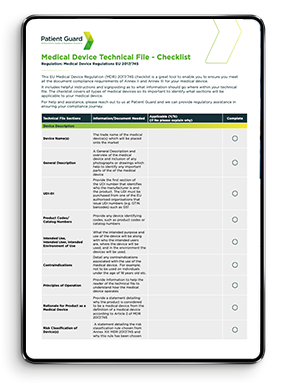
Get the Medical Device Technical Checklist

Thank you! The checklist is now ready to download.

checklist-tablet