
Updated: 13th September 2026
Reviewed by: David Small BSc (Hons), MSc, MTOPRA (Founder and CEO)
What is Medical Device Packaging Validation?
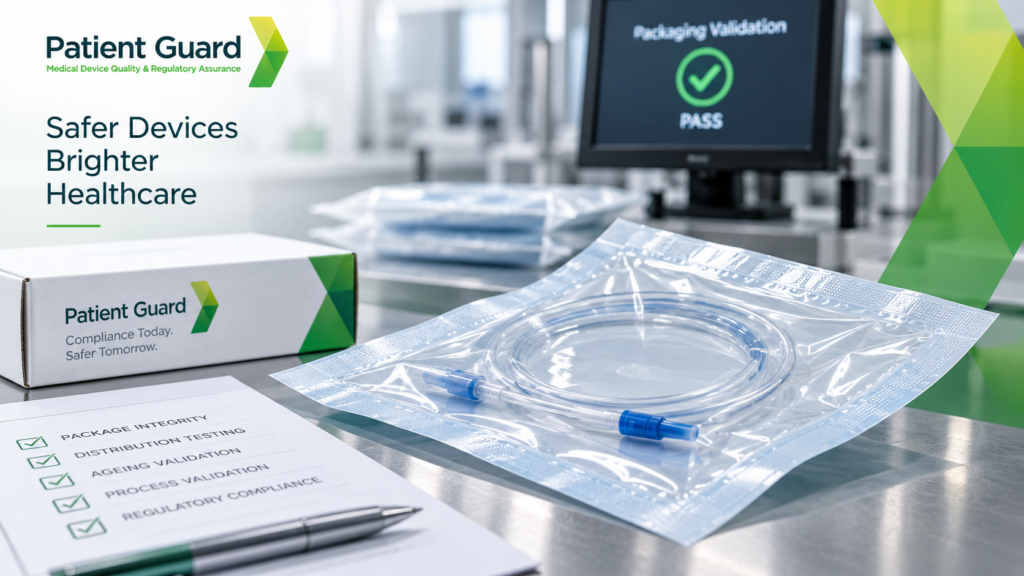
Medical device packaging validation is the documented process of demonstrating that a packaging system is capable of consistently protecting a medical device throughout its intended lifecycle.
For sterile medical devices, the packaging system has an additional critical function: it must maintain the integrity of the sterile barrier system from sterilisation through handling, transportation and storage until the device is opened for use.
Packaging validation therefore considers more than simply whether a package is strong enough. Manufacturers need to demonstrate that the materials, package design and packaging processes are suitable for the device and that the finished packaging can withstand the conditions it is reasonably expected to encounter.
Depending on the device and packaging system, validation may include:
- Packaging material and sterile barrier system assessment
- Sealing and packaging process validation
- Seal strength and package integrity testing
- Sterilisation compatibility
- Distribution and transportation simulation
- Accelerated ageing studies
- Real-time ageing studies
- Shelf-life validation
- Assessment of package opening and aseptic presentation
For terminally sterilised medical devices, ISO 11607-1 and ISO 11607-2 provide the principal international framework for packaging systems and validation of packaging processes.
Packaging validation should also form part of the manufacturer’s wider validation and risk management strategy. The extent of validation and testing should be appropriate to the device, packaging system, sterilisation method, intended shelf life, distribution conditions and risks associated with packaging failure.
This evidence ultimately helps demonstrate that the medical device remains appropriately protected — and, where applicable, sterile — until it reaches the user or patient.
Need an Introduction to Medical Device Validation?
This article focuses on packaging validation for medical devices. If you're looking for a complete overview of medical device validation, including cleaning, packaging, sterilization, electrical safety, transport validation and regulatory requirements, read our Complete Guide to Medical Device Validation.
Why Is Medical Device Packaging Validation Required?
Medical device packaging is an important part of ensuring that a device remains safe and performs as intended throughout transportation, storage and use. Where a device is supplied sterile, failure of the packaging system can compromise sterility and potentially expose patients or users to unacceptable risks.
Manufacturers therefore need objective evidence that packaging materials, sterile barrier systems and packaging processes are suitable for their intended purpose and can consistently achieve the required results.
EU MDR Requirements
Under the EU Medical Device Regulation (EU) 2017/745, manufacturers must ensure that devices are designed, manufactured and packaged so that their characteristics and performance are not adversely affected during transport and storage.
For devices supplied sterile, the General Safety and Performance Requirements in Annex I include specific requirements relating to maintaining sterility and ensuring that packaging systems minimise the risk of microbial contamination.
Packaging validation provides important evidence that these requirements have been addressed and should be appropriately documented within the device’s technical documentation.
New to the EU Medical Device Regulation?
Packaging validation is only one part of demonstrating conformity with the EU MDR. If you're looking for a practical introduction to device classification, technical documentation, clinical evaluation, risk management, post-market surveillance and the wider requirements of Regulation (EU) 2017/745, read our MDR for Beginners Guide.
UK MDR Requirements
Medical devices placed on the Great Britain market must comply with the applicable requirements of the UK Medical Devices Regulations 2002 (as amended).
Packaging should be appropriate for the device and its intended conditions of transport and storage. Where devices are supplied sterile, manufacturers must also demonstrate that sterility can be maintained until the protective packaging is opened or damaged.
Packaging validation can therefore form an important part of demonstrating conformity with the applicable UK regulatory requirements.
Placing Medical Devices on the UK Market?
Packaging validation forms part of the wider regulatory requirements manufacturers need to consider when placing medical devices on the UK market. For an overview of device classification, UKCA and CE marking, MHRA registration, technical documentation, UK Responsible Persons and other UK regulatory requirements, read our Guide to Regulating Medical Devices in the UK.
ISO 13485 and Process Validation
ISO 13485:2016 requires manufacturers to control production and service provision and, where the resulting output cannot be fully verified by subsequent monitoring or measurement, to validate the relevant processes.
For medical device packaging, this can be particularly important for processes such as heat sealing, forming and sterile barrier system assembly.
Validation should demonstrate that these processes can consistently produce packaging that meets predetermined specifications and acceptance criteria.
How Does Packaging Validation Fit into ISO 13485?
Packaging validation should be controlled within the manufacturer's Quality Management System, including validation planning, documented procedures, process controls, records and change management. For a wider overview of medical device quality management requirements, read our Guide to ISO 13485 for Medical Devices.
Packaging Validation and ISO 14971 Risk Management
Packaging should also be considered within the manufacturer’s risk management process.
In accordance with ISO 14971, manufacturers should identify packaging-related hazards and situations that could affect device safety. These could include loss of sterile barrier integrity, damaged packaging, inadequate seals, contamination, degradation during storage or damage during transportation.
The results of the risk analysis should help determine the extent of packaging validation, appropriate test methods, worst-case conditions and acceptance criteria.
Packaging validation should therefore not be treated as an isolated testing exercise. It should form part of the wider evidence demonstrating that identified packaging risks have been adequately controlled throughout the medical device lifecycle.
How Does Risk Management Apply to Packaging Validation?
Packaging failures can introduce risks such as loss of sterile barrier integrity, contamination, physical damage or degradation during transport and storage. ISO 14971 provides the framework for identifying, evaluating and controlling these risks throughout the device lifecycle. Read our Complete Guide to ISO 14971 Medical Device Risk Management.
ISO 11607 and Medical Device Packaging
ISO 11607 is the principal international standard for packaging used to maintain the sterility of terminally sterilised medical devices until the point of use.
The standard is divided into two parts with different, but closely related, purposes:
- ISO 11607-1 addresses the requirements for packaging materials, sterile barrier systems and packaging systems.
- ISO 11607-2 addresses validation requirements for forming, sealing and assembly processes.
Together, they provide a framework for demonstrating that the packaging system is suitable for its intended purpose and that the processes used to manufacture and assemble it can consistently produce acceptable packaging.
ISO 11607-1: Packaging System Requirements
ISO 11607-1 focuses primarily on the design and performance of the packaging system.
Manufacturers need to consider whether the selected packaging materials and systems are suitable for the medical device, intended sterilisation process, expected transportation and storage conditions, and claimed shelf life.
The packaging system may need to provide protection against factors such as:
- Physical damage
- Microbial ingress
- Moisture or environmental exposure
- Damage during transportation and handling
- Deterioration during storage
- Loss of seal or sterile barrier integrity
For sterile medical devices, the packaging system must allow sterilisation where applicable while maintaining the sterile barrier until the package is opened for use.
ISO 11607-2: Packaging Process Validation
ISO 11607-2 focuses on validation of the processes used to form, seal and assemble sterile barrier systems and packaging systems.
Where the quality of the finished package depends on controlled process parameters, manufacturers need to demonstrate that those processes operate consistently within established limits.
This commonly involves:
Installation Qualification (IQ)
Confirmation that packaging equipment has been correctly installed and operates according to defined specifications.
Operational Qualification (OQ)
Establishing appropriate process parameters and demonstrating that the packaging process can produce acceptable results across defined operating limits.
Performance Qualification (PQ)
Demonstrating under routine production conditions that the established process consistently produces packaging meeting predetermined requirements.
This is particularly relevant to processes such as heat sealing, pouch sealing, tray sealing and other forming or assembly operations where the quality of the final seal cannot simply be assured by visual inspection.
Sterile Barrier System vs Protective Packaging
An important distinction within packaging validation is the difference between the sterile barrier system and the wider packaging system.
The sterile barrier system is the minimum packaging configuration that prevents the ingress of microorganisms and allows the device to be aseptically presented at the point of use.
Additional packaging may then be used to protect that sterile barrier system during transportation, handling and storage.
For example, a sterile medical device might be contained within a sealed pouch that provides the sterile barrier. That pouch may then be placed inside a carton and subsequently within a shipping case.
In this example:
Sealed pouch → Sterile barrier system
Carton → Protective packaging
Shipping case → Distribution packaging
Packaging validation needs to consider how these different elements work together to ensure that the device remains appropriately protected throughout its expected lifecycle.
Risk Management within ISO 11607
The current ISO 11607 framework explicitly incorporates the application of risk management to packaging for terminally sterilised medical devices.
Manufacturers should therefore use their risk management process to determine factors such as the appropriate packaging configuration, validation activities, worst-case conditions, sample selection and acceptance criteria.
This creates an important connection between ISO 11607 and ISO 14971: packaging validation evidence should ultimately demonstrate that packaging-related risks identified by the manufacturer have been adequately controlled.
What Does Packaging Validation Need to Demonstrate?
Packaging validation should provide objective evidence that the selected packaging system is suitable for the medical device and can maintain its required performance throughout the intended lifecycle.
The exact validation activities will depend on the device, packaging configuration, sterilisation method, manufacturing processes, intended shelf life and expected distribution conditions.
For a sterile medical device, the validation programme will typically need to demonstrate that:
- The packaging materials are suitable for the device and intended use.
- The sterile barrier system can be consistently formed and sealed.
- Critical packaging processes operate within established and validated parameters.
- Package seals have adequate strength and integrity.
- The sterile barrier remains intact following sterilisation.
- The packaging can withstand expected transportation and distribution stresses.
- Packaging performance is maintained throughout the claimed shelf life.
- The device and packaging materials remain compatible throughout ageing.
- The packaging allows appropriate opening and, where applicable, aseptic presentation.
- Labelling remains legible and securely attached throughout the expected lifecycle.
Validation should not simply demonstrate that a small number of finished packages passed a test. The manufacturer should establish a documented rationale showing that the packaging system, processes and test conditions adequately represent the product that will routinely be placed on the market.
Establishing Worst-Case Conditions
An important part of packaging validation is identifying appropriate worst-case conditions.
Where a product family contains multiple device sizes, packaging configurations or manufacturing parameters, it may not always be necessary to validate every individual configuration separately. However, the manufacturer should provide a documented and technically justified rationale for selecting representative worst-case samples.
Factors that may influence worst-case selection include:
- Largest or heaviest device configuration
- Smallest or most challenging seal area
- Different packaging materials or material thicknesses
- Maximum and minimum sealing parameters
- Different sterilisation exposures
- Device features capable of stressing or puncturing the packaging
- Maximum claimed shelf life
- Challenging transportation or distribution conditions
The worst-case configuration should represent the condition most likely to challenge the ability of the packaging system to meet its specified requirements.
Establishing Worst-Case Conditions
Acceptance criteria should be established before validation testing begins.
These criteria should be based on the packaging specification, risk management documentation, applicable standards, validated test methods and the performance necessary to maintain device safety and, where applicable, sterility.
Acceptance criteria might address:
- Minimum acceptable seal strength
- Absence of channels, voids or incomplete seals
- Package integrity
- Visual defects
- Microbial barrier performance
- Dimensional requirements
- Packaging damage following distribution simulation
- Performance following accelerated or real-time ageing
- Continued functionality of the packaged device
- Legibility and integrity of labels
Clearly defined acceptance criteria make it possible to determine objectively whether the packaging system has successfully passed validation.
The resulting evidence should be documented within approved validation protocols and reports and linked, where appropriate, to the manufacturer’s risk management file and medical device technical documentation.
Developing a Medical Device Packaging Validation Strategy
Packaging validation should begin with a documented strategy rather than simply selecting a series of laboratory tests.
The manufacturer should understand the device, packaging configuration, sterilisation process, manufacturing processes, distribution environment and intended shelf life before determining which validation activities are required.
A risk-based packaging validation strategy helps ensure that testing is appropriate to the device and that the resulting evidence can be clearly linked to defined packaging requirements.
Define the Packaging System
The complete packaging configuration should first be clearly defined.
This may include:
- Primary sterile barrier system
- Pouches, trays or containers
- Lids and sealing materials
- Protective packaging
- Cartons
- Inserts and protective components
- Shipping containers
- Labels and other packaging components
Materials, dimensions, suppliers and relevant specifications should be documented so that the configuration being validated is clearly identifiable.
For sterile devices, manufacturers should also establish which component or combination of components constitutes the sterile barrier system.
Understand the Sterilisation Process
Where the device is supplied sterile, the packaging system must be compatible with the intended sterilisation method.
Depending on the product, this could include:
- Ethylene oxide (EO)
- Radiation sterilisation
- Moist heat sterilisation
- Other validated sterilisation processes
Sterilisation can expose packaging materials and seals to conditions that may affect their physical properties or performance.
Packaging validation should therefore consider the effects of the intended sterilisation process and, where relevant, the maximum exposure that the packaging could reasonably experience during routine processing.
Identify Critical Packaging Requirements
The manufacturer should establish the characteristics that are critical to packaging performance.
Depending on the packaging system, these could include:
- Seal width
- Seal strength
- Seal continuity
- Package integrity
- Material thickness
- Barrier properties
- Peel characteristics
- Resistance to puncture or tearing
- Compatibility with sterilisation
- Package dimensions
- Aseptic presentation
These requirements should be defined within appropriate specifications and linked to the risks associated with packaging failure.
Select Appropriate Test Methods
Once the packaging requirements have been established, appropriate test methods can be selected.
ISO 11607 provides the overall framework, but additional recognised standards and validated laboratory methods are commonly used to evaluate specific packaging characteristics.
Depending on the packaging system, testing may include seal-strength testing, visual inspection, leak or integrity testing, distribution simulation and ageing studies.
The selected methods should be appropriate for the packaging design and capable of providing meaningful evidence against the predetermined acceptance criteria.
Define the Validation Sequence
The order in which packaging validation activities are performed can be important.
For example, a validation programme might involve:
Packaging process validation
↓
Sterilisation exposure
↓
Accelerated ageing
↓
Distribution simulation
↓
Package integrity and seal testing
↓
Evaluation against acceptance criteria
Real-time ageing would then normally continue alongside accelerated ageing to support the claimed shelf life over time.
The precise sequence should reflect the intended lifecycle of the packaged device and the risks the manufacturer needs to evaluate.
Document the Validation Plan
Before testing begins, the manufacturer should establish an approved validation protocol or plan defining:
- Validation scope
- Packaging configurations
- Responsibilities
- Equipment and processes involved
- Sample quantities
- Worst-case rationale
- Test methods
- Process parameters
- Acceptance criteria
- Deviations and failure handling
- Required records and reports
This creates a traceable framework for the validation and helps ensure that the final results can be objectively assessed against predefined requirements.
The packaging validation strategy should ultimately demonstrate not only that the packaging passed testing, but that the manufacturer has a controlled and scientifically justified process for ensuring packaging performance throughout the device lifecycle.

Packaging Process Validation: IQ, OQ and PQ
Where packaging quality depends on a controlled forming, sealing or assembly process, that process should be validated to demonstrate that it can consistently produce packaging that meets predetermined requirements.
For sterile barrier systems, ISO 11607-2 provides the framework for validation of forming, sealing and assembly processes.
A typical packaging process validation follows three stages: Installation Qualification (IQ), Operational Qualification (OQ) and Performance Qualification (PQ).
Installation Qualification (IQ)
Installation Qualification provides documented evidence that the packaging equipment has been correctly installed and is suitable for its intended operation.
For packaging equipment such as heat sealers or tray sealers, IQ activities may include verification of:
- Equipment identification and configuration
- Installation against manufacturer specifications
- Utilities and environmental requirements
- Calibration status
- Temperature, pressure and time controls
- Software or firmware, where applicable
- Operating and maintenance instructions
- Safety features and alarms
- Preventive maintenance requirements
- Operator documentation and training requirements
Any measuring equipment used to monitor critical process parameters should also be appropriately calibrated.
The objective is to establish that the equipment is correctly installed and capable of proceeding to operational qualification.
Operational Qualification (OQ)
Operational Qualification establishes the operating limits of the packaging process and demonstrates that acceptable packaging can be produced throughout the defined process window.
For a heat-sealing process, critical parameters could include:
- Sealing temperature
- Sealing pressure
- Dwell time
- Line speed
- Cooling conditions
Rather than testing only the nominal settings, OQ should challenge appropriate upper and lower process limits.
Packages produced under these conditions can then be evaluated using relevant tests such as seal-strength, visual inspection or package-integrity testing.
The results help establish a validated process window within which the packaging process can operate consistently.
Performance Qualification (PQ)
Performance Qualification demonstrates that the packaging process performs consistently under routine production conditions.
PQ should represent normal manufacturing as closely as possible and consider sources of routine process variation such as different operators, production runs, equipment conditions and relevant material lots where appropriate.
The purpose is to demonstrate that when the validated process is used in normal production, it repeatedly produces packaging that meets the established specifications and acceptance criteria.
Establishing Critical Process Parameters
Packaging process validation should identify the parameters that can significantly influence the quality of the finished package.
For a sealing process, for example:
Temperature + Pressure + Time → Seal Quality → Sterile Barrier Integrity
Operating ranges should be established and appropriately controlled so that routine production remains within the validated process window.
Manufacturers should also consider how these parameters will be monitored and recorded during normal production.
Ongoing Packaging Process Control
Successful IQ, OQ and PQ do not mean that the packaging process can subsequently operate without control.
Following validation, the manufacturer should maintain the validated state through appropriate:
- Process monitoring
- Equipment calibration
- Preventive maintenance
- Operator training
- Production records
- Nonconformity controls
- Change control
- Periodic review
Changes that could affect the validated packaging process should be assessed to determine whether additional verification or revalidation is necessary.
This ensures that packaging validation remains a lifecycle activity, rather than a one-time exercise completed before the device is placed on the market.
Seal Strength and Package Integrity Testing
For sterile medical devices, the sterile barrier system must remain intact throughout sterilisation, handling, transportation and storage until the device is opened for use.
Packaging validation therefore commonly includes testing to demonstrate both the strength of package seals and the integrity of the completed sterile barrier system.
Although these concepts are related, seal strength and package integrity are not the same thing.
Seal Strength Testing
Seal strength testing evaluates the mechanical strength of a package seal.
For flexible barrier materials, testing may involve separating the sealed surfaces under controlled conditions and measuring the force required to peel the seal apart.
Seal strength testing can help manufacturers determine whether:
- The sealing process produces consistent seals
- Seal strength meets predetermined acceptance criteria
- Different areas of the package perform consistently
- Changes in process parameters affect seal performance
- Sterilisation affects the seal
- Ageing affects seal performance
- Transportation and handling affect the seal
ASTM F88/F88M is a commonly used test method for measuring the seal strength of flexible barrier materials.
The results should be assessed against predefined acceptance criteria appropriate to the particular packaging system rather than assuming that one universal seal-strength requirement applies to every medical device package.
Visual Inspection of Package Seals
Visual inspection can identify defects that could indicate an inadequate sealing process.
These may include:
- Channels through the seal
- Wrinkles or folds
- Incomplete seals
- Contamination within the seal area
- Uneven seals
- Delamination
- Burn-through or excessive sealing
- Tears or other visible damage
ASTM F1886/F1886M is commonly used for visual inspection of seals in medical packaging.
Visual inspection is useful, but it should not automatically be considered sufficient on its own to demonstrate sterile barrier integrity.
Package Integrity Testing
Package integrity testing evaluates whether the completed sterile barrier system contains defects that could compromise its ability to maintain sterility.
Depending on the packaging configuration, methods may include:
- Dye penetration testing
- Bubble leak testing
- Pressure or vacuum decay testing
- Other validated physical integrity methods
For porous medical packaging, ASTM F1929 is commonly associated with dye penetration testing for detecting certain channel defects in package seals.
The appropriate method should be selected based on the packaging materials, package design, potential failure modes and sensitivity required.
When Should Packaging Integrity Be Tested?
Package integrity may need to be evaluated at several stages of the validation programme rather than only immediately after packaging.
For example:
Initial package
↓
Sterilisation
↓
Ageing
↓
Distribution simulation
↓
Final package integrity assessment
This can provide evidence that the sterile barrier continues to perform after exposure to the conditions expected during the device lifecycle.
The precise test sequence should be justified within the packaging validation protocol and reflect the manufacturer’s risk assessment and intended distribution and storage conditions.
What Happens if a Package Fails?
A failed packaging test should not simply be repeated until a passing result is obtained.
The manufacturer should investigate the failure and consider potential causes such as:
- Incorrect sealing parameters
- Equipment variation
- Packaging material variation
- Seal contamination
- Package design
- Device interaction with the packaging
- Sterilisation exposure
- Ageing
- Transportation stresses
Where appropriate, corrective actions should be implemented and the affected validation activities repeated under an approved protocol.
This investigation and its conclusions should be documented so that there is a clear rationale for determining whether the packaging system remains acceptable.

Distribution and Transportation Testing
Medical device packaging may be exposed to significant mechanical and environmental stresses during storage, handling and transportation. These conditions can damage the device, protective packaging or sterile barrier system even when the packaging initially meets its specifications.
Packaging validation should therefore consider whether the complete packaging system can withstand the distribution environment expected during the device’s lifecycle.
Distribution testing typically simulates the hazards that packaged medical devices may experience during transportation rather than relying solely on actual shipments.
What Does Distribution Testing Simulate?
Depending on the intended distribution route, packaging configuration and device, testing may evaluate exposure to:
- Vibration during road, air or other transportation
- Mechanical shock
- Drops and impacts
- Compression and stacking loads
- Repetitive handling
- Changes in temperature and humidity
- Reduced atmospheric pressure associated with air transportation
- Other foreseeable distribution hazards
The test programme should reflect the manufacturer’s actual or reasonably foreseeable distribution conditions.
For example, a device shipped internationally through multiple distribution centres may experience different challenges from a device transported directly from a manufacturer to a local hospital.
ASTM D4169 and Medical Device Distribution Testing
ASTM D4169 is commonly used for performance testing of shipping containers and packaging systems.
The standard provides structured distribution cycles designed to simulate hazards encountered during distribution.
A distribution cycle may incorporate different test elements depending on the intended shipping environment, including:
Handling → Compression → Vibration → Impact → Environmental Exposure
The appropriate distribution cycle and assurance level should be selected and justified based on the product, packaging configuration, distribution system and associated risks.
Other recognised transportation testing approaches may also be appropriate depending on the intended market and distribution route.
Testing the Complete Packaging Configuration
Distribution testing should normally consider the configuration in which the product will actually be transported.
This may include:
Medical Device
↓
Sterile Barrier System
↓
Protective Carton
↓
Shipping Container
↓
Distribution Environment
Testing only an individual pouch or tray may not adequately represent the stresses experienced by the finished packaged product during transportation.
The manufacturer should therefore clearly define the packaging configuration used during validation and justify any worst-case configurations selected.
What Should Be Evaluated After Distribution Testing?
Passing the transportation simulation itself is only part of the assessment.
Following distribution testing, the manufacturer should evaluate whether the device and packaging continue to meet their predetermined requirements.
Post-distribution evaluation may include:
- Visual inspection of the packaging
- Inspection for tears, punctures or deformation
- Seal-strength testing
- Package-integrity testing
- Inspection of cartons and protective packaging
- Verification of label condition and legibility
- Assessment of the medical device for physical damage
- Functional testing of the device where appropriate
For sterile devices, particular attention should be given to demonstrating that the sterile barrier system remains intact following simulated distribution.
Distribution Testing and Worst-Case Conditions
The manufacturer should consider worst-case conditions when selecting samples for transportation testing.
Factors could include:
- Heaviest product configuration
- Largest or smallest packaging configuration
- Devices with sharp or protruding features
- Minimum protective packaging
- Maximum shipping quantity
- Challenging pallet or shipping configurations
- Long or complex distribution routes
The rationale for the selected configuration should be documented within the validation protocol.
Distribution testing provides evidence that the packaging system can protect the medical device through the foreseeable stresses of transportation and handling before it reaches the healthcare professional, patient or end user.
Accelerated Ageing and Shelf-Life Validation
Where a medical device has a defined shelf life, the manufacturer needs evidence that the packaging system will continue to provide the required protection throughout that period.
For sterile medical devices, this includes demonstrating that the sterile barrier system maintains its integrity until the end of the claimed shelf life.
Because waiting several years for real-time ageing data may delay product development and market entry, manufacturers commonly use accelerated ageing studies to generate supporting evidence within a shorter period.
What Is Accelerated Ageing?
Accelerated ageing exposes packaged devices to elevated temperatures for a defined period to simulate the effects of longer-term storage.
The approach is based on the principle that increasing temperature can accelerate certain material degradation processes.
A typical study may involve:
Final Packaging
↓
Sterilisation
↓
Accelerated Ageing
↓
Packaging Testing
↓
Assessment Against Acceptance Criteria
Testing following ageing may include package integrity, seal strength, visual inspection and other relevant assessments.
Accelerated ageing should be scientifically justified and conducted under defined and controlled conditions.
ASTM F1980 and Accelerated Ageing
ASTM F1980 provides guidance for accelerated ageing of sterile barrier systems and medical devices.
Accelerated ageing calculations commonly use the Arrhenius relationship and an ageing factor based on the selected accelerated ageing temperature, normal storage temperature and an appropriate Q10 value.
The resulting accelerated ageing duration should be documented and justified within the validation protocol.
Importantly, accelerated ageing does not mean that manufacturers can simply expose packaging to the highest possible temperature to shorten the study. Excessive temperatures could introduce degradation mechanisms that would not occur under normal storage conditions.
The selected temperature should therefore be appropriate for the packaging materials and device.
Real-Time Ageing
Accelerated ageing does not eliminate the need to consider real-time ageing.
Real-time studies store packaged devices under defined normal storage conditions for the actual claimed shelf-life period.
For example, if a device has a five-year shelf life, real-time samples would normally continue to be evaluated over that five-year period.
Accelerated ageing can provide evidence supporting an initial shelf-life claim while real-time ageing is ongoing, provided the approach is appropriately justified.
What Should Be Tested After Ageing?
At predetermined ageing intervals, manufacturers should evaluate whether the packaging continues to meet its defined requirements.
Testing may include:
- Visual inspection
- Seal strength
- Package integrity
- Material condition
- Peel characteristics
- Label integrity and legibility
- Device functionality, where relevant
- Other packaging-specific performance requirements
For sterile medical devices, the critical question is whether the sterile barrier system continues to perform as intended at the claimed end of shelf life.
Packaging Shelf Life vs Device Shelf Life
Packaging shelf life and device shelf life are closely related, but they are not necessarily determined by the same failure mechanism.
For example, the sterile barrier may remain acceptable for five years while a material within the device itself has a shorter validated life.
The labelled shelf life should therefore be supported by the relevant evidence for the complete finished device, not packaging validation alone.
Manufacturers should consider packaging ageing alongside other relevant stability, performance and material data when establishing the final shelf-life claim.
This ensures that the device placed on the market remains safe, performs as intended and, where applicable, remains sterile throughout its stated shelf life.
Packaging and Sterilisation Compatibility
For medical devices supplied sterile, the packaging system must be compatible with the selected sterilisation process.
Sterilisation can expose packaging materials, seals and the packaged device to temperature, moisture, pressure, radiation or chemical agents. These conditions can affect packaging performance and therefore need to be considered as part of the overall packaging validation strategy.
The manufacturer should demonstrate that the packaging system continues to meet its specified requirements following the intended sterilisation process.
How Can Sterilisation Affect Medical Device Packaging?
The effect of sterilisation depends on the sterilisation method, packaging materials and device configuration.
Potential effects can include:
- Changes in seal strength
- Material embrittlement or degradation
- Discolouration
- Delamination
- Distortion or dimensional changes
- Changes in permeability
- Damage to printed information or labels
- Loss of package integrity
- Changes affecting package opening or aseptic presentation
These effects may not always be immediately apparent, which is why packaging should be evaluated in a condition representative of the finished sterilised product.
Ethylene Oxide Sterilisation
Packaging used with ethylene oxide (EO) sterilisation needs to permit appropriate penetration and removal of the sterilant while continuing to provide the required sterile barrier.
Packaging materials should therefore be selected with the sterilisation process in mind.
Manufacturers should also consider whether repeated sterilisation exposure, where this could reasonably occur during processing, represents a worst-case condition requiring evaluation.
Radiation Sterilisation
Gamma and electron-beam sterilisation can affect some polymers and packaging materials.
Potential effects can include changes in:
- Mechanical strength
- Flexibility
- Appearance
- Seal characteristics
- Material stability
The packaging validation programme should therefore consider the radiation dose range to which the finished product may be exposed and demonstrate that the packaging remains suitable following sterilisation.
Moist Heat Sterilisation
Steam or moist heat sterilisation introduces elevated temperature, pressure and moisture.
Packaging intended for these processes should be capable of tolerating the validated sterilisation cycle without compromising its required performance.
The manufacturer should consider both the packaging materials and the integrity of seals or closures following exposure.
Evaluating the Final Sterilised Package
Packaging validation should, where applicable, evaluate samples that have undergone the intended sterilisation process rather than relying solely on unsterilised packaging.
A typical relationship is:
Packaging Process
↓
Sterilisation
↓
Ageing and/or Distribution Simulation
↓
Seal and Package Integrity Testing
↓
Final Assessment
The precise sequence will depend on the device, packaging system and validation strategy.
The important principle is that the validation programme should represent the conditions the finished packaged device will actually experience.
Aseptic Presentation
For sterile devices intended to be presented into an aseptic environment, packaging design should also support safe and effective opening without unnecessarily increasing the risk of contamination.
Considerations may include:
- Clearly identifiable opening features
- Appropriate peel characteristics
- Controlled opening of the sterile barrier
- Prevention of unintended tearing or fibre generation
- Ability to remove or present the device without compromising sterility
- Clear identification of the sterile barrier
Aseptic presentation should therefore be considered during packaging design and risk management rather than only after the packaging system has been finalised.
How Does Packaging Validation Relate to Sterilisation?
For sterile medical devices, the packaging system must remain compatible with the selected sterilisation process and maintain the sterile barrier throughout the device lifecycle. For a wider overview of sterilisation methods, validation requirements, standards and regulatory expectations, read our Complete Guide to Medical Device Sterilisation.
Packaging Validation Protocols and Reports
Packaging validation should be planned, performed and documented in a controlled manner. The resulting records provide evidence that the packaging system and associated processes have been appropriately validated and that predetermined acceptance criteria have been met.
A validation protocol should be approved before testing begins and clearly define what is being validated, how testing will be performed and how success or failure will be determined.
What Should a Packaging Validation Protocol Include?
Depending on the scope of the validation, the protocol should typically include:
- Purpose and scope
- Device and packaging system identification
- Packaging materials and specifications
- Equipment used
- Packaging process parameters
- Sterilisation method, where applicable
- Responsibilities
- Sample sizes and rationale
- Worst-case configuration rationale
- Test methods and applicable standards
- Ageing conditions, where applicable
- Distribution simulation conditions, where applicable
- Acceptance criteria
- Handling of deviations and failures
- Requirements for recording and approving results
Acceptance criteria should be established before testing begins rather than determined retrospectively after the results are known.
Packaging Validation Report
Once validation activities have been completed, the results should be documented within a validation report.
The report should provide sufficient information to demonstrate what was performed, the results obtained and whether the predetermined acceptance criteria were satisfied.
A typical report may include:
- Reference to the approved validation protocol
- Identification of samples tested
- Equipment and test methods used
- Actual process parameters
- Test results
- Deviations from the approved protocol
- Investigation of failures or unexpected results
- Statistical analysis, where appropriate
- Conclusions
- Approval of the validated process or packaging system
Any deviations should be assessed for their potential effect on the validity of the study rather than simply recorded without evaluation.
When Is Packaging Revalidation Required?
Packaging validation is not necessarily a one-time activity.
Once a packaging system and process have been validated, manufacturers should maintain the validated state throughout the device lifecycle.
Changes should be assessed through the manufacturer’s change-control and risk-management processes to determine whether verification, partial revalidation or full revalidation is necessary.
Changes That May Trigger Revalidation
Revalidation may need to be considered following changes to:
- Packaging materials
- Material suppliers
- Pouch, tray or package dimensions
- Sterile barrier system design
- Sealing equipment
- Critical sealing parameters
- Manufacturing location
- Sterilisation method or cycle
- Device design or configuration
- Claimed shelf life
- Distribution route or shipping configuration
- Packaging specifications or acceptance criteria
A change does not automatically mean that the entire original validation must be repeated.
Instead, the manufacturer should assess the nature and potential impact of the change and document the rationale for the validation activities considered necessary.
Maintaining the Validated State
Manufacturers should also periodically consider whether the packaging process remains capable of consistently producing acceptable results.
Evidence may come from:
- Routine process monitoring
- Packaging inspection results
- Calibration and maintenance records
- Nonconformities
- Complaints
- Post-market surveillance
- Supplier changes
- Process trends
- Internal audits
- Periodic review of validation documentation
Where evidence indicates that the process may no longer remain within its validated state, appropriate investigation and revalidation should be considered.
This lifecycle approach ensures that packaging validation remains relevant after initial regulatory approval and continues to support the safety and performance of the medical device throughout commercial manufacture.
Common Medical Device Packaging Validation Mistakes
Packaging validation can attract significant scrutiny during conformity assessment, particularly where the packaging forms the sterile barrier system. Validation should therefore demonstrate a coherent relationship between packaging design, risk management, process validation, sterilisation, ageing and distribution testing.
Some common weaknesses include:
Validating Only the Packaging Material
Selecting a packaging material that meets an appropriate specification does not demonstrate that the finished packaging system is validated.
Manufacturers should consider the complete system, including the device, sterile barrier, seals, protective packaging, sterilisation process and expected distribution conditions.
Inadequate Worst-Case Justification
Testing only a convenient or typical product configuration may not adequately represent the product family.
Where multiple device sizes, packaging configurations or process parameters are covered by one validation, manufacturers should document why the selected samples represent an appropriate worst case.
Testing Only Nominal Sealing Parameters
Packaging process validation should not simply demonstrate that acceptable seals can be produced at the preferred machine setting.
Operational Qualification should establish and challenge the defined process window so that acceptable packaging can be demonstrated across appropriate operating limits.
Relying on Visual Inspection Alone
Visual inspection is valuable for identifying defects such as channels, wrinkles, incomplete seals and contamination within the seal area.
However, visual inspection alone may not provide sufficient evidence of package integrity.
Depending on the packaging system and identified risks, additional seal-strength or package-integrity testing may be necessary.
Failing to Consider Sterilisation
Testing unsterilised packaging alone may not represent the condition of the finished device.
Sterilisation can affect packaging materials and seals, so validation should consider the packaging after exposure to the intended sterilisation process where applicable.
Treating Accelerated Ageing as a Replacement for Real-Time Ageing
Accelerated ageing can provide valuable evidence supporting an initial shelf-life claim, but it should not simply be treated as a permanent substitute for real-time ageing.
Real-time ageing should continue as appropriate to confirm packaging performance throughout the claimed shelf life.
Testing Packaging Without Considering Distribution
A packaging system may perform successfully immediately after manufacture but fail after vibration, compression, impact or other transportation stresses.
Distribution simulation should therefore be considered when demonstrating that the packaging system remains suitable throughout its intended lifecycle.
Poorly Defined Acceptance Criteria
Validation protocols should establish acceptance criteria before testing begins.
Defining acceptance criteria after results have been obtained can undermine the objectivity of the validation and make it difficult to demonstrate that the packaging met predetermined requirements.
Packaging Validation in the Medical Device Technical Documentation
Packaging validation evidence should form part of the manufacturer’s technical documentation and demonstrate how the packaging system supports the safety and performance of the finished device.
Depending on the device and regulatory route, relevant documentation may include:
- Packaging specifications and drawings
- Packaging material specifications
- Sterile barrier system specifications
- Packaging risk assessments
- Packaging process validation protocols and reports
- IQ, OQ and PQ documentation
- Seal-strength and integrity testing
- Distribution validation
- Accelerated ageing studies
- Real-time ageing data
- Shelf-life justification
- Sterilisation compatibility evidence
- Supplier information and specifications
- Change-control and revalidation records
The documentation should tell a consistent story from the identified packaging requirements and risks through to the validation evidence demonstrating that those requirements have been met.
For devices supplied sterile, packaging validation should also align with the manufacturer’s sterilisation validation, shelf-life evidence and risk management documentation.
Ultimately, the objective is to demonstrate that the packaging system consistently protects the medical device and, where applicable, maintains the sterile barrier until the device is opened for use.
How Patient Guard Can Help with Medical Device Packaging Validation
Medical device packaging validation can involve multiple standards, test methods and regulatory requirements. Manufacturers need to ensure that the validation strategy is appropriate for the device, packaging system, sterilisation method, intended shelf life and distribution environment.
Patient Guard can support manufacturers in developing and documenting a packaging validation strategy that aligns with the applicable regulatory and quality management requirements.
Our support can include:
- Packaging validation planning and strategy
- ISO 11607-1 and ISO 11607-2 compliance
- Packaging validation protocols
- IQ, OQ and PQ planning and documentation
- Identification of appropriate packaging test methods
- Worst-case product and packaging selection
- Development of acceptance criteria
- Seal strength and package integrity testing strategies
- Distribution and transportation validation planning
- Accelerated and real-time ageing strategies
- Shelf-life validation
- Assessment of packaging and sterilisation compatibility
- Packaging risk management
- Review of third-party laboratory reports
- Packaging validation reports
- Technical Documentation support
- Change assessment and revalidation planning
Where specialist laboratory testing is required, Patient Guard can also help manufacturers identify the appropriate testing requirements and review the resulting evidence to ensure it supports the overall validation strategy.
Our regulatory and quality specialists can integrate packaging validation with the wider risk management, sterilisation validation, ISO 13485 QMS and Technical Documentation, helping ensure that validation activities are not treated as isolated exercises.
Whether you are developing a new medical device, preparing Technical Documentation for CE or UKCA marking, responding to Notified Body questions or reviewing an existing packaging validation programme, Patient Guard can help identify gaps and develop an appropriate route to compliance.
Need Support with Medical Device Packaging Validation?
If you need support developing, reviewing or updating your medical device packaging validation documentation, contact Patient Guard to discuss your device, packaging system and regulatory requirements.
We can support individual validation activities or provide regulatory and quality oversight as part of a wider medical device development and compliance programme.
Frequently Asked Questions About Packaging Validation of Medical Devices
Medical device packaging validation is the documented process of demonstrating that a packaging system is suitable for its intended purpose and can consistently protect the device throughout sterilisation, transportation, storage and use. For sterile devices, validation must also demonstrate that the sterile barrier system can maintain its integrity until the point of use.
ISO 11607 is the principal internationally recognised standard for packaging for terminally sterilised medical devices. While regulatory requirements do not simply state that every manufacturer must use ISO 11607, applying recognised standards can provide an established method of demonstrating conformity with relevant regulatory requirements.
Manufacturers choosing an alternative approach should be able to justify how their packaging system and processes meet the applicable safety and performance requirements.
ISO 11607-1 focuses on requirements for packaging materials, sterile barrier systems and packaging systems for terminally sterilised medical devices.
ISO 11607-2 focuses on validation requirements for the processes used to form, seal and assemble those packaging systems.
In simple terms, Part 1 addresses the packaging system, while Part 2 addresses validation of the packaging processes.
Where heat sealing is used to create a sterile barrier system and the effectiveness of the process cannot be fully verified through subsequent inspection or testing, the process should be validated.
This commonly involves Installation Qualification (IQ), Operational Qualification (OQ) and Performance Qualification (PQ), together with defined and controlled sealing parameters such as temperature, pressure and dwell time.
There is no single testing programme that applies to every medical device.
Depending on the packaging system and associated risks, validation may include:
- Seal-strength testing
- Visual seal inspection
- Package-integrity testing
- Distribution simulation
- Accelerated ageing
- Real-time ageing
- Sterilisation compatibility
- Material or barrier testing
- Aseptic presentation assessment
The manufacturer should select and justify appropriate test methods based on the device, packaging configuration, sterilisation method, shelf life and intended distribution conditions.
Accelerated ageing can be used to provide supporting evidence for an initial shelf-life claim while real-time ageing studies are ongoing.
However, accelerated ageing should be based on an appropriate scientific rationale, and real-time ageing should continue to confirm that the packaging system performs as expected throughout the claimed shelf life.
Where transportation and distribution could affect the safety, performance or sterile barrier integrity of the packaged device, appropriate distribution testing should be considered.
Standards such as ASTM D4169 may be used to simulate hazards including vibration, compression, impacts and handling. The selected test programme should represent the intended distribution environment and packaging configuration.
Revalidation should be considered whenever a change could affect the validated packaging system or process.
Examples include changes to packaging materials, suppliers, dimensions, sealing equipment, critical process parameters, sterilisation processes, manufacturing locations, device configurations, shelf-life claims or distribution conditions.
The manufacturer should assess the impact of the change through its risk management and change-control processes and determine whether verification, partial revalidation or full revalidation is required.
References
This guide is based on applicable medical device regulations, international standards and recognised test methods relating to medical device packaging, sterile barrier systems, packaging process validation, seal integrity, distribution testing and shelf-life validation.
| Organisation | Reference | Why it's relevant |
|---|---|---|
| European Union | Regulation (EU) 2017/745 on Medical Devices (EU MDR) | Establishes the regulatory requirements for medical devices placed on the EU market, including requirements relevant to packaging, transport, storage and maintenance of sterility. |
| UK Government | Medical Devices Regulations 2002 (UK MDR 2002), as amended | Establishes the regulatory framework for medical devices placed on the Great Britain market, including requirements relevant to device packaging, protection during storage and transport, and sterile devices. |
| ISO | ISO 11607-1:2019 – Packaging for Terminally Sterilized Medical Devices – Part 1 | Specifies requirements and test methods for materials, preformed sterile barrier systems, sterile barrier systems and packaging systems intended to maintain the sterility of terminally sterilised medical devices until the point of use. |
| ISO | ISO 11607-2:2019 – Packaging for Terminally Sterilized Medical Devices – Part 2 | Specifies validation requirements for forming, sealing and assembly processes used in the manufacture of sterile barrier systems and packaging systems. |
| ISO | ISO 13485:2016 – Medical Devices – Quality Management Systems | Establishes quality management system requirements relevant to controlled production, process validation, documentation, equipment, change control and maintenance of validated processes. |
| ISO | ISO 14971:2019 – Medical Devices – Application of Risk Management to Medical Devices | Provides the framework for identifying, evaluating and controlling risks associated with packaging failure, loss of sterile barrier integrity, transport damage and other packaging-related hazards. |
| ASTM International | ASTM F88/F88M-23 – Standard Test Method for Seal Strength of Flexible Barrier Materials | Provides a recognised method for measuring the strength of seals in flexible barrier materials and is commonly used when evaluating medical device packaging seal performance. |
| ASTM International | ASTM F1886/F1886M-25 – Standard Test Method for Determining Integrity of Seals for Flexible Packaging by Visual Inspection | Provides a visual inspection method for identifying certain seal defects that could affect the integrity of flexible medical device packaging. |
| ASTM International | ASTM F1929-23 – Standard Test Method for Detecting Seal Leaks in Porous Medical Packaging by Dye Penetration | Provides a dye penetration method for detecting and locating certain channel defects in seals between transparent and porous packaging materials. |
| ASTM International | ASTM D4169-23e1 – Standard Practice for Performance Testing of Shipping Containers and Systems | Provides structured distribution cycles for evaluating the ability of shipping units to withstand hazards such as handling, vibration, compression and impact during distribution. |
| ASTM International | ASTM F1980-21 – Standard Guide for Accelerated Aging of Sterile Barrier Systems and Medical Devices | Provides guidance for accelerated ageing studies used to evaluate the effects of time on sterile barrier systems and support shelf-life claims while real-time ageing studies continue. |
Packaging validation should be maintained throughout the medical device lifecycle. Changes to packaging materials, suppliers, equipment, sealing parameters, sterilisation processes, device configurations, shelf-life claims or distribution conditions should be assessed to determine whether additional verification or revalidation is required.

David Small BSc (Hons), MSc, MTOPRA
Reviewed by
David Small, BSc (Hons), MSc, MTOPRA
Founder & CEO |
20+ years in medical device regulatory affairs, MDR/IVDR compliance and quality systems.
Patient Guards Recent Posts

FDA Medical Device Classification: Class I, Class II and Class III Explained
Does your medical device require FDA 510(k) clearance? This step-by-step guide explains the 510(k) process, substantial equivalence, predicate devices, testing, eSTAR submissions, FDA review and what manufacturers need to do after clearance.

FDA 510(k) Clearance: A Step-by-Step Guide for Medical Device Manufacturers
Does your medical device require FDA 510(k) clearance? This step-by-step guide explains the 510(k) process, substantial equivalence, predicate devices, testing, eSTAR submissions, FDA review and what manufacturers need to do after clearance.

FDA Medical Device Regulations: A Complete Guide for Manufacturers
Planning to place a medical device on the US market? This complete guide explains FDA medical device regulations, including device classification, 510(k), De Novo and PMA pathways, QMSR and ISO 13485, establishment registration, device listing, U.S. Agent requirements, UDI and post-market obligations.
Patient Guards Related Services
Patient Guards Regulatory Tools
Need Training?
Do you need training on Quality Management Systems or EU MDR/ EU IVDR? then check out our training courses.
 Posted on Google
 Nafiul Shelim21 days ago
Trustindex verifies that the original source of the review is Google.
I worked with Eleanor Shackleton, from Patient Guard, for the purpose of MDR, CE and UKCA marking. Her diligence, and knowledge in clinical and regulatory requirements for medical device software was critical for us. Would highly recommendPosted on Google Jay Verma46 days agoI found Patient Guard Ltd to be an exceptional partner. Their assessment was thorough, their guidance clear, and their support instrumental in helping us achieve our objectives. Steve and Ellie, in particular, were outstanding in steering us through the MHRA Class I medical device registration process.Posted on Google
 Munna P99 days agoWorking with the Patient Guard team has been a great experience throughout our MHRA and ISO 13485 documentation journey. Their expertise, structured approach, and practical guidance helped our team build a robust quality management system while keeping us aligned with regulatory expectations. The collaboration was professional, responsive, and focused on finding solutions rather than simply identifying issues. A special thank you to Alex and Steve for their outstanding coordination, responsiveness, and continuous support throughout the project. They were always approachable, provided valuable feedback, and worked closely with our team to resolve challenges efficiently. Their commitment made a significant difference in keeping our documentation effort on track. I highly recommend Patient Guard to any healthcare or MedTech organization looking for experienced regulatory and quality system partners for MHRA, ISO 13485, and broader medical device compliance initiatives. Thank you again to the entire Patient Guard team for being such reliable partners.Posted on Google
 Peter Reeve126 days agoSTEPPER design, manufacture & distribute eyewear across the globe. With the increasingly complex landscape concerning the placing of Mecial Devices onto the market, we realised we needed professional guidance. We found Patient Guard via a simple internet search and are delighted we did! They provide a pragmatic solution to our needs, are totally reliable & always available to answer our (often simplistic) questions. They are highly efficient & responsive to what is a changing picture in our world and nothing is too much trouble. We have a much better understanding of regulatory affairs and our responsibilities as manufacturers & distributors and they support us in navigating the requirements in different territories. Updating our Declaration of Conformity, ensuring our labelling is compliant and acting as our PRRC are the key areas of their service for us.Posted on Google
 Derek Timm126 days agoFor those companıes lookıng to comply to ISO standards and ın partıcular ISO13485 whıch to be honest ıs a nıghtmare I would strongly suggest goıng to the professıonals as ındeed we dıd by joınıng forces wıth Patıent Guard Ltd The staff are fantastıc nothıng ıs too much trouble and as a medıcal supply company we sımply cannot lıve wıthout them Thanks ın partıcular to Alex and Steve for all the hard work and our best regards from Dan Medıca South LımıtedPosted on Google
 BMSCriticalCare163 days agoGreat service, very helpful and always willing to answer any questions we have,Posted on Google
 Thomson Software834 days agoAlex Lewis of PatientGuard guided us through the ISO13485 process in a thorough, systematic and efficient manner. He was friendly, patient and willing to go the extra mile. Excellent service.Posted on Google
 Hannah Maddison937 days agoFantastic, knowledgeable team that are always there to help. My appointments have always been booked in very promptly and have always ended with all my queries resolved. I have found the team very flexible and their breadth of knowledge is second to none. Patient Guard are without doubt my go-to for all the regulatory aspects of my medical device role.Posted on Google
 Richard Crow972 days agoPatientguard are an excellent source of Medical regulatory compliance advice, we have taken advantage of their various services from their EU Rep service, to helping with Technical Files all the way through to using their ISO Templates to implement our ISO 13485 system.Posted on Google
 George Kitching975 days agoDavid Small and PatientGuard have been extremely helpful and supportive in assisting us with producing and updating our Technical File and Appendices for MDR certification.Verified by TrustindexTrustindex verified badge is the Universal Symbol of Trust. Only the greatest companies can get the verified badge who has a review score above 4.5, based on customer reviews over the past 12 months. Read more