Quality Management

V-58.-How-Changes-in-the-EU-MDR-Impact-Your-Supply-Chain-Agreements

How EU MDR Changes Impact Supply Chain Agreements

The EU MDR supply chain agreement revolution has caught many medical device companies off guard. What started as a regulatory update has evolved into a comprehensive overhaul of how suppliers, distributors, and manufacturers must collaborate. If your contracts still look like they were written during the Medical Devices Directive era, you’re playing regulatory Russian roulette.

How EU MDR Changes Impact Supply Chain Agreements Read More »

CE Marking and Supply Chain Responsibilities

When it comes to selling medical devices in Europe, most people assume that CE marking is the manufacturer’s responsibility alone. While it’s true that the manufacturer plays the lead role, distributors are not off the hook.

CE Marking and Supply Chain Responsibilities Read More »

CHOOSING-THE-RIGHT-PARTNER

Authorised Representative / Importer for Your Medical Device

Expanding into the European Union (EU) or the United Kingdom (UK) is a big step for any medical device manufacturer. The markets are highly regulated — and for good reason. Patient safety, product quality, and regulatory compliance are at the core of the EU Medical Device Regulation (MDR), In Vitro Diagnostic Regulation (IVDR), and the UK Medical Device Regulations (UK MDR).

Authorised Representative / Importer for Your Medical Device Read More »

MDR/IVDR Compliance Obligations for Importers & Distributors

Understanding Your Obligations Under MDR/IVDR

Under the EU Medical Device Regulation (MDR) and In Vitro Diagnostic Regulation (IVDR), compliance isn’t just the manufacturer’s responsibility. Importers, distributors, and suppliers are now considered economic operators — and that means you are legally liable for specific obligations. From verifying CE marking and language requirements to registering devices in EUDAMED and maintaining long-term traceability, your role in the supply chain is critical.

Understanding Your Obligations Under MDR/IVDR Read More »

Post-Market-Surveillance

Post‑Market Surveillance Lessons from Real‑World Audits

Post-Market Surveillance (PMS) is one of the most underestimated areas of medical device compliance — yet it’s also one of the first places regulators look during an audit. Recent audits have shown a clear trend: Notified Bodies and regulators expect more than basic checklists. They want data-driven, risk-based PMS systems that prove medical devices remain safe and effective throughout their lifecycle.

Post‑Market Surveillance Lessons from Real‑World Audits Read More »

medical device post market surveillance.

Post Market Surveillance – Medical Devices

Post-market surveillance (PMS) is a pivotal aspect that governs the continued monitoring and assessment of medical devices after they have entered the market. Across the EU, UK, and USA, distinct regulatory frameworks shape PMS protocols, fostering safety, and innovation simultaneously.

Post Market Surveillance – Medical Devices Read More »

Core elements that make up quality management systems

Understanding the core elements of Quality Management Systems

In today’s competitive marketplace, delivering high-quality products and services is essential for business success. A Quality Management System (QMS) is a structured framework that helps organizations ensure they meet customer requirements and enhance customer satisfaction. But what are the fundamental elements that constitute a robust QMS? In this blog, we will explore the basic components that form the backbone of effective quality management systems.

Understanding the core elements of Quality Management Systems Read More »

FDA update of QSR to be inline with ISO 13485 for harmonisation.

5 Differences Between ISO 13485 & FDAs Medical Device QSR

Medical device manufacturers face a daunting task: navigating complex regulatory landscapes to ensure their products meet safety and quality standards. In order to sell products in the US, manufacturers are required to comply with CFR 21 Part 820, whereas for global markets, the voluntary ISO 13485 is used. These two standards are not the same, and companies must understand the differences between them if they are to get their products to market across regions. However, with the FDA actively working to align CFR 21 Part 820 more closely with ISO 13485, the effort toward global harmonization is a promising sign for medical device manufacturers.

5 Differences Between ISO 13485 & FDAs Medical Device QSR Read More »

A certificate that says 'ISO 13485 certified' on it - This image is used by patient guard to represent ISO 13485 quality assurance and QMS services.

What is ISO 13485?

ISO 13485 is an international standard for mapping what is required from a medical device. The system ensures that medical devices are effective and consistent throughout their life cycle, from planning and production to disposal.

Ensuring consistency is extremely important for medical devices, as patient safety could be at risk. Implementing quality management systems can also provide protection for manufacturers and their reputations, as risks can be easily identified and rectified.

Medical device regulation varies based on the classification of the medical device being manufactured. All parties are required to demonstrate compliance, from the medical device manufacturing process to the disposal of the product.

What is ISO 13485? Read More »

Speak to one of our regulatory experts

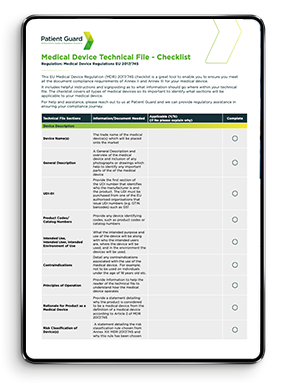
For help with the checklist or other aspects of your compliance journey, please reach out to us at Patient Guard and our experts would be happy to help.

UK Office

Get the Medical Device Technical Checklist

Thank you! The checklist is now ready to download.

checklist-tablet

Speak to one of our medical device consultants

For help with the checklist or other aspects of your compliance journey, please reach out to us at Patient Guard and our experts would be happy to help.

UK Office

Do you need support with Medical Device or IVD compliance?

We can help you!