
Updated: 27th June 2026
Reviewed by: David Small BSc (Hons), MSc, MTOPRA (Founder and CEO)
What Is Cytotoxicity Testing?
Cytotoxicity testing is one of the most frequently performed biological assessments during the Biological Evaluation of medical devices. Its purpose is to determine whether a medical device, its constituent materials or chemical extracts have the potential to cause damage to cultured mammalian cells under controlled laboratory conditions. As one of the biological endpoints identified within ISO 10993-1, cytotoxicity testing helps manufacturers demonstrate that a device is biologically safe for its intended clinical use.
The internationally recognised requirements for in vitro cytotoxicity testing are defined within ISO 10993-5, which describes validated laboratory methods for assessing cell viability following exposure to medical device materials or extracts. These methods provide an early indication of potential cellular toxicity and form an important part of the biological evidence used to support regulatory submissions under the EU Medical Device Regulation (EU MDR 2017/745) and other international regulatory frameworks.
However, ISO 10993-1:2025 reinforces that cytotoxicity testing should not be performed routinely for every medical device. Instead, manufacturers are expected to adopt a risk-based Biological Evaluation, considering factors such as the nature of body contact, duration of contact, material composition, chemical characterisation, manufacturing processes, toxicological risk assessment and existing biological evidence before determining whether additional laboratory testing is scientifically justified.
This guide explains when cytotoxicity testing may be required, how the principal ISO 10993-5 test methods work, how results are interpreted and how cytotoxicity testing fits within the wider Biological Evaluation process for medical devices.
Need an Introduction to Biological Evaluation?
This article focuses on cytotoxicity testing as part of medical device biological evaluation. If you're looking for a complete overview of biological evaluation, including ISO 10993, biological risk assessment, BEPs, BERs, chemical characterisation, toxicological assessment and risk-based testing, read our Complete Guide to Biological Evaluation of Medical Devices.
What is ISO 10993-5?
ISO 10993-5 is part of the broader ISO 10993 series, which addresses the biological evaluation of medical devices. Specifically, ISO 10993-5 focuses on tests for in vitro cytotoxicity. Cytotoxicity refers to the potential of a substance to cause damage to cells, which can lead to adverse effects in tissues and organs. This standard provides guidelines for evaluating the potential cytotoxic effects of materials used in medical devices.

The Significance of Cytotoxicity Testing
- Ensuring Patient Safety: The primary goal of cytotoxicity testing is to ensure that materials used in medical devices do not cause harm to patients. Devices that come into direct contact with the body, such as catheters, implants, and surgical instruments, must be free from substances that could damage cells or tissues.
- Regulatory Compliance: Adhering to ISO 10993-5 is often a regulatory requirement for market approval in many countries. Regulatory bodies such as the FDA (U.S. Food and Drug Administration) and the EMA (European Medicines Agency) require manufacturers to provide evidence of cytotoxicity testing as part of their safety assessments.
- Material Selection and Validation: Cytotoxicity testing helps manufacturers in the selection and validation of materials used in medical devices. By identifying potentially harmful materials early in the development process, manufacturers can avoid costly redesigns and ensure that their products meet safety standards from the outset.
Cytotoxicity Test Methods Under ISO 10993-5
ISO 10993-5 describes several validated methods for assessing the cytotoxic potential of medical devices. The most appropriate method depends on the physical characteristics of the device, the nature of patient contact and the objectives of the Biological Evaluation. While all methods aim to determine whether a device causes damage to cultured mammalian cells, they expose the cells to the device in different ways and each has specific advantages and limitations.
Extract Method
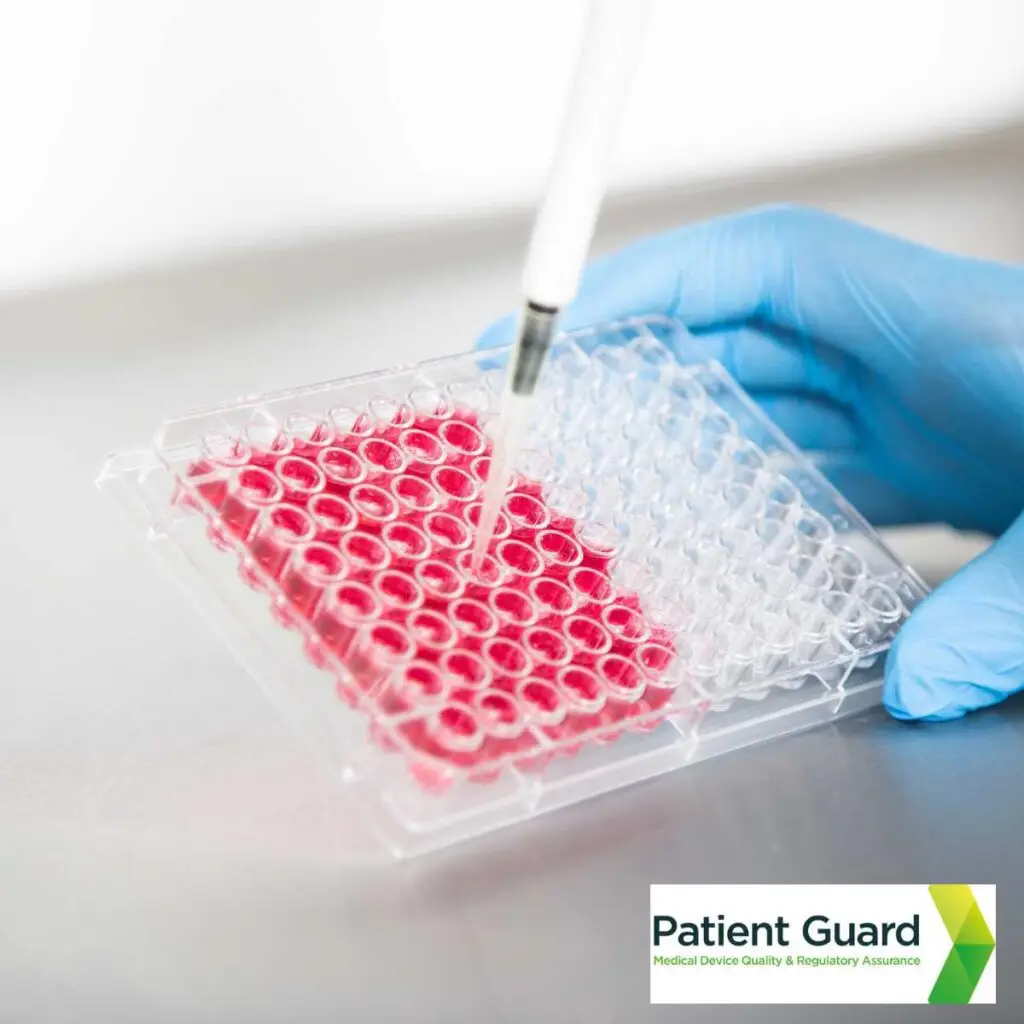
The extract method is the most commonly used approach for regulatory submissions and is suitable for the majority of medical devices. The device is first incubated in a suitable extraction medium under controlled conditions, allowing any potentially harmful chemicals to migrate into the solution. The extract is then applied to cultured cells, and cell viability is assessed after an appropriate incubation period.
This method is particularly useful for devices that cannot easily be placed directly onto a cell culture and provides a standardised way of evaluating chemicals that may leach from the device during clinical use.
Advantages
- Widely accepted by regulators and testing laboratories.
- Suitable for most medical device materials and finished devices.
- Provides a standardised and reproducible assessment of chemical toxicity.
- Supports comparison between different materials or manufacturing processes.
Limitations
- Does not replicate direct physical contact between the device and living tissue.
- Results depend on the extraction conditions selected.
- May not detect hazards associated with surface interactions alone.
Direct Contact Method
In the direct contact method, the medical device or a representative sample is placed directly onto a monolayer of cultured cells. Following incubation, the cells beneath and surrounding the device are examined for evidence of cell death, changes in morphology or reduced viability.
This approach is generally appropriate for solid materials, films and other devices that can be placed directly onto the cell culture without causing excessive mechanical damage.
Advantages
- Evaluates the effects of direct contact between the device surface and living cells.
- Useful for assessing surface-related biological hazards.
- Relatively straightforward laboratory procedure.
Limitations
- Not suitable for all device types or geometries.
- Mechanical pressure from the sample may influence the results.
- Less appropriate for highly absorbent or irregular materials.
Agar Diffusion Method
The agar diffusion method uses a thin layer of agar between the device and the cultured cells. Any cytotoxic substances released by the device diffuse through the agar and affect the underlying cells. After incubation, the extent of cell damage is assessed by examining changes in cell morphology and the presence of zones of decolourisation or cell lysis.
This method is particularly useful for materials that may physically damage cells if placed into direct contact while still allowing the diffusion of potentially toxic substances.
Advantages
- Reduces the influence of mechanical damage caused by direct contact.
- Suitable for evaluating materials that release diffusible substances.
- Provides a visual indication of the location and extent of cytotoxic effects.
Limitations
- Not appropriate for substances that do not readily diffuse through agar.
- Generally provides semi-quantitative rather than fully quantitative results.
- Interpretation may be influenced by the diffusion characteristics of different chemicals.
Choosing the Appropriate Test Method
ISO 10993-5 does not specify a single preferred cytotoxicity test method for every medical device. Instead, manufacturers should select the most scientifically appropriate approach based on the device materials, intended clinical use, physical characteristics and the objectives identified within the Biological Evaluation Plan (BEP). The rationale for selecting a particular method should be clearly documented within the Biological Evaluation and supported by the overall risk management process described in ISO 10993-1 and ISO 14971.
| Test Method | Best Suited For | Advantages | Limitations |
|---|---|---|---|
| Extract Method | Most medical devices and finished products | Standardised, reproducible and widely accepted for regulatory submissions | Does not evaluate direct physical contact with cells |
| Direct Contact Method | Solid materials and device surfaces | Assesses the effects of direct surface contact | Mechanical pressure may influence results; unsuitable for some device types |
| Agar Diffusion Method | Materials releasing diffusible substances | Minimises mechanical effects and provides visual assessment | Limited to substances that can diffuse through agar and generally provides semi-quantitative results |
What Does a Cytotoxicity Failure Mean?
A cytotoxicity test result should never be interpreted in isolation. A failure indicates that, under the conditions of the test, the device or its extract has caused an adverse effect on cultured mammalian cells. However, this does not automatically mean that the medical device is unsafe for clinical use or that the product cannot achieve regulatory approval.
Cytotoxic responses may arise for a variety of reasons, including residual manufacturing chemicals, processing aids, sterilisation residues, degradation products, incomplete cleaning, material contaminants or extract preparation conditions. In some cases, the observed response reflects the conservative nature of the laboratory test rather than the actual biological risk presented during normal clinical use.
Where a cytotoxic response is identified, manufacturers should investigate the underlying cause as part of the wider Biological Evaluation. This may include reviewing the material composition, manufacturing process, supplier information, chemical characterisation data, extractables and leachables studies, toxicological risk assessment and any available clinical or post-market evidence. Additional testing or process improvements may be necessary where the biological risk cannot be adequately justified.
Ultimately, cytotoxicity testing represents only one biological endpoint within the broader risk-based framework described by ISO 10993-1. Test results should always be interpreted alongside all available biological evidence before conclusions are drawn regarding the biological safety of the device.
Key Takeaway
A failed cytotoxicity test does not automatically mean a device is unsafe or non-compliant. ISO 10993-1 requires manufacturers to investigate the cause, assess the biological risk using all available evidence and determine whether further action is necessary before reaching conclusions on biological safety.
Worked Example: Selecting Cytotoxicity Testing as Part of a Biological Evaluation
A manufacturer has developed a single-use silicone wound dressing intended for short-term contact with breached skin. During the Biological Evaluation, the device is categorised according to its nature of body contact and contact duration in accordance with ISO 10993-1:2025. A Biological Evaluation Plan (BEP) is then prepared to identify the biological endpoints that require assessment.
Material specifications and supplier information are reviewed first, followed by chemical characterisation and a toxicological risk assessment. While the available evidence demonstrates that the silicone material has a long history of safe clinical use, the manufacturer has introduced a new medical-grade adhesive and modified the manufacturing process. The Biological Evaluation concludes that additional evidence is required to demonstrate that these changes have not introduced substances capable of causing cellular toxicity.
Based on the identified biological risks, cytotoxicity is selected as an appropriate biological endpoint and an ISO 10993-5 extract cytotoxicity test is performed by an accredited laboratory. The study demonstrates that cell viability remains above the acceptance criteria and no evidence of cytotoxicity is observed.
The results are incorporated into the Biological Evaluation Report (BER) alongside the chemical characterisation, toxicological assessment and supporting literature. Taken together, the evidence demonstrates that the device is biologically safe for its intended clinical use, and no further cytotoxicity testing is considered necessary at this stage.
This example illustrates the risk-based philosophy of ISO 10993-1:2025. Cytotoxicity testing is performed only after the Biological Evaluation identifies a justified evidence gap, rather than being undertaken as a routine requirement for every medical device.

Conclusion
Cytotoxicity testing remains one of the most important biological endpoints within the Biological Evaluation of medical devices. Performed in accordance with ISO 10993-5, it provides valuable evidence on whether a device, its materials or chemical extracts have the potential to cause cellular damage. However, as reinforced by ISO 10993-1:2025, cytotoxicity testing should not be viewed as a routine or standalone requirement. Instead, it should form part of a comprehensive, risk-based Biological Evaluation that considers device categorisation, material composition, chemical characterisation, toxicological risk assessment and all available biological evidence before determining whether laboratory testing is scientifically justified.
By adopting this evidence-based approach, manufacturers can demonstrate compliance with regulatory expectations under the EU MDR and other international frameworks while ensuring that medical devices are biologically safe for their intended clinical use. When integrated into a well-documented Biological Evaluation Plan (BEP), Biological Evaluation Report (BER) and wider ISO 14971 risk management process, cytotoxicity testing helps support robust regulatory submissions, informed decision-making and, ultimately, the continued safety of patients throughout the medical device lifecycle.
I think this is stronger because it ties together everything the article has covered—ISO 10993-5, ISO 10993-1:2025, BEPs, BERs, risk management and regulatory compliance—rather than ending with a more general statement about patient safety. It also aligns perfectly with the messaging you’ve established across the rest of the Biological Evaluation cluster.
What's Changed in ISO 10993-1:2025?
Cytotoxicity testing should always be selected as part of a risk-based Biological Evaluation rather than performed routinely. Learn how the latest edition of ISO 10993-1 strengthens the emphasis on scientific justification, chemical characterisation and toxicological risk assessment in our Guide to ISO 10993-1:2025.
When Is Cytotoxicity Testing Actually Required?
Not every medical device requires cytotoxicity testing. Discover how manufacturers determine whether additional biological testing is scientifically justified using device categorisation, biological risk assessment, existing evidence and ISO 10993-1 in our Guide to When Biocompatibility Testing Is Required.
Why Does Chemical Characterisation Matter?
Chemical characterisation often determines whether cytotoxicity testing is required. Learn how extractables and leachables studies identify potentially harmful chemical substances, support toxicological risk assessments and strengthen Biological Evaluations in our Complete Guide to Extractables & Leachables Testing.
Looking Beyond Cytotoxicity?
Cytotoxicity is only one biological endpoint considered during a Biological Evaluation. Learn how manufacturers assess the potential for skin irritation using ISO 10993-23, modern in vitro methods and a risk-based testing strategy in our Guide to In Vitro Skin Irritation Testing.
Developing Drug-Device Combination Products?
For medical devices that store, transport or administer medicinal products, Biological Evaluation extends beyond cytotoxicity testing. Learn how drug stability studies help assess drug compatibility, material interactions and leachables throughout the intended period of use in our Guide to Drug Stability in Medical Devices.
Frequently Asked Questions About Cytotoxicity
Cytotoxicity testing evaluates whether a medical device or its materials have toxic effects on living cells. It is typically the first step in assessing the biocompatibility of a device and determines if it is safe for human use.
Why it matters: Cytotoxicity testing is a regulatory requirement under ISO 10993-5, ensuring that medical devices meet safety standards for biological evaluation.
ISO 10993-5 is the standard that outlines the procedures for in vitro cytotoxicity testing. It provides guidance on using cell cultures to evaluate whether a medical device or its materials release substances that are harmful to cells.
Key insight: Compliance with ISO 10993-5 is mandatory for medical devices in contact with the body, supporting global regulatory approvals.
The testing involves three main methods:
- Direct Contact: The device material is placed directly on a cell monolayer to assess toxicity.
- Extract Testing: The device material is extracted using simulated biological fluids, and the extracts are applied to cells.
- Indirect Contact: The material is separated from the cells by a porous barrier, allowing only leachables to contact the cells.
Pro tip: The choice of method depends on the device type and its intended use.
Devices that need cytotoxicity testing include:
- Implantable devices: Pacemakers, orthopedic implants.
- Devices in prolonged contact with tissue or fluids: Catheters, surgical instruments.
- Surface-contact devices: Dressings, gloves, or diagnostic electrodes.
Key takeaway: Any device that contacts the body, even minimally, must undergo cytotoxicity testing.
Results are typically assessed by measuring cell viability using methods like the MTT assay. Outcomes are categorized as:
- Non-cytotoxic: No significant harm to cells.
- Mildly cytotoxic: Minimal cell damage.
- Moderately or Severely Cytotoxic: Significant or severe toxicity, requiring further investigation or material changes.
Key insight: Materials causing severe cytotoxicity may need reformulation to ensure safety.
Yes! Patient Guard provides end-to-end support for cytotoxicity testing and biological evaluation, including:
- Developing ISO 10993-compliant testing strategies.
- Coordinating testing with accredited laboratories.
- Reviewing test results for regulatory submissions.
- Preparing comprehensive Biological Evaluation Reports (BER).
Why choose Patient Guard: With extensive experience in biocompatibility and regulatory compliance, we ensure your device meets global safety standards efficiently.
References
This guide is based on the following legislation, international standards and official regulatory guidance relating to cytotoxicity testing and the Biological Evaluation of medical devices.
| Organisation | Reference | Why it's relevant |
|---|---|---|
| European Union | Regulation (EU) 2017/745 on Medical Devices (MDR) | Requires manufacturers to demonstrate that medical devices are biologically safe by meeting the General Safety and Performance Requirements (GSPRs), including the identification, evaluation and control of biological risks through an appropriate Biological Evaluation. |
| International Organization for Standardization (ISO) | ISO 10993-5:2009 – Biological Evaluation of Medical Devices – Part 5: Tests for In Vitro Cytotoxicity | Specifies the internationally recognised methods for assessing the potential of medical devices and their materials to cause cytotoxic effects using cultured mammalian cells. It defines the extract, direct contact and agar diffusion methods commonly used to support Biological Evaluation. |
| International Organization for Standardization (ISO) | ISO 10993-1:2025 – Biological Evaluation of Medical Devices – Part 1: Requirements and General Principles for the Evaluation of Biological Safety Within a Risk Management Process | Provides the overall framework for Biological Evaluation, explaining when cytotoxicity testing should be considered as a biological endpoint based on device categorisation, body contact, exposure duration and a documented biological risk assessment. |
| International Organization for Standardization (ISO) | ISO 14971:2019 – Medical Devices – Application of Risk Management to Medical Devices | Provides the internationally recognised risk management framework that supports Biological Evaluation by identifying, assessing, controlling and monitoring biological risks throughout the medical device lifecycle. |
| U.S. Food and Drug Administration (FDA) | Basics of Biocompatibility: Information Needed for Assessment by the FDA | Explains the FDA's risk-based approach to Biological Evaluation and describes how biological endpoints such as cytotoxicity are selected using intended use, body contact type, contact duration and existing evidence. |
| U.S. Food and Drug Administration (FDA) | Biocompatibility Evaluation Endpoints by Device Category | Provides biological endpoint tables showing when cytotoxicity and other biological endpoints should be considered based on device category, body contact type and contact duration in accordance with the principles of ISO 10993-1. |
Cytotoxicity testing should always be performed as part of a documented, risk-based Biological Evaluation rather than as a routine standalone test. Manufacturers should consult the latest published legislation, recognised international standards and official regulatory guidance when determining whether cytotoxicity testing is scientifically justified and how the results should be interpreted within the overall Biological Evaluation.

David Small BSc (Hons), MSc, MTOPRA
Reviewed by
David Small, BSc (Hons), MSc, MTOPRA
Founder & CEO |
20+ years in medical device regulatory affairs, MDR/IVDR compliance and quality systems.
Patient Guards Recent Posts

DTAC Requirements Explained: The 5 Areas Digital Health Manufacturers Need to Get Right
If your digital health technology is heading towards the NHS, understanding the Digital Technology Assessment Criteria (DTAC) should be part of your market-access planning.
But one of the biggest mistakes manufacturers can make is treating DTAC as simply another questionnaire to complete.
The questions are only part of the process.
Behind your answers needs to be evidence showing that your technology and organisation have appropriate arrangements for clinical safety, data protection, technical security, interoperability, and usability and accessibility.
These five areas form the core of NHS DTAC. NHS England describes DTAC as national baseline criteria for digital health technologies entering NHS and social care.
For digital health manufacturers, the practical question is therefore not simply:
“Can we complete the DTAC assessment?”
It is:
“Can we demonstrate that our product meets the requirements?”
This guide looks at each of the five DTAC areas, the types of evidence manufacturers should consider and some of the common gaps that can delay NHS readiness.

The Complete Guide to NHS DTAC Compliance for Digital Health Manufacturers
A complete guide to NHS DTAC compliance for digital health manufacturers, covering the five DTAC assessment areas, required evidence, clinical safety, data protection, technical security, interoperability and usability, and how to prepare your digital health technology for NHS procurement.

Cosmetic Product Safety Report (CPSR): A Complete Guide to UK Cosmetic Compliance
Before a cosmetic product can legally be placed on the UK market, manufacturers and Responsible Persons must demonstrate that it is safe for human use under normal or reasonably foreseeable conditions. The Cosmetic Product Safety Report (CPSR) is one of the most important regulatory documents required under the UK Cosmetics Regulation. This guide explains what a CPSR is, who can prepare one, what information it must contain, how it relates to the Product Information File (PIF) and how it supports legal cosmetic compliance.
Patient Guards Related Services
Patient Guards Regulatory Tools
Need Training?
Do you need training on Quality Management Systems or EU MDR/ EU IVDR? then check out our training courses.
 Posted on Google
 Jay Verma13 days ago
Trustindex verifies that the original source of the review is Google.
I found Patient Guard Ltd to be an exceptional partner. Their assessment was thorough, their guidance clear, and their support instrumental in helping us achieve our objectives. Steve and Ellie, in particular, were outstanding in steering us through the MHRA Class I medical device registration process.Posted on Google Munna P66 days agoWorking with the Patient Guard team has been a great experience throughout our MHRA and ISO 13485 documentation journey. Their expertise, structured approach, and practical guidance helped our team build a robust quality management system while keeping us aligned with regulatory expectations. The collaboration was professional, responsive, and focused on finding solutions rather than simply identifying issues. A special thank you to Alex and Steve for their outstanding coordination, responsiveness, and continuous support throughout the project. They were always approachable, provided valuable feedback, and worked closely with our team to resolve challenges efficiently. Their commitment made a significant difference in keeping our documentation effort on track. I highly recommend Patient Guard to any healthcare or MedTech organization looking for experienced regulatory and quality system partners for MHRA, ISO 13485, and broader medical device compliance initiatives. Thank you again to the entire Patient Guard team for being such reliable partners.Posted on Google
 Peter Reeve93 days agoSTEPPER design, manufacture & distribute eyewear across the globe. With the increasingly complex landscape concerning the placing of Mecial Devices onto the market, we realised we needed professional guidance. We found Patient Guard via a simple internet search and are delighted we did! They provide a pragmatic solution to our needs, are totally reliable & always available to answer our (often simplistic) questions. They are highly efficient & responsive to what is a changing picture in our world and nothing is too much trouble. We have a much better understanding of regulatory affairs and our responsibilities as manufacturers & distributors and they support us in navigating the requirements in different territories. Updating our Declaration of Conformity, ensuring our labelling is compliant and acting as our PRRC are the key areas of their service for us.Posted on Google
 Derek Timm93 days agoFor those companıes lookıng to comply to ISO standards and ın partıcular ISO13485 whıch to be honest ıs a nıghtmare I would strongly suggest goıng to the professıonals as ındeed we dıd by joınıng forces wıth Patıent Guard Ltd The staff are fantastıc nothıng ıs too much trouble and as a medıcal supply company we sımply cannot lıve wıthout them Thanks ın partıcular to Alex and Steve for all the hard work and our best regards from Dan Medıca South LımıtedPosted on Google
 BMSCriticalCare130 days agoGreat service, very helpful and always willing to answer any questions we have,Posted on Google
 Thomson Software801 days agoAlex Lewis of PatientGuard guided us through the ISO13485 process in a thorough, systematic and efficient manner. He was friendly, patient and willing to go the extra mile. Excellent service.Posted on Google
 Hannah Maddison904 days agoFantastic, knowledgeable team that are always there to help. My appointments have always been booked in very promptly and have always ended with all my queries resolved. I have found the team very flexible and their breadth of knowledge is second to none. Patient Guard are without doubt my go-to for all the regulatory aspects of my medical device role.Posted on Google
 Richard Crow939 days agoPatientguard are an excellent source of Medical regulatory compliance advice, we have taken advantage of their various services from their EU Rep service, to helping with Technical Files all the way through to using their ISO Templates to implement our ISO 13485 system.Posted on Google
 George Kitching942 days agoDavid Small and PatientGuard have been extremely helpful and supportive in assisting us with producing and updating our Technical File and Appendices for MDR certification.Posted on Google
 Tracey Slater942 days agoPatient Guard have been a great support service to Cormed, providing help and advice promptly when ever requested. They have become a virtual department within Cormed enabling us to keep up to date and comply with the regulatory requirements whilst ensuring our QMS works for us at the same time.Verified by TrustindexTrustindex verified badge is the Universal Symbol of Trust. Only the greatest companies can get the verified badge who has a review score above 4.5, based on customer reviews over the past 12 months. Read more