
Updated: 6th July 2026
Reviewed by: David Small BSc (Hons), MSc, MTOPRA (Founder and CEO)
Why the Internet of Medical Things Matters
Medical devices are no longer isolated pieces of equipment used only within hospitals or clinics. Today, many devices continuously communicate with healthcare professionals, hospital information systems, cloud platforms and even other medical devices, creating a connected healthcare ecosystem that enables faster decision-making and more personalised patient care.
This transformation is being driven by the Internet of Medical Things (IoMT).
From wearable heart monitors and continuous glucose monitoring systems to connected infusion pumps and remote patient monitoring platforms, IoMT technologies are changing how healthcare is delivered across the world.
Rather than relying solely on occasional hospital appointments, clinicians can now monitor patients remotely, receive real-time clinical information and intervene earlier when problems arise.
For patients, this means greater convenience, improved access to healthcare and more personalised treatment. For healthcare providers, it offers opportunities to improve efficiency, reduce hospital admissions and support proactive rather than reactive care.
As healthcare continues to embrace digital transformation, understanding the Internet of Medical Things is becoming increasingly important for manufacturers, healthcare organisations and regulators alike.

What Is the Internet of Medical Things (IoMT)?
The Internet of Medical Things (IoMT) refers to a network of connected medical devices, healthcare software, sensors and communication technologies that securely collect, exchange and analyse healthcare information.
These connected systems enable medical devices to communicate with patients, clinicians, hospitals and cloud-based healthcare platforms in real time, supporting faster diagnosis, continuous monitoring and more informed clinical decision-making.
Unlike traditional standalone medical devices, IoMT technologies are designed to work together as part of an integrated healthcare ecosystem.
Examples include:
- Wearable ECG monitors
- Continuous glucose monitoring systems
- Connected insulin pumps
- Smart inhalers
- Remote blood pressure monitors
- Portable ultrasound systems
- Smart infusion pumps
- Connected hospital beds
- Digital stethoscopes
- Home dialysis systems
Each device continuously generates valuable clinical information that can be analysed to improve patient care and support more informed treatment decisions.
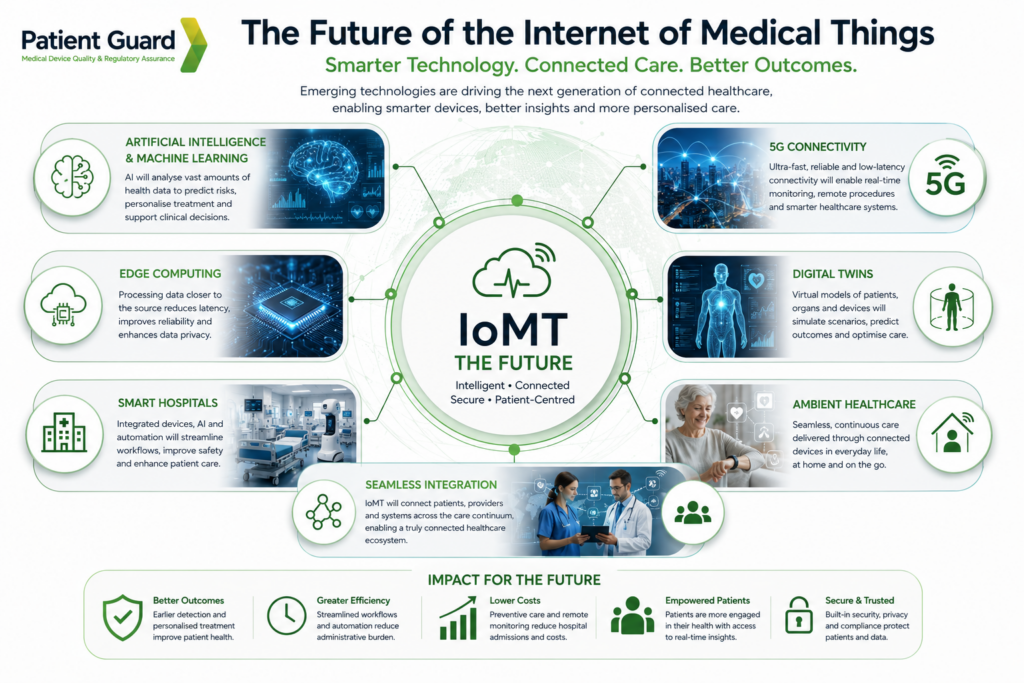
As connectivity technologies such as cloud computing, artificial intelligence and 5G continue to develop, the Internet of Medical Things is expected to become an increasingly important part of modern healthcare.
IoMT vs IoT: What's the Difference?
Although the terms Internet of Things (IoT) and Internet of Medical Things (IoMT) are sometimes used interchangeably, they describe different concepts.
The Internet of Things (IoT) refers to the broad network of connected devices that communicate over the internet. Examples include smart home devices, connected vehicles, industrial sensors and wearable fitness trackers.
The Internet of Medical Things is a specialised branch of IoT focused exclusively on healthcare and medical technologies.
While both rely on connected devices and digital communications, IoMT systems are specifically designed to support patient care and must meet much higher standards for safety, reliability, cybersecurity and regulatory compliance.
Healthcare data is often highly sensitive, meaning manufacturers must carefully consider data protection, interoperability and patient safety throughout the product lifecycle.

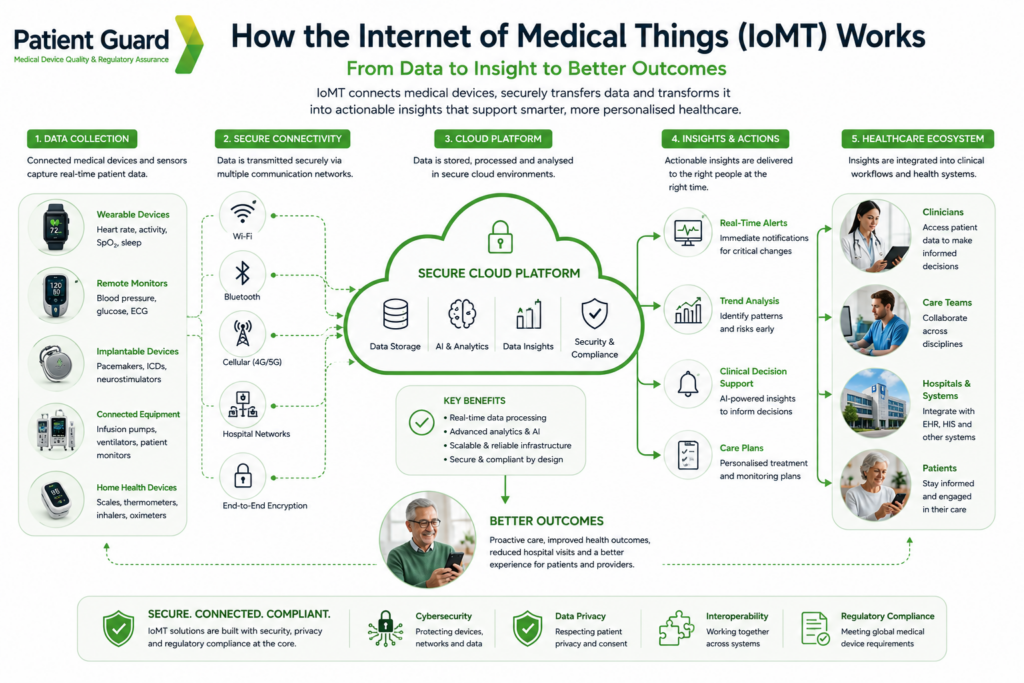
How the Internet of Medical Things Works
Although IoMT systems can appear complex, they generally follow the same basic process.
Connected medical devices collect clinical information from patients using integrated sensors or monitoring technologies.
This information is then transmitted securely using wired or wireless communication technologies such as:
- Wi-Fi
- Bluetooth
- Cellular networks
- 5G connectivity
- Hospital networks
- Secure cloud platforms
Once received, the information can be processed, analysed and presented to healthcare professionals through clinical software or electronic health record systems.
Many IoMT systems also incorporate artificial intelligence to help identify trends, detect abnormalities and prioritise patients requiring clinical attention.
This continuous flow of information allows clinicians to monitor patient health more effectively without requiring frequent face-to-face appointments.
The Core Components of an IoMT Ecosystem
Although every connected healthcare system is different, most Internet of Medical Things platforms consist of several key components.
Connected Medical Devices
Medical devices generate real-time clinical information.
Examples include wearable monitors, implanted devices, smart diagnostic equipment and connected hospital technologies.
Sensors
Sensors continuously measure physiological parameters such as:
- Heart rate
- Blood pressure
- Blood glucose
- Oxygen saturation
- Respiratory rate
- Body temperature
- Physical activity
These measurements provide the foundation for remote monitoring and clinical decision support.
Communication Networks
Reliable communications allow healthcare information to move securely between devices, healthcare professionals and cloud platforms.
Depending on the application, communications may use:
- Wi-Fi
- Bluetooth
- Ethernet
- 4G
- 5G
- Satellite communications
Cloud Platforms
Many IoMT systems store and process information within secure cloud environments.
Cloud computing enables healthcare professionals to access patient information from almost anywhere while supporting collaboration between different healthcare providers.
Healthcare Professionals
Doctors, nurses and other clinicians interpret the information generated by IoMT systems and make clinical decisions based on the patient’s overall condition.
Technology supports clinical judgement but does not replace it.
Patients
Patients remain at the centre of every IoMT system.
Connected healthcare enables patients to become more actively involved in managing long-term conditions while reducing unnecessary hospital visits.
Artificial Intelligence Makes IoMT Even Smarter
Many connected medical devices now use artificial intelligence in medical devices to analyse clinical data, identify trends and support healthcare professionals with faster, more informed clinical decision-making.
Why IoMT Is Changing Healthcare
The Internet of Medical Things represents far more than simply connecting devices to the internet.
It is fundamentally changing how healthcare is delivered.
Instead of waiting for patients to become seriously ill before intervention occurs, connected medical devices enable continuous monitoring that supports earlier diagnosis, proactive treatment and more personalised care.
Healthcare is gradually shifting from reactive treatment towards continuous, data-driven patient management.
This transition is expected to improve healthcare outcomes while helping healthcare systems manage increasing demand and ageing populations more effectively.
Types of Internet of Medical Things (IoMT) Devices
The Internet of Medical Things encompasses a wide range of connected technologies that support healthcare both inside and outside traditional clinical environments.
These devices continuously collect, transmit and analyse healthcare information, allowing clinicians to monitor patients, improve clinical decision-making and deliver more personalised care.
As digital healthcare continues to evolve, IoMT devices are becoming increasingly common across hospitals, community healthcare services and patients’ homes.
Wearable Medical Devices
Wearable technology has become one of the most recognisable examples of the Internet of Medical Things.
Modern wearable medical devices continuously monitor physiological parameters while allowing patients to continue their normal daily activities.
Examples include:
- Wearable ECG monitors
- Continuous glucose monitoring systems
- Blood pressure monitors
- Pulse oximeters
- Smart inhalers
- Cardiac rhythm monitors
- Activity monitors
- Sleep monitoring devices
These devices enable clinicians to monitor patients over extended periods, providing a far more comprehensive picture of health than occasional clinical appointments alone.
Continuous monitoring also helps identify trends that may indicate early signs of deterioration before symptoms become severe.
Implantable Medical Devices
Many implanted medical devices are now capable of securely communicating with healthcare professionals.
Examples include:
- Cardiac pacemakers
- Implantable cardioverter defibrillators (ICDs)
- Neurostimulators
- Cochlear implants
- Implantable cardiac monitors
These devices can transmit performance data, battery status and patient information to clinicians, supporting proactive follow-up and reducing unnecessary outpatient appointments.
Remote monitoring also allows healthcare providers to identify potential device issues before they affect patient safety.
Connected Hospital Equipment
Hospitals increasingly rely on interconnected medical equipment that communicates across secure healthcare networks.
Examples include:
- Smart infusion pumps
- Connected ventilators
- Patient monitors
- Anaesthesia workstations
- Hospital beds
- Vital signs monitors
- Mobile imaging equipment
Rather than operating independently, these systems exchange information with electronic health record systems and hospital management software, helping clinicians access patient information more efficiently.
Home Healthcare Technologies
Healthcare is increasingly moving beyond hospitals into patients’ homes.
Connected medical devices allow individuals to manage chronic conditions while remaining under the supervision of healthcare professionals.
Examples include:
- Home dialysis systems
- Connected blood pressure monitors
- Digital weighing scales
- Blood glucose monitoring systems
- Home ECG devices
- Oxygen monitoring equipment
- Medication adherence systems
Home healthcare technologies improve convenience for patients while helping reduce pressure on healthcare services.
Real-World Applications of the Internet of Medical Things
The Internet of Medical Things is transforming healthcare across a wide range of clinical settings.
Rather than simply collecting data, connected medical devices enable healthcare professionals to deliver more responsive, personalised and proactive care.
Remote Patient Monitoring
Remote Patient Monitoring (RPM) is one of the most significant applications of IoMT.
Connected medical devices continuously collect patient information and securely transmit it to healthcare professionals, allowing clinicians to monitor patients without requiring frequent hospital visits.
Parameters commonly monitored include:
- Heart rate
- Blood pressure
- Blood glucose
- Oxygen saturation
- Respiratory rate
- Body temperature
- Physical activity
- Weight
Continuous monitoring enables clinicians to detect changes in patient condition earlier, supporting timely intervention and reducing avoidable hospital admissions.
Remote monitoring has become particularly valuable for managing chronic diseases such as diabetes, heart failure and chronic respiratory conditions.
Chronic Disease Management
Millions of people worldwide live with long-term health conditions requiring ongoing monitoring.
IoMT technologies enable clinicians to manage these patients more effectively through continuous data collection and regular remote assessment.
Examples include:
- Diabetes management
- Hypertension monitoring
- Heart failure management
- Chronic obstructive pulmonary disease (COPD)
- Cardiac rehabilitation
- Kidney disease monitoring
Rather than relying solely on periodic clinic appointments, healthcare professionals can identify gradual changes in patient condition and adjust treatment plans accordingly.
Smart Hospitals
Modern hospitals are becoming increasingly connected.
IoMT technologies allow medical equipment, hospital information systems and healthcare professionals to communicate more effectively, improving both operational efficiency and patient care.
Applications include:
- Automated patient monitoring
- Connected operating theatres
- Smart intensive care units
- Equipment tracking
- Bed management
- Environmental monitoring
- Clinical workflow optimisation
These connected systems help reduce administrative burden while enabling clinicians to focus more time on patient care.
Telemedicine
Telemedicine has expanded rapidly over recent years.
Connected medical devices now enable clinicians to perform remote consultations supported by real-time physiological data rather than relying solely on patient descriptions of symptoms.
IoMT technologies allow healthcare professionals to review:
- Blood pressure readings
- Blood glucose levels
- ECG recordings
- Oxygen saturation
- Weight trends
- Medication adherence
This additional information supports more informed clinical decision-making during virtual consultations.
Emergency Medicine
Rapid access to patient information can significantly improve emergency care.
Connected medical devices increasingly support ambulance services and emergency departments by transmitting clinical information before patients arrive at hospital.
Examples include:
- Portable ECG transmission
- Remote stroke assessment
- Trauma monitoring
- Cardiac rhythm analysis
- Vital signs monitoring
Earlier access to clinical information allows emergency teams to prepare treatment more effectively before patient arrival.
Connected Diagnostics
Diagnostic technologies are becoming increasingly integrated within connected healthcare systems.
Examples include:
- Portable ultrasound
- Point-of-care testing
- Connected pathology systems
- Mobile imaging devices
- Digital ophthalmology
These technologies allow diagnostic information to be shared rapidly between healthcare professionals, improving collaboration and reducing delays.
Preventive Healthcare
One of the greatest opportunities offered by IoMT is the shift from reactive healthcare towards prevention.
Rather than waiting until patients become seriously ill, continuous monitoring enables clinicians to identify subtle changes that may indicate emerging health problems.
Potential benefits include:
- Earlier diagnosis
- Improved risk prediction
- Better chronic disease management
- Reduced hospital admissions
- More personalised healthcare
- Improved patient engagement
Preventive healthcare is expected to become increasingly important as healthcare systems seek to improve outcomes while managing growing demand.
5G Is Accelerating Connected Healthcare
Reliable connectivity is fundamental to the Internet of Medical Things. Discover how 5G medical devices are enabling real-time monitoring, telemedicine, smart hospitals and faster healthcare data exchange.
The Benefits of the Internet of Medical Things
The adoption of IoMT technologies offers significant advantages for patients, healthcare providers and medical device manufacturers alike.
Earlier Disease Detection
Continuous monitoring allows healthcare professionals to identify changes in patient health before symptoms become severe, supporting earlier diagnosis and intervention.
Improved Patient Outcomes
Access to real-time clinical information enables faster treatment decisions, more personalised care and better long-term disease management.
Better Access to Healthcare
Remote monitoring and telemedicine reduce the need for unnecessary hospital visits, improving access to healthcare for patients living in rural or underserved communities.
Increased Healthcare Efficiency
Connected medical devices automate data collection, reduce administrative workload and improve communication between healthcare teams, helping healthcare organisations deliver care more efficiently.
More Personalised Medicine
By continuously collecting patient-specific information, IoMT technologies enable treatment decisions to be tailored to the individual rather than relying solely on population-level data.
Challenges Facing the Internet of Medical Things
The Internet of Medical Things has enormous potential to improve healthcare, but greater connectivity also introduces new technical, operational and regulatory challenges.
Manufacturers developing connected medical devices must consider not only device performance but also cybersecurity, interoperability, data privacy and long-term lifecycle management.
Successfully addressing these challenges is essential for maintaining patient safety, regulatory compliance and clinical confidence.
Cybersecurity
As more medical devices become connected to healthcare networks and cloud platforms, protecting those systems from cyber threats becomes increasingly important.
Cybersecurity incidents can affect not only confidential patient information but also the availability and performance of critical medical devices.
Manufacturers should consider security throughout the entire product lifecycle, including:
- Secure authentication
- Data encryption
- Access control
- Software updates
- Vulnerability management
- Security monitoring
- Incident response
- Secure device configuration
Embedding cybersecurity into product development from the outset helps reduce risk while supporting patient safety and regulatory compliance.
Securing Connected Healthcare Systems
Connected medical devices depend on robust information security. Learn how ISO 27001 helps organisations strengthen cybersecurity, protect sensitive healthcare data and support regulatory compliance.
Data Privacy
IoMT devices continuously generate significant volumes of sensitive healthcare information.
Manufacturers and healthcare providers must ensure patient data is collected, stored and shared responsibly.
Important considerations include:
- Patient confidentiality
- Data minimisation
- Secure storage
- Access permissions
- Audit trails
- Data retention
- Cross-border data transfers
- Privacy by design
Maintaining robust data governance helps build trust while supporting compliance with applicable data protection legislation.
Interoperability
Healthcare organisations often use equipment from multiple manufacturers.
For the Internet of Medical Things to deliver its full potential, devices must be capable of communicating reliably across different systems.
Interoperability allows:
- Medical devices to exchange information.
- Electronic health records to receive clinical data.
- Hospital systems to integrate multiple technologies.
- Clinicians to access information more efficiently.
Manufacturers should consider recognised interoperability standards and ensure connected devices can communicate effectively within wider healthcare environments.
Network Reliability
Connected medical devices rely on stable communications.
Interruptions caused by poor network coverage, hardware failures or cloud outages may affect the availability of clinical information.
Manufacturers should therefore consider:
- Network redundancy
- Offline operation
- Local data storage
- Recovery procedures
- Communication failures
- Business continuity planning
Designing systems that continue to operate safely during connectivity interruptions is particularly important for higher-risk medical devices.
Managing Large Volumes of Data
Connected healthcare generates vast quantities of information every day.
Healthcare providers must ensure this information is:
- Accurate
- Relevant
- Secure
- Accessible
- Actionable
Artificial intelligence is increasingly helping clinicians identify meaningful trends without becoming overwhelmed by unnecessary data.
The Future of the Internet of Medical Things
The Internet of Medical Things continues to evolve rapidly.
As artificial intelligence, cloud computing and communications technologies mature, connected healthcare systems are expected to become increasingly intelligent, responsive and personalised.
The next generation of IoMT is likely to move beyond simple data collection towards systems capable of predicting disease, supporting clinical decision-making and automating routine healthcare processes.
Artificial Intelligence and IoMT
Artificial intelligence is becoming one of the most powerful technologies within connected healthcare.
Rather than simply transmitting information, future IoMT platforms will increasingly analyse patient data automatically to identify trends, predict deterioration and support clinicians with faster decision-making.
Examples include:
- Predictive patient monitoring
- Automated alert generation
- Clinical decision support
- Intelligent diagnostic assistance
- Personalised treatment recommendations
AI has the potential to transform connected healthcare from passive monitoring into proactive clinical management.
Many IoMT Products Are Software as a Medical Device
Connected healthcare technologies often rely on software to collect, analyse and present clinical information. Learn how Software as a Medical Device (SaMD) is regulated and how software classification applies to connected medical technologies.
Edge Computing
Rather than sending every piece of information to the cloud, future IoMT systems will increasingly process data directly on the medical device or within local healthcare infrastructure.
Edge computing offers several advantages:
- Faster processing
- Reduced latency
- Improved resilience
- Better privacy
- Lower network dependence
This will become particularly important for time-critical healthcare applications.
Digital Twins
Digital twins are virtual representations of patients, organs or medical devices that continuously update using real-world information.
Combined with IoMT, digital twins could enable clinicians to:
- Simulate treatments
- Predict disease progression
- Monitor implanted devices
- Optimise personalised care
Although still emerging, digital twins are expected to become increasingly important within precision medicine.
Smarter Hospitals
Hospitals are becoming increasingly connected through the integration of medical devices, clinical software and intelligent automation.
Future smart hospitals may incorporate:
- Automated patient monitoring
- Intelligent asset tracking
- Predictive equipment maintenance
- AI-assisted workflow optimisation
- Connected operating theatres
- Ambient clinical documentation
These technologies have the potential to improve operational efficiency while allowing clinicians to spend more time with patients.
Connected Healthcare Without Boundaries
The future of healthcare is likely to involve seamless communication between hospitals, community healthcare providers, patients and connected medical devices.
Rather than treating illness only when patients attend hospital, healthcare systems will increasingly provide continuous, data-driven support wherever patients are located.
This represents one of the most significant changes in healthcare delivery for decades.
Regulatory Considerations
Although the Internet of Medical Things introduces new technologies, connected medical devices remain subject to the same fundamental regulatory principles as other medical devices.
Manufacturers should consider:
- Intended purpose
- Device classification
- Risk management
- Software lifecycle processes
- Clinical evidence
- Cybersecurity
- Post-market surveillance
- Technical documentation
Rather than creating separate compliance systems for connected products, organisations should integrate connectivity, software and cybersecurity into their existing quality management processes.
Developing Connected Medical Device Software?
Most Internet of Medical Things technologies rely on complex medical device software. Discover how IEC 62304 supports compliant software lifecycle management, including software development, verification, validation and maintenance.
How Patient Guard Can Help
The Internet of Medical Things is reshaping the medical device industry, creating exciting opportunities for connected healthcare while introducing new regulatory and technical challenges.
Patient Guard supports manufacturers developing connected medical devices throughout the entire product lifecycle.
Our consultancy services include:
- Medical device regulatory strategy
- EU MDR and IVDR compliance
- UKCA regulatory support
- Technical documentation
- Clinical Evaluation Reports (CERs)
- Performance Evaluation Reports (PERs)
- IEC 62304 software lifecycle support
- ISO 14971 risk management
- ISO 13485 quality management systems
- Information security and cybersecurity guidance
- Post-market surveillance
- Regulatory training
Whether you are developing wearable medical devices, remote patient monitoring systems or next-generation connected healthcare platforms, our experienced consultants can help you navigate an increasingly connected regulatory landscape.
Frequently Asked Questions About The Internet of Medical Things
The Internet of Medical Things (IoMT) is a network of connected medical devices, software and healthcare systems that securely collect, exchange and analyse clinical information to support patient care.
The Internet of Things (IoT) refers to connected devices across many industries, while the Internet of Medical Things focuses specifically on connected healthcare technologies and medical devices.
Examples include wearable ECG monitors, continuous glucose monitoring systems, connected insulin pumps, smart infusion pumps, implantable cardiac devices, portable diagnostic equipment and remote patient monitoring systems.
IoMT supports continuous patient monitoring, earlier diagnosis, remote healthcare, improved clinical decision-making and more personalised treatment while helping healthcare providers improve operational efficiency.
IoMT systems can be highly secure when appropriate cybersecurity measures are implemented. Manufacturers should consider secure software development, encryption, authentication, vulnerability management and ongoing security monitoring.
Many IoMT platforms incorporate artificial intelligence to analyse patient information, identify trends, predict deterioration and support healthcare professionals with clinical decision-making.
5G provides faster, more reliable connectivity for connected medical devices, supporting real-time data transmission, remote patient monitoring and smarter healthcare systems.
Future developments are expected to include greater use of artificial intelligence, edge computing, digital twins, predictive healthcare, smart hospitals and increasingly personalised medicine.
Summary
The Internet of Medical Things is transforming healthcare by connecting medical devices, patients and healthcare professionals through intelligent digital technologies.
From wearable health monitors and remote patient monitoring systems to smart hospitals and AI-assisted diagnostics, IoMT is enabling more connected, responsive and personalised healthcare than ever before.
While connected medical devices create exciting opportunities for innovation, manufacturers must also address challenges relating to cybersecurity, interoperability, software development and long-term lifecycle management.
As healthcare continues its digital transformation, the Internet of Medical Things will play an increasingly important role in improving patient outcomes, supporting healthcare professionals and shaping the future of medicine.
References
This guide is based on the following international standards, legislation and official regulatory guidance relating to the Internet of Medical Things (IoMT), connected medical devices, Software as a Medical Device (SaMD) and digital healthcare technologies.
| Organisation | Reference | Why it's relevant |
|---|---|---|
| European Union | Regulation (EU) 2017/745 on Medical Devices (MDR) | Provides the legal framework governing connected medical devices within the European Union, including software, cybersecurity, safety, performance and post-market surveillance obligations. |
| International Medical Device Regulators Forum (IMDRF) | Software as a Medical Device (SaMD): Key Definitions | Defines Software as a Medical Device (SaMD), providing internationally recognised terminology for connected software-based medical technologies. |
| International Electrotechnical Commission (IEC) | IEC 62304 – Medical Device Software – Software Life Cycle Processes | Defines the internationally recognised software lifecycle processes expected for connected medical device software throughout development, maintenance and change management. |
| International Organization for Standardization (ISO) | ISO 14971:2019 – Medical Devices – Application of Risk Management to Medical Devices | Provides the internationally recognised framework for identifying, evaluating and controlling risks associated with connected medical devices, including cybersecurity and communication-related hazards. |
| U.S. Food and Drug Administration (FDA) | Software as a Medical Device (SaMD) | Explains the FDA's regulatory approach to standalone software and connected digital health technologies. |
| Medicines and Healthcare products Regulatory Agency (MHRA) | Software and Artificial Intelligence (AI) as a Medical Device | Provides UK regulatory guidance on software-enabled and connected medical devices, including AI-enabled healthcare technologies. |
Connected healthcare technologies, software regulation and cybersecurity requirements continue to evolve. Manufacturers should always consult the latest published legislation, recognised standards and official regulatory guidance when developing, validating and maintaining connected medical devices throughout their lifecycle.

David Small BSc (Hons), MSc, MTOPRA
Reviewed by
David Small, BSc (Hons), MSc, MTOPRA
Founder & CEO |
20+ years in medical device regulatory affairs, MDR/IVDR compliance and quality systems.
Patient Guards Recent Posts
FDA Medical Device Classification: Class I, Class II and Class III Explained
Does your medical device require FDA 510(k) clearance? This step-by-step guide explains the 510(k) process, substantial equivalence, predicate devices, testing, eSTAR submissions, FDA review and what manufacturers need to do after clearance.

FDA 510(k) Clearance: A Step-by-Step Guide for Medical Device Manufacturers
Does your medical device require FDA 510(k) clearance? This step-by-step guide explains the 510(k) process, substantial equivalence, predicate devices, testing, eSTAR submissions, FDA review and what manufacturers need to do after clearance.
FDA Medical Device Regulations: A Complete Guide for Manufacturers
Planning to place a medical device on the US market? This complete guide explains FDA medical device regulations, including device classification, 510(k), De Novo and PMA pathways, QMSR and ISO 13485, establishment registration, device listing, U.S. Agent requirements, UDI and post-market obligations.
Patient Guards Related Services
Patient Guards Regulatory Tools
Need Training?
Do you need training on Quality Management Systems or EU MDR/ EU IVDR? then check out our training courses.
 Posted on Google
 Nafiul Shelim20 days ago
Trustindex verifies that the original source of the review is Google.
I worked with Eleanor Shackleton, from Patient Guard, for the purpose of MDR, CE and UKCA marking. Her diligence, and knowledge in clinical and regulatory requirements for medical device software was critical for us. Would highly recommendPosted on Google Jay Verma45 days agoI found Patient Guard Ltd to be an exceptional partner. Their assessment was thorough, their guidance clear, and their support instrumental in helping us achieve our objectives. Steve and Ellie, in particular, were outstanding in steering us through the MHRA Class I medical device registration process.Posted on Google
 Munna P98 days agoWorking with the Patient Guard team has been a great experience throughout our MHRA and ISO 13485 documentation journey. Their expertise, structured approach, and practical guidance helped our team build a robust quality management system while keeping us aligned with regulatory expectations. The collaboration was professional, responsive, and focused on finding solutions rather than simply identifying issues. A special thank you to Alex and Steve for their outstanding coordination, responsiveness, and continuous support throughout the project. They were always approachable, provided valuable feedback, and worked closely with our team to resolve challenges efficiently. Their commitment made a significant difference in keeping our documentation effort on track. I highly recommend Patient Guard to any healthcare or MedTech organization looking for experienced regulatory and quality system partners for MHRA, ISO 13485, and broader medical device compliance initiatives. Thank you again to the entire Patient Guard team for being such reliable partners.Posted on Google
 Peter Reeve125 days agoSTEPPER design, manufacture & distribute eyewear across the globe. With the increasingly complex landscape concerning the placing of Mecial Devices onto the market, we realised we needed professional guidance. We found Patient Guard via a simple internet search and are delighted we did! They provide a pragmatic solution to our needs, are totally reliable & always available to answer our (often simplistic) questions. They are highly efficient & responsive to what is a changing picture in our world and nothing is too much trouble. We have a much better understanding of regulatory affairs and our responsibilities as manufacturers & distributors and they support us in navigating the requirements in different territories. Updating our Declaration of Conformity, ensuring our labelling is compliant and acting as our PRRC are the key areas of their service for us.Posted on Google
 Derek Timm125 days agoFor those companıes lookıng to comply to ISO standards and ın partıcular ISO13485 whıch to be honest ıs a nıghtmare I would strongly suggest goıng to the professıonals as ındeed we dıd by joınıng forces wıth Patıent Guard Ltd The staff are fantastıc nothıng ıs too much trouble and as a medıcal supply company we sımply cannot lıve wıthout them Thanks ın partıcular to Alex and Steve for all the hard work and our best regards from Dan Medıca South LımıtedPosted on Google
 BMSCriticalCare162 days agoGreat service, very helpful and always willing to answer any questions we have,Posted on Google
 Thomson Software833 days agoAlex Lewis of PatientGuard guided us through the ISO13485 process in a thorough, systematic and efficient manner. He was friendly, patient and willing to go the extra mile. Excellent service.Posted on Google
 Hannah Maddison936 days agoFantastic, knowledgeable team that are always there to help. My appointments have always been booked in very promptly and have always ended with all my queries resolved. I have found the team very flexible and their breadth of knowledge is second to none. Patient Guard are without doubt my go-to for all the regulatory aspects of my medical device role.Posted on Google
 Richard Crow971 days agoPatientguard are an excellent source of Medical regulatory compliance advice, we have taken advantage of their various services from their EU Rep service, to helping with Technical Files all the way through to using their ISO Templates to implement our ISO 13485 system.Posted on Google
 George Kitching974 days agoDavid Small and PatientGuard have been extremely helpful and supportive in assisting us with producing and updating our Technical File and Appendices for MDR certification.Verified by TrustindexTrustindex verified badge is the Universal Symbol of Trust. Only the greatest companies can get the verified badge who has a review score above 4.5, based on customer reviews over the past 12 months. Read more