
Updated: 24th June 2026
Reviewed by: David Small BSc (Hons), MSc, MTOPRA (Founder & CEO)
What is a Medical Device EU Authorised Representative?
The EU Authorised Representative (EUAR) role for medical devices has existed since before the introduction of the Medical Device and In Vitro Diagnostic Regulations (EU MDR 2017/745 and EU IVDR 2017/746) were introduced in 2017. It was a requirement of their predecessors the medical device directives.
Since the MDR and IVDR Regulations were introduced, the role of the EUAR has become wider in scope and responsibilities.
New to the EU MDR?
Authorised Representatives play an important role for non-EU manufacturers placing medical devices on the European market. For a complete overview of Regulation (EU) 2017/745, including classification, Article 10 obligations, GSPRs, technical documentation, UDI, EUDAMED and CE marking requirements, explore our EU MDR for Beginners Guide.
Working with In Vitro Diagnostic Medical Devices?
The requirement to appoint an EU Authorised Representative also applies to non-EU manufacturers placing IVDs on the European market under Regulation (EU) 2017/746. For a broader explanation of IVDR classification, performance evaluation, Technical Documentation, EUDAMED, vigilance and manufacturer obligations, read our IVDR for Beginners Guide.
Article 11 MDR and IVDR
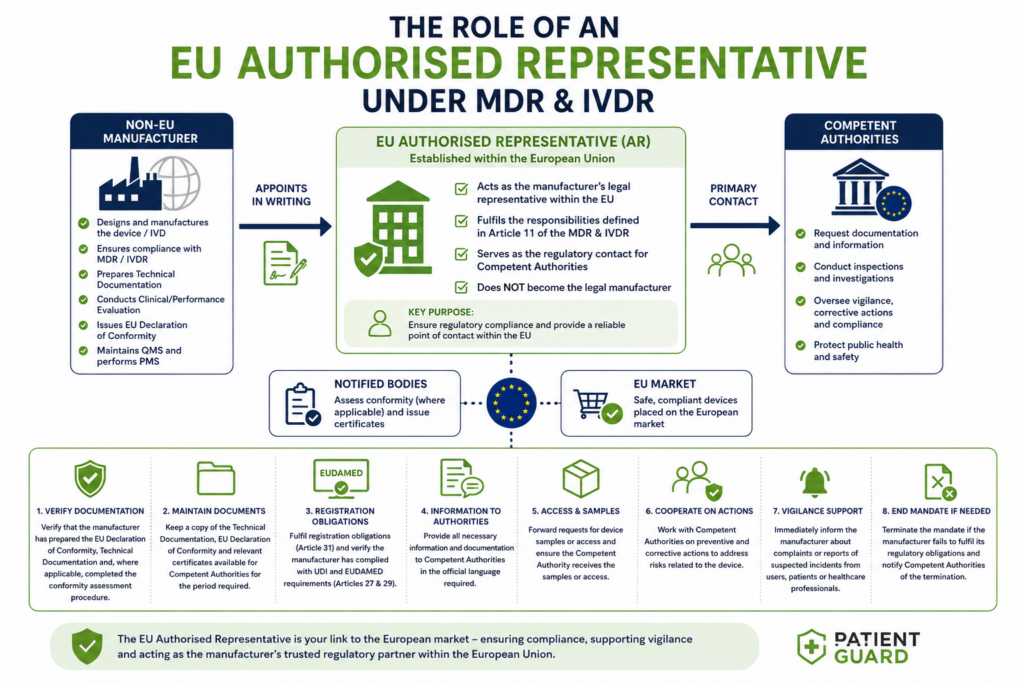
Article 11 of the MDR and the IVDR sets out the requirements and responsibilities of an EUAR. This includes the following:
Non-member state-based manufacturers:
Where the manufacturer of a device is not established in a Member State, the device may only be placed on the Union market if the manufacturer designates a sole Authorised Representative.
Manufacturer vs EU Authorised Representative Responsibilities
Although both parties have important regulatory responsibilities, the manufacturer remains responsible for designing, manufacturing and demonstrating conformity of the medical device. The EU Authorised Representative acts on behalf of the manufacturer within the European Union, carrying out the responsibilities defined in Article 11 of the MDR and IVDR. The table below summarises the key differences.
| Manufacturer | EU Authorised Representative |
|---|---|
| Designs, manufactures and validates the medical device or IVD. | Represents the manufacturer within the European Union under a written mandate. |
| Creates and maintains the Technical Documentation. | Verifies that the Technical Documentation and Declaration of Conformity have been prepared and are available for inspection. |
| Conducts Clinical Evaluation or Performance Evaluation and demonstrates conformity with the MDR or IVDR. | Makes regulatory documentation available to Competent Authorities upon request and cooperates during investigations. |
| Establishes and maintains a Post-Market Surveillance (PMS) system and fulfils vigilance obligations. | Cooperates with Competent Authorities on vigilance, corrective actions and post-market surveillance activities. |
| Issues and signs the EU Declaration of Conformity before CE marking. | Verifies that the Declaration of Conformity has been correctly drawn up before accepting the mandate. |
| Implements and maintains an ISO 13485 Quality Management System where applicable. | Maintains documented procedures, keeps regulatory records and serves as the primary regulatory contact for Competent Authorities. |
| Retains overall responsibility for ensuring the device complies with the MDR or IVDR. | Shares certain legal responsibilities under Article 11 but does not become the legal manufacturer. |
From Appointment to Ongoing Compliance: The EU Authorised Representative Process
Once a manufacturer decides to place a medical device or IVD on the European market, appointing an EU Authorised Representative is only one step in a broader regulatory process. The workflow below illustrates how manufacturers and Authorised Representatives work together to achieve and maintain compliance throughout the product lifecycle.
Step 1 – Prepare Technical Documentation
The manufacturer prepares the documentation required under the MDR or IVDR, including the Technical Documentation, Risk Management File, Clinical Evaluation or Performance Evaluation, Post-Market Surveillance documentation, labelling, Instructions for Use and the EU Declaration of Conformity. The manufacturer remains fully responsible for demonstrating that the device complies with the applicable regulatory requirements.
Step 2 – Sign a Written Mandate
The manufacturer formally appoints an EU Authorised Representative through a written mandate that defines the responsibilities of each party in accordance with Article 11 of the MDR or IVDR. This agreement establishes the Authorised Representative as the manufacturer’s legal representative within the European Union.
Step 3 – Authorised Representative Due Diligence
Before accepting the appointment, the Authorised Representative performs appropriate due diligence to verify that the required regulatory documentation has been prepared and that the manufacturer appears to meet the relevant legal obligations. Any deficiencies should be addressed before the device is placed on the EU market.
Step 4 – Update Device Labelling
The manufacturer’s device labels, packaging and, where applicable, the Instructions for Use are updated to include the name and address of the EU Authorised Representative, ensuring compliance with the MDR or IVDR labelling requirements before CE-marked products are placed on the European market.
Step 5 – Complete EUDAMED Registration (Where Applicable)
Where required, the manufacturer and Authorised Representative complete the necessary EUDAMED registrations, including obtaining a Single Registration Number (SRN) and registering device information as the relevant EUDAMED modules become mandatory.
Step 6 – Ongoing Regulatory Support
Following market placement, the manufacturer and Authorised Representative continue working together throughout the device lifecycle. This includes supporting Post-Market Surveillance (PMS), vigilance reporting, field safety corrective actions, communications with Competent Authorities and maintaining regulatory documentation to ensure continued compliance.
Choosing an EU Authorised Representative or Importer?
Appointing an EU Authorised Representative is a legal requirement, but selecting the right regulatory partner is equally important. Learn the key questions to ask, the warning signs to avoid and the essential criteria for choosing a compliant Authorised Representative or Importer by reading our Guide to Selecting an Authorised Representative or Importer.
Responsibilities of an EU Authorised Representative Under Article 11
Article 11 of the EU MDR and IVDR sets out a number of specific legal obligations for EU Authorised Representatives. These responsibilities are designed to ensure that non-EU manufacturers remain accountable for their devices while providing Competent Authorities with a regulatory contact established within the European Union.
The key responsibilities include the following.
1. Verifying Technical Documentation and the Declaration of Conformity
Legal obligation
The Authorised Representative must verify that the manufacturer has prepared the EU Declaration of Conformity, Technical Documentation and, where applicable, completed the appropriate conformity assessment procedure.
What this means in practice
Before accepting a mandate, the Authorised Representative will normally review the manufacturer’s regulatory documentation to ensure it appears complete and supports the device’s intended regulatory pathway. This is not a full technical file audit, but it is an important due diligence exercise.
Documentation typically reviewed
- EU Declaration of Conformity
- Technical Documentation
- Clinical Evaluation or Performance Evaluation
- Risk Management File
- CE Certificate (where applicable)
2. Maintaining Regulatory Documentation
Legal obligation
The Authorised Representative must retain copies of the Technical Documentation, Declaration of Conformity and relevant certificates for the retention periods specified by the MDR or IVDR.
What this means in practice
Competent Authorities may request documentation at any time. The Authorised Representative must therefore maintain access to the latest approved documentation and ensure it can be supplied promptly when requested.
3. Supporting Registration Requirements
Legal obligation
The Authorised Representative fulfils the registration obligations described in Article 31 and verifies that the manufacturer has complied with Articles 27 and 29, including UDI and EUDAMED requirements where applicable.
What this means in practice
This includes supporting Actor Registration, obtaining a Single Registration Number (SRN) where required and ensuring that regulatory information entered into EUDAMED is accurate and maintained throughout the device lifecycle.
4. Cooperating with Competent Authorities
Legal obligation
The Authorised Representative must provide information and documentation requested by Competent Authorities and facilitate access to devices where necessary.
What this means in practice
If regulators investigate a device, request additional information or inspect documentation, the Authorised Representative acts as the manufacturer’s primary regulatory contact within the European Union.
5. Supporting Vigilance and Corrective Actions
Legal obligation
The Authorised Representative cooperates with Competent Authorities regarding preventive and corrective actions and immediately informs the manufacturer about complaints or reports relating to suspected incidents.
What this means in practice
The Authorised Representative works alongside the manufacturer during Post-Market Surveillance (PMS), vigilance reporting, Field Safety Corrective Actions (FSCAs) and recalls to help ensure regulatory obligations are met without unnecessary delay.
6. Terminating the Mandate Where Necessary
Legal obligation
If the manufacturer persistently fails to comply with its obligations under the MDR or IVDR, the Authorised Representative must terminate the written mandate.
What this means in practice
This requirement prevents an Authorised Representative from continuing to represent a manufacturer that refuses to address serious regulatory non-conformities. If a mandate is terminated, the Authorised Representative must also notify the relevant Competent Authority in accordance with the Regulation.
Common Questions and Misconceptions About EU Authorised Representatives
One of the most common causes of confusion under the MDR and IVDR is the role of the EU Authorised Representative. The following answers address some of the questions manufacturers ask most frequently.
Does the EU Authorised Representative become the legal manufacturer?
No.
The legal manufacturer always remains responsible for designing, manufacturing and demonstrating conformity of the medical device or IVD. An EU Authorised Representative performs specific legal responsibilities defined in Article 11 of the MDR and IVDR but does not assume ownership of the device or become the legal manufacturer.
Does every medical device manufacturer need an EU Authorised Representative?
No.
Only manufacturers established outside the European Union are required to appoint an EU Authorised Representative before placing MDR or IVDR devices on the EU market. Manufacturers established within an EU Member State do not require an Authorised Representative.
Can an importer also act as the EU Authorised Representative?
Sometimes.
An importer may also act as the EU Authorised Representative provided they are formally appointed through a written mandate and are able to fulfil all of the legal obligations defined in Article 11 of the MDR or IVDR. In practice, many manufacturers choose to keep these roles separate to avoid potential conflicts of interest.
Is an EU Authorised Representative the same as a Notified Body?
No.
A Notified Body is an independent conformity assessment organisation designated by an EU Member State to assess certain medical devices before CE marking. An EU Authorised Representative represents a non-EU manufacturer within the European Union and acts as the manufacturer’s regulatory contact with Competent Authorities. The two organisations perform entirely different functions.
Can one EU Authorised Representative represent multiple manufacturers?
Yes.
An EU Authorised Representative may represent multiple manufacturers, provided each appointment is covered by its own written mandate and the Representative has sufficient resources to fulfil all of its legal responsibilities.
Can a manufacturer change its EU Authorised Representative?
Yes.
Manufacturers may appoint a different EU Authorised Representative if their circumstances change. However, the transfer should be carefully managed to ensure regulatory documentation, registrations, labelling and Competent Authority communications remain accurate and up to date.
Is the EU Authorised Representative responsible for maintaining the Technical Documentation?
No.
The manufacturer is responsible for creating, maintaining and updating the Technical Documentation. The Authorised Representative must, however, verify that the documentation exists, retain access to key regulatory documents and make them available to Competent Authorities when requested.
Is an EU Authorised Representative required for IVDs as well as medical devices?
Yes.
The requirement applies to manufacturers established outside the European Union that place both medical devices under the MDR and in vitro diagnostic medical devices (IVDs) under the IVDR on the EU market.
Looking for EU Authorised Representative Services?
This guide explains the legal role and responsibilities of an EU Authorised Representative under Article 11 of the MDR and IVDR. If you're ready to appoint an EU Authorised Representative, explore our dedicated EU Authorised Representative Service to learn about our onboarding process, what's included, timelines and ongoing regulatory support.
How can Patient Guard help you?
Patient Guard, through its subsidiary Patient Guard Europe UG in Neuhausen auf den Fildern, Germany, provides Authorised Representative services. We have assisted many medical device manufacturers outside the EU in registering their devices in Europe. To learn more about how Patient Guard can help register your medical device in the EU, click the button below.
Frequently Asked Questions About EU Authorised Representatives
An EU Authorized Representative (EU AR) is a legal entity based in the European Union that acts on behalf of a non-EU medical device manufacturer to ensure compliance with EU Medical Device Regulation (MDR) 2017/745 or In Vitro Diagnostic Regulation (IVDR) 2017/746.
Why it’s important:
The EU AR is the primary contact between the manufacturer, EU regulators, and notified bodies, ensuring the device complies with EU requirements before it is placed on the market.
Any medical device or IVD manufacturer located outside the European Union must appoint an EU Authorized Representative to market their devices in the EU.
Key insight:
Without an EU AR, non-EU manufacturers cannot place their products on the EU market, making this role vital for market access.
An EU Authorized Representative has the following responsibilities:
- Regulatory Compliance: Ensures the manufacturer meets EU MDR/IVDR requirements.
- Technical Documentation Review: Verifies that the technical file is complete and compliant.
- Vigilance and Reporting: Handles post-market surveillance, including adverse event reporting.
- Communication with Authorities: Acts as a liaison with EU regulators and notified bodies.
- Labeling Verification: Ensures the device label includes the EU AR’s contact information.
- Document Retention: Maintains a copy of the technical documentation for at least ten years after the last device is placed on the market.
Tip for manufacturers: Partner with an experienced EU AR to ensure smooth regulatory compliance.
The EU AR plays a critical role in post-market surveillance (PMS) by:
- Monitoring adverse events and reporting them to authorities.
- Supporting post-market clinical follow-up (PMCF) activities.
- Ensuring compliance with PMS obligations throughout the device lifecycle.
Why it matters:
Effective PMS activities ensure the device maintains its safety and performance after it is marketed.
The label of a medical device or IVD must include:
- The name of the EU Authorized Representative.
- The full address within the EU.
- The contact details of the EU AR.
Pro tip for compliance: Double-check labeling requirements to avoid costly delays or regulatory issues.
Yes, an EU Authorized Representative can represent multiple manufacturers as long as they fulfill their regulatory obligations for each manufacturer separately.
Best practice: Choose an EU AR with experience in handling diverse portfolios to ensure efficient compliance.
Non-EU manufacturers without an EU AR cannot legally market their devices in the EU. Furthermore:
- Regulatory authorities may remove non-compliant devices from the market.
- Manufacturers face reputational damage and potential financial penalties.
Key insight: An EU AR is not just a regulatory requirement—it’s critical for maintaining market access and compliance.
When selecting an EU AR, consider the following factors:
- Experience: Look for an EU AR with expertise in your device type and MDR/IVDR compliance.
- Location: Ensure they are physically based in the EU or EEA.
- Reputation: Verify their track record and client testimonials.
- Responsiveness: Choose an EU AR that offers prompt communication and support.
Why it matters: A reliable EU AR reduces compliance risks and enhances your market success.
Yes! Patient Guard Europe UG, based in Neuhausen auf den Fildern, Germany, provides comprehensive EU Authorized Representative services. Our expertise includes:
- Ensuring MDR and IVDR compliance.
- Managing regulatory submissions and communications.
- Supporting technical documentation reviews and vigilance reporting.
- Providing dedicated support for post-market surveillance and labeling compliance.
Why choose Patient Guard: With years of experience and a proven track record of helping over 500 manufacturers, we offer tailored services to ensure your device’s success in the EU market.
Following Brexit, the UK is no longer part of the EU regulatory framework. Non-EU manufacturers must appoint both:
- An EU Authorized Representative for compliance with EU MDR/IVDR.
- A UK Responsible Person for compliance with UK-specific regulations.
Insight for manufacturers: Patient Guard offers both EU AR and UK Responsible Person services to simplify your regulatory journey.
References
This guide is based on the following legislation and official regulatory guidance relating to Authorised Representatives under the European Medical Devices Regulation (MDR) and In Vitro Diagnostic Medical Devices Regulation (IVDR).
| Organisation | Reference | Why it's relevant |
|---|---|---|
| European Union | Regulation (EU) 2017/745 on Medical Devices (MDR) | Contains Article 11, which establishes the legal requirement for manufacturers established outside the European Union to appoint an Authorised Representative and defines the representative's responsibilities under the MDR. |
| European Union | Regulation (EU) 2017/746 on In Vitro Diagnostic Medical Devices (IVDR) | Establishes equivalent Authorised Representative requirements for manufacturers of in vitro diagnostic medical devices placing products on the European Union market. |
| European Commission | Authorised Representatives, Importers and Distributors | Provides official European Commission information explaining the roles, responsibilities and legal obligations of Authorised Representatives, importers and distributors under the MDR and IVDR. |
| European Commission | MDCG Endorsed Documents and Other Guidance | Provides access to official Medical Device Coordination Group guidance, including guidance relating to Authorised Representatives and the implementation of economic operator obligations under the MDR and IVDR. |
| European Commission | Economic Operators | Explains the responsibilities of manufacturers, Authorised Representatives, importers, distributors and other economic operators throughout the medical device and IVD supply chain. |
Requirements relating to Authorised Representatives continue to evolve through legislation and regulatory guidance. Manufacturers should always consult the latest published legislation and official guidance when appointing an Authorised Representative and maintaining compliance under the MDR and IVDR.

David Small BSc (Hons), MSc, MTOPRA
Reviewed by
David Small, BSc (Hons), MSc, MTOPRA
Founder & CEO |
20+ years in medical device regulatory affairs, MDR/IVDR compliance and quality systems.
Patient Guards Recent Posts

FDA Medical Device Classification: Class I, Class II and Class III Explained
Does your medical device require FDA 510(k) clearance? This step-by-step guide explains the 510(k) process, substantial equivalence, predicate devices, testing, eSTAR submissions, FDA review and what manufacturers need to do after clearance.

FDA 510(k) Clearance: A Step-by-Step Guide for Medical Device Manufacturers
Does your medical device require FDA 510(k) clearance? This step-by-step guide explains the 510(k) process, substantial equivalence, predicate devices, testing, eSTAR submissions, FDA review and what manufacturers need to do after clearance.

FDA Medical Device Regulations: A Complete Guide for Manufacturers
Planning to place a medical device on the US market? This complete guide explains FDA medical device regulations, including device classification, 510(k), De Novo and PMA pathways, QMSR and ISO 13485, establishment registration, device listing, U.S. Agent requirements, UDI and post-market obligations.
Patient Guards Related Services
Patient Guards Regulatory Tools
Need Training?
Do you need training on Quality Management Systems or EU MDR/ EU IVDR? then check out our training courses.
 Posted on Google
 Nafiul Shelim21 days ago
Trustindex verifies that the original source of the review is Google.
I worked with Eleanor Shackleton, from Patient Guard, for the purpose of MDR, CE and UKCA marking. Her diligence, and knowledge in clinical and regulatory requirements for medical device software was critical for us. Would highly recommendPosted on Google Jay Verma46 days agoI found Patient Guard Ltd to be an exceptional partner. Their assessment was thorough, their guidance clear, and their support instrumental in helping us achieve our objectives. Steve and Ellie, in particular, were outstanding in steering us through the MHRA Class I medical device registration process.Posted on Google
 Munna P99 days agoWorking with the Patient Guard team has been a great experience throughout our MHRA and ISO 13485 documentation journey. Their expertise, structured approach, and practical guidance helped our team build a robust quality management system while keeping us aligned with regulatory expectations. The collaboration was professional, responsive, and focused on finding solutions rather than simply identifying issues. A special thank you to Alex and Steve for their outstanding coordination, responsiveness, and continuous support throughout the project. They were always approachable, provided valuable feedback, and worked closely with our team to resolve challenges efficiently. Their commitment made a significant difference in keeping our documentation effort on track. I highly recommend Patient Guard to any healthcare or MedTech organization looking for experienced regulatory and quality system partners for MHRA, ISO 13485, and broader medical device compliance initiatives. Thank you again to the entire Patient Guard team for being such reliable partners.Posted on Google
 Peter Reeve126 days agoSTEPPER design, manufacture & distribute eyewear across the globe. With the increasingly complex landscape concerning the placing of Mecial Devices onto the market, we realised we needed professional guidance. We found Patient Guard via a simple internet search and are delighted we did! They provide a pragmatic solution to our needs, are totally reliable & always available to answer our (often simplistic) questions. They are highly efficient & responsive to what is a changing picture in our world and nothing is too much trouble. We have a much better understanding of regulatory affairs and our responsibilities as manufacturers & distributors and they support us in navigating the requirements in different territories. Updating our Declaration of Conformity, ensuring our labelling is compliant and acting as our PRRC are the key areas of their service for us.Posted on Google
 Derek Timm126 days agoFor those companıes lookıng to comply to ISO standards and ın partıcular ISO13485 whıch to be honest ıs a nıghtmare I would strongly suggest goıng to the professıonals as ındeed we dıd by joınıng forces wıth Patıent Guard Ltd The staff are fantastıc nothıng ıs too much trouble and as a medıcal supply company we sımply cannot lıve wıthout them Thanks ın partıcular to Alex and Steve for all the hard work and our best regards from Dan Medıca South LımıtedPosted on Google
 BMSCriticalCare163 days agoGreat service, very helpful and always willing to answer any questions we have,Posted on Google
 Thomson Software834 days agoAlex Lewis of PatientGuard guided us through the ISO13485 process in a thorough, systematic and efficient manner. He was friendly, patient and willing to go the extra mile. Excellent service.Posted on Google
 Hannah Maddison937 days agoFantastic, knowledgeable team that are always there to help. My appointments have always been booked in very promptly and have always ended with all my queries resolved. I have found the team very flexible and their breadth of knowledge is second to none. Patient Guard are without doubt my go-to for all the regulatory aspects of my medical device role.Posted on Google
 Richard Crow972 days agoPatientguard are an excellent source of Medical regulatory compliance advice, we have taken advantage of their various services from their EU Rep service, to helping with Technical Files all the way through to using their ISO Templates to implement our ISO 13485 system.Posted on Google
 George Kitching975 days agoDavid Small and PatientGuard have been extremely helpful and supportive in assisting us with producing and updating our Technical File and Appendices for MDR certification.Verified by TrustindexTrustindex verified badge is the Universal Symbol of Trust. Only the greatest companies can get the verified badge who has a review score above 4.5, based on customer reviews over the past 12 months. Read more