

Updated: 2nd November 2026
Reviewed by: David Small BSc (Hons), MSc, MTOPRA (Founder and CEO)
Why Usability Engineering Matters
Medical devices are designed to improve patient outcomes, support healthcare professionals and deliver safe, effective treatments. However, even a technically sophisticated medical device can present significant safety risks if users cannot operate it correctly.
IEC 62366-1 usability engineering provides a structured process for identifying, evaluating and reducing risks associated with the use of medical devices. The standard helps manufacturers consider human factors throughout device design and development, reducing the likelihood of use errors that could result in harm.
Many medical device safety incidents involve interactions between users and devices rather than equipment failures alone. Confusing instructions, poorly designed interfaces, unclear labelling and complex operating procedures can all contribute to hazardous situations.
By incorporating usability engineering into the development process, manufacturers can evaluate how healthcare professionals, patients and other intended users interact with devices in their intended use environments.
Factors such as user experience, physical ability, environmental conditions, workload and stress can influence safe and effective device operation.
IEC 62366-1 is particularly relevant to demonstrating compliance with the EU Medical Device Regulation (EU MDR 2017/745), including Annex I requirements concerning use-related risks, ergonomics and intended users.
Usability engineering is relevant to a wide range of medical technologies, including active and non-active medical devices, in vitro diagnostic devices (IVDs), home-use products, connected medical devices and Software as a Medical Device (SaMD).
The extent and nature of usability engineering activities should be appropriate to the device, its intended purpose, users, use environments and associated use-related risks.
This guide explains the IEC 62366-1 usability engineering process, including use-related risk analysis, formative evaluation, summative evaluation and the documentation maintained within the Usability Engineering File.

What Is Usability Engineering?
Usability engineering is the systematic process of designing and evaluating medical devices to support safe and effective use by their intended users within their intended use environments.
Under IEC 62366-1, usability engineering focuses specifically on identifying and reducing risks associated with how users interact with medical devices. This includes evaluating user interfaces, identifying potential use errors and implementing appropriate risk control measures.
Unlike general user experience (UX) design, which may prioritise convenience, satisfaction and efficiency, medical device usability engineering places particular emphasis on patient safety and the prevention of use-related harm.
The process considers normal use, including correct use and use error, as well as reasonably foreseeable interactions between users, devices and their environments. It also helps manufacturers identify abnormal use, which is treated differently under IEC 62366-1.
Importantly, usability engineering is not simply about making medical devices more attractive or easier to operate. Its primary objective under IEC 62366-1 is to identify and minimise use-related risks that could result in harm.
By integrating usability engineering with the manufacturer’s risk management process under ISO 14971, potential use errors can be systematically evaluated and appropriate risk control measures implemented throughout device development.
Human Factors Engineering vs Usability Engineering
The terms human factors engineering and usability engineering are frequently used interchangeably within the medical device industry. Both disciplines focus on understanding how people interact with medical devices to improve safety and reduce use-related risks.
Human factors engineering is a broader discipline that examines how human capabilities, limitations and behaviours influence interactions with products, systems and environments. It considers physical, cognitive and organisational factors that affect human performance.
Usability engineering applies these principles through a structured design and evaluation process, with particular emphasis on identifying and reducing risks associated with medical device use.
Within the medical device industry, the terminology varies between regulatory frameworks:
IEC 62366-1: Establishes a usability engineering process focused on safety and the identification and reduction of use-related risks.
US Food and Drug Administration (FDA): Commonly uses the term human factors engineering in its guidance on medical device design, user interfaces and human factors validation testing.
EU Medical Device Regulation (EU MDR): Establishes requirements relating to ergonomics, intended users and the reduction of risks associated with use error, particularly under Annex I.
Although terminology differs, the underlying objective remains consistent: ensuring that medical devices can be used safely by their intended users in their intended use environments.
What Is IEC 62366-1?
IEC 62366-1 is the international standard for the application of usability engineering to medical devices. It establishes a structured process that manufacturers can use to analyse, specify, develop and evaluate medical device usability as it relates to safety.
The standard, IEC 62366-1:2015+A1:2020, focuses on identifying and reducing risks associated with the use of medical devices, particularly those arising from interactions between intended users, user interfaces and intended use environments.
Rather than prescribing specific device designs, IEC 62366-1 establishes a risk-based usability engineering process that manufacturers can integrate into their existing medical device design and development activities.
IEC 62366-1 is closely associated with ISO 14971 medical device risk management, as usability engineering activities contribute to identifying, evaluating and controlling risks arising from device use.
The standard is relevant to a broad range of medical devices, including diagnostic equipment, surgical instruments, medical software, home-use devices and other technologies where user interaction could contribute to harm.
By applying IEC 62366-1 throughout medical device development, manufacturers can demonstrate that use-related risks have been systematically considered and that appropriate usability engineering activities have been performed to support safe device use.
Why Was IEC 62366-1 Developed?
Historically, many medical device incidents were attributed to “user error”, with responsibility often placed on healthcare professionals, patients or other individuals operating the device.
However, investigations into medical device incidents highlighted that use errors can arise from poorly designed user interfaces, inadequate instructions and failures to consider human capabilities and limitations during device development.
Use-related safety concerns can arise from confusing controls, unclear displays, ambiguous labelling, complex operating procedures, poorly designed alarms and similar-looking connectors. These examples demonstrate why manufacturers must consider foreseeable use errors and human capabilities during device design, rather than attributing incidents solely to user mistakes.
IEC 62366-1 was developed as a dedicated standard for applying a systematic, safety-focused usability engineering process to medical devices. It builds on the earlier IEC 62366 standard, separating the normative usability engineering process from supporting guidance.
Rather than relying solely on training, warnings or instructions to prevent mistakes, the standard encourages manufacturers to identify potential use-related hazards and address them through appropriate user interface design and risk control measures.
By integrating usability engineering throughout device development, manufacturers can identify and address potential safety concerns before products are placed on the market, while continuing to consider relevant use-related information throughout the device lifecycle.
Which Medical Devices Does IEC 62366-1 Apply To?
IEC 62366-1 usability engineering is applicable to a wide range of medical devices, regardless of their complexity, technology or intended use environment.
The standard establishes a risk-based usability engineering process that can be applied to medical devices where interactions between users and the device may contribute to hazardous situations or harm.
IEC 62366-1 can be applied to many different medical technologies, including surgical instruments, infusion pumps, ventilators, patient monitors, diagnostic equipment, in vitro diagnostic devices (IVDs), implantable devices, wearable technologies and Software as a Medical Device (SaMD).
The usability engineering activities required will depend on the device’s intended purpose, intended users, use environment and associated use-related risks. For example, an infusion pump used in an intensive care unit may require extensive usability evaluation involving healthcare professionals, while a simpler device may justify a more limited evaluation process.
IEC 62366-1 does not prescribe an identical level of usability testing for every medical device. Instead, manufacturers must apply and document an appropriate usability engineering process based on the device and its safety-related user interactions.
This risk-based approach helps manufacturers integrate usability engineering into medical device development while generating evidence to support applicable regulatory requirements.
The Relationship Between IEC 62366-1 and ISO 14971
IEC 62366-1 and ISO 14971 work together to support medical device safety by identifying, evaluating and controlling risks associated with device use.
While IEC 62366-1 establishes a usability engineering process focused on safety-related user interactions, ISO 14971:2019 provides the broader framework for identifying hazards, estimating and evaluating risks, implementing risk controls and monitoring their effectiveness throughout the medical device lifecycle.
Under IEC 62366-1, manufacturers identify potential use errors, analyse hazard-related use scenarios and evaluate how interactions between intended users, device interfaces and use environments could contribute to hazardous situations.
These findings contribute to the manufacturer’s overall risk management activities under ISO 14971.
The relationship between the two standards can be understood through several key activities:
Hazard identification: Identifying potential hazards associated with device use, including those arising from user interface design, unclear information or foreseeable use errors.
Use-related risk analysis: Identifying sequences of events, hazardous situations and potential harms associated with user interactions.
Risk evaluation: Applying the manufacturer’s ISO 14971 risk acceptability criteria to identified use-related risks.
Risk control: Implementing appropriate measures, particularly user interface design improvements, to reduce risks associated with use errors.
Usability evaluation: Conducting formative and summative evaluations to assess the user interface and obtain evidence supporting the effectiveness of relevant risk controls.
Post-market monitoring: Reviewing complaints, user feedback and post-market surveillance information to identify emerging usability concerns.
For example, an infusion pump with a confusing dose-entry interface could create a risk of incorrect medication delivery. IEC 62366-1 usability engineering activities help identify and evaluate the potential use error, while ISO 14971 provides the framework for assessing the associated risk and determining whether further risk control measures are necessary.
IEC 62366-1 complements rather than replaces ISO 14971. Manufacturers should ensure that usability engineering findings inform the Risk Management File, with appropriate traceability to the activities and evidence maintained in the Usability Engineering File. Together, these processes support a systematic and documented approach to identifying and controlling use-related risks.
Usability Engineering and Risk Management Go Hand in Hand
IEC 62366-1 focuses on identifying and reducing use-related risks, while ISO 14971 provides the framework for medical device risk management. Together, these standards help manufacturers identify hazards, implement effective risk controls and demonstrate that medical devices are safe throughout their lifecycle.
The Relationship Between IEC 62366-1 and ISO 13485
IEC 62366-1 and ISO 13485 work together to support the systematic development of safe and effective medical devices. While IEC 62366-1 establishes a safety-focused usability engineering process, ISO 13485:2016 provides the quality management system framework within which these activities can be planned, controlled and documented.
ISO 13485 includes requirements for medical device design and development, particularly under Clause 7.3, which addresses design planning, inputs, outputs, reviews, verification, validation and design changes.
Manufacturers can integrate IEC 62366-1 usability engineering activities into these established design and development controls to ensure that user needs, intended use environments and use-related risks are considered throughout product development.
Integrating IEC 62366-1 into an ISO 13485 quality management system allows manufacturers to incorporate usability engineering into design planning, design inputs, design reviews, verification, validation and change control. This includes defining user interface requirements, identifying use-related risks, documenting usability evaluations and ensuring that relevant findings inform design decisions.
Usability engineering records should be maintained under appropriate document and record controls, with traceability between the Usability Engineering File, risk management documentation and relevant design and development records.
For example, formative usability evaluations may identify difficulties with a medical device’s controls or instructions. These findings can inform design changes managed through the manufacturer’s ISO 13485 design and development procedures.
Similarly, summative usability evaluation provides evidence relevant to the safety of the final user interface and may contribute to the manufacturer’s overall design validation activities.
IEC 62366-1 complements ISO 13485 design and development controls, but ISO 13485 certification alone does not demonstrate conformity with IEC 62366-1. Manufacturers must still establish and document an appropriate usability engineering process for their medical devices.
Usability Engineering Should Be Embedded Within Your QMS
IEC 62366-1 is most effective when integrated into a robust Quality Management System. Discover how ISO 13485 helps manufacturers incorporate usability engineering, design controls, risk management and continuous improvement throughout the medical device lifecycle.
The Relationship Between IEC 62366-1 and IEC 62304
Many modern medical devices incorporate software, making the relationship between IEC 62366-1 usability engineering and IEC 62304 software lifecycle processes particularly important for manufacturers.
IEC 62304 establishes lifecycle requirements for medical device software, including software development planning, requirements analysis, architecture, implementation, verification, maintenance and software risk management.
IEC 62366-1 complements these activities by establishing a usability engineering process focused on identifying and reducing risks associated with interactions between users and medical device interfaces.
For software-controlled medical devices and Software as a Medical Device (SaMD), IEC 62304 supports the controlled development, verification and maintenance of software, while IEC 62366-1 addresses the safety of interactions between intended users and the software interface.
Manufacturers should consider how software requirements, user interface design, risk management and usability evaluation interact throughout development. Changes to software interfaces should also be assessed for potential new use-related risks and the need for further usability evaluation.
For example, a medical device software application may correctly calculate a clinical measurement but present the result in a confusing format. Although the underlying software functionality may satisfy its technical requirements, the interface could still contribute to incorrect interpretation or clinical decisions.
IEC 62304 supports the controlled development and verification of the software, while IEC 62366-1 helps manufacturers identify and address safety-related usability concerns associated with its interface.
Conformity with IEC 62304 does not automatically demonstrate conformity with IEC 62366-1. Manufacturers should maintain appropriate traceability between software requirements, user interface specifications, risk management documentation and usability evaluation evidence to demonstrate that both software functionality and safety-related user interactions have been appropriately addressed.
Developing Medical Device Software?
Many modern medical devices incorporate embedded software or Software as a Medical Device (SaMD). While IEC 62366-1 focuses on safe user interaction, IEC 62304 defines the software lifecycle requirements, including software planning, development, verification, validation and maintenance. Together, these standards help manufacturers develop software that is both technically robust and safe for users.
Why Regulators Expect Usability Engineering
Regulatory authorities expect medical device manufacturers to demonstrate that their products have been designed and developed with appropriate consideration of patient safety, intended users, use environments and foreseeable use errors.
Usability engineering plays an important role in meeting these expectations by providing a systematic approach to identifying, evaluating and reducing risks associated with interactions between users and medical devices.
Under the EU Medical Device Regulation (EU MDR 2017/745), Annex I establishes General Safety and Performance Requirements (GSPRs) addressing risks associated with device use, ergonomic characteristics, intended users and reasonably foreseeable use errors. The EU In Vitro Diagnostic Medical Devices Regulation (IVDR 2017/746) also establishes relevant Annex I requirements concerning device safety, performance, intended users and the reduction of use-related risks.
Similarly, the US Food and Drug Administration (FDA) recognises human factors and usability engineering as important considerations in medical device design, particularly where use errors could result in serious harm.
Rather than relying exclusively on user training, warnings or Instructions for Use (IFU), manufacturers should consider how risks can be reduced through appropriate device and user interface design.
From a regulatory perspective, usability engineering helps manufacturers demonstrate that foreseeable use errors have been considered, use-related risks have been evaluated and appropriate risk control measures have been implemented. It also provides documented evidence supporting the safety of the device’s user interface for its intended users and use environments.
Manufacturers can demonstrate their usability engineering activities through documentation such as the Use Specification, use-related risk analysis, user interface requirements, formative evaluation records and summative evaluation reports.
These records are typically maintained or referenced within the Usability Engineering File and can provide supporting evidence for technical documentation, regulatory submissions and conformity assessments.
IEC 62366-1 provides a recognised framework for demonstrating that safety-related usability has been systematically considered, although the precise regulatory obligations and expectations depend on the applicable jurisdiction, device classification and regulatory pathway.
The Medical Device Usability Engineering Process
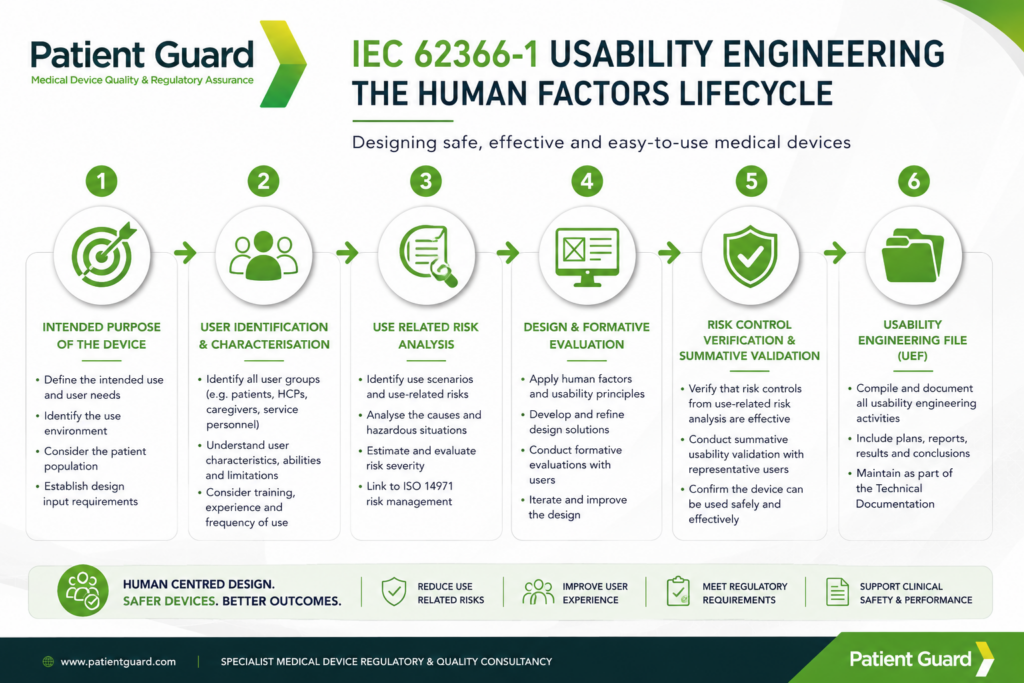
The medical device usability engineering process under IEC 62366-1 is a structured, risk-based approach to identifying, evaluating and reducing risks associated with the use of medical devices.
Usability engineering is not simply a test performed at the end of product development. Instead, it is an iterative process that begins during the early stages of medical device design and continues through development, with relevant findings informing subsequent design decisions and risk management activities.
IEC 62366-1 establishes a series of activities that enable manufacturers to understand intended users, define use environments, identify potentially hazardous interactions and evaluate the safety-related characteristics of the user interface.
The extent of usability engineering activities should be appropriate to the medical device, its intended users, use environments and associated use-related risks.
The following sections explain the key stages of the IEC 62366-1 usability engineering process, from establishing the Use Specification and identifying hazard-related use scenarios through to formative evaluation, summative evaluation and maintenance of the Usability Engineering File.
Free Download: IEC 62366-1 Usability Engineering Checklist
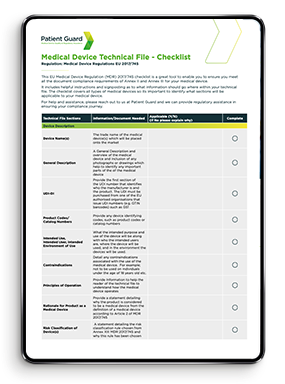
Applying IEC 62366-1 to medical device design and development? Download Patient Guard's printable IEC 62366-1 Usability Engineering Checklist to help review intended users, use specification, use-related risks, formative evaluation, summative validation, the Usability Engineering File and post-market feedback.
Define the Intended Medical Purpose
The first stage of the IEC 62366-1 usability engineering process involves establishing a clear understanding of the medical device’s intended purpose and the circumstances in which it will be used.
Under IEC 62366-1, manufacturers establish a Use Specification that describes the intended use of the medical device, its intended users and the environments in which it is expected to operate.
This information provides the foundation for identifying potential use errors, analysing use-related risks and planning subsequent usability engineering activities.
A comprehensive Use Specification should consider:
Intended medical indication: The medical condition, clinical application or diagnostic purpose for which the device is intended.
Intended patient population: The patients or individuals for whom the device is intended, including relevant characteristics that may influence its use.
Intended users: Healthcare professionals, patients, carers or other individuals expected to operate or interact with the device.
Intended use environment: Hospitals, clinics, laboratories, ambulances, homes or other environments where the device will be used.
Operating principle: A high-level description of how the medical device functions and achieves its intended medical purpose.
Manufacturers should also consider relevant user characteristics, including experience, training, physical abilities and cognitive limitations. For example, a blood glucose monitoring device intended for home use may need to accommodate users with reduced vision, limited dexterity or little medical training, influencing the design of its controls, displays and instructions.
The intended purpose and Use Specification should remain consistent with the manufacturer’s technical documentation, risk management records and applicable regulatory submissions.
Establishing this information early in development helps ensure that subsequent usability engineering activities reflect the intended users and realistic conditions of device operation.
Identify the Intended Users
Identifying and understanding intended users is an essential part of IEC 62366-1 usability engineering, as different user groups may have significantly different capabilities, experience, training and expectations when interacting with medical devices.
A consultant surgeon, laboratory technician and patient using a medical device independently at home may interact with medical technology in very different ways.
Manufacturers should identify and characterise all relevant intended user groups as part of the Use Specification, considering how their individual characteristics could influence safe device operation.
Depending on the medical device, intended users may include healthcare professionals such as surgeons, nurses, general practitioners and laboratory personnel, as well as emergency responders, biomedical engineers, caregivers, patients and lay users. Manufacturers should consider the activities performed by each user group and how differences in experience, responsibilities and working conditions could affect safe device operation.
In addition to identifying user groups, manufacturers should consider relevant user characteristics, including:
Clinical knowledge and previous experience with similar devices.
Education, literacy and language proficiency.
Physical capabilities, including strength, dexterity and mobility.
Sensory capabilities, including vision and hearing.
Cognitive capabilities, including memory, attention and decision-making.
Expected training and familiarity with the device.
Potential effects of fatigue, stress and workload.
For example, a home-use medical device intended for older adults may require consideration of visual accessibility, control size, readability and clear operating instructions.
These user characteristics should inform user interface requirements, use-related risk analysis and the selection of representative participants for usability evaluations. Where differences between user groups could influence safety-related interactions, manufacturers should ensure that these differences are appropriately represented during evaluation.
Define the Context of Use
Defining the context of use is an important part of IEC 62366-1 usability engineering, as the environment in which a medical device is operated can significantly influence user behaviour, performance and safety.
Under IEC 62366-1, manufacturers establish the intended use environment as part of the Use Specification, considering the physical, environmental and operational conditions that could affect interactions between users and the medical device.
Medical devices may be used in operating theatres, intensive care units, emergency departments, hospital wards, clinical laboratories, ambulances, community healthcare settings and patients’ homes. Each environment presents different conditions that may influence device operation, user performance and use-related risks.
Manufacturers should also consider relevant environmental and operational factors, including:
Lighting conditions: Poor visibility, glare or changing light levels that may affect displays and labels.
Background noise: Environmental sounds that could interfere with audible alarms or instructions.
Interruptions and distractions: Situations where users may lose concentration during safety-critical tasks.
Time pressure and workload: Circumstances that could influence decision-making and task performance.
Protective equipment: Gloves, masks or other equipment that may affect visibility, dexterity or communication.
Available space: Physical restrictions that could influence device positioning, accessibility and operation.
Training and support: The level of instruction and assistance reasonably available to intended users.
For example, a medical device designed for use in an intensive care unit may need to accommodate frequent alarms, interruptions and simultaneous operation of other equipment. A device intended for home use may require a different approach to instructions, controls and user feedback.
Usability evaluations should reflect the relevant characteristics of the intended use environment, particularly where these could affect safety-related interactions. Where testing in the actual environment is impractical, manufacturers may use appropriately designed simulated-use environments that reproduce relevant conditions.
Considering these factors during development helps manufacturers identify potential use errors, establish suitable user interface requirements and generate usability evidence that reflects realistic operating conditions.
Identify Use-Related Hazards
Identifying use-related hazards and potential use errors is a fundamental part of the IEC 62366-1 usability engineering process.
While ISO 14971 establishes the broader framework for medical device risk management, IEC 62366-1 focuses specifically on identifying and reducing risks associated with interactions between users and medical device interfaces.
Manufacturers should systematically examine how intended users might interact with a device and identify situations where foreseeable use errors could contribute to hazardous situations or harm.
A use error occurs when a user performs an action, or fails to perform an action, that leads to a result different from that intended by the manufacturer or expected by the user.
Potential use errors may include selecting an incorrect treatment mode, misinterpreting displayed information, connecting accessories incorrectly, entering inaccurate patient information, confusing measurement units or omitting essential preparation steps. For in vitro diagnostic devices, use errors may also arise during specimen collection, sample handling or interpretation of test results.
Manufacturers should consider how these interactions could contribute to hazardous situations, taking account of the intended users, user interface and reasonably foreseeable conditions of use.
Manufacturers should distinguish between the use error itself, the resulting hazardous situation and the potential harm.
For example, a user might enter an incorrect infusion rate because of a confusing interface. The resulting hazardous situation could involve delivery of an inappropriate medication dose, potentially causing patient harm.
Identifying these scenarios enables manufacturers to establish appropriate use-related risk controls, including improvements to user interface design, clearer information presentation, safeguards and other measures.
These findings should be integrated into the manufacturer’s ISO 14971 risk management activities and documented within, or referenced by, the Usability Engineering File.
Early identification of potential use errors allows manufacturers to address safety concerns during device development and provides a foundation for subsequent hazard-related use scenario analysis and usability evaluation.
Clear Labelling Helps Prevent Use Errors
Effective medical device labelling plays a vital role in usability engineering by helping users understand how to identify, prepare and operate devices safely. Learn more about medical device labelling requirements, including regulatory expectations, symbols, warnings and best practices for supporting safe device use.
Develop the User Interface
The medical device user interface includes all elements through which intended users interact with a device, extending beyond software screens and electronic controls to encompass physical components, information and instructions.
Under IEC 62366-1, manufacturers should develop user interfaces that support safe operation and minimise use-related risks identified during the usability engineering process.
The medical device user interface may include physical controls, touchscreens, displays, connectors, accessories, packaging, labelling, Instructions for Use (IFU), audible alarms, visual indicators and ergonomic design features. Manufacturers should consider how these elements influence user behaviour, device operation and potential use errors.
Effective user interface design should consider the characteristics of intended users, the intended use environment and the potential consequences of foreseeable use errors.
For example, an infusion pump may incorporate clearly differentiated controls, confirmation steps and safeguards to reduce the likelihood of incorrect medication delivery.
Similarly, a home-use medical device may require accessible controls, readable displays and clear instructions to accommodate users with varying physical or cognitive capabilities.
Safety-related risk control measures should be incorporated into the user interface wherever practicable, prioritising design features that prevent or reduce use errors rather than relying solely on warnings, instructions or training.
Manufacturers should document relevant user interface requirements, maintain traceability to identified use-related risks and use formative evaluation findings to refine the design throughout development. Subsequent usability evaluations should provide evidence that safety-related aspects of the user interface have been appropriately addressed.
Conduct Formative Evaluations
Formative usability evaluation is an essential part of the IEC 62366-1 usability engineering process, helping medical device manufacturers identify potential use errors and improve user interface design throughout product development.
Unlike summative usability evaluation, which assesses the final user interface, formative evaluations are conducted during development to identify usability problems, assess design alternatives and inform improvements before the design is finalised.
Formative evaluations are iterative and may be performed at different stages of development, depending on the device’s complexity, intended users and associated use-related risks.
Formative evaluation methods may include usability testing with representative users, expert reviews, cognitive walkthroughs, user interviews, prototype assessments and simulated-use testing. Manufacturers should select methods appropriate to the device’s development stage, intended users and safety-related usability questions being investigated.
For example, a formative evaluation of an infusion pump might reveal that healthcare professionals frequently confuse two similar operating controls. Manufacturers could use these findings to redesign the controls, improve their differentiation and evaluate the revised interface.
Formative evaluations should focus particularly on safety-related user interactions, including tasks where use errors could contribute to hazardous situations.
Manufacturers should establish appropriate evaluation objectives, select suitable methods and document relevant findings.
Formative evaluation records may include:
Evaluation objectives and methods.
User groups and participant characteristics, where applicable.
Device prototypes or interface versions evaluated.
Tasks and use scenarios assessed.
Observed use errors, difficulties and participant feedback.
Identified usability problems and potential safety implications.
Recommended design improvements and subsequent actions.
Findings should be reviewed alongside the manufacturer’s use-related risk analysis and incorporated into relevant design and development activities.
IEC 62366-1 does not prescribe a fixed number of participants or formative evaluation sessions for every medical device. The approach should be justified according to the device, evaluation objectives and associated risks.
By conducting formative usability evaluations throughout development, manufacturers can identify potential safety concerns early, refine user interface designs and reduce the likelihood of significant usability problems being discovered during final validation.
Implement Risk Control Measures
Implementing risk control measures is a critical part of IEC 62366-1 usability engineering, helping medical device manufacturers reduce risks associated with foreseeable use errors and potentially hazardous user interactions.
Where usability engineering activities identify unacceptable use-related risks, manufacturers must determine and implement appropriate risk control measures in accordance with their ISO 14971 risk management process.
Risk control measures should address the underlying causes of potential use errors wherever practicable, rather than relying exclusively on users to recognise and avoid hazardous situations.
The hierarchy of risk control measures under ISO 14971 includes:
Inherently safe design and manufacture: Eliminating hazards or reducing risks through device and user interface design. Examples include physically incompatible connectors, simplified controls and interface layouts that reduce the likelihood of incorrect selections.
Protective measures: Incorporating safeguards within the medical device or manufacturing process. Examples include software interlocks, confirmation mechanisms and alarms that help prevent or mitigate hazardous situations.
Information for safety: Providing appropriate warnings, labelling, Instructions for Use (IFU) and user training to communicate residual risks and support safe operation.
Manufacturers should apply these risk control options in the specified priority order, considering the effectiveness and suitability of the measures for the identified risks.
For example, if formative evaluation identifies repeated errors when selecting medication doses, the manufacturer should consider redesigning the dose-entry interface and introducing appropriate safeguards. Relying solely on additional warnings or instructions may not adequately reduce the underlying use-related risk.
Manufacturers should verify that risk control measures have been implemented and are effective, assess whether they introduce new hazards or affect existing risks, and maintain appropriate documentation within the Risk Management File. Relevant usability evaluation evidence should be maintained or referenced within the Usability Engineering File.
This approach helps demonstrate that identified use-related risks have been systematically addressed through appropriate design, protective measures and information for safety.
Conduct Summative Evaluation
Summative usability evaluation is a critical stage of the IEC 62366-1 usability engineering process, providing objective evidence that the final medical device user interface has been evaluated in relation to safety-related use scenarios.
Unlike formative evaluation, which is performed during development to identify usability problems and improve the design, summative evaluation assesses the completed user interface against the selected hazard-related use scenarios identified through the usability engineering process.
The objective is to evaluate whether intended users can interact with the medical device safely under conditions representative of its intended use.
Planning Summative Usability Evaluation
Under IEC 62366-1, manufacturers must establish a summative evaluation plan that addresses the selected hazard-related use scenarios.
The evaluation plan should consider:
Evaluation objectives: Defining the safety-related user interactions and hazard-related use scenarios being assessed.
Representative intended users: Selecting participants who appropriately reflect relevant user groups, capabilities, experience and training.
Intended use environments: Establishing realistic or appropriately simulated conditions representative of device operation.
Critical user tasks: Identifying tasks where use errors could contribute to hazardous situations or harm.
Evaluation methods: Selecting appropriate methods for assessing the final user interface.
Training conditions: Reflecting the training users would reasonably receive before operating the device.
Data collection: Establishing how observed use errors, close calls, difficulties and participant feedback will be recorded.
Evaluation and analysis: Defining how findings will be analysed in relation to the identified use-related risks.
Conducting Summative Usability Testing
Summative evaluations commonly involve representative intended users performing relevant tasks with the final or production-equivalent medical device interface.
Testing should reflect realistic operating conditions and should avoid providing participants with assistance that would not ordinarily be available during actual device use.
For example, a summative usability evaluation of an infusion pump may assess whether healthcare professionals can correctly configure treatment parameters, respond to alarms and complete safety-critical operating tasks.
Observed use errors, close calls and use difficulties should be investigated to determine their potential causes and safety implications.
Evaluating the Results
Following summative evaluation, manufacturers should analyse the findings to determine whether the user interface adequately addresses the selected hazard-related use scenarios.
Where use errors or other usability problems are identified, manufacturers should investigate their causes and determine whether additional risk control measures or design modifications are necessary.
Significant changes to the user interface may require further formative activities and additional summative evaluation.
Documenting Summative Evaluation
Summative evaluation records should provide traceable evidence of the evaluation activities performed and their results.
Documentation may include:
Summative evaluation plan and protocols.
Selected hazard-related use scenarios.
Participant selection and user group characteristics.
Device configuration and evaluation environment.
Training and instructions provided to participants.
Observed use errors, close calls and use difficulties.
Root cause investigations and safety-related findings.
Conclusions concerning the evaluated user interface.
Any required design changes or additional evaluations.
These records should be maintained within, or referenced by, the Usability Engineering File and linked to relevant risk management documentation.
IEC 62366-1 does not specify a universal minimum number of participants for summative usability evaluation. Manufacturers should justify their evaluation approach based on the intended user groups, selected hazard-related use scenarios, device characteristics and applicable regulatory expectations.
For medical devices intended for the United States, FDA human factors guidance generally recommends a minimum of 15 participants from each distinct user population for human factors validation testing. This is an FDA guidance recommendation rather than a requirement established by IEC 62366-1, and the appropriate study design should be justified for the particular device.
A properly planned and documented summative evaluation provides evidence that the final user interface has been assessed against the selected hazard-related use scenarios. Manufacturers should ensure that any observed use errors, close calls or use difficulties are investigated and that the conclusions are supported by appropriate evaluation records and risk management evidence.
Prepare the Usability Engineering File
The Usability Engineering File (UEF) is a key documentation requirement under IEC 62366-1, providing evidence that a medical device manufacturer has systematically applied the usability engineering process to identify and address safety-related use risks.
The Usability Engineering File contains or references records generated throughout the usability engineering process, demonstrating how intended users, use environments, user interface characteristics and potential use errors have been considered during medical device development.
Under IEC 62366-1:2015+A1:2020, manufacturers must establish and maintain a Usability Engineering File containing the records and other documents generated by the usability engineering process.
The file does not necessarily need to exist as a single standalone document. Relevant records may be maintained within the manufacturer’s design and development documentation, Risk Management File or quality management system, provided they are appropriately referenced and accessible.
What Should a Usability Engineering File Contain?
Depending on the medical device and the usability engineering activities performed, the Usability Engineering File should contain or reference evidence covering the following areas:
Use Specification: Documentation describing the intended medical indication, patient population, intended user profiles, intended use environments, operating principles and other applicable characteristics.
Safety-Related User Interface Characteristics: Identification of user interface features that could influence safety, including controls, displays, alarms, labelling and Instructions for Use (IFU).
Known or Foreseeable Use-Related Hazards: Information identifying potential use errors, hazardous situations and associated harms.
Hazard-Related Use Scenarios: Documentation describing relevant sequences of user interactions that could contribute to hazardous situations.
Selection of Hazard-Related Use Scenarios: The rationale for selecting scenarios for summative evaluation.
User Interface Specification: Documented requirements for the user interface, including safety-related requirements and applicable risk controls.
User Interface Evaluation Plan: The planned approach to formative and summative usability evaluation.
Formative Evaluation Records: Evaluation methods, observations, identified usability problems and resulting design improvements.
Summative Evaluation Records: Evaluation plans, protocols, results, analysis of observed use errors and conclusions concerning the final user interface.
Risk Management Traceability: References linking relevant usability findings, use-related risks and risk control measures to the manufacturer’s ISO 14971 risk management documentation.
Design Changes and Re-evaluation: Records demonstrating how significant usability findings and relevant user interface modifications have been addressed.
The Usability Engineering File and Regulatory Compliance
Usability engineering documentation provides supporting evidence for applicable safety and performance requirements under the EU MDR and IVDR, as well as relevant UK regulatory requirements and FDA expectations, depending on the device and regulatory pathway.
The Usability Engineering File should provide a coherent, traceable record of the activities performed, rather than simply a collection of usability test reports. Manufacturers should also assess whether post-market findings or device changes require relevant usability documentation to be reviewed and updated.
Usability Engineering Is an Ongoing Process
Usability engineering does not end when a medical device is placed on the market. Manufacturers should continue to review relevant post-market surveillance information, complaints, reported use errors and user feedback to identify emerging safety-related usability concerns.
Changes to device controls, displays, software interfaces, labelling or Instructions for Use (IFU) should also be assessed for their potential impact on use-related risks. Where significant changes or new safety concerns are identified, additional usability evaluation may be necessary.
Maintaining appropriate links between IEC 62366-1 usability engineering, ISO 14971 risk management, ISO 13485 change control and post-market surveillance helps manufacturers address emerging use-related risks throughout the device lifecycle.
Understanding Human Factors Engineering
Human factors engineering plays an important role in medical device design and development, helping manufacturers understand how human capabilities, limitations and behaviours influence interactions with medical technology.
While IEC 62366-1 establishes a structured usability engineering process focused on safety, human factors engineering provides the scientific principles that inform user interface design, risk analysis and usability evaluation.
Human factors considerations generally fall into three areas:
Physical factors: Human characteristics such as strength, dexterity, mobility, vision and hearing that may influence device operation.
Cognitive factors: Mental processes including attention, memory, information processing, decision-making and workload.
Organisational and environmental factors: Working conditions, interruptions, communication, training and other circumstances that may influence user performance.
For example, a medical device used in an emergency department may need to accommodate healthcare professionals operating under significant time pressure, while a home-use device may need to support patients with limited training or reduced physical capabilities.
Human factors principles help manufacturers identify potential mismatches between device design, user capabilities and real-world operating conditions. These findings should inform safety-related user interface requirements, use-related risk controls and usability evaluation activities under IEC 62366-1.
Physical Human Factors
Physical human factors are an important consideration in medical device usability engineering, particularly where the physical characteristics, capabilities and limitations of intended users may influence safe device operation.
Under IEC 62366-1, manufacturers should consider relevant physical interactions between users and medical device interfaces when identifying use-related risks and developing appropriate risk control measures.
Physical human factors include:
Strength and dexterity: The physical effort and fine motor control required to operate buttons, switches, connectors and other device components.
Hand size and grip: The ability of intended users to hold, manipulate and control medical devices safely.
Vision: The readability of displays, labels, symbols and operating instructions under intended use conditions.
Hearing: The ability to recognise and distinguish audible alarms, notifications and other safety-related signals.
Mobility and reach: The accessibility of controls and components for users with different physical capabilities.
Posture and positioning: The potential effects of device placement, repetitive movements and awkward operating positions.
Tactile feedback: The physical feedback provided by controls, connectors and other interface elements to confirm user actions.
Protective equipment: The influence of gloves, protective clothing and other equipment on device handling and operation.
For example, a medical device intended for use by healthcare professionals wearing surgical gloves should incorporate controls that can be operated reliably under those conditions.
Similarly, a home-use medical device intended for patients with reduced manual dexterity may require larger controls, simplified handling procedures or alternative methods of interaction.
Manufacturers should assess relevant physical interactions through ergonomic assessments, prototype evaluations and usability testing with representative intended users. Where appropriate, anthropometric data can also support user interface design decisions.
Findings should inform safety-related user interface requirements, risk control measures and usability engineering documentation, helping reduce foreseeable use errors associated with physical interaction.
Cognitive Human Factors
Cognitive human factors are an important consideration in medical device usability engineering, particularly where mental workload, attention, memory and decision-making may influence how safely users interact with medical devices.
Under IEC 62366-1, manufacturers should consider relevant cognitive capabilities and limitations of intended users when identifying potential use errors, designing user interfaces and evaluating safety-related interactions.
Cognitive human factors include:
Attention and concentration: The ability to focus on important information and complete tasks accurately, particularly in environments involving interruptions or distractions.
Memory: The ability to remember operating procedures, instructions, settings and sequences of actions required for safe device use.
Information processing: How users receive, interpret and respond to information presented through displays, alarms, symbols and instructions.
Decision-making: The ability to select appropriate actions based on the information provided by a medical device.
Mental workload: The cognitive demands associated with operating equipment, particularly when users must perform multiple tasks simultaneously.
Situational awareness: Understanding the current device status, operating conditions and potential consequences of user actions.
Learning and familiarity: How previous experience, training and familiarity with similar technologies influence device operation.
Stress and fatigue: The potential effects of time pressure, tiredness and demanding clinical environments on user performance.
For example, an infusion pump displaying multiple treatment parameters may increase cognitive workload if important information is difficult to distinguish or interpret. A poorly organised interface could contribute to incorrect parameter selection or delayed recognition of an unsafe condition.
Similarly, a home-use medical device with complicated operating instructions or poorly organised menus may place excessive demands on users with limited technical experience. Simplifying the interface, presenting information clearly and providing appropriate feedback can help reduce foreseeable use errors.
Manufacturers should consider cognitive capabilities and limitations when establishing user interface requirements, identifying use-related risks and planning usability evaluations. Where cognitive demands could contribute to hazardous situations, appropriate design measures should be implemented and evaluated.
Environmental Factors
Environmental factors play an important role in medical device usability engineering, as the conditions in which a device is operated can significantly influence user performance, decision-making and safety.
Under IEC 62366-1, manufacturers should consider relevant characteristics of the intended use environment when identifying use-related risks, developing user interfaces and planning usability evaluations.
Even a well-designed medical device may present safety concerns if environmental conditions interfere with the user’s ability to operate it correctly.
Relevant environmental factors may include lighting, background noise, interruptions, limited space, temperature, humidity, movement, vibration, time pressure and communication difficulties. Manufacturers should also consider environments where users must monitor or operate several medical devices simultaneously, as competing demands may affect attention and safe device operation.
For example, a patient monitor used in an intensive care unit may need to provide alarms that remain distinguishable from those generated by surrounding equipment.
Similarly, a medical device intended for ambulance use may require controls and displays that remain accessible and understandable during vehicle movement and under varying lighting conditions.
Manufacturers should document relevant environmental conditions within the Use Specification and consider their potential contribution to use errors when establishing user interface requirements and planning usability evaluations.
Where simulated-use testing is performed, the environment should adequately reproduce the conditions relevant to the selected hazard-related use scenarios. This helps identify usability problems that may not be apparent under ideal laboratory conditions.
Designing for Different Types of Users
One of the fundamental principles of IEC 62366-1 usability engineering is recognising that medical device users have different levels of knowledge, training, experience and physical or cognitive capabilities.
Manufacturers should identify the intended user populations for their medical devices and consider how these characteristics may influence safe and effective interaction with the user interface.
Medical devices may be designed for use by several different groups, each with distinct usability requirements.
Healthcare Professionals
Healthcare professionals may operate medical devices in demanding clinical environments involving time pressure, interruptions and competing responsibilities. Manufacturers should consider clinical workflows, familiarity with the device, clarity of alarms and the potential for errors during high-workload situations.
For example, an infusion pump should clearly present critical settings and operating information to support safe operation by its intended clinical users.
Laboratory Personnel
Laboratory personnel may use diagnostic analysers and other devices requiring accurate sample handling, equipment configuration and interpretation of results. User interfaces should support correct operating sequences, clear identification of samples and consumables, and recognition of errors or warnings.
For example, an in vitro diagnostic analyser should help users identify incorrect sample placement or operating conditions that could affect test results.
Patients
Patients may use medical devices independently, often without direct clinical supervision. Manufacturers should consider differences in health literacy, physical capabilities, experience and the ability to understand instructions and safety-related information.
For example, a home-use blood glucose monitoring system should support patients in completing the testing procedure correctly and recognising relevant warnings.
Caregivers
Caregivers may include family members or professional carers who assist patients with medical devices. Their training and medical knowledge may vary, making clear instructions, understandable alarms and safe handling particularly important.
For example, a caregiver using a home enteral feeding device should be able to identify the correct connections and recognise conditions requiring intervention.
Lay Users
Lay users do not have formal professional healthcare training relevant to the device and may include patients, caregivers or members of the public. Devices intended for these users should minimise unnecessary complexity and reliance on specialist knowledge, with appropriate instructions and feedback.
For example, a public-access automated external defibrillator (AED) should provide clear instructions that support intended users during an emergency.
Where a medical device is intended for multiple distinct user populations, manufacturers should consider the relevant characteristics of each population when planning usability evaluations.
Representative participants should be selected according to the intended users and the safety-related tasks being evaluated. Different user populations may require separate consideration during formative and summative usability evaluations.
By designing and evaluating medical devices with their actual intended users in mind, manufacturers can identify potential interaction difficulties and implement appropriate measures to reduce use-related risks.
Foreseeable Misuse
Medical device use errors do not necessarily result from carelessness or inadequate training. They may arise from confusing interfaces, unclear instructions, environmental conditions or differences between how manufacturers expect a device to be operated and how users actually interact with it.
IEC 62366-1 requires manufacturers to identify and evaluate use-related risks associated with the medical device user interface. This includes considering reasonably foreseeable use errors and distinguishing them from abnormal use.
Reasonably foreseeable misuse describes use of a medical device in a manner not intended by the manufacturer but which may be predicted from human behaviour and readily foreseeable circumstances.
Examples of potentially foreseeable misuse or use errors include skipping essential preparation steps, selecting incorrect operating modes, using incompatible accessories, misinterpreting alarms or displayed information, and operating a device outside its specified conditions.
For in vitro diagnostic medical devices, relevant examples may also include incorrect specimen collection or handling. Whether a particular situation constitutes a use error, reasonably foreseeable misuse or abnormal use depends on the device, intended use and circumstances involved.
For example, if users repeatedly select the wrong operating mode because two options appear visually similar, the manufacturer should investigate whether the interface design contributes to the error rather than simply attributing the problem to user behaviour.
Potential risk control measures may include clearer interface layouts, improved feedback, physical design safeguards, compatibility controls or changes to operating sequences.
IEC 62366-1 distinguishes use errors associated with the user interface from abnormal use. Manufacturers should apply these distinctions appropriately within usability engineering and address relevant risks through their broader ISO 14971 risk management activities.
Considering reasonably foreseeable user behaviour during development helps manufacturers identify opportunities for safer interface design and appropriate risk controls before devices are placed on the market.
Accessibility and Inclusive Design
Accessibility and inclusive design are important considerations in medical device usability engineering, particularly where devices are intended for users with different physical, sensory or cognitive capabilities.
Under IEC 62366-1, manufacturers should consider the characteristics and limitations of their intended user populations when designing and evaluating safety-related user interfaces.
Inclusive design aims to accommodate a range of user capabilities and circumstances, reducing unnecessary barriers to safe device operation.
Accessibility considerations may include readable text, appropriate colour contrast, understandable symbols, clear instructions, accessible controls and suitable alternatives to visual or audible information where necessary for safe use.
Manufacturers should also consider relevant differences in physical capabilities, cognitive abilities, age, language and health literacy among intended users. Where appropriate, compatibility with assistive technologies or accessibility features may help support safe device operation.
For example, a home-use medical device intended for older adults may require larger display text, clearly differentiated controls and straightforward operating instructions.
Similarly, medical device software intended for users with visual impairments may benefit from accessible interface features, provided these are compatible with the device’s safety and performance requirements.
Accessibility requirements should be proportionate to the device’s intended purpose, intended user populations and identified use-related risks. Manufacturers should assess relevant accessibility needs during user interface design and include representative users with appropriate characteristics in usability evaluations.
IEC 62366-1 does not establish a universal accessibility requirement for every medical device. However, its usability engineering process helps manufacturers identify and address safety-related barriers that could affect intended users.
Usability Begins During Medical Device Design
Effective usability engineering starts long before validation testing. Discover how medical device design and development integrates user needs, design controls, verification, validation and risk management to create safer, more intuitive medical devices from concept through to commercialisation.
Understanding Use Errors
Understanding use errors is an essential part of medical device usability engineering under IEC 62366-1. Manufacturers should assess how interactions between intended users and device interfaces may contribute to hazardous situations, taking account of foreseeable human behaviour and operating conditions.
What Is a Use Error?
Under IEC 62366-1, a use error is a user action, or lack of action, that leads to a result different from that intended by the manufacturer or expected by the user.
Use errors can occur even when a medical device functions correctly and the user is appropriately trained.
For example, a healthcare professional may select an incorrect infusion rate because two values appear similar on a device display. The device may operate exactly as designed, but the interaction between the user and the interface has contributed to an unintended outcome.
Use errors may result from several factors, including:
Confusing controls or interface layouts.
Unclear instructions, labels or symbols.
Misleading or insufficient device feedback.
User fatigue, distractions or time pressure.
Differences in user knowledge, experience or capabilities.
A use error is not automatically a device malfunction or evidence of user negligence. Manufacturers should investigate whether user interface characteristics or operating conditions contributed to the error.
Identifying use errors and assessing their potential safety consequences is an essential part of the IEC 62366-1 usability engineering process and associated ISO 14971 risk management activities.
Common Types of Medical Device Use Errors
Common use errors may include selecting incorrect device settings, omitting essential operating steps, performing actions in the wrong sequence, misinterpreting displayed information, making incorrect connections or performing actions at the wrong time.
Users may also fail to recognise or respond appropriately to safety-related alarms and notifications. The significance of these errors depends on the device, the circumstances of use and their potential contribution to hazardous situations.
For example, a healthcare professional may accidentally enter an incorrect infusion rate because the device’s input controls or displayed values are difficult to distinguish.
Similarly, a patient using a home-use medical device may misunderstand an instruction and omit an essential preparation step.
In both cases, manufacturers should investigate whether characteristics of the user interface contributed to the error.
Identifying and Reducing Use Errors
IEC 62366-1 establishes a process for identifying and evaluating use-related risks associated with medical device user interfaces.
Manufacturers should consider foreseeable use errors when analysing hazard-related use scenarios and determining appropriate risk control measures.
Potential measures include improving the layout of controls, simplifying operating sequences, providing clearer feedback and introducing safeguards against incorrect actions.
Formative usability evaluations can help identify potential use errors during development. Summative usability evaluations assess the safety-related use of the final user interface against selected hazard-related use scenarios.
Not every use error results in harm, but errors that could contribute to hazardous situations must be appropriately considered within the manufacturer’s risk management process.
The objective is to identify how user interface characteristics may contribute to hazardous situations and implement appropriate design measures to reduce associated risks. Manufacturers should evaluate the effectiveness of relevant risk controls rather than relying solely on warnings, instructions or additional training.
Use Error vs Device Failure
A use error occurs when a user performs an action, or fails to perform an action, resulting in an outcome different from that intended by the manufacturer or expected by the user.
A device failure occurs when a medical device or one of its components fails to perform as intended because of a hardware, software or other technical problem.
For example, consider an infusion pump:
Use error: A healthcare professional unintentionally selects an incorrect infusion rate because the device’s controls or displayed information are confusing.
Device failure: The infusion pump delivers an incorrect volume because of a malfunctioning component or software defect.
A use error can occur even when a device functions as designed, whereas a device failure involves the device not performing as intended. However, the two can interact: a technical malfunction may contribute to user confusion, while an interface design weakness may increase the likelihood of an incorrect action.
IEC 62366-1 addresses safety-related risks associated with user interface interactions, while ISO 14971 provides the broader risk management framework. Manufacturers should consider both sources of risk and any potential interactions when determining appropriate risk control measures.
Use Error vs Abnormal Use
IEC 62366-1 distinguishes between use errors and abnormal use because they are addressed differently within the medical device usability engineering process.
A use error occurs when a user performs an action, or fails to perform an action, resulting in an outcome different from that intended by the manufacturer or expected by the user.
Abnormal use refers to a conscious, intentional act or intentional omission that is contrary to normal use and beyond any reasonable means of user interface-related risk control by the manufacturer.
For example, consider an infusion pump:
Use error: A healthcare professional unintentionally selects the wrong infusion rate because the controls or displayed information are confusing.
Abnormal use: A user deliberately defeats a safety mechanism in circumstances where the behaviour is beyond reasonable user interface-related risk control.
An incorrect action should not automatically be classified as abnormal use simply because the manufacturer provided instructions or training. Where foreseeable interaction difficulties could be influenced by user interface design, manufacturers should assess the associated risks through the IEC 62366-1 usability engineering process.
Although abnormal use falls outside the user interface-related risk control process addressed by IEC 62366-1, manufacturers should still consider applicable risks associated with reasonably foreseeable misuse within their broader ISO 14971 risk management activities. The rationale for distinguishing use errors from abnormal use should be documented appropriately.
Critical Tasks
Not every interaction with a medical device presents the same level of risk. Some user actions are particularly important because performing them incorrectly, or failing to perform them, could result in serious harm.
In medical device human factors engineering, these safety-related interactions are often described as critical tasks, particularly within U.S. Food and Drug Administration (FDA) human factors guidance.
A critical task is a user task that, if performed incorrectly or not performed at all, could cause serious harm to the patient or user. Harm can also arise through compromised medical care.
Examples of potentially critical tasks include programming an infusion pump, confirming patient identity, selecting treatment parameters, preparing an implant, performing safety-related calibration, collecting patient specimens and interpreting diagnostic results.
For example, entering an incorrect infusion rate could result in unintended medication delivery, while incorrectly collecting or identifying a diagnostic specimen could contribute to an inappropriate clinical decision. Whether a task is critical depends on the device, its intended users and the potential consequences of incorrect performance.
Critical Tasks and IEC 62366-1
Although the term critical task is widely used in FDA human factors engineering, IEC 62366-1 focuses on identifying hazard-related use scenarios and selecting those requiring summative evaluation.
A hazard-related use scenario describes a sequence of user interactions that could lead to a hazardous situation and potentially result in harm.
Manufacturers should identify use-related hazards, evaluate the associated risks and determine which hazard-related use scenarios require particular attention during usability evaluation.
For example, incorrectly programming an infusion pump may create a hazardous situation involving unintended medication delivery. Under IEC 62366-1, the manufacturer should assess the relevant user interactions and identify the hazard-related use scenarios requiring summative evaluation.
FDA human factors validation generally focuses on whether representative intended users can perform identified critical tasks safely and effectively. IEC 62366-1 instead structures summative evaluation around selected hazard-related use scenarios. Understanding this distinction helps manufacturers plan appropriate usability evaluations and prepare documentation for their applicable regulatory markets.
Hazard-Related Use Scenarios
Hazard-related use scenarios are a fundamental part of the IEC 62366-1 usability engineering process. They describe sequences of user interactions with a medical device that could lead to a hazardous situation and potentially result in harm.
Manufacturers should identify these scenarios through their use-related risk analysis, considering the intended users, operating environment, user interface characteristics and reasonably foreseeable use errors.
A hazard-related use scenario may involve a single user action or a sequence of interactions that contributes to a hazardous situation.
Examples of hazard-related use scenarios may involve failing to recognise a safety-critical alarm, selecting an incorrect treatment parameter, connecting accessories incorrectly, experiencing difficulty activating an emergency function or misinterpreting diagnostic information.
For example, an infusion pump user who fails to recognise an occlusion alarm may not take the necessary corrective action, potentially delaying treatment. The manufacturer should analyse the sequence of user interactions and the circumstances that could lead to the hazardous situation.
Identifying and Evaluating Hazard-Related Use Scenarios
Under IEC 62366-1, manufacturers should identify hazard-related use scenarios and determine which require particular attention during usability evaluation.
Relevant considerations include:
The potential severity of harm associated with the scenario.
The characteristics and capabilities of intended users.
The complexity of the user interactions involved.
The operating conditions in which the scenario may occur.
The potential for user interface characteristics to contribute to use errors.
IEC 62366-1 requires manufacturers to select hazard-related use scenarios for summative evaluation using the approach established by the standard, including consideration of potential harm severity.
Summative usability evaluation should provide evidence concerning the safety-related use of the final user interface for the selected hazard-related use scenarios.
Evaluations should involve representative intended users and sufficiently representative use conditions. Where simulated-use testing is appropriate, the simulation should reflect the characteristics of the intended environment that are relevant to the scenarios being evaluated.
Manufacturers should document the selected hazard-related use scenarios, the rationale for their selection, the evaluation methods and the results within the Usability Engineering File. Relevant findings should also be considered within the associated ISO 14971 risk management activities.
Examples of Medical Device Use Errors
Medical device use errors can occur across a wide range of technologies, from traditional surgical instruments to complex medical device software.
Under IEC 62366-1, manufacturers should consider how user interface characteristics, intended user capabilities and operating conditions may contribute to foreseeable use errors and associated risks.
The following illustrative examples demonstrate how usability problems can affect medical device safety.
Infusion Pumps
Confusing controls or poorly differentiated settings may cause healthcare professionals to select an incorrect infusion rate or medication concentration, potentially resulting in unintended medication delivery.
Surgical Instruments
Similar-looking instruments or unclear markings may contribute to incorrect instrument selection. Distinctive design features and clearer identification can help reduce associated risks.
In Vitro Diagnostic Medical Devices
Laboratory personnel may incorrectly prepare specimens, misidentify samples or misunderstand diagnostic results. Clear sample-loading instructions, interface feedback and identification controls can help prevent errors that could affect clinical decisions.
Home Healthcare Devices
Patients and caregivers may omit preparation steps, misunderstand instructions or fail to recognise important warnings. Straightforward controls and understandable feedback are particularly important where users have limited training.
Wearable Medical Devices
Incorrect sensor positioning, misunderstood alerts or failure to recognise device problems may affect monitoring reliability. Manufacturers should consider how users fit, operate and respond to information from wearable devices.
Medical Device Software
Confusing navigation, unclear terminology or inadequate confirmation of safety-critical actions may contribute to incorrect data entry, inappropriate settings or misinterpretation of clinical information. Usability evaluations should reflect relevant clinical workflows and intended operating conditions.
These examples illustrate how different medical device interfaces can contribute to use-related risks. Manufacturers should investigate relevant foreseeable use errors and evaluate appropriate design measures with representative intended users under realistic use conditions.
Reducing Use Errors Through Good Design
Effective medical device usability engineering aims to reduce foreseeable use errors through appropriate user interface design and risk control measures.
Under IEC 62366-1, manufacturers should consider how the design of a medical device influences user behaviour and whether interface characteristics could contribute to hazardous situations.
The risk control principles established in ISO 14971 prioritise inherently safe design and manufacturing, followed by protective measures and information for safety.
This means manufacturers should not rely solely on warnings, instructions or user training where reasonably practicable design improvements could reduce the associated risks.
Good usability design may include consistent interface layouts, logical operating sequences, readable displays, clearly differentiated controls and effective alarm systems. Packaging, labelling and Instructions for Use (IFU) should also support correct identification, preparation and operation.
Where appropriate, physical safeguards, input constraints and confirmation steps can help prevent incorrect actions. Manufacturers should ensure that design measures remain appropriate for the intended users and do not introduce additional difficulties, such as excessive confirmation prompts or reliance on colour alone to communicate safety-critical information.
For example, a medical device with multiple tubing connections may incorporate physically incompatible connectors to prevent incorrect assembly, rather than relying exclusively on written instructions.
Similarly, medical device software may incorporate clear parameter displays, appropriate input constraints and confirmation of safety-critical settings to reduce the likelihood of incorrect operation.
Manufacturers should evaluate the effectiveness of relevant usability-related risk controls through appropriate formative and summative usability activities. Findings should inform the usability engineering process and associated ISO 14971 risk management documentation.
Learning from Post-Market Experience
Post-market experience provides valuable evidence about how medical devices are used under real-world conditions. Even comprehensive usability evaluations conducted during development may not identify every potential interaction difficulty or use-related risk.
Manufacturers should therefore consider relevant usability information collected through their post-market surveillance (PMS) and quality management activities.
Relevant information may come from customer complaints, incident and vigilance reports, technical support enquiries, user surveys, clinical feedback, scientific literature and post-market surveillance trend analysis.
Manufacturers should review this information for recurring operating difficulties, misunderstood instructions, interface-related errors or other indications of emerging use-related risks.
Using Post-Market Information to Improve Usability
Where post-market information identifies a potential usability concern, manufacturers should investigate whether the issue is associated with the user interface, operating environment, instructions or other relevant factors.
For example, repeated complaints about incorrect device configuration may indicate that users are misunderstanding a particular setting or operating sequence.
The manufacturer should assess whether the issue introduces a previously unidentified use-related risk or changes an existing risk assessment.
Depending on the findings, appropriate actions may include:
Updating the use-related risk analysis.
Reviewing relevant hazard-related use scenarios.
Improving user interface controls, displays or operating sequences.
Revising instructions or other information for safety.
Conducting additional formative or summative usability evaluations where necessary.
Updating the Usability Engineering File and associated risk management documentation.
Post-market usability findings should be considered within the manufacturer’s ISO 14971 risk management process and applicable quality management and post-market surveillance procedures.
By systematically reviewing real-world user experience and incorporating relevant findings into device improvements, manufacturers can identify emerging use-related risks and support continued medical device safety throughout the product lifecycle.
Post-Market Surveillance Improves Usability Over Time
Usability engineering continues long after a medical device reaches the market. Discover how Post-Market Surveillance (PMS) helps manufacturers monitor real-world use, identify use-related issues, evaluate customer feedback and continuously improve device safety and usability throughout the product lifecycle.
Formative and Summative Evaluation
IEC 62366-1 distinguishes between formative and summative usability evaluation. Formative evaluation supports iterative user interface development by identifying usability problems and informing design improvements. Summative evaluation provides evidence concerning the safety-related use of the final user interface for selected hazard-related use scenarios.
Although both activities involve evaluating user interactions, they serve different purposes within the usability engineering process.
The key differences are:
| Formative Evaluation | Summative Evaluation |
|---|---|
| Supports iterative design improvements | Evaluates the final user interface |
| Can be performed at different development stages | Conducted when the interface is sufficiently finalised |
| Identifies usability difficulties and potential use errors | Evaluates safety-related performance in selected scenarios |
| May use prototypes and exploratory methods | Uses a representative final or production-equivalent interface |
| Informs further design development | Supports the usability engineering conclusion |
Both activities should consider the characteristics of intended users and the conditions in which the medical device will be operated.
IEC 62366-1 does not prescribe a single testing method or fixed participant number for every medical device. The evaluation approach should be appropriate to the device, its intended users and the relevant use-related risks.
What Is Formative Evaluation?
Formative evaluation is an iterative activity within the IEC 62366-1 usability engineering process, used to identify potential usability problems and improve the medical device user interface during design and development.
Unlike summative evaluation, which assesses the final user interface against selected hazard-related use scenarios, formative evaluation focuses on understanding how intended users interact with a developing design.
Manufacturers can conduct formative evaluations using early prototypes, partially developed interfaces or more complete device designs.
The objective is to identify potential use errors, understand their underlying causes and implement appropriate improvements before the design is finalised.
Formative evaluation methods may include user interviews, prototype testing, task analysis, simulated-use sessions, observational studies, expert usability reviews and heuristic evaluations. Manufacturers may also assess preliminary software screens, physical controls, labelling and operating sequences before progressing to more developed designs.
The methods selected should be appropriate to the device, its intended users, the stage of development and the usability questions being investigated.
For example, formative evaluation of a medical device software interface may reveal that users frequently overlook an important warning because it is positioned away from the main operating controls.
The manufacturer could modify the interface and conduct further evaluation to determine whether the changes have addressed the identified problem.
Safety-related findings and resulting design changes should be documented within the usability engineering process and considered in the associated risk management activities.
IEC 62366-1 does not specify a universal number of formative evaluation sessions. Manufacturers should determine the appropriate extent of evaluation based on the device, its intended users, development stage and identified use-related risks.
Why Formative Evaluation Is Important
Formative usability evaluation helps medical device manufacturers identify and address potential use-related problems before the user interface design is finalised.
Identifying usability difficulties early in development allows manufacturers to make improvements when design changes are generally easier and less costly to implement.
Under IEC 62366-1, formative evaluation supports the development of user interfaces that account for the capabilities, limitations and operating conditions of intended users.
Formative evaluation can help manufacturers improve interface layouts, simplify operating workflows, clarify instructions, identify ergonomic difficulties and assess potential sources of user confusion. It can also highlight where appropriate training or additional risk control measures may be necessary.
Identifying these problems during early development allows manufacturers to investigate alternative designs before changes become more difficult or expensive to implement.
For example, formative evaluation may reveal that users repeatedly select an incorrect operating mode because two controls are positioned too closely together.
Identifying this problem during prototype development allows the manufacturer to investigate alternative layouts and evaluate whether the revised design reduces the likelihood of error.
Formative evaluation also helps manufacturers prepare for summative usability evaluation by identifying potential problems before the final user interface is assessed.
However, successful formative evaluations do not replace the need for summative evaluation or guarantee that the final device will satisfy all applicable usability engineering requirements.
Designing Effective Formative Studies
Effective formative usability studies should be designed to identify potential use errors, investigate user interface difficulties and support improvements during medical device development.
IEC 62366-1 does not prescribe a single method for conducting formative evaluations. The approach should reflect the medical device’s complexity, intended users, development stage and associated use-related risks.
When planning formative evaluations, manufacturers should consider the following principles:
Define clear evaluation objectives: Identify the user interface characteristics, operating procedures or potential use-related problems that the study will investigate.
Involve representative users: Select participants whose relevant knowledge, experience and capabilities reflect the intended user population.
Consider realistic use conditions: Include environmental characteristics, equipment and operating circumstances relevant to the interactions being evaluated.
Evaluate relevant user tasks: Focus on activities that may reveal usability difficulties, including safety-related tasks and potential use errors.
Encourage honest feedback: Allow participants to describe difficulties and uncertainties without being unnecessarily guided towards the expected actions.
Observe user behaviour: Record how participants interact with the device, including errors, hesitation, confusion and difficulties completing tasks.
Document findings objectively: Record the evaluation methods, relevant observations, identified usability problems and conclusions.
Implement and assess improvements: Use the findings to inform design changes and determine whether further evaluation is appropriate.
For example, a formative study involving a prototype diagnostic device may reveal that laboratory personnel frequently misunderstand the sequence required for sample preparation.
The manufacturer could use these findings to revise the interface, improve procedural guidance or simplify the operating sequence before conducting further evaluations.
Formative evaluation is intended to identify usability difficulties and inform design improvements, rather than demonstrate that a device is free from all potential use errors. Manufacturers should document relevant findings, resulting decisions and any further evaluation activities within, or by reference from, the Usability Engineering File.
What Is Summative Evaluation?
Summative usability evaluation is a formal assessment of the final medical device user interface, conducted to obtain objective evidence concerning its safety-related use under IEC 62366-1.
Unlike formative evaluation, which supports iterative design improvements, summative evaluation assesses whether the final user interface supports safe operation by intended users when performing selected hazard-related use scenarios.
Summative evaluation is generally conducted towards the end of medical device development, once the user interface design has been finalised or is sufficiently representative of the intended production configuration.
The evaluation should consider:
Representative intended users: Participants whose relevant characteristics, experience and capabilities reflect the identified user populations.
Final user interface: A device or interface representative of the configuration intended for market placement.
Hazard-related use scenarios: Scenarios selected through the IEC 62366-1 usability engineering process.
Representative use conditions: Operating environments and circumstances that reflect relevant aspects of actual device use.
Use errors and difficulties: Observations of incorrect actions, unsuccessful task completion and other safety-related interaction problems.
Evaluation results: Documented findings and conclusions concerning the safety-related use of the user interface.
Where summative evaluation identifies use errors or other safety-related difficulties, manufacturers should investigate their causes, assess the associated risks and determine whether further risk controls or design changes are necessary. Changes affecting safety-related user interactions may require additional usability evaluation.
Summative evaluation does not demonstrate that every possible use error has been eliminated. Its results provide evidence concerning the safety-related use of the final user interface and should be documented within, or referenced by, the Usability Engineering File and considered alongside ISO 14971 risk management activities.
Why Summative Evaluation Is Required
Summative usability evaluation is an essential requirement of the IEC 62366-1 usability engineering process, providing objective evidence concerning the safety-related use of the final medical device user interface.
Although a medical device may appear intuitive during development, representative users may encounter difficulties that were not identified through design reviews or earlier formative evaluations.
Summative evaluation helps manufacturers assess whether the final user interface supports safe operation under conditions representative of its intended use.
Summative evaluation provides evidence to support the manufacturer’s usability engineering conclusions, technical documentation and assessment of use-related risks. It can also reveal residual usability concerns that require investigation before the device is placed on the market.
The results should be considered alongside relevant design validation activities and ISO 14971 risk management documentation, helping manufacturers demonstrate that safety-related user interface interactions have been appropriately evaluated.
For example, a medical device may perform correctly during technical verification but still present safety concerns if intended users cannot reliably recognise an important warning or complete an essential operating sequence.
Summative evaluation can identify these difficulties and provide evidence for determining whether further design improvements or risk control measures are necessary.
Under IEC 62366-1, summative evaluation should address the selected hazard-related use scenarios. The results and any necessary follow-up actions should be documented within, or referenced by, the Usability Engineering File.
Selecting Representative Users
Selecting representative intended users is a fundamental consideration when conducting summative usability evaluations under IEC 62366-1.
Participants should reflect the characteristics of the individuals expected to operate the medical device under its intended conditions of use.
Depending on the device’s intended purpose, relevant user populations may include surgeons, nurses, laboratory scientists, biomedical engineers, patients, caregivers, lay users and community healthcare professionals. Manufacturers should identify distinct user populations based on their intended interactions with the device, rather than relying solely on professional job titles.
Manufacturers should consider relevant user characteristics when establishing participant selection criteria, including:
Professional training and qualifications.
Experience with similar medical devices.
Familiarity with the intended operating environment.
Physical, sensory and cognitive capabilities.
Language proficiency and ability to understand safety-related information.
Relevant differences between distinct intended user populations.
For example, a home-use medical device intended for both patients and caregivers may require evaluation with participants representing each relevant user population.
Participants should not be selected solely from internal development teams or individuals whose familiarity with the device makes them unrepresentative of its intended users. Manufacturers should document the rationale for participant selection, including how participants reflect the relevant user populations and selected hazard-related use scenarios.
IEC 62366-1 does not prescribe a universal minimum number of participants for every device. The sample size and composition should be justified according to the evaluation objectives, distinct user populations, use-related risks and applicable regulatory expectations.
Simulated Use Environments
Simulated-use environments play an important role in medical device usability evaluation under IEC 62366-1, allowing manufacturers to assess how intended users interact with a device under conditions representative of its intended use.
Although usability testing can be conducted in controlled facilities, the evaluation environment should reflect the characteristics of actual use that may influence safety-related user interactions.
Representative simulated-use environments may reproduce relevant conditions found in operating theatres, hospital wards, clinical laboratories, ambulances, domestic settings and community clinics. The appropriate setting will depend on the device’s intended purpose, user populations and the environmental characteristics that could influence safety-related interactions.
Manufacturers should also consider environmental factors that may influence device operation, including:
Lighting levels, glare and display visibility.
Background noise and competing audible alarms.
Interruptions and distractions.
Time pressure and workload.
Availability of supporting equipment and accessories.
User positioning, movement and physical access to controls.
Relevant communication and workflow conditions.
For example, a summative usability evaluation of a patient monitoring device may need to reproduce relevant background noise and competing alarms to assess whether intended users can recognise and respond appropriately to safety-critical notifications.
Similarly, evaluating a home-use medical device in an environment resembling a domestic setting may reveal difficulties involving device preparation, storage, handling or interpretation of instructions.
Usability evaluations do not necessarily need to take place in the actual intended use environment. Simulated conditions may be appropriate where they adequately reproduce the characteristics relevant to the selected hazard-related use scenarios.
Manufacturers should document the evaluation conditions and justify their suitability, particularly where environmental factors could influence use errors or other safety-related interactions.
Critical Tasks During Evaluation
Summative usability evaluation assesses whether intended users can interact safely with the final medical device user interface when performing safety-related activities.
Under IEC 62366-1, manufacturers select hazard-related use scenarios for summative evaluation based on their use-related risk analysis and the requirements of the standard.
These scenarios may involve tasks that are also considered critical tasks under FDA human factors guidance, particularly where incorrect performance or omission could result in serious harm.
Depending on the device, safety-related interactions selected for evaluation may involve preparation and setup, programming treatment parameters, interpreting displayed information, collecting patient samples, responding to alarms, administering therapy, performing user maintenance or shutting down the device.
Not every task listed above will be safety-critical for every medical device. Manufacturers should determine which interactions require evaluation based on the device’s intended purpose, intended users and associated risks.
Observing and Assessing User Performance
During summative evaluation, manufacturers should observe how representative users perform the selected hazard-related use scenarios under appropriately representative conditions.
Relevant observations may include:
Whether users complete the required actions correctly.
Any use errors, omissions or difficulties encountered.
Whether users recognise and respond appropriately to safety-related information.
Whether participants require unexpected assistance.
Whether observed difficulties could contribute to hazardous situations.
An observed use error does not automatically invalidate the entire summative evaluation. Manufacturers should investigate relevant errors and difficulties, determine their underlying causes and assess their implications for use-related risk.
Where findings indicate a need for additional risk controls or user interface changes, further usability evaluation may be necessary. The observations, investigations and resulting conclusions should be documented within, or referenced by, the Usability Engineering File and considered alongside ISO 14971 risk management activities.
Recording Objective Evidence
Usability evaluations should generate clear, objective and traceable evidence that supports the manufacturer’s assessment of safety-related user interactions under IEC 62366-1.
Rather than relying solely on participant opinions or general impressions, manufacturers should systematically document relevant observations, evaluation results and identified usability difficulties.
Depending on the evaluation objectives and methods, records may include:
Task completion results: Whether participants successfully completed the activities being evaluated.
Observed use errors: Incorrect actions, omissions or interactions that produced unintended outcomes.
User feedback: Participant comments explaining confusion, uncertainty or difficulties encountered during device operation.
Task completion times: The time required to perform relevant activities, where timing may influence safety or provide useful evaluation information.
Requests for assistance: Situations where participants required unexpected guidance or support.
Workflow deviations: Differences between observed user behaviour and the expected operating sequence.
Close calls and difficulties: Situations where participants nearly made an error, hesitated or struggled to complete a task.
Analysis of findings: Investigation of relevant use errors and difficulties to identify potential contributing factors.
Risk control actions: Design modifications or other measures introduced where findings indicate that additional controls are necessary.
Evaluation records should clearly distinguish observed user behaviour, participant feedback and the manufacturer’s subsequent analysis. They should also identify the relevant participants, user interface configuration, evaluation methods, conditions and results so that the findings can be understood and traced.
The evidence should be maintained within, or referenced by, the Usability Engineering File, with appropriate links to relevant ISO 14971 risk management activities.

The Usability Engineering File (UEF)
The Usability Engineering File (UEF) provides documented evidence that a medical device manufacturer has applied the usability engineering process established by IEC 62366-1.
It records how the manufacturer has considered intended users, user interface characteristics, foreseeable use errors and associated use-related risks throughout medical device development.
Rather than being a single report prepared at the end of a project, the UEF may consist of multiple documents, records and references maintained within the manufacturer’s quality management and design documentation systems.
The Usability Engineering File provides traceability between key usability engineering activities, including:
Identification of intended users and use environments.
Analysis of safety-related user interface characteristics.
Identification of use-related hazards and hazard-related use scenarios.
Development and evaluation of user interface risk control measures.
Formative usability evaluation activities.
Selection and evaluation of hazard-related use scenarios during summative evaluation.
Documentation of relevant findings, design decisions and conclusions.
IEC 62366-1 allows the Usability Engineering File to reference information maintained in other controlled documents, provided the relevant records can be identified and retrieved. The UEF should also maintain appropriate links to ISO 14971 risk management documentation, including identified use-related risks and associated risk control measures.
For devices subject to the EU MDR, usability engineering evidence can support conformity with applicable General Safety and Performance Requirements (GSPRs), particularly those relating to ergonomic characteristics, use errors and intended users.
What Should Be Included in the Usability Engineering File?
The Usability Engineering File (UEF) should contain, or reference, the documentation and objective evidence necessary to demonstrate conformity with the IEC 62366-1 usability engineering process.
The organisation and extent of the documentation will depend on the medical device, its intended users, the complexity of its user interface and the associated use-related risks.
In practice, the UEF brings together the usability engineering plan, use specification, relevant user interface characteristics, use-related risk analysis, hazard-related use scenarios, risk control measures and formative and summative evaluation evidence.
It should also provide traceability between identified usability concerns, resulting design decisions, evaluation findings and the manufacturer’s risk management conclusions. Supporting records may be maintained elsewhere in the manufacturer’s controlled documentation system and referenced from the UEF.
Maintaining a Traceable Usability Engineering File
The UEF should demonstrate how findings from usability engineering activities have influenced the design and evaluation of the medical device user interface.
For example, where formative evaluation identifies that users frequently select an incorrect operating mode, the documentation should allow the manufacturer to trace:
The identified usability problem and associated hazardous situation.
The relevant use-related risk assessment.
The design modification or risk control measure introduced.
The subsequent evaluation of the modified interface.
The documented findings and conclusions.
The supporting evidence may be maintained across controlled design, quality management and ISO 14971 risk management records, provided the relevant information can be identified and retrieved through the Usability Engineering File.
Maintaining these links allows manufacturers to demonstrate how usability findings informed risk control decisions and how subsequent evaluations assessed the resulting user interface changes.
How the UEF Supports Technical Documentation
The Usability Engineering File (UEF) provides important supporting evidence for medical device technical documentation, helping manufacturers demonstrate how safety-related user interactions have been considered throughout design and development.
For manufacturers seeking CE marking under the EU Medical Device Regulation (EU MDR), usability engineering evidence can support conformity with applicable General Safety and Performance Requirements (GSPRs) in Annex I, particularly those addressing ergonomic design, intended user characteristics and use-related risks.
The UEF also supports relevant technical documentation requirements under Annex II and may provide evidence for compliance with applicable UK medical device requirements and other international regulatory frameworks.
Usability engineering evidence may contribute to several areas of medical device technical documentation, including the device description and intended purpose, design and development records, risk management, verification and validation, clinical evaluation, labelling, Instructions for Use (IFU) and benefit-risk assessment.
For example, the UEF may provide evidence showing how intended user characteristics informed the interface design, how foreseeable use errors were assessed and how safety-related warnings or operating instructions were evaluated.
For example, where a medical device incorporates a safety-critical alarm, the UEF may contain evidence demonstrating how the alarm interface was designed, evaluated and assessed in relation to foreseeable use errors.
This evidence can support the manufacturer’s risk management documentation and relevant GSPR conformity justifications.
The UEF complements, rather than replaces, the manufacturer’s technical documentation, clinical evaluation and ISO 14971 risk management records. Maintaining appropriate references between these documents helps demonstrate how safety-related usability evidence supports regulatory conformity and relevant design decisions.
Relationship Between the UEF and Risk Management
The Usability Engineering File (UEF) and the ISO 14971 Risk Management File should be closely connected throughout medical device development.
IEC 62366-1 establishes a process for identifying and evaluating risks associated with medical device user interfaces, while ISO 14971 provides the broader framework for identifying hazards, evaluating risks, implementing risk controls and assessing residual risks.
These processes are complementary and should not be managed independently.
Use-related risk analysis may identify potential errors involving device settings, interpretation of information, assembly, alarm responses, specimen handling, cleaning or maintenance. It should also consider reasonably foreseeable misuse where relevant to the user interface.
Manufacturers should assess whether these interactions could contribute to hazardous situations and potential harm, with the findings appropriately reflected in both usability engineering and risk management documentation.
For example, a user selecting an incorrect infusion rate may create a hazardous situation involving unintended medication delivery.
The UEF may document how the user interface contributed to the potential error, what design improvements were introduced and how those improvements were evaluated.
The Risk Management File should address the associated hazardous situation, potential harm, risk evaluation, risk control measures and residual risk assessment.
The UEF and Risk Management File should remain consistent as the device design evolves and new usability findings emerge. Relevant design changes, evaluation results and use-related risk assessments should be traceable across both sets of records.
IEC 62366-1 does not require unnecessary duplication of documentation. Appropriate references between controlled usability engineering and ISO 14971 risk management records can provide the necessary traceability.
Usability Engineering Supports the Entire Device Lifecycle
Usability engineering begins during product design but continues throughout the medical device lifecycle. Discover how risk management throughout the device lifecycle helps manufacturers identify emerging risks, evaluate post-market information and continuously improve the safety and performance of their medical devices.
Keeping the UEF Up to Date
The Usability Engineering File (UEF) should be maintained throughout the medical device lifecycle to ensure that it remains consistent with the current device design, intended use and associated use-related risks.
When changes occur, manufacturers should assess whether they affect the safety-related characteristics of the user interface and whether additional usability engineering activities are necessary.
A usability review may be necessary following changes to device controls, displays, alarms, software interfaces, accessories or operating workflows. Changes to the intended purpose, user populations, use environments, labelling, Instructions for Use (IFU) or user training may also affect existing usability engineering conclusions.
Manufacturers should also consider new use-related concerns identified through complaints, post-market surveillance or corrective and preventive actions (CAPA), particularly where these indicate previously unidentified hazards or limitations in existing risk controls.
Not every change will require additional usability testing. Manufacturers should document their assessment and determine whether existing usability evidence remains applicable or further formative or summative evaluation is justified.
Where changes or post-market findings affect use-related risks, manufacturers should update the relevant UEF and ISO 14971 risk management records as appropriate. Integrating these reviews into established change control processes helps maintain consistency between the device and its supporting usability evidence.
Common Documentation Mistakes
Incomplete or poorly organised usability engineering documentation can make it difficult for manufacturers to demonstrate that the IEC 62366-1 process has been appropriately implemented.
Common weaknesses in Usability Engineering Files (UEFs) include:
Retrospective documentation: Preparing usability records only at the end of development rather than documenting activities as they occur.
Incomplete traceability: Failing to establish clear links between hazard-related use scenarios, risk control measures and usability evaluation results.
Insufficient user justification: Not adequately explaining how evaluation participants represent the intended user populations.
Incomplete evaluation reports: Omitting relevant observations, use errors, investigation findings or evaluation conclusions.
Poorly documented design decisions: Failing to record how usability findings influenced user interface modifications.
Inadequate formative evaluation records: Conducting usability activities without maintaining sufficient evidence of methods, findings and subsequent improvements.
Weak integration with ISO 14971: Maintaining inconsistent information between the UEF and the manufacturer’s Risk Management File.
Outdated documentation: Failing to assess the usability implications of relevant design changes, software updates or post-market findings.
Manufacturers should also avoid assuming that successful summative evaluation automatically demonstrates that all use-related risks have been eliminated. Relevant findings must be assessed, and residual risks addressed through the applicable risk management process.
Manufacturers can reduce these documentation weaknesses by maintaining usability records as development progresses, ensuring consistency with ISO 14971 risk management activities and keeping evaluation findings, design decisions and supporting evidence appropriately traceable.
Organise Your Technical File for Regulatory Success
The Usability Engineering File forms an important part of your wider Technical Documentation. Learn how to structure a medical device Technical File in line with EU MDR Annex II and Annex III, creating a clear, traceable and audit-ready submission for Notified Bodies and regulatory authorities.

Common Usability Engineering Mistakes Manufacturers Should Avoid
Effective usability engineering requires more than completing testing activities or preparing documentation for regulatory submission. Under IEC 62366-1, manufacturers should systematically address safety-related user interface considerations throughout medical device design and development.
Common mistakes include introducing usability engineering too late, selecting unrepresentative evaluation participants, relying excessively on training and failing to incorporate usability findings into design decisions. These weaknesses can increase use-related risks, lead to avoidable redesign and create difficulties during conformity assessment.
The following sections explain how manufacturers can recognise and avoid these problems.
Leaving Usability Engineering Until the End of Development
One of the most significant usability engineering mistakes is treating IEC 62366-1 compliance as a final testing exercise rather than an integral part of medical device design and development.
When usability engineering is introduced late in development, manufacturers may discover that intended users struggle to operate the device safely or that important use-related hazards have not been adequately addressed.
Discovering significant usability problems late in development can require user interface redesign, reassessment of use-related risks, additional verification or usability evaluation, and updates to technical documentation or Instructions for Use (IFU). These activities may delay regulatory submissions and product launch.
For example, discovering during final usability testing that healthcare professionals frequently misinterpret a device’s operating controls may require substantial design modifications and further evaluation.
Manufacturers should integrate usability engineering from the early design stages so that intended users, use environments and foreseeable use errors can inform interface requirements and risk control decisions. Early formative evaluation can then identify difficulties while design changes are generally easier to implement.
Selecting the Wrong Participants
Usability evaluations must involve participants who appropriately represent the intended users of the medical device. Selecting unsuitable participants can produce misleading results and leave important use-related risks unidentified.
A common mistake is relying exclusively on internal engineers, product developers or clinical specialists who are already familiar with the device.
Although these individuals can provide valuable technical feedback during development, their familiarity with the product may prevent them from identifying difficulties that less experienced users could encounter.
For example:
In Vitro Diagnostic (IVD) devices: A trained laboratory scientist may interact with a diagnostic device differently from a patient performing a home test.
Hospital medical devices: A consultant surgeon may have different experience, responsibilities and expectations from a general ward nurse.
Home healthcare devices: An experienced biomedical engineer may overlook difficulties encountered by patients or caregivers operating equipment without professional supervision.
Manufacturers should select evaluation participants based on the characteristics of their intended user populations, including relevant training, experience, capabilities and operating environments. Where distinct user groups interact with the device differently, their representation should be considered when planning usability evaluations.
Participant selection should be justified and documented, particularly during summative evaluation, to demonstrate that the selected users are appropriate for the hazard-related use scenarios being assessed.
Relying Too Heavily on Training
Training is an important aspect of safe medical device use, but it should not be relied upon as a substitute for effective user interface design.
A common usability engineering mistake is attempting to address identified use errors through additional training, warning labels or instructions without first considering whether the device design itself could be improved.
For example, if users repeatedly select an incorrect operating mode, manufacturers should investigate whether clearer controls, improved screen layouts or additional design safeguards could reduce the likelihood of error.
The ISO 14971 risk control hierarchy prioritises inherently safe design and manufacturing, followed by protective measures, before relying on information for safety.
Manufacturers should consider whether use-related risks can be reduced through improved interface design or appropriate protective measures before relying primarily on additional training, warning labels, Instructions for Use (IFU) or procedures that depend on users remembering specific actions.
Training remains important for devices requiring specialist knowledge or professional competence. However, usability evaluations should reflect the training that intended users will actually receive and assess whether the user interface supports safe operation under the expected conditions of use.
Where training forms part of a risk control strategy, manufacturers should document the relevant assumptions and evaluate its effectiveness as appropriate.
Ignoring the Real-World Environment
A common usability engineering mistake is evaluating medical devices under conditions that do not adequately represent their intended use environments.
Although controlled laboratory testing can provide valuable evidence, overly simplified evaluation conditions may fail to reveal use errors that could occur during routine operation.
Relevant environmental factors may include time pressure, background noise, distractions, lighting, interruptions, personal protective equipment (PPE), high workloads and shared equipment. For home-use devices, manufacturers should also consider domestic conditions, limited space and the absence of professional supervision.
The significance of these factors will depend on the device, its intended users and the hazard-related use scenarios being evaluated.
For example, evaluating an infusion pump in a quiet laboratory may not adequately represent its operation in a busy hospital ward where users encounter frequent interruptions and competing alarms.
Similarly, a home diagnostic device should be evaluated with consideration of the conditions and capabilities of its intended users rather than assuming a controlled professional laboratory environment.
Manufacturers should justify and document the evaluation conditions, including any differences from actual use that could influence safety-related user interactions or the interpretation of usability findings.
Confusing Usability with Appearance
An attractive medical device user interface is not necessarily a safe or effective interface.
A common mistake is prioritising visual appearance over the practical requirements of intended users, particularly when designing touchscreen displays, software interfaces and device controls.
Under IEC 62366-1, usability engineering focuses on identifying and addressing risks associated with user interaction rather than simply improving the appearance of a product.
Safety-related interface design should consider the readability of important information, logical operating workflows, clearly distinguishable controls, understandable navigation, effective feedback and the ergonomic needs of intended users.
These characteristics should be evaluated in relation to foreseeable use errors and the conditions under which the device will be operated.
For example, a medical device touchscreen may appear visually sophisticated but introduce use-related risks if important controls are difficult to distinguish or safety-critical information is obscured.
Visual design should support safe and understandable user interactions. Manufacturers should assess whether interface decisions help intended users complete safety-related activities under representative conditions, rather than relying on appearance alone as evidence of usability.
Usability Engineering Strengthens Your Technical File
Evidence generated through IEC 62366-1 forms an important part of your medical device Technical Documentation. Learn how to build a strong MDR Technical File by linking usability engineering, risk management, verification, validation and post-market evidence into a clear, audit-ready submission for Notified Bodies.
Overlooking Instructions for Use and Labelling
Instructions for Use (IFU), labelling and safety-related information are important elements of medical device usability engineering.
A common mistake is concentrating usability evaluations on physical controls or software interfaces while overlooking the information that users rely upon to operate, maintain and handle the device safely.
Poorly written instructions, ambiguous symbols or unclear warnings can contribute to foreseeable use errors, even when the device itself has been carefully designed.
Manufacturers should assess whether instructions use language and terminology appropriate for the intended users, communicate safety information clearly and present symbols and labels consistently. Relevant procedures for setup, operation, cleaning and maintenance should be understandable, with safety-related information accessible when users need it.
Under IEC 62366-1, manufacturers should consider information supplied with the device when identifying safety-related user interface characteristics and evaluating relevant hazard-related use scenarios.
For example, unclear instructions for preparing a home diagnostic test could contribute to incorrect specimen handling and potentially unreliable results.
Where instructions, warnings or other information for safety form part of a risk control strategy, manufacturers should assess their effectiveness as appropriate. Such information should support, rather than unnecessarily substitute for, opportunities to reduce use-related risks through safer interface design.
Treating Usability Engineering as a Regulatory Checkbox
One of the most significant mistakes manufacturers can make is treating usability engineering as a documentation exercise undertaken solely to satisfy regulatory requirements.
IEC 62366-1 establishes a systematic process for addressing risks associated with medical device user interfaces. However, effective usability engineering can also deliver benefits beyond regulatory compliance.
Integrating usability engineering throughout development can help manufacturers identify safety-related interface problems earlier, improve user confidence, simplify operating workflows and reduce avoidable training or support requirements. Early identification of usability issues may also reduce the need for costly design modifications, while providing stronger evidence of how use-related risks have been addressed.
For example, involving representative healthcare professionals during early device development may reveal confusing operating sequences before the design is finalised, potentially avoiding costly modifications following summative evaluation.
Usability engineering should be integrated into medical device design, risk management and lifecycle activities. Treating it as an ongoing safety-focused process, rather than a regulatory checkbox, helps manufacturers make better-informed design decisions and maintain meaningful evidence of compliance.
The Future of Medical Device Usability Engineering
Advances in artificial intelligence (AI), connected medical devices, wearable technologies and home healthcare are creating new challenges for medical device usability engineering.
As medical devices become increasingly software-driven and interconnected, manufacturers must consider how emerging technologies affect user interaction, decision-making and the potential for use-related risks.
Emerging technologies introduce additional safety-related usability considerations. AI-enabled devices may influence clinical decision-making and create risks associated with misunderstanding automated outputs. Software-based and connected devices introduce increasingly complex interfaces, alerts, notifications and interactions between systems. Meanwhile, wearable technologies, home-use devices and remote healthcare place greater responsibility on patients and caregivers who may have limited technical experience or professional supervision.
IEC 62366-1 provides a framework for addressing safety-related user interface risks associated with these technologies. Manufacturers should continue to identify intended users, assess foreseeable use errors and evaluate relevant hazard-related use scenarios, while considering any additional standards or regulatory requirements applicable to their devices.
Artificial Intelligence and Human Oversight
Artificial intelligence (AI) introduces additional human factors considerations for medical device manufacturers, particularly where users rely on AI-generated information to support clinical decisions.
AI-enabled medical devices may present diagnostic findings, risk assessments, treatment recommendations or automated alerts. The way this information is communicated can influence how healthcare professionals and other intended users interpret and act upon the results.
A particular concern is automation bias, where users place excessive confidence in automated outputs or fail to question recommendations that may be incorrect or inappropriate.
Manufacturers should assess whether intended users can correctly interpret AI-generated information, understand relevant system limitations and uncertainty, exercise appropriate professional judgement and respond to safety-related alerts. Where human oversight is part of the intended operation, the interface should also communicate the user’s responsibilities and support appropriate intervention.
For example, an AI-enabled diagnostic system may present a risk classification that influences clinical decision-making. Usability engineering should consider whether intended users can interpret the classification correctly and recognise relevant limitations of the information provided.
The appropriate level of human oversight depends on the device’s intended purpose, degree of automation and associated risks. Manufacturers should address safety-related interactions with AI functionality through their IEC 62366-1 usability engineering process and ISO 14971 risk management activities, including foreseeable errors in interpreting or acting upon automated outputs.
Human Factors Are Essential for AI Medical Devices
Artificial intelligence can support diagnosis, clinical decision-making and patient monitoring, but it must be designed with people in mind. Discover how artificial intelligence in medical devices is transforming healthcare while highlighting the importance of usability engineering, human oversight and intuitive user interfaces.
Digital Health and Connected Medical Devices
Connected medical devices introduce additional usability engineering considerations because users may interact with multiple interfaces, systems and sources of information.
Modern medical devices may communicate with mobile applications, hospital information systems, cloud platforms, electronic health records and remote monitoring services.
Where these connected components form part of the intended medical device system or its user interface, manufacturers should consider how interactions between them could influence safe operation.
Manufacturers should consider how safety-related information is presented across connected interfaces, whether users can recognise connectivity failures and how alerts or notifications are communicated. Usability engineering should also address foreseeable misunderstandings involving delayed, incomplete or incorrectly associated data, together with safety-related workflows requiring interaction between multiple connected components.
For example, a remote patient monitoring system may transmit physiological measurements to a clinician-facing dashboard. If connectivity is interrupted, the interface should communicate relevant information clearly so that users do not mistakenly interpret outdated measurements as current.
Usability evaluations should reflect the intended system configuration, relevant user populations and realistic operating environments. Where connected interfaces influence safety-related user interactions, manufacturers should address foreseeable use errors through their IEC 62366-1 usability engineering process and ISO 14971 risk management activities.
Connected Medical Devices Need Intuitive User Interfaces
As connected healthcare continues to evolve, usability engineering is becoming increasingly important. Discover how the Internet of Medical Things (IoMT) is transforming patient care through connected medical devices, remote patient monitoring and digital healthcare, while highlighting the need for intuitive user interfaces and safe human interaction.
New to the EU MDR?
IEC 62366-1 is just one part of the wider European regulatory framework for medical devices. If you're looking for a complete introduction to the Medical Device Regulation, including device classification, General Safety and Performance Requirements (GSPRs), Technical Documentation, Clinical Evaluation, Risk Management, CE marking and Post-Market Surveillance, read our EU MDR for Beginners: Complete Compliance Guide.
Placing Medical Devices on the UK Market?
Usability engineering plays an important role in demonstrating that medical devices are safe and suitable for their intended users. If you're planning to place a device on the Great Britain market, read our guide to regulating medical devices in the UK, covering UK MDR requirements, MHRA registration, UK Responsible Persons, conformity assessment and post-market obligations.
Developing an In Vitro Diagnostic (IVD)?
Usability engineering is just as important for IVDs as it is for medical devices, helping ensure users can safely collect specimens, perform tests and interpret results. If you're looking for a complete introduction to the In Vitro Diagnostic Regulation, including device classification, Performance Evaluation, Technical Documentation, GSPRs, PMPF and CE marking, read our IVDR for Beginners: Complete Guide to Regulation (EU) 2017/746.
How Patient Guard Can Help
Need support with IEC 62366-1 usability engineering or medical device human factors compliance?
Patient Guard supports medical device and In Vitro Diagnostic (IVD) manufacturers with IEC 62366-1 usability engineering, human factors considerations, use-related risk management and regulatory documentation.
Our consultants can help manufacturers identify gaps in existing usability engineering evidence, plan appropriate activities and prepare traceable documentation that supports applicable UK, EU and international regulatory requirements. We work alongside manufacturers to integrate usability engineering with ISO 14971 risk management and the wider technical documentation process.
Our IEC 62366-1 Usability Engineering Support
Patient Guard can assist with:
IEC 62366-1 Gap Assessments: Reviewing existing usability engineering activities and documentation to identify potential compliance gaps.
Usability Engineering Planning: Supporting the development of usability engineering plans, use specifications and associated documentation.
Human Factors and Use-Related Risk Reviews: Identifying relevant user interface characteristics, foreseeable use errors and hazard-related use scenarios.
Formative and Summative Evaluation Support: Advising on evaluation planning, documentation requirements and the assessment of usability evidence.
Usability Engineering File (UEF) Preparation: Preparing, reviewing and organising usability engineering documentation to support regulatory submissions.
ISO 14971 Risk Management Integration: Establishing appropriate links between usability engineering activities and the manufacturer’s risk management process.
Technical Documentation and Regulatory Compliance: Supporting the integration of usability engineering evidence into EU MDR, UK medical device and other applicable regulatory documentation.
We work with manufacturers developing a wide range of medical technologies, including active medical devices, implantable devices, home healthcare products, IVDs, connected medical devices and Software as a Medical Device (SaMD).
Whether you are developing a new medical device, addressing gaps in existing documentation or preparing for conformity assessment, Patient Guard can provide practical regulatory support tailored to your device and development stage.
Contact Patient Guard to discuss your IEC 62366-1 usability engineering requirements and find out how our regulatory consultants can support your medical device development project.
Free Download: IEC 62366-1 Usability Engineering Checklist
Applying IEC 62366-1 to medical device design and development? Download Patient Guard's printable IEC 62366-1 Usability Engineering Checklist to help review intended users, use specification, use-related risks, formative evaluation, summative validation, the Usability Engineering File and post-market feedback.
IEC 62366-1 Usability Engineering FAQ
IEC 62366-1 is the international standard that specifies the process for applying usability engineering to medical devices. Its objective is to reduce use-related risks by ensuring devices are designed for safe and effective interaction with their intended users.
Usability engineering is the systematic process of designing medical devices so they can be used safely, effectively and efficiently by their intended users within their intended environments.
IEC 62366-1 can be applied to a wide range of medical devices, including active and non-active devices, IVDs, implantable devices, home-use products and Software as a Medical Device (SaMD). The extent of the usability engineering activities should be appropriate to the device and its associated risks.
Human factors engineering is the broader scientific discipline that studies how people interact with products and systems. Usability engineering applies these human factors principles specifically to the design and development of medical devices.
A use error occurs when a user's action or omission results in an unintended outcome that may lead to a hazardous situation. Many use errors arise from design issues rather than carelessness or inadequate training.
Formative evaluations are performed during development to identify and resolve usability issues. Summative evaluations validate that the final medical device can be used safely and effectively by representative users under realistic conditions.
The Usability Engineering File is the collection of documents demonstrating how usability engineering has been applied throughout the design and development process. It includes plans, evaluations, risk assessments, design changes and validation evidence.
IEC 62366-1 focuses on identifying and reducing use-related risks, while ISO 14971 provides the overall framework for medical device risk management. The two standards complement each other and are typically implemented together.
Yes. Usability engineering is equally important for in vitro diagnostic medical devices, particularly where specimen handling, result interpretation or user interaction may influence diagnostic performance and patient safety.
Yes. Home-use medical devices often require particularly careful usability engineering because they may be operated by patients or caregivers with limited medical training.
Yes. Software interfaces used within medical devices and Software as a Medical Device (SaMD) should also be considered during usability engineering to ensure users can safely interpret information and complete critical tasks.
Usability engineering should begin during the earliest stages of device design and continue throughout development, validation and post-market surveillance. Leaving usability activities until the end of development often results in unnecessary redesign and increased project costs.
References
This guide is based on the following international standards, legislation and official regulatory guidance relating to usability engineering, human factors engineering and the safe design of medical devices.
| Organisation | Reference | Why it's relevant |
|---|---|---|
| International Electrotechnical Commission (IEC) | IEC 62366-1:2015 – Medical Devices – Part 1: Application of Usability Engineering to Medical Devices | Defines the internationally recognised usability engineering process for identifying, evaluating and reducing use-related risks throughout the medical device lifecycle. |
| International Organization for Standardization (ISO) | ISO 14971:2019 – Medical Devices – Application of Risk Management to Medical Devices | Provides the internationally recognised framework for identifying and controlling medical device risks, including those arising from user interaction and use error. |
| European Union | Regulation (EU) 2017/745 on Medical Devices (MDR) | Provides the legal framework requiring manufacturers to consider usability, intended users and risk reduction when designing medical devices for the European market. |
| European Union | Regulation (EU) 2017/746 on In Vitro Diagnostic Medical Devices (IVDR) | Establishes equivalent regulatory expectations for usability engineering and user safety in in vitro diagnostic medical devices. |
| U.S. Food and Drug Administration (FDA) | Applying Human Factors and Usability Engineering to Medical Devices | Provides the FDA's guidance on integrating human factors engineering and usability validation into medical device development and regulatory submissions. |
| Medicines and Healthcare products Regulatory Agency (MHRA) | Software and Artificial Intelligence (AI) as a Medical Device | Provides UK regulatory guidance relevant to usability engineering for software-enabled and AI-enabled medical devices. |
Usability engineering, human factors practices and regulatory expectations continue to evolve. Manufacturers should always consult the latest published legislation, recognised standards and official regulatory guidance when designing, validating and maintaining medical devices intended for safe and effective use.

David Small BSc (Hons), MSc, MTOPRA
Reviewed by
David Small, BSc (Hons), MSc, MTOPRA
Founder & CEO |
20+ years in medical device regulatory affairs, MDR/IVDR compliance and quality systems.
Patient Guards Recent Posts

FDA QMSR and ISO 13485: What Medical Device Manufacturers Need to Know in 2026
FDA’s Quality Management System Regulation (QMSR) is now in effect. This guide explains how QMSR incorporates ISO 13485:2016, what FDA-specific requirements remain, how FDA inspections have changed and what medical device manufacturers need to do to maintain US compliance.

MHRA Confirms Indefinite Recognition of CE-Marked Medical Devices in Great Britain
The MHRA has confirmed plans to recognise CE-marked medical devices indefinitely in Great Britain, removing the planned 2030 deadline for qualifying EU MDR and IVDR devices. Discover what this significant regulatory announcement means for manufacturers, UKCA marking, UK Responsible Person requirements and future access to the UK medical device market.

FDA Medical Device Classification: Class I, Class II and Class III Explained
Understand FDA medical device classification and the differences between Class I, Class II and Class III devices. Learn how to identify your FDA product code, regulatory controls, 510(k) exemptions and the appropriate pathway to the US market.
Patient Guards Related Services
Patient Guards Regulatory Tools
Need Training?
Do you need training on Quality Management Systems or EU MDR/ EU IVDR? then check out our training courses.


 Trustindex verifies that the original source of the review is Google.
 Trustindex verifies that the original source of the review is Google.
 Trustindex verifies that the original source of the review is Google.
 Trustindex verifies that the original source of the review is Google.
 Trustindex verifies that the original source of the review is Google.
 Trustindex verifies that the original source of the review is Google.
 Trustindex verifies that the original source of the review is Google.
 Trustindex verifies that the original source of the review is Google.
 Trustindex verifies that the original source of the review is Google.
 Trustindex verifies that the original source of the review is Google.