
Blog

Illustration of Regulation (EU) 2017/746 (IVDR) showing laboratory diagnostics, CE marking and compliance requirements for in vitro diagnostic medical devices in the European Union.

Regulation (EU) 2017/746 Explained: The Complete Guide to the EU IVDR

Regulation (EU) 2017/746, commonly known as the In Vitro Diagnostic Medical Device Regulation (IVDR), establishes the legal framework for placing in vitro diagnostic medical devices on the European Union market. It replaced the previous IVDD, introducing stricter requirements for clinical evidence, quality management systems, technical documentation and ongoing post-market surveillance.

Whether you manufacture laboratory diagnostics, companion diagnostics, self-tests or IVD software, understanding the IVDR is essential for achieving and maintaining CE marking. This guide explains the key requirements of Regulation (EU) 2017/746, helping manufacturers navigate compliance with confidence.

Regulation (EU) 2017/746 Explained: The Complete Guide to the EU IVDR Read More »
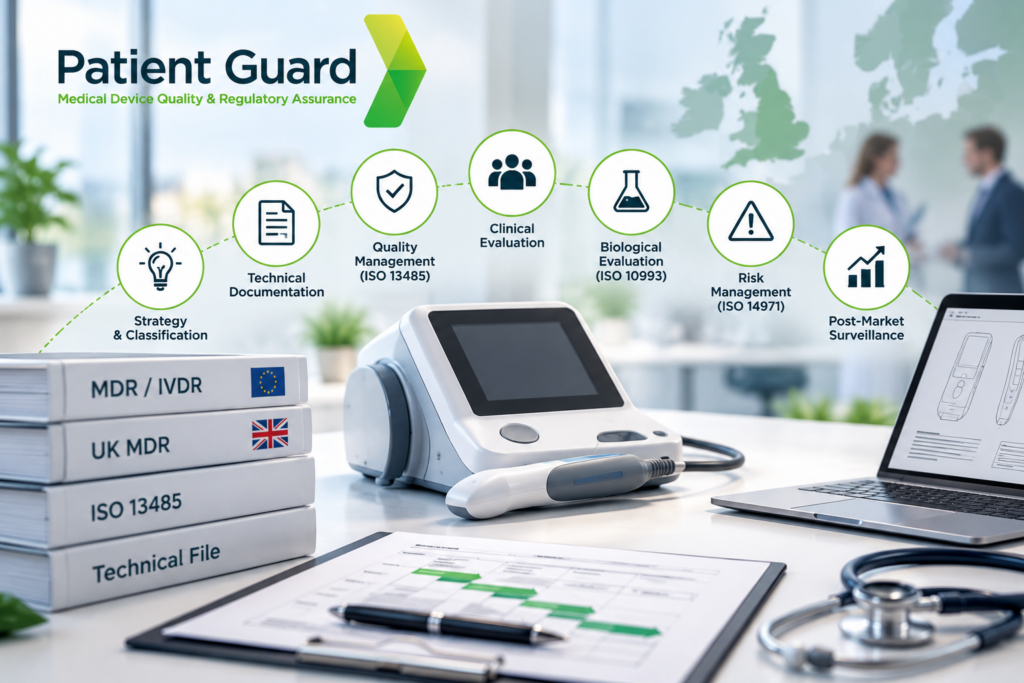
Medical device consultancy services covering UK and EU regulatory compliance, technical documentation, ISO 13485, clinical evaluation, biological evaluation, risk management and post-market surveillance.

Medical Device Consultancy UK: A Complete Guide for Manufacturers

Medical device consultancy can help manufacturers navigate complex regulatory requirements throughout the medical device lifecycle. This guide explains how medical device consultants support UK, EU and international market access, including device classification, quality management systems, technical documentation, clinical evaluation, biological evaluation, risk management, UKCA and CE marking, post-market surveillance and ongoing regulatory compliance.

Medical Device Consultancy UK: A Complete Guide for Manufacturers Read More »

Hero illustration representing artificial intelligence in medical devices, featuring AI-powered diagnostics, medical imaging, robotic surgery, wearable health technology and connected healthcare.

Artificial Intelligence in Medical Devices Explained: Applications, Benefits and Future Trends

Artificial intelligence is transforming the medical device industry, enabling faster diagnoses, more personalised treatments and smarter connected healthcare. Discover how AI is being used in modern medical devices, the technologies driving innovation and the future of intelligent healthcare.

Artificial Intelligence in Medical Devices Explained: Applications, Benefits and Future Trends Read More »

Illustration of the European Database on Medical Devices (EUDAMED) under the EU MDR and IVDR, showing the six interconnected modules—Actor Registration, UDI and Device Registration, Notified Bodies and Certificates, Clinical Investigations and Performance Studies, Vigilance, and Market Surveillance—supporting medical device transparency, traceability and patient safety across the European Union.

What is EUDAMED? A Complete Guide for Medical Device Manufacturers

EUDAMED (the European Database on Medical Devices) is the European Commission’s central database supporting the implementation of the Medical Device Regulation (EU) 2017/745 (EU MDR) and the In Vitro Diagnostic Medical Device Regulation (EU) 2017/746 (IVDR). It brings together information on manufacturers, medical devices, certificates, clinical investigations, vigilance activities and market surveillance into a single interconnected system.

By improving transparency, traceability and regulatory oversight, EUDAMED helps competent authorities, notified bodies, manufacturers and healthcare professionals access accurate information throughout the medical device lifecycle. This guide explains what EUDAMED is, how its six modules work together and why it has become an essential part of medical device regulatory compliance.

What is EUDAMED? A Complete Guide for Medical Device Manufacturers Read More »

medical device consultancy

Medical Device Regulatory Strategy for Startups: A Complete Guide (2026)

Launching a medical device startup can be an exciting journey, but regulatory requirements are often underestimated during the early stages of product development. Many start-ups focus on innovation, funding, and product design while leaving regulatory planning until later. Unfortunately, this approach can lead to significant delays, increased costs, and even project failure.

A well-defined regulatory strategy should be established as early as possible to ensure your medical device reaches the market efficiently while meeting all applicable regulatory requirements.

In this guide, we explain how medical device startups can build a successful regulatory strategy and avoid common compliance pitfalls.

Medical Device Regulatory Strategy for Startups: A Complete Guide (2026) Read More »

Professional reviewing medical device regulatory documentation, illustrating the role of the Person Responsible for Regulatory Compliance (PRRC) under Article 15 of EU MDR 2017/745 and IVDR 2017/746, including technical documentation, post-market surveillance and regulatory oversight.

Person Responsible for Regulatory Compliance (PRRC) under EU MDR & IVDR

The Person Responsible for Regulatory Compliance (PRRC) is a mandatory role under Article 15 of the EU Medical Device Regulation (EU MDR 2017/745) and In Vitro Diagnostic Medical Device Regulation (IVDR 2017/746). This guide explains who needs a PRRC, the required qualifications, key responsibilities, when the role can be outsourced, and how manufacturers can demonstrate compliance with regulatory requirements.

Person Responsible for Regulatory Compliance (PRRC) under EU MDR & IVDR Read More »

Medical Device Classification EU infographic showing the EU MDR classification hierarchy from Class I to Class III, explaining how device classification determines conformity assessment, clinical evidence, Notified Body involvement and the pathway to CE marking.

Medical Device Classification EU: A Practical Guide to MDR Classification Rules

Correctly classifying your medical device is one of the most important steps in achieving EU MDR compliance. Your device classification determines the conformity assessment route, clinical evidence requirements, technical documentation, Notified Body involvement and the pathway to CE marking. This guide explains the EU MDR classification rules, provides practical examples and helps manufacturers identify the correct classification for their medical devices.

Medical Device Classification EU: A Practical Guide to MDR Classification Rules Read More »

UK medical device classification showing Class I, IIa, IIb and Class III risk categories under the UK Medical Devices Regulations 2002.

Medical Device Classification UK: A Complete Guide

Medical device classification in the UK determines the regulatory requirements a manufacturer must meet before placing a device on the Great Britain market. Under the UK Medical Devices Regulations 2002 (UK MDR 2002), medical devices are classified according to their intended purpose and associated level of risk.

This guide explains the UK medical device classification system, including Class I, Class IIa, Class IIb and Class III devices, the applicable classification rules, examples of devices in each class, and how classification affects UKCA marking and conformity assessment.

Medical Device Classification UK: A Complete Guide Read More »

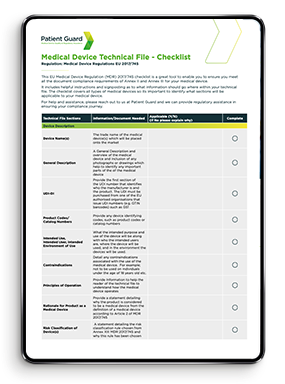
Get the Medical Device Technical Checklist

Thank you! The checklist is now ready to download.